Vectibix 20 mg/ml concentrate for solution for infusion
Spain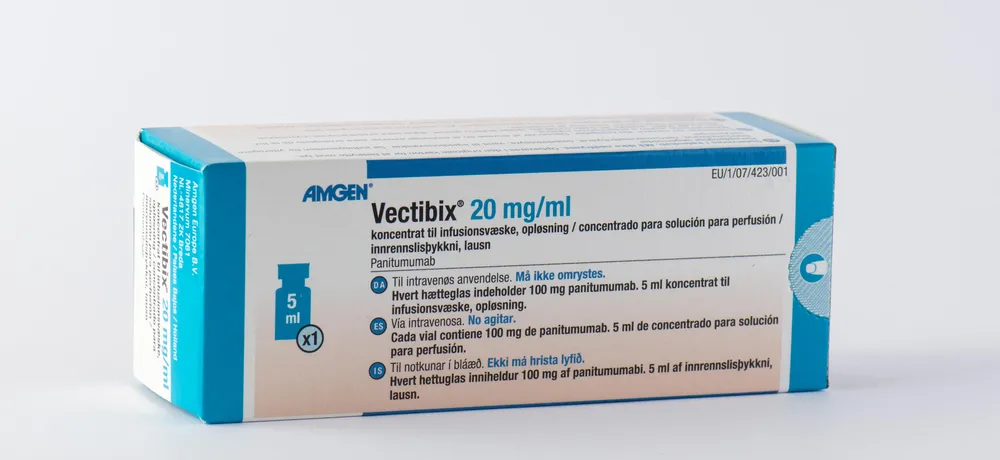
Table of Contents
Package leaflet: Information for the user
Introduction
Package leaflet: information for the user
Vectibix 20 mg/ml concentrate for solution for infusion
panitumumab
Read this entire leaflet carefully before you start using this medicine, because it contains important information for you.
- Keep this leaflet, as you may need to read it again.
- If you have any questions, consult your doctor.
- If you experience any adverse reactions, consult your doctor, even if they are not listed in this leaflet. See section 4.
Contents of the leaflet
- What Vectibix is and what it is used for
- What you need to know before using Vectibix
- How to use Vectibix
- Possible adverse effects
- How to store Vectibix
- Contents of the pack and other information
1. What Vectibix is and what it is used for
Vectibix is used in the treatment of metastatic colorectal cancer (bowel cancer) in adult patients with a type of tumour known as "RAS wild-type tumours". Vectibix is used as monotherapy or in combination with other anticancer treatments.
Vectibix contains the active substance panitumumab, which belongs to a group of medicines called monoclonal antibodies. Monoclonal antibodies are proteins that specifically recognize and bind to other proteins in the body.
Panitumumab specifically recognizes and binds to a protein called epidermal growth factor receptor (EGFR), which is found on the surface of certain cancer cells. When growth factors (other body proteins) bind to EGFR, they stimulate the growth and division of cancer cells. Panitumumab binds to EGFR and prevents the cancer cell from receiving the signals it needs for growth and division.
2. What you need to know before using Vectibix
Do not use Vectibix
- if you are allergic to panitumumab or to any of the other ingredients of this medicine (listed in section 6).
- if you have had or currently have symptoms of interstitial pneumonitis (inflammation of the lungs causing cough and breathing difficulty) or pulmonary fibrosis (scarring and thickening of the lungs, also causing breathing difficulty).
- in combination with oxaliplatin-based chemotherapy, if the RAS test confirms that you have a RAS mutated tumor, or if your RAS status is unknown. Inform your doctor if you are unsure about your tumor’s RAS status.
Warnings and precautions
You may experience severe skin reactions or swelling and tissue damage. If these worsen or become unbearable, inform your doctor or nurse immediately. If you develop a severe skin reaction, your doctor may recommend a dose adjustment of Vectibix. If you develop a serious infection or fever as a result of skin reactions, your doctor may interrupt your treatment with Vectibix.
It is recommended that you limit sun exposure while receiving Vectibix, especially if you experience skin reactions, as sunlight may worsen them. Use sunscreen and wear a hat if you are exposed to the sun. Your doctor may advise you to use a moisturizing cream, sunscreen (SPF > 15), topical steroids, and/or oral antibiotics, which may help manage skin toxicity associated with treatment with Vectibix.
Your doctor will monitor your blood levels of certain substances such as magnesium, calcium, and potassium before starting treatment with Vectibix. Your doctor will also periodically monitor your blood levels of magnesium and calcium during treatment and for up to 8 weeks after treatment has ended. If these levels become too low, your doctor may prescribe appropriate supplements.
If you experience severe diarrhea, inform your doctor or nurse, as you may lose a large amount of body fluid (become dehydrated), which could damage your kidneys.
Inform your doctor if you wear contact lenses and/or have a history of eye problems such as severe dry eye, inflammation of the front part of the eye (cornea), or corneal ulcers.
If you experience sudden or worsening eye redness and pain, increased eye tearing, blurred vision, and/or sensitivity to light, inform your doctor or nurse immediately, as you may require urgent treatment (see “Possible side effects” below).
Based on your age (over 65 years) or your overall health, your doctor will discuss your ability to tolerate treatment with Vectibix in combination with your chemotherapy regimen.
Use of Vectibix with other medicines
Inform your doctor or pharmacist if you are taking, have recently taken, or might need to take any other medicines.
Vectibix must not be used in combination with bevacizumab (another monoclonal antibody used in bowel cancer) or with a chemotherapy regimen known as “IFL”.
Pregnancy and breastfeeding
Vectibix has not been studied in pregnant women. It is important that you inform your doctor if you are pregnant, think you may be pregnant, or plan to become pregnant. Vectibix may harm the unborn baby or affect your ability to become pregnant.
If you are a woman of childbearing potential, you must use effective contraception during treatment with Vectibix and for 2 months after the last dose.
Breastfeeding is not recommended during treatment with Vectibix and for 2 months after the last dose. It is important to inform your doctor if you are considering breastfeeding.
Consult your doctor or pharmacist before using any medicine.
Driving and using machines
Consult your doctor before driving or operating machinery, as some of the side effects of Vectibix may impair your ability to perform these activities safely.
Vectibix contains sodium
This medicine contains 3.45 mg of sodium (a key component of table/cooking salt) per ml. This corresponds to 0.17% of the maximum daily recommended sodium intake for an adult.
3. How to use Vectibix
Vectibix will be administered at a healthcare facility and under the supervision of a physician experienced in the use of cancer treatments.
Vectibix is given intravenously (into a vein) using an infusion pump (a device that delivers the medication slowly).
The recommended dose of Vectibix is 6 mg/kg (milligrams per kilogram of body weight), administered once every two weeks. The treatment is usually given over a period of approximately 60 minutes.
4. Possible adverse effects
Like all medicines, Vectibix can cause adverse effects, although not everyone experiences them.
Below are listed the most serious and main adverse effects:
Infusion reactions
You may experience an infusion reaction during or after treatment. These reactions may be mild or moderate, affecting up to 1 in 100 people, or severe, affecting 1 in 1,000 people. Symptoms may include headache, rash, itching or hives, flushing, swelling (of the face, lips, mouth, around the eyes, and throat area), rapid or irregular heartbeat, fast pulse, sweating, nausea, vomiting, dizziness, difficulty breathing or swallowing, or a drop in blood pressure that may be serious or life-threatening, and very rarely may lead to death. If you experience any of these symptoms, you must inform your doctor immediately. Your doctor may decide to reduce the infusion rate or interrupt your treatment with Vectibix.
Allergic reactions
Very rarely, severe allergic reactions (hypersensitivity), including symptoms similar to an infusion reaction (see “Infusion reactions”), with fatal outcome occurring more than 24 hours after treatment, have been reported. If you experience symptoms of an allergic reaction to Vectibix, including but not limited to, difficulty breathing, tightness in the chest, feeling of suffocation, dizziness, or fainting, seek immediate medical attention.
Skin reactions
Skin-related reactions may occur in approximately 94 out of 100 people using Vectibix and are usually mild to moderate. The rash often resembles acne and frequently appears on the face, upper chest, and back, but may affect any part of the body. Some rashes are associated with redness, itching, and skin peeling, which may become severe. In some cases, they may cause infected sores requiring medical and/or surgical treatment, or lead to serious skin infections that rarely may be fatal. In rare cases, patients may experience blistering of the skin, mouth, eyes, and genitals, which may indicate a serious skin reaction called “Stevens-Johnson syndrome,” or blistering of the skin, which may indicate a serious skin reaction called “toxic epidermal necrolysis.” You must inform your doctor immediately if you develop blistering. Prolonged sun exposure may worsen the rash. Dry skin, skin cracks (fissures) on fingers and toes, infection around fingernails and toenails (paronychia), or inflammation have also been reported. Skin reactions generally resolve after discontinuation or interruption of treatment. Your doctor may decide to treat the rash, adjust the dose, or interrupt your treatment with Vectibix.
Other adverse effects include:
Very common: may affect more than 1 in 10 people
- low red blood cell levels (anemia); low potassium levels in blood (hypokalemia); low magnesium levels in blood (hypomagnesemia);
- eye inflammation (conjunctivitis);
- localized or generalized rash, which may be irregular (with or without spots), itchy, red, or scaly;
- hair loss (alopecia); mouth ulcers and cold sores (stomatitis); mouth inflammation (mucosal inflammation);
- diarrhea; nausea; vomiting; abdominal pain; constipation; decreased appetite; weight loss;
- extreme tiredness (fatigue); fever or high temperature (pyrexia); lack or loss of strength (asthenia); fluid accumulation in the limbs (peripheral edema);
- back pain;
- inability to sleep (insomnia);
- cough; dyspnea (difficulty breathing).
Common: may affect up to 1 in 10 people
- low white blood cell levels (leucopenia); low calcium levels in blood (hypocalcemia); low phosphate levels in blood (hypophosphatemia); high blood glucose levels (hyperglycemia);
- eyelash growth; excessive tearing (increased lacrimation); eye redness (ocular hyperemia); dry eyes; itchy eyes (ocular pruritus); eye irritation; eyelid inflammation (blepharitis);
- skin ulcer; scab; excessive hair growth (hypertrichosis); redness and swelling of the palms of the hands or soles of the feet (hand-foot syndrome); excessive sweating (hyperhidrosis); skin reaction (dermatitis);
- spread of infection beneath the skin (cellulitis); inflammation of hair follicles (folliculitis); localized infection; blistering rash filled with pus (pustular eruption); urinary tract infection;
- nail disorders; nail breakage (onychoclasis);
- dehydration;
- dry mouth; indigestion (dyspepsia); rectal bleeding (rectal hemorrhage); lip inflammation (cheilitis); heartburn (gastroesophageal reflux);
- chest pain; pain; chills; limb pain; immune reaction (hypersensitivity); rapid heart rate (tachycardia);
- blood clot in the lung (pulmonary embolism), symptoms of which may include sudden shortness of breath or chest pain; nosebleed (epistaxis); blood clot in a deep vein (deep vein thrombosis); high blood pressure (hypertension); flushing;
- headache; dizziness; anxiety.
Uncommon: may affect up to 1 in 100 people
- bluish discoloration of the skin and mucous membranes (cyanosis);
- death of skin cells (cutaneous necrosis);
- severe skin reaction with blistering of the skin, mouth, eyes, and genitals (Stevens-Johnson syndrome);
- severe skin reaction with blistering of the skin (toxic epidermal necrolysis);
- a serious condition characterized by ulcers affecting the front part of the eye (cornea) requiring urgent treatment (ulcerative keratitis);
- inflammation affecting the front part of the eye (cornea) (keratitis);
- eyelid irritation; cracked and/or dry lips; eye infection; eyelid infection; nasal dryness; nail loss (onycholysis); ingrown nails; excessive hair growth (hirsutism);
- lung inflammation (interstitial lung disease).
Reporting of adverse effects
If you experience any adverse effect, talk to your doctor or nurse, even if it is a possible adverse effect not listed in this leaflet. You can also report them directly through the national reporting system listed in Appendix V. By reporting adverse effects, you can help provide more information on the safety of this medicine.
5. Storage of Vectibix
Vectibix will be stored at the healthcare facility where it will be used.
Keep this medicine out of the sight and reach of children.
Store in a refrigerator (between 2 °C and 8 °C).
Do not freeze.
Keep in the original packaging to protect from light.
Do not use this medicine after the expiry date stated on the label and on the packaging after EXP. The expiry date is the last day of the month indicated.
Medicines should not be disposed of via wastewater or household waste. Ask your pharmacist how to dispose of any unused medicines and their packaging. This will help protect the environment.
6. Contents of the container and other information
Composition of Vectibix
- Each ml of concentrate contains 20 mg of panitumumab. Each vial contains 100 mg of panitumumab in 5 ml or 400 mg of panitumumab in 20 ml.
- The other components are sodium chloride, sodium acetate trihydrate, glacial acetic acid, and water for injections. See section 2 “Vectibix contains sodium”.
Appearance of the product and contents of the pack
Vectibix is a colourless liquid which may contain visible particles and is supplied in a glass vial. Each pack contains one vial.
Marketing Authorisation Holder and Manufacturer
Amgen Europe B.V.
Minervum 7061
4817 ZK Breda
The Netherlands
Marketing Authorisation Holder
Amgen Europe B.V.
Minervum 7061
4817 ZK Breda
The Netherlands
Manufacturer
Amgen Technology (Ireland) Unlimited Company
Pottery Road
Dun Laoghaire
Co Dublin
Ireland
Manufacturer
Amgen NV
Telecomlaan 5-7
1831 Diegem
Belgium
More information about this medicinal product is available upon request by contacting the local representative of the Marketing Authorisation Holder:
Belgium/Belgique/Belgien s.a. Amgen n.v. Tél/Tel: +32 (0)2 7752711 | Lithuania Amgen Switzerland AG Vilnius Branch Tel. +370 5 219 7474 |
| Luxembourg/Luxemburg s.a. Amgen Belgium/Belgien Tél/Tel: +32 (0)2 7752711 |
Czech Republic Amgen s.r.o. Tel: +420 221 773 500 | Hungary Amgen Kft. Tel.: +36 1 35 44 700 |
Denmark Amgen, branch of Amgen AB, Sweden Tlf.: +45 39617500 | Malta Amgen S.r.l. Italy Tel: +39 02 6241121 |
Germany Amgen GmbH Tel.: +49 89 1490960 | Netherlands Amgen B.V. Tel: +31 (0)76 5732500 |
Estonia Amgen Switzerland AG Vilnius Branch Tel: +372 586 09553 | Norway Amgen AB Tlf: +47 23308000 |
Greece Amgen Hellas Pharmaceutical S.A. Tel: +30 210 3447000 | Austria Amgen GmbH Tel: +43 (0)1 50 217 |
Spain Amgen S.A. Tel: +34 93 600 18 60 | Poland Amgen Biotechnologia Sp. z o.o. Tel.: +48 22 581 3000 |
France Amgen S.A.S. Tél: +33 (0)9 69 363 363 | Portugal Amgen Biofarmacêutica, Lda. Tel: +351 21 4220606 |
Croatia Amgen d.o.o. Tel: +385 (0)1 562 57 20 | Romania Amgen România SRL Tel: +4021 527 3000 |
Ireland Amgen Ireland Limited Tel: +353 1 8527400 | Slovenia AMGEN zdravila d.o.o. Tel: +386 (0)1 585 1767 |
Iceland Vistor hf. Sími: +354 535 7000 | Slovakia Amgen Slovakia s.r.o. Tel: +421 2 321 114 49 |
Italy Amgen S.r.l. Tel: +39 02 6241121 | Finland Amgen AB, branch in Finland / Amgen AB, filial i Finland Puh/Tel: +358 (0)9 54900500 |
Cyprus C.A. Papaellinas Ltd Tel: +357 22741 741 | Sweden Amgen AB Tel: +46 (0)8 6951100 |
Latvia Amgen Switzerland AG Riga Branch Tel: +371 257 25888 |

Date of the most recent review of this leaflet
Other sources of information
Detailed information on this medicinal product is available on the European Medicines Agency website: https://www.ema.europa.eu.
This information is intended for healthcare professionals only:
Vectibix is intended for single use only. Vectibix must be diluted in a 9 mg/ml (0.9%) sodium chloride injectable solution by healthcare professionals using an aseptic technique. Do not remove or shake the vial vigorously. Vectibix should be inspected visually before administration. The solution should be colourless and may contain translucent to white, amorphous, proteinaceous particles, which are visible (these will be removed by in-line filtration). Do not administer Vectibix if it does not appear as described above. Use only a hypodermic needle with a diameter of 21 G or smaller to withdraw the required amount of Vectibix for a 6 mg/kg dose. Do not use needle-free devices (e.g., vial adapters) to withdraw the contents from the vial. Dilute to a total volume of 100 ml. Doses exceeding 1,000 mg should be diluted in 150 ml of 9 mg/ml (0.9%) sodium chloride injectable solution. The final concentration must not exceed 10 mg/ml. Mix the diluted solution gently by inversion; do not shake.
Vectibix does not contain any antimicrobial preservative or bacteriostatic agent. The product should be used immediately after dilution. If not used immediately, the in-use storage conditions and duration prior to use are the responsibility of the user and must not exceed 24 hours at 2°C to 8°C. The diluted solution must not be frozen.
Discard the vial and any remaining liquid in the vial after single use.
The infusion line must be flushed with sodium chloride solution before and after administration of Vectibix to prevent mixing with other medicinal products or intravenous solutions.
Vectibix must be administered as an intravenous infusion using an infusion pump through a peripheral line or a central catheter, and using a low protein-binding 0.2 or 0.22 micrometre in-line filter. The recommended infusion time is approximately 60 minutes. Doses exceeding 1,000 mg should be infused over approximately 90 minutes.
No incompatibility has been observed between Vectibix and 9 mg/ml (0.9%) sodium chloride injectable solution in polyvinyl chloride bags or polyolefin bags.
Date of the last review of this summary Other sources of information Detailed information on this medicine is available on the European Medicines Agency website: https://www.ema.europa.eu. --------------------------------------------------------------------------------------------------------------------------- This information is intended for healthcare professionals only: Vectibix is intended for single use. Vectibix must be diluted in an injection solution of sodium chloride 9 mg/mL (0.9%) by healthcare professionals using an aseptic technique. Do not shake or vigorously agitate the vial. Vectibix should be visually inspected before administration. The solution should be colourless and may contain translucent to white, amorphous, visible protein particles (which will be removed by in-line filtration). Do not administer Vectibix if it does not appear as described above. Use only a hypodermic needle with a diameter of 21 G or smaller to withdraw the required amount of Vectibix for a dose of 6 mg/kg. Do not use needle-free devices (e.g., vial adapters) to extract the contents from the vial. Dilute to a total volume of 100 mL. Doses exceeding 1,000 mg should be diluted in 150 mL of injection solution of sodium chloride 9 mg/mL (0.9%). The final concentration should not exceed 10 mg/mL. The diluted solution should be mixed gently by inversion, without shaking. Vectibix does not contain any antimicrobial preservative or bacteriostatic agent. The medicinal product should be used immediately after dilution. If not used immediately, the in-use storage conditions and times prior to use are the responsibility of the user and should not exceed 24 hours between 2°C and 8°C. The diluted solution must not be frozen. Discard the vial and any remaining liquid in the vial after a single use. The infusion line should be flushed with sodium chloride solution before and after administration of Vectibix to avoid mixing with other medicines or intravenous solutions. Vectibix should be administered as an intravenous infusion using an infusion pump through a peripheral line or a central catheter, and using a low-protein-binding in-line filter of 0.2 or 0.22 micrometres. The recommended infusion time is approximately 60 minutes. Doses exceeding 1,000 mg should be infused over approximately 90 minutes. No incompatibility has been observed between Vectibix and sodium chloride 9 mg/mL (0.9%) injection solution in polyvinyl chloride or polyolefin bags. |