Urokinase Syner Medica 25,000 IU powder for injection and for infusion
Spain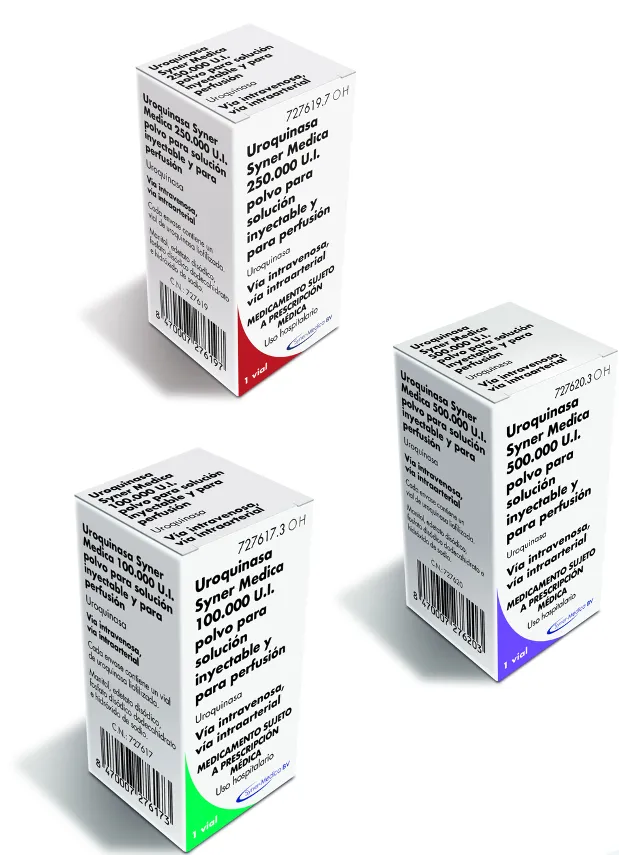
Table of Contents
- Package leaflet: Information for the user
- Introduction
- 1. What Uroquinase Syner Medica is and what it is used for
- 2. What you need to know before using Uroquinase Syner Medica
- 3. How to use Urokinase Syner Medica
- 4. Possible adverse effects
- 5. Storage of Urokinase Syner Medica
- 6. Contents of the container and other information
Package leaflet: Information for the user
Introduction
Package leaflet: information for the user
Urokinase SYNER MEDICA 10,000 I.U. powder for solution for injection and for infusion
Urokinase SYNER MEDICA 25,000 I.U. powder for solution for injection and for infusion
Urokinase SYNER MEDICA 100,000 I.U. powder for solution for injection and for infusion
Urokinase SYNER MEDICA 250,000 I.U. powder for solution for injection and for infusion
Urokinase SYNER MEDICA 500,000 I.U. powder for solution for injection and for infusion
urokinase
Read all of this leaflet carefully before you start using this medicine because it contains important information for you
-
Keep this leaflet. You may need to read it again.
-
If you have any questions, ask your doctor or pharmacist.
-
If you experience any adverse effects, consult your doctor, even if they are adverse effects not listed in this leaflet. See section 4.
Contents of the leaflet
- What Urokinase Syner Medica is and what it is used for
- What you need to know before you use Urokinase Syner Medica
- How to use Urokinase Syner Medica
- Possible side effects
- How to store Urokinase Syner Medica
- Contents of the pack and other information
1. What Uroquinase Syner Medica is and what it is used for
This medicine is called Uroquinase Syner Medica. The active substance is urokinase, an enzyme extracted from human urine that can act as a thrombolytic. This means that it can help dissolve blood clots that may form in:
-
Intravenous catheters or cannulae (surgical tubes used to remove fluids or introduce fluids into the body)
-
Lungs
-
Deep veins
-
Peripheral arteries (blood vessels distant from the heart, such as those in the legs).
2. What you need to know before using Uroquinase Syner Medica
Do not use Uroquinase Syner Medica
- if you are allergic (hypersensitive) to urokinase or to any of the other ingredients of this medicine (listed in section 6).
- if you have or have recently had bleeding in the stomach or intestines
- if you have any type of cancer with a risk of bleeding
- if you have recently undergone major surgery or suffered a stroke
- if you have recently experienced trauma, such as cardiopulmonary resuscitation or thoracic or cerebral surgery (for example, within the last 2 months)
- if you have very high blood pressure
- if you have abnormal blood clotting or a very low platelet count
- if you have blood vessel malformations, for example, an aneurysm (dilation)
- if you have an infection in the pancreas or heart, or any other serious infection
- if you have severe liver or kidney failure
- if you have recently given birth.
Warnings and precautions
Due to the increased risk of bleeding, special precautions will be taken with Uroquinase Syner Medica if:
- you have a serious blood vessel disease, especially in the brain
- you have a high risk of blood clot formation in the heart chambers, for example, due to an abnormal heart rhythm (atrial fibrillation)
- you have blood coagulation disorders, including those caused by severe nephropathy or hepatopathy
- you have lung cavities
- you have urinary tract problems that could lead to bleeding (e.g., a bladder catheter)
- you have infected and obstructed blood vessels
- you are elderly, particularly if over 75 years of age.
In all these circumstances, your doctor will decide whether or not to administer Uroquinase Syner Medica.
If severe bleeding occurs during treatment, Uroquinase Syner Medica will be discontinued and you will be given medications to control the bleeding.
Uroquinase Syner Medica is manufactured from human urine; certain measures are taken to prevent transmission of infections to patients. However, despite these measures, when medicines derived from human urine are administered, the possibility of transmitting an infection cannot be completely ruled out.
Use of Uroquinase Syner Medica with other medicines
Inform your doctor if you are taking or have recently taken any of the following medicines, as the likelihood of bleeding may be increased by drugs that counteract blood clotting, such as:
- heparin or other anticoagulants
- acetylsalicylic acid (aspirin), non-steroidal anti-inflammatory drugs
- dipyridamole, dextrans (used to treat decreased circulating blood plasma volume).
Inform your doctor if you are taking an angiotensin-converting enzyme (ACE) inhibitor (used to treat high blood pressure), as this may increase the likelihood of an allergic reaction.
Inform your doctor if you are using, have recently used, or might need to use any other medicine.
Use in children
Uroquinase Syner Medica may be used in children to dissolve blood clots in intravenous catheters or cannulae.
Pregnancy and breastfeeding
If you are pregnant or breastfeeding, think you might be pregnant, or plan to become pregnant, consult your doctor before using this medicine.
Uroquinase Syner Medica must not be used during pregnancy or immediately after childbirth unless your doctor recommends otherwise.
You must not breastfeed while being treated with Uroquinase Syner Medica.
Excipients
This medicine contains less than 1 mmol of sodium (23 mg) per vial; i.e., essentially "sodium-free".
3. How to use Urokinase Syner Medica
Urokinase Syner Medica will be administered to you by a doctor or a nurse.
Before you are given Urokinase Syner Medica, it will be dissolved in a saline solution (a solution of salt and water). It must never be injected into a muscle or under the skin. Your doctor will decide the dose and duration of treatment with Urokinase Syner Medica.
If you are being treated for:
A blocked intravascular catheter or cannula
Urokinase may be injected at a concentration of 5,000 to 25,000 IU per ml directly into the catheter or cannula, and the fluid left in place for 20 to 60 minutes before removal. This may be repeated several times if necessary. Alternatively, up to 250,000 IU of Urokinase Syner Medica may be infused as a solution containing 1,000–2,500 units per ml into the blocked tube over a period of 90 to 180 minutes.
Blood clots blocking deep veins in the limbs
Initially, you may be given 4,400 IU of urokinase per kg of body weight in 15 ml of solvent by injection into a vein over a period of 10 minutes. This will be followed by 4,400 IU/kg/hour for 12–24 hours.
Blood clots blocking blood vessels in the lungs
Initially, you may be given 4,400 IU of urokinase per kg of body weight in 15 ml of solvent by injection into a vein over a period of 10 minutes. This will be followed by 4,400 IU/kg/hour for 12 hours. Alternatively, your doctor may choose to administer 3 injections into the pulmonary artery at 24-hour intervals.
Blood clots blocking an artery
Initially, a solution of 2,000 IU per ml may be administered directly into the clot at a rate of 4,000 IU per minute for 2 hours. Your doctor will assess the blockage and may repeat this treatment up to 4 times until the clot dissolves.
4. Possible adverse effects
Like all medicines, this medicine may cause adverse effects, although not everyone experiences them.
Tell your doctor immediately if you experience:
- any bleeding
- any signs of an allergic reaction, such as difficulty breathing, swelling of the face, lips or throat, skin rash or blisters
- collapse (drop in blood pressure) or turning blue (cyanosis).
Some patients may experience a sensation of heat or cold (fever or chills), nausea and vomiting (feeling of dizziness), back pain or a feeling of shortness of breath starting within one hour after starting the infusion.
Other adverse effects include:
Very common adverse effects (affect more than 1 in 10 users)
- unusual bleeding, particularly from puncture sites or nosebleeds
- blood in urine detected during a urine test
- blood clot: small fragments of the blood clot may break off and travel through blood vessels, causing a blockage elsewhere, such as in the lungs, heart or limbs
- a decrease in hematocrit (a blood test measuring red blood cells) and a temporary increase in certain liver enzymes
Common adverse effects (affect 1 to 10 in every 100 users)
- bleeding in the stomach or in/around the brain or at puncture sites, in urine, or in muscles
- stroke
- tear in the wall of an artery
- blockage of blood vessels due to cholesterol (fat)
- fever, chills and/or shivering
Uncommon adverse effects (affect 1 to 10 in every 1,000 users)
- kidney failure
- bleeding in the liver
Rare adverse effects (affect 1 to 10 in every 10,000 users)
- visible blood in urine
- damage or swelling of the arterial wall
If you consider any of the adverse effects you experience to be severe, or if you notice any adverse effects not listed in this leaflet, inform your doctor or pharmacist.
Reporting of adverse effects
If you experience any type of adverse effect, talk to your doctor, pharmacist or nurse, even if it is a possible adverse effect not listed in this leaflet. You can also report them directly via the Spanish Pharmacovigilance System for Human Medicines: https://www.notificaram.es. By reporting adverse effects, you can help provide more information on the safety of this medicine.
5. Storage of Urokinase Syner Medica
Keep this medicine out of the sight and reach of children.
Do not store above 25°C.
Stability studies in use have demonstrated stable biological activity in a 2000 IU/ml dilution for up to 10 hours at room temperature.
From a microbiological standpoint, the product should be used immediately. If not used immediately, the storage times under conditions of use and the preceding conditions shall be the responsibility of the user, and generally should not exceed 24 hours at 2–8°C, except when dilution has been carried out under controlled and validated aseptic conditions. Do not store the reconstituted solution for later use.
Store in the original packaging to protect from light.
Do not use this medicine after the expiry date stated on the label, following the "CAD". The expiry date refers to the last day of the month indicated.
Do not use this medicine if discoloration of the contents is observed.
Medicines must not be disposed of via wastewater or household waste. If you are unsure how to dispose of unused medicines or their packaging, consult your pharmacist. This will help protect the environment.
6. Contents of the container and other information
Composition of Urokinase Syner Medica
- The active substance is urokinase.
- The other components are mannitol, disodium edetate, dodecahydrate disodium phosphate, sodium hydroxide.
Appearance of the product and contents of the container
Each package contains one vial (small bottle). The content is a white powder: Urokinase Syner Medica. Different doses are available:
Urokinase Syner Medica 10,000 I.U.
Urokinase Syner Medica 25,000 I.U.
Urokinase Syner Medica 100,000 I.U.
Urokinase Syner Medica 250,000 I.U.
Urokinase Syner Medica 500,000 I.U.
Marketing Authorization Holder
Syner-Medica BV
Laanzichtweg 60
4847SJ Teteringen
The Netherlands
Manufacturer
Sirton Pharmaceuticals SpA
Piazza XX Settembre, 2
22079 Villa Guardia (CO)
Italy
GiPharma SRL
Via Crescentino
13040 Saluggia (VC)
Italy
Lyocontract GmbH
Pulverwiese 1
38871 Ilsenburg
Germany
Local representative of the marketing authorization holder
MANA PHARMA S.L.
Carretera Fuencarral 22
28108 Alcobendas, Madrid
Spain
This leaflet was last reviewed in September 2023
Detailed information on this medicinal product is available on the website of the Spanish Agency of Medicines and Health Products (AEMPS) (http://www.aemps.gob.es/)