Talzenna 0.1 mg hard capsules
Spain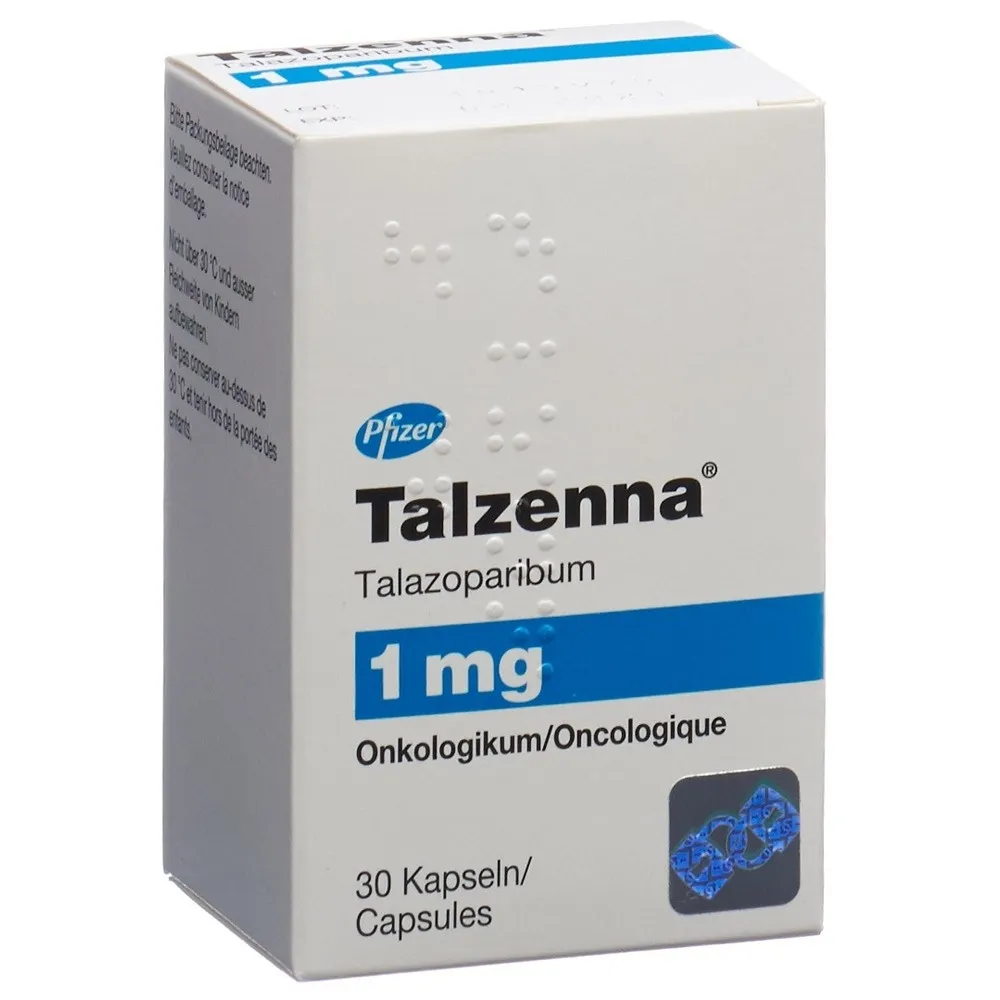
Table of Contents
Package leaflet: Information for the patient
Introduction
Package leaflet: information for the patient
Talzenna 0.1 mg hard capsules
Talzenna 0.25 mg hard capsules
Talzenna 0.35 mg hard capsules
Talzenna 0.5 mg hard capsules
Talzenna 1 mg hard capsules
talazoparib
Read all of this leaflet carefully before you start taking this medicine because it contains important information for you.
- Keep this leaflet. You may need to read it again.
- If you have any further questions, ask your doctor, pharmacist, or nurse.
- This medicine has been prescribed for you only. Do not pass it on to others. It may harm them, even if they have the same signs as you.
- If you get any side effects, talk to your doctor, pharmacist, or nurse. This includes any possible side effects not listed in this leaflet. See section 4.
Contents of this leaflet
- What Talzenna is and what it is used for
- What you need to know before taking Talzenna
- How to take Talzenna
- Possible side effects
- How to store Talzenna
- Contents of the pack and other information
1. What Talzenna is and what it is used for
What Talzenna is and how it works
Talzenna contains the active substance talazoparib. It is a type of cancer medicine known as a "PARP (poly-ADP ribose polymerase) inhibitor".
Talzenna works by blocking the PARP protein, an enzyme that repairs damaged DNA in certain cancer cells. As a result, the cancer cells are unable to repair themselves and eventually die.
What Talzenna is used for
Talzenna is a medicine used
- as monotherapy to treat adults with breast cancer of a type known as HER2-negative breast cancer that has an abnormal inherited germline BRCA gene. Your doctor will perform a test to make sure Talzenna is suitable for you.
- in combination with a medicine called enzalutamide to treat adults with prostate cancer that no longer responds to hormonal therapy or surgical treatment to lower testosterone.
Talzenna is used when the cancer has spread beyond the original tumour or to other parts of the body.
If you have any questions about how Talzenna works or why this medicine has been prescribed for you, please consult your doctor.
2. What you need to know before starting Talzenna
Do not take Talzenna
- If you are allergic to talazoparib or any of the other ingredients of this medicine (listed in section 6).
- If you are breastfeeding.
Warnings and precautions
Talk to your doctor, pharmacist, or nurse before starting Talzenna and during treatment if you experience any of the signs or symptoms described in this section.
Low blood cell counts
Talzenna reduces blood cell counts, such as red blood cell count (anemia), white blood cell count (neutropenia), or platelet count (thrombocytopenia). Signs and symptoms to watch for include:
- Anemia: feeling short of breath, feeling very tired, pale skin, or rapid heartbeat; these may be signs of low red blood cell count.
- Neutropenia: infection, chills or shaking, or fever; these may be signs of low white blood cell count.
- Thrombocytopenia: bruising easily or bleeding longer than normal when injured; these may be signs of low platelet count.
During treatment with Talzenna, you will have regular blood tests to monitor your blood cells (white blood cells, red blood cells, and platelets).
Serious bone marrow problems
Rarely, low blood counts may be a sign of more serious bone marrow problems, such as myelodysplastic syndrome (MDS) or acute myeloid leukemia (AML). Your doctor may want to examine your bone marrow to check for these conditions.
Blood clots
Talzenna may cause blood clots in the veins. Inform your doctor, pharmacist, or nurse if you experience signs or symptoms of blood clots in the veins, such as pain or stiffness, swelling, and redness in the affected leg (or arm), chest pain, difficulty breathing, or dizziness.
Male and female contraception
Women who can become pregnant and men with partners who are or may become pregnant must use effective contraception methods.
See the section “Male and female contraception” below.
Children and adolescents
Talzenna is not indicated for use in children or adolescents (under 18 years of age).
Other medicines and Talzenna
Tell your doctor, pharmacist, or nurse if you are taking, have recently taken, or might need to take any other medicines. This includes medicines obtained without a prescription and herbal remedies. This is because Talzenna may affect how other medicines work. Likewise, certain medicines may affect how Talzenna works.
In particular, the following medicines may increase the risk of adverse effects with Talzenna:
- Amiodarone, carvedilol, dronedarone, propafenone, quinidine, ranolazine, and verapamil – generally used to treat heart conditions.
- Clarithromycin and erythromycin, antibiotics – used to treat bacterial infections.
- Itraconazole and ketoconazole – used to treat fungal infections.
- Cobicistat, darunavir, indinavir, lopinavir, ritonavir, saquinavir, telaprevir, and tipranavir – used to treat HIV/AIDS infections.
- Cyclosporine – used in organ transplantation to prevent rejection.
- Lapatinib – used to treat patients with certain types of breast cancer.
- Curcumin (found, for example, in turmeric root) in some medicines (see also section "Taking Talzenna with food and drink").
The following medicines may reduce the effect of Talzenna:
- Carbamazepine and phenytoin – antiepileptic drugs used to treat seizures or fits.
- St. John’s wort (Hypericum perforatum) – a herbal remedy used to treat mild depression and anxiety.
Taking Talzenna with food and drink
Do not take curcumin supplements while taking Talzenna, as it may increase the adverse effects of Talzenna. Curcumin is found in turmeric root, and you should avoid large amounts of turmeric root. However, using spices in food is unlikely to cause problems.
Pregnancy
Talzenna could be harmful to the unborn baby. If you are pregnant or breastfeeding, think you may be pregnant, or plan to become pregnant, consult your doctor before using this medicine. Your doctor will perform a pregnancy test before starting Talzenna treatment.
- You must not use Talzenna if you are pregnant unless your doctor considers it necessary.
- You must not become pregnant while taking Talzenna.
- Discuss contraception with your doctor if there is any chance you or your partner may become pregnant.
Male and female contraception
Women who can become pregnant must use an effective method of birth control (contraception) during treatment with Talzenna and for at least 7 months after the last dose of Talzenna. Since hormonal contraceptives are not recommended if you have breast cancer, you should use two non-hormonal contraceptive methods.
Consult your healthcare provider about which contraceptive methods may be suitable for you.
Men with female partners who are pregnant or who may become pregnant must use an effective method of birth control (contraception), even after vasectomy, during treatment with Talzenna and for at least 4 months after the last dose.
Breastfeeding
You must not breastfeed while taking Talzenna and for at least 1 month after the last dose. It is unknown whether Talzenna passes into breast milk.
Fertility
Talazoparib may reduce male fertility.
Driving and using machines
The effect of Talzenna on the ability to drive and use machines is minor. If you feel dizzy, weak, or tired (these are very common side effects of Talzenna), you should not drive or operate machinery.
3. How to take Talzenna
Follow exactly the administration instructions given to you by your doctor or pharmacist. If in doubt, consult your doctor or pharmacist again.
Dosage
Talzenna is taken orally once daily. The recommended dose is:
- for breast cancer: one 1 mg capsule of Talzenna.
- for prostate cancer: Talzenna is taken with a medicine called enzalutamide. The usual dose of Talzenna is 0.5 mg.
If you experience certain adverse effects while taking Talzenna alone or in combination with enzalutamide (see section 4), your doctor may reduce your dose or temporarily or permanently discontinue treatment. Take Talzenna and enzalutamide exactly as directed by your doctor.
You may take Talzenna with or without food. Swallow the capsule whole with a glass of water. Do not chew or crush the capsules. Do not open the capsules. Contact with the capsule contents should be avoided.
If you take more Talzenna than you should
If you have taken more Talzenna than your prescribed dose, contact your doctor or the nearest hospital immediately. Emergency treatment may be necessary.
Take the package and this leaflet with you so the doctor knows what you have taken.
If you forget to take Talzenna
If you miss a dose or vomit, take your next dose as scheduled. Do not take a double dose to make up for missed or vomited capsules.
If you stop taking Talzenna
Do not stop treatment with Talzenna unless instructed by your doctor.
If you have any further questions about the use of this medicine, ask your doctor, pharmacist, or nurse.
4. Possible adverse effects
Like all medicines, this medicine can cause adverse effects, although not everyone experiences them.
Tell your doctor immediately if you notice any of the following symptoms, which could be signs of a serious blood disorder:
Very common (may affect more than 1 in 10 people)
- Feeling short of breath, very tired, pale skin, or rapid heartbeat; these may be signs of low red blood cell count (anaemia).
- Infection, chills or shivering, or fever or feeling feverish – these may be signs of low white blood cell count (neutropenia).
- Bruising easily or bleeding longer than normal after injury – these may be signs of low platelet count (thrombocytopenia).
Contact your doctor if you have any other adverse effects. These may include:
Very common (may affect more than 1 in 10 people)
- Low white blood cell, red blood cell, and platelet counts
- Decreased appetite
- Feeling dizzy
- Headache
- Feeling unwell (nausea)
- Vomiting
- Diarrhoea
- Abdominal pain
- Hair loss
Common (may affect up to 1 in 10 people)
- Taste disturbance (dysgeusia)
- Swollen and painful legs, chest pain, difficulty breathing, rapid breathing, or rapid heart rate, as these may be signs of blood clots in the veins
- Indigestion
- Inflammation of the mouth
Uncommon (may affect up to 1 in 100 people)
- Abnormal blood cell counts due to serious bone marrow problems (myelodysplastic syndrome or acute myeloid leukaemia). See “Warnings and precautions” in section 2.
Reporting of adverse effects
If you experience any adverse effect, talk to your doctor, pharmacist, or nurse, even if it is a possible adverse effect not listed in this leaflet. You can also report them directly through the national reporting system detailed in Appendix V. By reporting adverse effects, you can help provide more information on the safety of this medicine.
5. Storage of Talzenna
Keep this medicine out of the sight and reach of children.
Do not use this medicine after the expiry date stated on the carton, bottle, or blister pack following EXP. The expiry date is the last day of the month indicated.
This medicine requires no special storage conditions.
Do not use this medicine if you notice that the packaging is damaged or shows signs of deterioration.
Medicines must not be disposed of via wastewater or household waste. Ask your pharmacist how to dispose of medicines and packaging that you no longer need. This will help protect the environment.
6. Contents of the pack and other information
Composition of Talzenna
The active substance is talazoparib. Talzenna hard capsules are available in different strengths.
- Talzenna 0.1 mg hard capsules: each capsule contains talazoparib tosylate equivalent to 0.1 mg of talazoparib.
- Talzenna 0.25 mg hard capsules: each capsule contains talazoparib tosylate equivalent to 0.25 mg of talazoparib.
- Talzenna 0.35 mg hard capsules: each capsule contains talazoparib tosylate equivalent to 0.35 mg of talazoparib.
- Talzenna 0.5 mg hard capsules: each capsule contains talazoparib tosylate equivalent to 0.5 mg of talazoparib.
- Talzenna 1 mg hard capsules: each capsule contains talazoparib tosylate equivalent to 1 mg of talazoparib.
The other components are:
- Capsule contents: silicified microcrystalline cellulose (microcrystalline cellulose and silicon dioxide).
- Capsule coating for 0.1 mg: hypromellose and titanium dioxide (E171).
- Capsule coating for 0.25 mg: hypromellose, yellow iron oxide (E172) and titanium dioxide (E171).
- Capsule coating for 0.35 mg: hypromellose, yellow iron oxide (E172) and titanium dioxide (E171).
- Capsule coating for 0.5 mg: hypromellose, red iron oxide (E172) and titanium dioxide (E171).
- Capsule coating for 1 mg: hypromellose, yellow iron oxide (E172), titanium dioxide (E171) and red iron oxide (E172).
- Printing ink: shellac (E904), propylene glycol (E1520), ammonium hydroxide (E527), black iron oxide (E172) and potassium hydroxide (E525).
Appearance of the product and contents of the pack
Talzenna 0.1 mg is presented as an opaque hard capsule of approximately 14 mm × 5 mm, with a white cap (printed with “Pfizer” in black) and a white body (printed with “TLZ 0.1” in black).
Talzenna 0.25 mg is presented as an opaque hard capsule of approximately 14 mm × 5 mm, with an ivory cap (printed with “Pfizer” in black) and a white body (printed with “TLZ 0.25” in black).
Talzenna 0.35 mg is presented as an opaque hard capsule of approximately 14 mm × 5 mm, with an ivory cap (printed with “Pfizer” in black) and an ivory body (printed with “TLZ 0.35” in black).
Talzenna 0.5 mg is presented as an opaque hard capsule of approximately 14 mm × 5 mm, with a light pink cap (printed with “Pfizer” in black) and a white body (printed with “TLZ 0.5” in black).
Talzenna 1 mg is presented as an opaque hard capsule of approximately 14 mm × 5 mm, with a light red cap (printed with “Pfizer” in black) and a white body (printed with “TLZ 1” in black).
Talzenna 0.1 mg is available in 30 hard capsules in plastic bottles.
Talzenna 0.25 mg is available in unit-dose, pre-cut blisters of 30 × 1, 60 × 1 or 90 × 1 hard capsules, and in 30 hard capsules in plastic bottles.
Talzenna 0.35 mg is available in 30 hard capsules in plastic bottles.
Talzenna 0.5 mg is available in 30 hard capsules in plastic bottles.
Talzenna 1 mg is available in unit-dose, pre-cut blisters of 30 × 1 hard capsules and in 30 hard capsules in plastic bottles.
Only certain pack sizes may be marketed.
Marketing Authorisation Holder
Pfizer Europe MA EEIG
Boulevard de la Plaine 17
1050 Bruxelles
Belgium
Manufacturer Responsible for Batch Release
Excella GmbH & Co. KG
Nürnberger Strasse 12
90537 Feucht
Germany
For more information about this medicine, please contact the local representative of the Marketing Authorisation Holder:
| Latvia Pfizer Luxembourg SARL branch in Latvia Tel: + 371 670 35 775 |
| Lithuania Pfizer Luxembourg SARL branch in Lithuania Tel: + 370 52 51 4000 |
Czech Republic Pfizer s.r.o. Tel: +420 283 004 111 | Hungary Pfizer Kft. Tel.: +36-1-488-37-00 |
Denmark Pfizer ApS Tlf.: +45 44 20 11 00 | Malta Vivian Corporation Ltd Tel: +356 21344610 |
Germany PFIZER PHARMA GmbH Tel: +49 (0)30 550055-51000 | Netherlands Pfizer bv Tel: +31 (0)800 63 34 636 |
Estonia Pfizer Luxembourg SARL Estonia branch Tel: +372 666 7500 | Norway Pfizer AS Tlf: +47 67 52 61 00 |
Greece Pfizer Hellas A.E. Tel: +30 210 6785 800 | Austria Pfizer Corporation Austria Ges.m.b.H. Tel: +43 (0)1 521 15-0 |
Spain Pfizer, S.L. Tel: +34 91 490 99 00 | Poland Pfizer Polska Sp. z o.o. Tel.: +48 22 335 61 00 |
France Pfizer Tel: +33 (0)1 58 07 34 40 | Portugal Laboratórios Pfizer, Lda. Tel: +351 21 423 5500 |
Croatia Pfizer Croatia d.o.o. Tel: +385 1 3908 777 | Romania Pfizer Romania S.R.L. Tel: +40 (0) 21 207 28 00 |
Ireland Pfizer Healthcare Ireland Unlimited Company Tel: 1800 633 363 (toll free) +44 (0)1304 616161 | Slovenia Pfizer Luxembourg SARL Pfizer, branch for consulting in pharmaceutical activities, Ljubljana Tel: + 386 (0)1 52 11 400 |
Iceland Icepharma hf. Tel: +354 540 8000 | Slovakia Pfizer Luxembourg SARL, organizational unit Tel: + 421 2 3355 5500 |
Italy Pfizer S.r.l. Tel: +39 06 33 18 21 | Finland Pfizer Oy Tel: +358 (0)9 430 040 |
Cyprus Pfizer Hellas A.E. (Cyprus Branch) Tel: +357 22 817690 | Sweden Pfizer AB Tel: +46 (0)8 550 520 00 |


Date of the latest revision of this leaflet: MM/YYYY.
Other sources of information
Detailed information on this medicinal product is available on the website of the European Medicines Agency: https://www.ema.europa.eu.