Siklos 100 mg film-coated tablets
Spain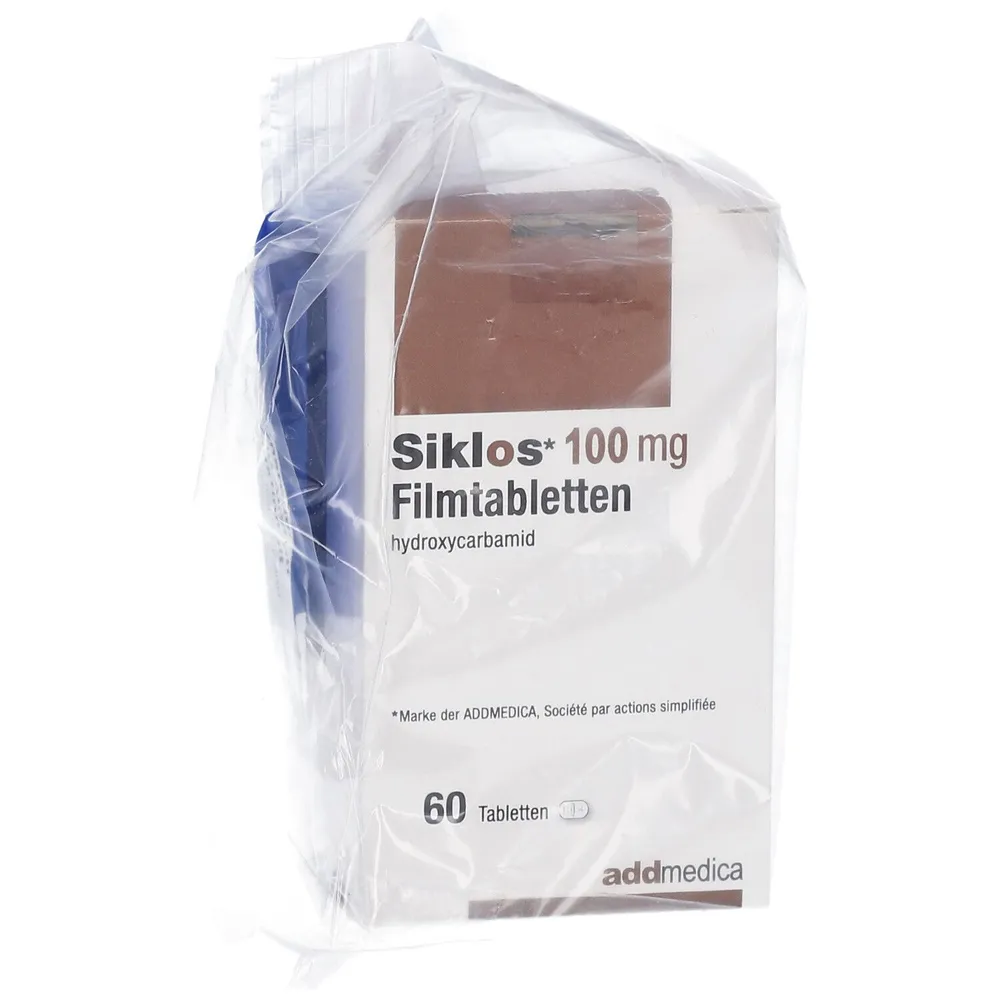
Table of Contents
Package leaflet: Information for the user
Introduction
Package leaflet: information for the user
Siklos 100 mg film-coated tablets
Siklos 1000 mg film-coated tablets
hydroxycarbamide
Read the entire leaflet carefully before you start taking this medicine because it contains important information for you.
-
Keep this leaflet; you may need to read it again.
-
If you have any questions, ask your doctor, pharmacist, or nurse.
-
This medicine has been prescribed for you only, and you should not give it to others, even if they have the same symptoms as you. It may harm them.
-
If you experience any adverse effects, consult your doctor, pharmacist, or nurse, even if these effects are not listed in this leaflet. See section 4.
Leaflet contents:
- What Siklos is and what it is used for
- What you need to know before taking Siklos
- How to take Siklos
- Possible adverse effects
- How to store Siklos
- Contents of the pack and other information
1. What Siklos is and what it is used for
Siklos is used to prevent painful crises, including sudden chest pain, caused by sickle cell anemia in adults, adolescents, and children over 2 years of age.
Sickle cell anemia is an inherited blood disorder affecting red blood cells, which are normally disc-shaped.
This disorder causes some red blood cells to become deformed, rigid, and shaped like a crescent or sickle, leading to anemia.
In addition, sickle-shaped cells stick to blood vessels and block blood flow, which can cause acute pain crises and organ damage.
Most patients require hospitalization when experiencing severe crises. Siklos reduces the number of pain crises and the need for hospitalization due to the disease.
The active substance in Siklos, hydroxycarbamide, is a compound that inhibits the growth and proliferation of certain cells, such as blood cells; these effects lead to a reduction in red and white blood cells and platelets (myelosuppressive effect). In sickle cell anemia, hydroxycarbamide also helps prevent red blood cells from becoming deformed.
2. What you need to know before starting Siklos
Do not take SIKLOS:
- if you are allergic to hydroxycarbamide or to any of the other ingredients of this medicine (listed in section 6),
- if you have severe liver disease,
- if you have severe kidney disease,
- if you are in myelosuppression (i.e., if you have reduced red blood cells, white blood cells, or platelets), as described in section 3 "How to take Siklos, monitoring of treatment",
- if you are breastfeeding (see section "Pregnancy, breastfeeding, and fertility").
Warnings and precautions
Talk to your doctor, pharmacist, or nurse before starting Siklos if:
- you have any liver disease,
- you have any kidney disease,
- you have leg ulcers,
- you are taking other myelosuppressive medicines (which reduce the production of red or white blood cells or platelets) or are receiving radiotherapy,
- you have a known deficiency of vitamin B12 or folate.
If you have experienced (or have previously experienced) any of these conditions, please inform your doctor. If you have any questions, please consult your doctor, pharmacist, or nurse.
Patients and/or parents or guardians must be able to follow the administration instructions, monitoring, and care related to this medicine.
Other medicines and Siklos
Inform your doctor or pharmacist if you are taking, have recently taken, or might need to take any other medicines.
Sharing information is especially important in the following cases:
- certain antiretrovirals (medicines that inhibit or destroy retroviruses, such as HIV), e.g., didanosine, stavudine, and indinavir (may cause a decrease in your white blood cell count),
- myelosuppressive agents (medicines that reduce the production of red or white blood cells or platelets) and radiotherapy,
- certain vaccines,
- continuous glucose monitoring (CGM) systems used to measure your blood glucose levels (hydroxycarbamide may falsely elevate glucose readings from the sensor of certain CGM systems and may lead to hypoglycemia if insulin dosing is based on sensor glucose results).
Pregnancy, breastfeeding, and fertility
If you are pregnant, breastfeeding, think you may be pregnant, or are planning to become pregnant, consult your doctor before using this medicine.
Taking Siklos during pregnancy is not recommended. Please contact your doctor if you think you may be pregnant. The use of effective contraceptive methods is strongly advised.
If you become pregnant or plan to become pregnant while taking Siklos, your doctor will discuss with you the potential benefits and risks of continuing Siklos treatment.
For male patients taking Siklos, if your partner becomes pregnant or plans to become pregnant, your doctor will discuss with you the potential benefits and risks of continuing Siklos treatment.
The active substance of Siklos is excreted in breast milk. You must not breastfeed while using Siklos.
Hydroxycarbamide may reduce sperm production in male patients during treatment.
Driving and using machines
Some people may experience dizziness while taking Siklos. Do not drive or operate tools or machinery if you feel dizzy during treatment with Siklos.
3. How to take Siklos
Follow exactly the instructions for administering Siklos as given by your doctor. If in doubt, consult your doctor or pharmacist again.
Dosage
Your doctor will determine the daily dose of Siklos and whether you should take the tablets whole or divided into halves or quarters.
The prescribed dose of Siklos should be taken once daily, preferably in the morning before breakfast.
You may take it with a glass of water or with a very small amount of food.
If you cannot swallow the tablets, you may dissolve them in water immediately before use:
- Place the prescribed dose on a spoon (preferably already in pieces if using Siklos 1000 mg) and add water.
- Take the contents of the spoon as soon as the tablet dissolves. You may add a drop of syrup or mix the contents with food to mask any possible bitter taste.
- Then drink a full glass of water or any other beverage.
Handling
Siklos is a cytotoxic medicine and must be handled with care.
If a tablet breaks, anyone not taking Siklos (especially pregnant women) must avoid contact with the fragments. Wash your hands before and after handling the tablets.
If you need to split the tablet into two or four parts to achieve the required dose, do so away from food areas. Clean up any powder resulting from breaking the tablet with a disposable moistened wipe and discard the wipe. For storage of unused broken tablets, see section 5 “Storage of Siklos”.
Monitoring during treatment
Your doctor will advise you on how long you need to take Siklos.
While taking Siklos, you will have periodic blood tests and liver and kidney monitoring.
Depending on your dose, these tests will be performed monthly or every two months.
Based on the results, your doctor may adjust your dose of Siklos.
If you take more Siklos than you should
If you take more Siklos than you should, or if a child takes it, contact your doctor or the nearest hospital immediately, as you may require urgent medical treatment. The most common symptoms of Siklos overdose are:
- Skin redness,
- Pain (tenderness) and swelling of the palms of the hands and soles of the feet, followed by peeling of the skin on hands and feet,
- Intense skin pigmentation (localized color changes),
- Pain or swelling in the mouth.
If you forget to take Siklos
Do not take a double dose to make up for the missed dose. Take the next tablet at the usual time, as prescribed by your doctor.
If you stop taking Siklos
Do not stop treatment unless instructed by your doctor.
If you have any further questions about the use of this product, ask your doctor or pharmacist.
4. Possible adverse effects
Like all medicines, Siklos can cause adverse effects, although not everyone will experience them.
If you experience any of the following serious adverse effects, tell your doctor immediately:
- Severe infection,
- Tiredness or paleness,
- Bruising (blood accumulation under the skin) or unexplained bleeding,
- Uncommon headache,
- Difficulty breathing.
If you notice any of the following adverse reactions, inform your doctor as soon as possible:
- Fever or chills,
- Feeling unwell or general malaise,
- Skin rash (red, itchy rash),
- Ulcers or sores on the legs,
- Skin lesions (visible skin infection),
- Disorientation (confusion) and dizziness.
DETAILS OF ADVERSE REACTIONS
Very common adverse reactions (may affect more than 1 in 10 people): Reduction in blood cell counts (myelosuppression), increased size of red blood cells.
Absence or reduced number of sperm in semen (azoospermia or oligospermia). Therefore, Siklos may reduce the ability of men to father children.
Common adverse reactions (may affect up to 1 in 10 people):
Reduction in the number of red blood cells (anaemia), reduction in the number of platelets, headache, skin reactions, inflammation or ulceration of the mouth (oral mucositis).
Uncommon adverse reactions (may affect up to 1 in 100 people):
Dizziness, nausea, red, itchy skin rash (exanthema), black nails (melanonichia), and hair loss.
Rare adverse reactions (may affect up to 1 in 1,000 people):
Leg ulcers and altered liver function.
Very rare adverse reactions (may affect up to 1 in 10,000 people) or frequency not known (cannot be estimated from available data):
Skin inflammation causing red, scaly patches, possibly associated with joint pain.
Isolated cases of malignant blood cell disorders (leukaemia), skin cancer in elderly patients, bleeding, gastrointestinal disorders, vomiting, dry skin, fever, absence of menstrual cycles (amenorrhoea), and weight gain.
Reporting of adverse effects
If you experience any type of adverse effect, consult your doctor, pharmacist, or nurse, even if it is a possible adverse effect not listed in this leaflet. You can also report them directly through the national reporting system included in Appendix V. By reporting adverse effects, you can help provide more information on the safety of this medicine.
5. Storage of Siklos
Keep out of the sight and reach of children.
Do not use Siklos after the expiry date stated on the carton and bottle after EXP.
Store below 30°C.
Unused broken (fractionated) tablets should be returned to the carton and used within three months.
Medicines should not be disposed of via wastewater or household waste. Ask your pharmacist how to dispose of medicines and packaging you no longer need. This will help protect the environment.
6. Contents of the pack and other information
Composition of Siklos
- The active substance is hydroxycarbamide.
Each Siklos 100 mg film-coated tablet contains 100 mg of hydroxycarbamide.
Each Siklos 1000 mg film-coated tablet contains 1,000 mg of hydroxycarbamide.
- The other components are sodium stearyl fumarate, silicified microcrystalline cellulose, and basic butylated methacrylate copolymer.
Appearance of the product and contents of the pack
Siklos 100 mg film-coated tablets are oblong, whitish tablets with a groove on both sides. The tablet can be divided into two equal parts. Each half of the tablet is marked with an “H” on one side.
Siklos 100 mg is available in plastic bottles containing 60, 90 or 120 tablets.
Siklos 1000 mg film-coated tablets are whitish, capsule-shaped tablets with three grooves on each side. The tablet can be divided into four equal parts.
Each quarter of the tablet is marked with a “T” on one side.
Siklos 1000 mg is available in bottles of 30 tablets.
Only certain pack sizes may be marketed.
Marketing Authorisation Holder
Addmedica
37 rue de Caumartin
75009 Paris
France
Manufacturer
Delpharm Lille
Parc d’Activités Roubaix-Est
22 rue de Toufflers
CS 50070
59452 Lys-lez-Lannoy
France
For further information about this medicine, please contact the local representative of the Marketing Authorisation Holder.
België/Belgique/Belgien
Norgine N.V./S.A.
Tél/Tel: +32 16 39 27 43
[email protected]
Lietuva
THERAVIA
16 Rue Montrosier
92200 Neuilly-sur-Seine – Prancuzija
Tel: +33 (0)1 72 69 01 86
Luxembourg/Luxemburg
Addmedica
37 rue de Caumartin
75009 Paris - France/Frankreich/Frankrijk
Tel: +33 (0)1 72 69 01 86
Česká republika
Addmedica
37 rue de Caumartin
75009 Paris - France
Tel: +33 (0)1 72 69 01 86
Magyarország
Addmedica
37 rue de Caumartin
75009 Paris - France
Tel: +33 (0)1 72 69 01 86
Danmark
Addmedica
37 rue de Caumartin
75009 Paris - Denmark
Tel: +33 (0)1 72 69 01 86
Malta
Addmedica
37 rue de Caumartin
75009 Paris - Malta
Tel: +33 (0)1 72 69 01 86
Deutschland
Addmedica
Tel: +49-(0)30-8878 9408
Nederland
Addmedica
Tel: +31-(0)20-208 2161
Eesti
Addmedica
37 rue de Caumartin
75009 Paris - France
Tel: +33 (0)1 72 69 01 86
Norge
Addmedica
37 rue de Caumartin
75009 Paris - Norway
Tel: +33 (0)1 72 69 01 86
Ελλάδα
DEMO ABEE
Tel: +30 210 81 61 802
Österreich
Addmedica
37 rue de Caumartin
75009 Paris - Austria
Tel: +33 (0)1 72 69 01 86
Spain Norgine de España, S.L.U. Tel:+34 913275320 | Poland Addmedica 37 rue de Caumartin 75009 Paris - France Tel : +33 (0)1 72 69 01 86 |
France Addmedica 37 rue de Caumartin 75009 Paris Tel : +33 (0)1 72 69 01 86 | Portugal Norgine Portugal Farmacêutica Unipessoal, Lda. Tel:+35 1218945581 |
Croatia Addmedica 37 rue de Caumartin 75009 Paris Tel : +33(0)1 72 69 01 86 | Romania Addmedica 37 rue de Caumartin 75009 Paris - France Tel : +33 (0)1 72 69 01 86 |
Ireland Addmedica Tel : +353-(0)1-903 8043 | Slovenia Addmedica 37 rue de Caumartin 75009 Paris - France Tel : +33 (0)1 72 69 01 86 |
Iceland Addmedica 37 rue de Caumartin 75009 Paris - France Tel : +33 (0)1 72 69 01 86 | Slovakia Addmedica 37 rue de Caumartin 75009 Paris - France Tel : +33 (0)1 72 69 01 86 |
Italy Addmedica 37 rue de Caumartin 75009 Paris - France Tel : +33 (0)1 72 69 01 86 | Finland Addmedica 37 rue de Caumartin 75009 Paris - Finland Tel : +33 (0)1 72 69 01 86 |
Cyprus The Star Medicines Importers Co Ltd Tel : +357 25 37 1056 | Sweden Addmedica 37 rue de Caumartin 75009 Paris - Sweden Tel : +33 (0)1 72 69 01 86 |
Latvia Addmedica 37 rue de Caumartin 75009 Paris - France Tel : +33 (0)1 72 69 01 86 |
Date of the most recent review of this leaflet
Detailed information on this medicine is available on the website of the European Medicines Agency: http://www.ema.europa.eu. There are also links to other websites on rare diseases and orphan medicinal products.