Rybrevant 2240 mg solution for injection
Spain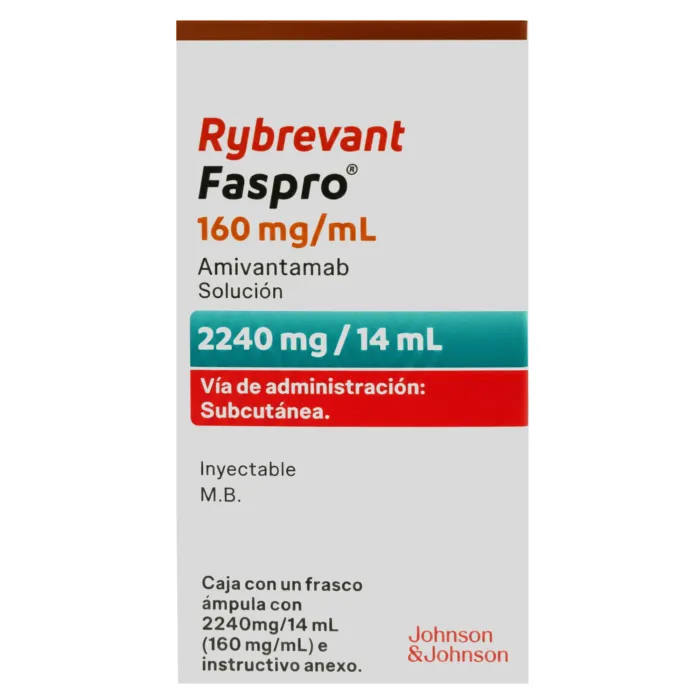
Table of Contents
Package leaflet: Information for the patient
Introduction
Package leaflet: information for the patient
Rybrevant 1600 mg injection solution
Rybrevant 2240 mg injection solution
amivantamab
This medicinal product is subject to additional monitoring, which will allow quicker detection of new safety information. You can help by reporting any side effects you may experience. See the end of section 4 for information on how to report side effects.
Read this entire leaflet carefully before you start receiving this medicine, because it contains important information for you.
- Keep this leaflet, as you may need to read it again.
- If you have any questions, ask your doctor or nurse.
- If you experience any side effects, talk to your doctor or nurse, even if they are side effects not listed in this leaflet. See section 4.
Leaflet contents
- What Rybrevant is and what it is used for
- What you need to know before receiving Rybrevant
- How Rybrevant is given
- Possible side effects
- How to store Rybrevant
- Contents of the pack and other information
1. What RyYbrevant is and what it is used for
What Rybrevant is
Rybrevant is an anticancer medicine. It contains the active substance «amivantamab», which is an antibody (a type of protein) designed to recognize and bind to specific targets in the body.
What Rybrevant is used for
Rybrevant is used in adults with a type of lung cancer called «non-small cell lung cancer». It is used when the cancer has spread to other parts of the body and has certain changes in a gene called «EGFR».
Rybrevant may be prescribed to you:
- as the first treatment you receive for your cancer, in combination with lazertinib, or
- when chemotherapy has stopped working against your cancer.
How Rybrevant works
The active substance in Rybrevant, amivantamab, targets two proteins present on cancer cells:
- epidermal growth factor receptor (EGFR), and
- mesenchymal-epithelial transition factor (MET).
This medicine works by binding to these proteins. This may help slow down or stop the growth of lung cancer. It may also help reduce tumor size.
Rybrevant may be given in combination with other anticancer medicines. It is important that you also read the package leaflets for these other medicines. If you have any questions about these medicines, consult your doctor.
2. What you need to know before you start receiving Rybrevant
Do not use Rybrevant if
- you are allergic to amivantamab or to any of the other ingredients of this medicine (listed in section 6).
Do not use this medicine if the above applies to you. If you are unsure, speak with your doctor or nurse before using this medicine.
Warnings and precautions
Tell your doctor or nurse before you start receiving Rybrevant if:
- you have previously had lung inflammation (a condition called "interstitial lung disease" or "pneumonitis").
Immediately inform your doctor or nurse if you experience any of the following side effects while receiving this medicine (for more information, see section 4):
- Any adverse reaction during the injection of the medicine.
- Sudden difficulty breathing, cough, or fever, which may indicate lung inflammation. This condition may be life-threatening; therefore, healthcare professionals will monitor you for possible symptoms.
- When used in combination with another medicine called lazertinib, serious side effects that may be life-threatening can occur (due to blood clot formation in the veins). Your doctor will give you additional medications to help prevent blood clots during treatment and will monitor you for possible symptoms.
- Skin problems. To reduce the risk of skin problems, avoid sun exposure, wear protective clothing, apply sunscreen, and regularly use moisturizing creams on your skin and nails while taking this medicine. You must continue these measures for 2 months after permanently stopping treatment. Your doctor may recommend starting one or more medications to prevent skin problems, may treat you with medication(s), or refer you to a skin specialist (dermatologist) if you develop skin reactions during treatment.
- Eye problems. If you experience vision problems or eye pain, contact your doctor or nurse immediately. If you wear contact lenses and develop any new eye symptoms, stop using them and inform your doctor immediately.
Children and adolescents
Do not administer this medicine to children or adolescents under 18 years of age. This is because it is not known whether the medicine is safe and effective in this age group.
Other medicines and Rybrevant
Tell your doctor or nurse if you are taking, have recently taken, or might need to take any other medicines.
Contraception
- If you can become pregnant, you must use an effective method of contraception during treatment with Rybrevant and for 3 months after stopping treatment.
Pregnancy
- If you are pregnant, think you may be pregnant, or plan to become pregnant, consult your doctor or nurse before receiving this medicine.
- This medicine may be harmful to the unborn baby. If you become pregnant while being treated with this medicine, inform your doctor or nurse immediately. You and your doctor will decide whether the benefit of taking the medicine outweighs the risk to the unborn baby.
Breast-feeding
It is not known whether Rybrevant passes into breast milk. Consult your doctor before receiving this medicine. You and your doctor will decide whether the benefit of breast-feeding outweighs the risk to your baby.
Driving and using machines
If you feel tired, dizzy, or have irritated eyes or impaired vision after using Rybrevant, do not drive or operate machinery.
Rybrevant contains sodium
This medicine contains less than 1 mmol of sodium (23 mg) per dose; this is, essentially, "sodium-free".
Rybrevant contains polysorbate
This medicine contains 0.6 mg of polysorbate 80 per ml, equivalent to 6 mg per 10 ml vial or 8.4 mg per 14 ml vial. Polysorbates may cause allergic reactions. Inform your doctor if you have any known allergies.
3. How Rybrevant is administered
How much Rybrevant is administered
Your doctor will determine the correct dose of Rybrevant for you. The dose of this medicine depends on your body weight at the start of treatment.
The recommended dose of Rybrevant is:
- 1,600 mg if you weigh less than 80 kg.
- 2,240 mg if you weigh 80 kg or more.
How the medicine is administered
A doctor or nurse will administer Rybrevant to you as an injection under the skin (subcutaneous injection) over approximately 5 minutes. It is administered in the stomach area (abdomen), nowhere else on the body, and never into areas of the abdomen where the skin is red, tender, painful, or hardened, or into areas with tattoos or scars.
If you experience pain during the injection, the doctor or nurse may pause the injection and administer the remainder in another area of the abdomen.
Rybrevant is administered as follows:
- once weekly for the first 4 weeks
- then once every 2 weeks starting from week 5, for as long as you continue to benefit from treatment.
Medications administered during Rybrevant treatment
Before each Rybrevant injection, you will be given medications to help reduce the likelihood of administration-related reactions. These may include:
- medications for allergic reactions (antihistamines)
- medications for inflammation (corticosteroids)
- medications for fever (such as paracetamol).
You may also be given additional medications depending on any symptoms you may have.
If you receive more Rybrevant than you should
This medicine will be administered by your doctor or nurse. In the unlikely event that you receive an excessive amount (overdose), your doctor will examine you to check for any side effects.
If you miss your appointment for Rybrevant administration
It is very important to attend all your appointments. If you miss an appointment, schedule another one as soon as possible.
If you have any further questions about the use of this medicine, ask your doctor or nurse.
4. Possible adverse effects
Like all medicines, this medicine can cause adverse effects, although not everyone experiences them.
Serious adverse effects
Immediately inform your doctor or nurse if you notice any of the following serious adverse effects:
Very common (may affect more than 1 in 10 people):
- Signs of an infusion-related reaction – such as chills, shortness of breath, nausea, redness, chest discomfort, and fever. This may occur especially with the first dose. Your doctor may give you other medications or may need to stop the infusion.
- Skin problems – such as rash (including acne), infected skin around the nails, dry skin, itching, pain, and redness. Inform your doctor if your skin or nail problems worsen.
- When administered together with another medicine called "lazertinib", a blood clot in the veins may occur, especially in the lungs or legs. Signs may include sudden sharp chest pain, difficulty breathing, rapid breathing, leg pain, and swelling in the arms or legs.
- Eye problems – such as dry eye, swollen eyelid, or itchy eyes.
Common (may affect up to 1 in 10 people):
- Signs of lung inflammation – such as sudden difficulty breathing, cough, or fever. This could lead to permanent damage ("interstitial lung disease"). Your doctor may decide to discontinue Rybrevant if you experience this side effect.
- Eye problems – such as vision disturbances and eyelash growth.
- Inflamed cornea (front part of the eye).
The following adverse effects have been reported in clinical studies with Rybrevant when administered alone as an intravenous infusion:
Other adverse effects
Inform your doctor if you experience any of the following adverse effects:
Very common (may affect more than 1 in 10 people):
- Low blood levels of the protein "albumin"
- Swelling due to fluid accumulation in the body
- Feeling very tired
- Mouth sores
- Nausea
- Vomiting
- Constipation or diarrhea
- Loss of appetite
- Increased blood levels of the liver enzymes "alanine aminotransferase" and "aspartate aminotransferase"
- Dizziness
- Increased blood levels of the enzyme "alkaline phosphatase"
- Muscle pain
- Fever
- Low blood calcium levels
Common (may affect up to 1 in 10 people):
- Stomach pain
- Low blood potassium levels
- Low blood magnesium levels
- Hemorrhoids
The following adverse effects have been reported in clinical studies with Rybrevant (administered as intravenous infusion or subcutaneous injection) in combination with lazertinib:
Other adverse effects
Inform your doctor immediately if you notice any of the following side effects:
Very common (may affect more than 1 in 10 people):
- Low blood levels of the protein "albumin"
- Mouth sores
- Hepatotoxicity (liver toxicity)
- Swelling due to fluid accumulation in the body
- Feeling very tired
- Abnormal skin sensations (such as tingling or prickling)
- Constipation
- Diarrhea
- Loss of appetite
- Nausea
- Low blood calcium levels
- Vomiting
- Muscle pain
- Low blood potassium levels
- Muscle spasms
- Dizziness
- Fever
- Stomach pain
Common (may affect up to 1 in 10 people):
- Hemorrhoids
- Irritation or pain at the injection site
- Low blood magnesium levels
- Redness, swelling, peeling, or sensitivity, mainly in the hands or feet (palmar-plantar erythrodysesthesia syndrome)
- Pruritic rash (urticaria)
Reporting of adverse effects
If you experience any adverse effect, consult your doctor or nurse, even if it is an adverse effect not listed in this leaflet. You may also report them directly through the national reporting system listed in Appendix V. By reporting adverse effects, you can help provide more information on the safety of this medicine.
5. Storage of Rybrevant
Rybrevant will be stored at the hospital or medical center.
Keep this medicine out of the sight and reach of children.
Do not use this medicine after the expiry date stated on the carton and label of the vial following "EXP". The expiry date refers to the last day of the month indicated.
Store in a refrigerator (between 2 °C and 8 °C). Do not freeze.
Keep in the original packaging to protect from light.
Chemical and physical stability has been demonstrated for the prepared syringe for up to 24 hours at 2 °C to 8 °C, followed by up to 24 hours at 15 °C to 30 °C. From a microbiological standpoint, unless the method of injection preparation prevents the risk of microbial contamination, the product should be used immediately. If not used immediately, the storage times and conditions during use are the responsibility of the user.
Medicines must not be disposed of via wastewater or household waste. Unused medicines will be discarded by your healthcare professional. This helps protect the environment.
6. Package contents and other information
Composition of Rybrevant
- The active substance is amivantamab. One ml of solution contains 160 mg of amivantamab. A 10 ml vial of injectable solution contains 1,600 mg of amivantamab. A 14 ml vial of injectable solution contains 2,240 mg of amivantamab.
- The other components are recombinant human hyaluronidase (rHuPH20), ethylenediaminetetraacetic acid disodium salt dihydrate (EDTA), glacial acetic acid, L-methionine, polysorbate 80 (E433), sodium acetate trihydrate, sucrose, and water for injections (see "Rybrevant contains sodium" and "Rybrevant contains polysorbate" in section 2).
Presentation of the product and contents of the pack
Rybrevant injectable solution is a liquid ranging from colourless to pale yellow. This medicine is supplied in a cardboard pack containing one 10 ml glass vial of solution or one 14 ml glass vial of solution.
Marketing Authorisation Holder
Janssen-Cilag International NV
Turnhoutseweg 30
B-2340 Beerse
Belgium
Manufacturer responsible for manufacturing
Janssen Biologics B.V.
Einsteinweg 101
2333 CB Leiden
The Netherlands
Further information on this medicine can be requested by contacting the local representative of the Marketing Authorisation Holder:
Belgium/Belgium/Belgium Janssen-Cilag NV Tel/Tel: +32 14 64 94 11 | Lithuania UAB "JOHNSON & JOHNSON" Tel: +370 5 278 68 88 |
| Luxembourg/Luxembourg Janssen-Cilag NV Tel/Tel: +32 14 64 94 11 |
Czech Republic Janssen-Cilag s.r.o. Tel: +420 227 012 227 | Hungary Janssen-Cilag Kft. Tel.: +36 1 884 2858 |
Denmark Janssen-Cilag A/S Tlf.: +45 4594 8282 | Malta AM MANGION LTD Tel: +356 2397 6000 |
Germany Janssen-Cilag GmbH Tel: 0800 086 9247 / +49 2137 955 6955 | Netherlands Janssen-Cilag B.V. Tel: +31 76 711 1111 |
Estonia UAB "JOHNSON & JOHNSON" Estonia branch Tel: +372 617 7410 | Norway Janssen-Cilag AS Tlf: +47 24 12 65 00 |
Greece Janssen-Cilag Φαρμακευτική Μονοπρόσωπη A.E.B.E. Tel: +30 210 80 90 000 | Austria Janssen-Cilag Pharma GmbH Tel: +43 1 610 300 |
Spain Janssen-Cilag, S.A. Tel: +34 91 722 81 00 | Poland Janssen-Cilag Polska Sp. z o.o. Tel.: +48 22 237 60 00 |
France Janssen-Cilag Tél: 0 800 25 50 75 / +33 1 55 00 40 03 | Portugal Janssen-Cilag Farmacêutica, Lda. Tel: +351 214 368 600 |
Croatia Johnson & Johnson S.E. d.o.o. Tel: +385 1 6610 700 | Romania Johnson & Johnson România SRL Tel: +40 21 207 1800 |
Ireland Janssen Sciences Ireland UC Tel: 1 800 709 122 | Slovenia Johnson & Johnson d.o.o. Tel: +386 1 401 18 00 |
Iceland Janssen-Cilag AB c/o Vistor hf. Tel: +354 535 7000 | Slovakia Johnson & Johnson, s.r.o. Tel: +421 232 408 400 |
Italy Janssen-Cilag SpA Tel: 800.688.777 / +39 02 2510 1 | Finland Janssen-Cilag Oy Tel/Tel: +358 207 531 300 |
Cyprus Varnavas Hadjipanagis Ltd Tel: +357 22 207 700 | Sweden Janssen-Cilag AB Tfn: +46 8 626 50 00 |
Latvia UAB "JOHNSON & JOHNSON" Latvia branch Tel: +371 678 93561 | United Kingdom (Northern Ireland) Janssen Sciences Ireland UC Tel: +44 1 494 567 444 |
Date of the most recent review of this leaflet:
Other sources of information
Detailed information on this medicinal product is available on the website of the European Medicines Agency: https://www.ema.euopa.eu, and on the website of the Spanish Agency of Medicines and Medical Devices (AEMPS) (http://www.aemps.gob.es/).
This information is intended for healthcare professionals only: Rybrevant subcutaneous formulation must be administered by a healthcare professional. To avoid medication errors, it is important to check vial labels to ensure the correct formulation (intravenous or subcutaneous) and dose are administered to the patient as prescribed. Rybrevant subcutaneous formulation must only be administered as a subcutaneous injection at the specified dose. Rybrevant subcutaneous formulation is not intended for intravenous administration. This medicinal product must not be mixed with other medicinal products except as indicated below. Prepare the subcutaneous injectable solution using aseptic technique as outlined below: Preparation
Storage of the prepared syringe The prepared syringe should be administered immediately. If immediate administration is not possible, the prepared syringe may be stored refrigerated for up to 24 hours at 2 °C to 8 °C, followed by up to 24 hours at room temperature between 15 °C and 30 °C. The prepared syringe must be discarded if stored for longer than 24 hours under refrigeration or longer than 24 hours at room temperature. If refrigerated, the solution must be brought to room temperature before administration. Traceability To improve traceability of biological medicinal products, the name and batch number of the administered product should be clearly recorded. Disposal This medicinal product is for single use only. Disposal of unused medicine and all materials that have come into contact with it must be carried out in accordance with local regulations. |