Puregon 300 IU/0.36 ml solution for injection
Spain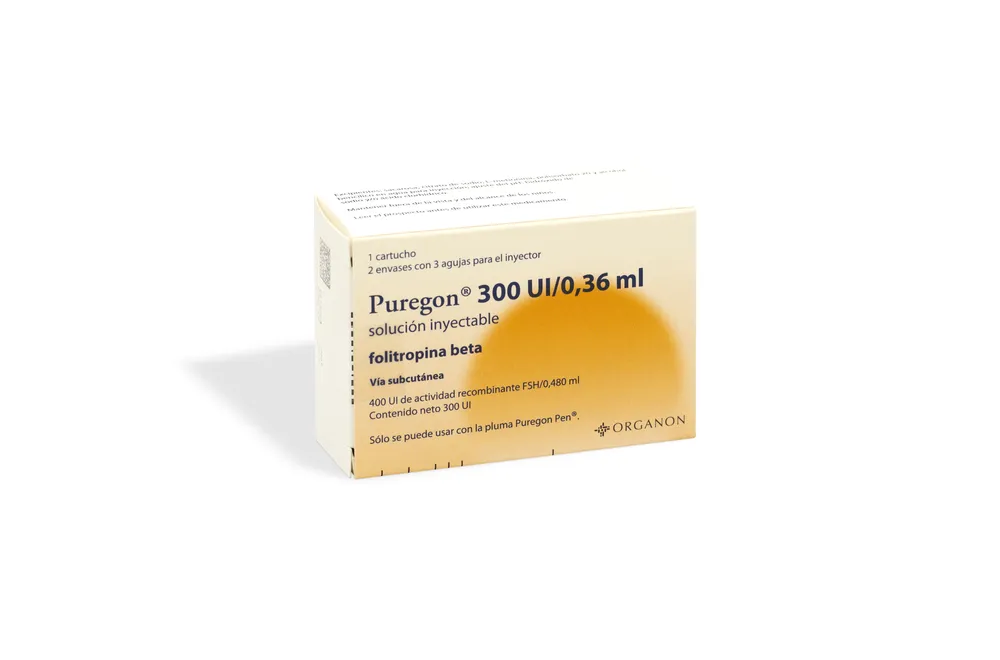
Table of Contents
Package leaflet: Information for the user
Introduction
Package leaflet: information for the user
Puregon 300 IU/0.36 ml solution for injection
Puregon 600 IU/0.72 ml solution for injection
Puregon 900 IU/1.08 ml solution for injection
Follitropin beta
Read all of this leaflet carefully before you start using this medicine, because it contains important information for you.
- Keep this leaflet as you may need to read it again.
- If you have any questions, ask your doctor or pharmacist.
- This medicine has been prescribed for you only and must not be given to other people, even if they have the same symptoms as you, because it may harm them.
- If you experience any side effects, talk to your doctor or pharmacist, even if they are side effects not listed in this leaflet. See section 4.
Contents of the leaflet
- What Puregon is and what it is used for
- What you need to know before you use Puregon
- How to use Puregon
- Possible side effects
- How to store Puregon
- Contents of the pack and other information
1. What Puregon is and what it is used for
Puregon injectable solution contains follitropin beta, a hormone known as follicle-stimulating hormone (FSH).
FSH belongs to the group of gonadotrophins, which play an important role in human fertility and reproduction. In women, FSH is necessary for the growth and development of follicles in the ovaries. Follicles are small, rounded sacs that contain the eggs. In men, FSH is necessary for sperm production.
Puregon is used to treat infertility in either of the following situations:
Women
In women who do not ovulate and who do not respond to treatment with clomiphene citrate, Puregon may be used to induce ovulation.
In women undergoing assisted reproductive techniques, such as in vitro fertilization (IVF) and other methods, Puregon may be used to stimulate the development of multiple follicles.
Men
In infertile men due to low hormone levels, Puregon may be used to stimulate sperm production.
2. What you need to know before using Puregon
Do not use Puregon
If:
- you are allergic to follitropin beta or any of the other ingredients of Puregon (listed in section 6)
- you have a tumor in the ovary, breast, uterus, testicles, or brain (pituitary gland or hypothalamus)
- you have unexplained heavy or irregular vaginal bleeding
- your ovaries do not function due to a condition called primary ovarian insufficiency
- you have ovarian cysts or enlarged ovaries not caused by polycystic ovary syndrome (PCOS)
- you have malformations of the reproductive organs that make normal pregnancy impossible
- you have uterine fibroids that make normal pregnancy impossible
- you are a man with infertility due to a condition called primary testicular insufficiency.
Warnings and precautions
Talk to your doctor before starting to use Puregon if:
- you have had an allergic reaction to certain antibiotics (neomycin and/or streptomycin)
- you have uncontrolled pituitary gland function or hypothalamic disorders
- you have an underactive thyroid gland (hypothyroidism)
- your adrenal glands do not function properly (adrenal insufficiency)
- you have high levels of prolactin in your blood (hyperprolactinemia)
- you have any other medical condition (e.g., diabetes, heart disease, or any other chronic illness)
If you are a woman:
Ovarian hyperstimulation syndrome (OHSS)
Your doctor will regularly monitor the effects of treatment to determine the appropriate dose of Puregon at all times. You will undergo regular ovarian ultrasounds. Your doctor may also check hormone levels in your blood. This is very important because an excessive dose of FSH may lead to rare but serious complications in which the ovaries become overstimulated and growing follicles become larger than normal. This serious condition is called ovarian hyperstimulation syndrome (OHSS). In rare cases, severe OHSS can be potentially life-threatening. OHSS causes sudden accumulation of fluid in the abdomen and chest areas, which may lead to blood clots. Contact your doctor immediately if you experience severe abdominal swelling, stomach (abdominal) pain, discomfort (nausea), vomiting, sudden weight gain due to fluid retention, diarrhea, reduced urine volume, or difficulty breathing (see also section 4, Possible side effects).
? Regular monitoring of the response to FSH treatment helps prevent ovarian overstimulation. Contact your doctor immediately if you experience abdominal pain, especially if it occurs several days after the last injection.
Multiple pregnancy or birth defects
After treatment with gonadotropins, there is an increased chance of multiple pregnancies, even when only one embryo is transferred to the uterus. Multiple pregnancies increase health risks for both mother and babies before and after birth. In addition, multiple pregnancies and characteristics of patients undergoing fertility treatment (e.g., woman's age, semen characteristics, genetic history of both parents) may be associated with a higher risk of birth defects.
Pregnancy complications
The risk of ectopic pregnancy (pregnancy outside the uterus) is slightly increased. Therefore, your doctor should perform an ultrasound early in pregnancy to rule out ectopic pregnancy.
Women undergoing fertility treatment have a slightly higher risk of miscarriage.
Blood clots (Thrombosis)
Treatment with Puregon, like pregnancy itself, may increase the risk of blood clots (thrombosis). Thrombosis is the formation of a clot in a blood vessel.
Blood clots can cause serious conditions such as:
- blockage in the lungs (pulmonary embolism)
- stroke
- heart attack
- blood vessel problems (thrombophlebitis)
- reduced blood flow (deep vein thrombosis), which could lead to loss of an arm or leg.
Discuss this with your doctor before starting treatment, especially if:
- you already know you have a higher risk of thrombosis
- you or a close family member has ever had thrombosis
- you have significant overweight.
Ovarian torsion
Ovarian torsion may occur after treatment with gonadotropins, including Puregon. Ovarian torsion is the twisting of an ovary. Twisting of the ovary may cut off blood flow to it.
Before starting this medicine, inform your doctor if:
- you have ever had ovarian hyperstimulation syndrome (OHSS)
- you are pregnant or think you might be pregnant
- you have ever had abdominal surgery
- you have ever had ovarian torsion
- you have had or currently have ovarian cysts.
Ovarian tumors and other reproductive system tumors
Cases of ovarian tumors and other reproductive system tumors have been reported in women who have undergone infertility treatment. It is not known whether fertility medication treatment increases the risk of these tumors in infertile women.
Other diseases
Additionally, before starting to use this medicine, inform your doctor if:
- your doctor has informed you that pregnancy could be dangerous for you.
If you are a man:
Men with high FSH levels in blood
Elevated blood levels of FSH indicate testicular damage. In such cases, Puregon is usually not effective. To monitor treatment effects, your doctor may request a semen sample for analysis four to six months after starting treatment.
Children and adolescents
Puregon is not intended for use in children and adolescents.
Using Puregon with other medicines
Tell your doctor or pharmacist if you are taking, have recently taken, or might need to take any other medicines.
If Puregon is administered together with clomiphene citrate, the effect of Puregon may increase. If a GnRH agonist (a medicine used to prevent premature ovulation) has been administered, higher doses of Puregon may be required.
Pregnancy and breastfeeding
Consult your doctor or pharmacist before using any medicine. You must not use Puregon if you are already pregnant or think you might be pregnant.
Puregon may affect milk production. It is unlikely that Puregon passes into breast milk. If you are breastfeeding, consult your doctor before using Puregon.
Driving and using machines
It is unlikely that Puregon will affect your ability to drive or use machines.
Puregon contains benzyl alcohol
This medicine contains 10 mg of benzyl alcohol per ml.
Benzyl alcohol may cause allergic reactions.
Consult your doctor or pharmacist if you have liver or kidney disease. This is because large amounts of benzyl alcohol may accumulate in the body and cause adverse effects (metabolic acidosis).
Consult your doctor or pharmacist if you are pregnant or breastfeeding. This is because large amounts of benzyl alcohol may accumulate in your body and cause adverse effects (metabolic acidosis).
Puregon contains sodium
This medicine contains less than 1 mmol of sodium (23 mg) per injection, which is essentially “sodium-free”.
3. How to use Puregon
Follow exactly your doctor's instructions for administering this medicine. If in doubt, consult your doctor or pharmacist again.
Dosage in women
Your doctor will decide the initial dose. This dose may be adjusted as your treatment progresses. Further details on the dosing regimen are provided below.
There are large individual variations in ovarian response to FSH among women, making it impossible to establish a single dosing regimen suitable for all patients. To determine the correct dosage, your doctor will monitor follicular growth by ultrasound and by measuring estradiol (a female sex hormone) levels in the blood.
-
Women who do not ovulate
Your doctor will set an initial dose, which is maintained for at least seven days. If no ovarian response is detected, the daily dose is gradually increased until follicular growth and/or plasma estradiol levels indicate an appropriate response. This daily dose is then maintained until a follicle of appropriate size is detected. Usually, 7 to 14 days of treatment are sufficient. Puregon treatment is then stopped, and ovulation is induced by administering human chorionic gonadotropin (hCG). -
Assisted reproductive programs, such as in vitro fertilization (IVF)
Your doctor will set an initial dose, which is maintained for at least the first four days. Afterwards, your dose may be adjusted according to your ovarian response. When a sufficient number of follicles of appropriate size are detected, the final phase of follicular maturation is induced by administering hCG. Oocyte (egg) retrieval is performed 34–35 hours later.
Dosage in men
Puregon is usually prescribed at a dose of 450 IU per week, typically given as three injections of 150 IU each, together with another hormone (hCG), for at least 3 to 4 months. The treatment duration corresponds to the time required for sperm development and the expected period for improvement to occur. If sperm production has not started after this period, treatment may continue for up to at least 18 months.
How to administer the injection
Puregon injectable solution in cartridges is designed for use with the Puregon Pen injector device. The instructions for using the injector, provided separately, must be followed carefully. Do not use the cartridge if the solution contains particles or is not clear.
With the pen injector, subcutaneous injections (e.g., in the lower abdomen) may be self-administered or given by your partner. Your doctor will tell you when and how to do this. If you are self-injecting Puregon, follow the instructions carefully to ensure correct and minimally uncomfortable administration.
The first injection of Puregon must be given under the supervision of a doctor or nurse.
A small amount of the medicine may remain in the cartridge after completing treatment with Puregon, even when all doses have been correctly administered. Do not attempt to use the remaining medicine. After administering the last dose, the cartridge must be properly discarded.
If you use more Puregon than you should
Inform your doctor immediately.
An overdose of Puregon may cause excessive ovarian stimulation (OHSS), which may present as stomach pain. If you experience discomfort or abdominal pain, inform your doctor immediately. See also section 4 on possible side effects.
If you forget to use Puregon
If you miss a dose, do not administer a double dose to make up for the missed dose.
? Contact your doctor.
If you have any further questions about the use of this medicine, ask your doctor.
4. Possible adverse effects
Like all medicines, this medicine can cause adverse effects, although not everyone gets them.
Inform your doctor if you notice:
Signs of a severe allergic reaction (anaphylactic reaction), such as swelling of the face, lips, throat or tongue causing difficulty swallowing or breathing, shortness of breath, or a feeling of fainting.
Severe adverse effects in women
A complication associated with FSH is ovarian hyperstimulation. Ovarian overstimulation may trigger a condition called ovarian hyperstimulation syndrome (OHSS), which can be a serious clinical problem. The risk of developing OHSS can be reduced by careful monitoring of follicular development during treatment. Your doctor will perform ultrasound scans of your ovaries to closely monitor the number of mature follicles. Your doctor may also check hormone levels in your blood. Early symptoms include stomach pain, discomfort, or diarrhea. In more severe cases, you may experience enlargement of the ovaries, accumulation of fluid in the abdomen and/or chest (which may cause sudden weight gain due to fluid retention), or development of blood clots in the circulatory system. See section 2, Warnings and precautions.
? Contact your doctor immediately if you experience stomach pain or any of these symptoms of ovarian hyperstimulation, even if they occur several days after the last injection.
If you are a woman:
Common adverse effects (may affect up to 1 in 10 people):
- Headache
- Reactions at the injection site (such as bruising, pain, redness, swelling, and itching)
- Ovarian hyperstimulation syndrome (OHSS)
- Pelvic pain
- Stomach pain and/or abdominal distension
Uncommon adverse effects (may affect up to 1 in 100 people):
- Breast discomfort (including tenderness)
- Diarrhea, constipation, and stomach discomfort
- Enlargement of the uterus
- Nausea
- Hypersensitivity reactions (such as skin rash, redness, urticaria, and itching)
- Ovarian cysts or increased size of the ovaries
- Ovarian torsion (twisting of the ovaries)
- Vaginal bleeding
Rare adverse effects (may affect up to 1 in 1,000 people):
- Blood clots (this may also occur independently of unwanted ovarian overstimulation; see section 2, Warnings and precautions)
Frequency not known (cannot be estimated from available data):
- Allergic reactions
- Swelling of the face, lips, throat or tongue causing difficulty swallowing or breathing, shortness of breath
- Pale skin, weak and rapid pulse, or feeling of fainting
Ectopic pregnancies (pregnancies outside the uterus), spontaneous abortions, and multiple pregnancies have also been reported. These adverse effects are not considered related to the use of Puregon, but rather to Assisted Reproductive Technologies (ART) or to a subsequent pregnancy.
If you are a man:
Common adverse effects (may affect up to 1 in 10 people):
- Acne
- Reactions at the injection site (such as hardening and pain)
- Headache
- Skin rash
- Breast development
- Testicular cysts
Frequency not known (cannot be estimated from available data):
- Allergic reactions
- Swelling of the face, lips, throat or tongue causing difficulty swallowing or breathing, shortness of breath
- Pale skin, weak and rapid pulse, or feeling of fainting
Reporting of adverse effects
If you experience any type of adverse effect, consult your doctor or pharmacist, even if it is a possible adverse effect not listed in this leaflet. You can also report them directly through the national reporting system included in Appendix V. By reporting adverse effects, you can help provide more information on the safety of this medicine.
5. Storage of Puregon
Keep this medicine out of the sight and reach of children.
Storage by the pharmacist
Store between 2°C - 8°C (in a refrigerator). Do not freeze.
Storage by the patient
You have two options:
- Store between 2°C - 8°C (in a refrigerator). Do not freeze.
- Store at or below 25°C for a single period of up to 3 months.
Record the date when you start storing the product outside the refrigerator.
Keep the cartridge in the outer packaging.
Once the cartridge's rubber stopper has been pierced with a needle, the product may be stored for a maximum of 28 days.
Please record the first day of use of the cartridge in the control table as shown in the Puregon Pen Instruction Manual.
Do not use this medicine after the expiry date stated on the packaging after 'EXP'. The expiry date refers to the last day of the month indicated.
Dispose of used needles immediately after injection.
Do not mix any other medicine in the cartridges. Do not refill empty cartridges.
Medicines should not be disposed of via wastewater or household waste. Ask your pharmacist how to dispose of medicines and packaging you no longer need. This will help protect the environment.
6. Contents of the container and other information
Composition of Puregon
- Each cartridge contains the active substance follitropin beta, a hormone known as follicle-stimulating hormone (FSH), at a dose of 833 UI/ml of aqueous solution.
- The other components are sucrose, sodium citrate, L-methionine, polysorbate 20, and benzyl alcohol in water for injection. The pH may have been adjusted with sodium hydroxide and hydrochloric acid.
Appearance of the product and contents of the container
Puregon solution for injection (injectable solution) is a clear, colourless liquid contained in a glass cartridge. It is available in packs containing 1 cartridge.
Marketing Authorization Holder and Manufacturer
N.V. Organon
Kloosterstraat 6
5349 AB Oss
The Netherlands
Further information on this medicinal product is available upon request by contacting the local representative of the Marketing Authorization Holder:
Belgium/Belgium/Belgium Organon Belgium Tel/Tel: 0080066550123 (+32 2 2418100) | Lithuania Organon Pharma B.V. Lithuania branch Tel.: +370 52041693 |
| Luxembourg/Luxembourg Organon Belgium Tel/Tel: 0080066550123 (+32 2 2418100) |
Czech Republic Organon Czech Republic s.r.o. Tel: +420 277 051 010 | Hungary Organon Hungary Kft. Tel.: +36 1 766 1963 |
Denmark Organon Denmark ApS Tlf: +45 4484 6800 | Malta Organon Pharma B.V., Cyprus branch Tel: +356 2277 8116 |
Germany Organon Healthcare GmbH Tel.: 0800 3384 726 (+49 (0) 89 2040022 10) | Netherlands N.V. Organon Tel: 00800 66550123 (+32 2 2418100) |
Estonia Organon Pharma B.V. Estonian RO Tel: +372 66 61 300 | Norway Organon Norway AS Tlf: +47 24 14 56 60 |
Greece BIANEX S.A. Tel: +30 210 8009111 | Austria Organon Healthcare GmbH Tel: +49 (0) 89 2040022 10 |
Spain Organon Salud, S.L. Tel: +34 91 591 12 79 | Poland Organon Polska Sp. z o.o. Tel.: +48 22 306 57 64 |
France Organon France Tel: +33 (0) 1 57 77 32 00 | Portugal Organon Portugal, Sociedade Unipessoal Lda. Tel: +351 218705500 |
Croatia Organon Pharma d.o.o. Tel: +385 1 638 4530 | Romania Organon Biosciences S.R.L. Tel: +40 21 527 29 90 |
Ireland Organon Pharma (Ireland) Limited Tel: +353 15828260 | Slovenia Organon Pharma B.V., Oss, Ljubljana branch Tel: +386 1 300 10 80 |
Iceland Vistor ehf. Tel: +354 535 7000 | Slovakia Organon Slovakia s.r.o. Tel: +421 2 44 88 98 88 |
Italy Organon Italia S.r.l. Tel: +39 06 90259059 | Finland/Finland Organon Finland Oy Tel: +358 (0) 29 170 3520 |
Cyprus Organon Pharma B.V., Cyprus branch Tel: +357 22866730 | Sweden Organon Sweden AB Tel: +46 8 502 597 00 |
Latvia Commercial representative office “Organon Pharma B.V.”, Latvia branch Tel: +371 66968876 |
Date of the most recent review of this leaflet:
Other sources of information
Detailed information on this medicine is available on the website of the European Medicines Agency: https://www.ema.europa.eu.