Pamidronate Hospira 3 mg/ml concentrate for infusion solution
Spain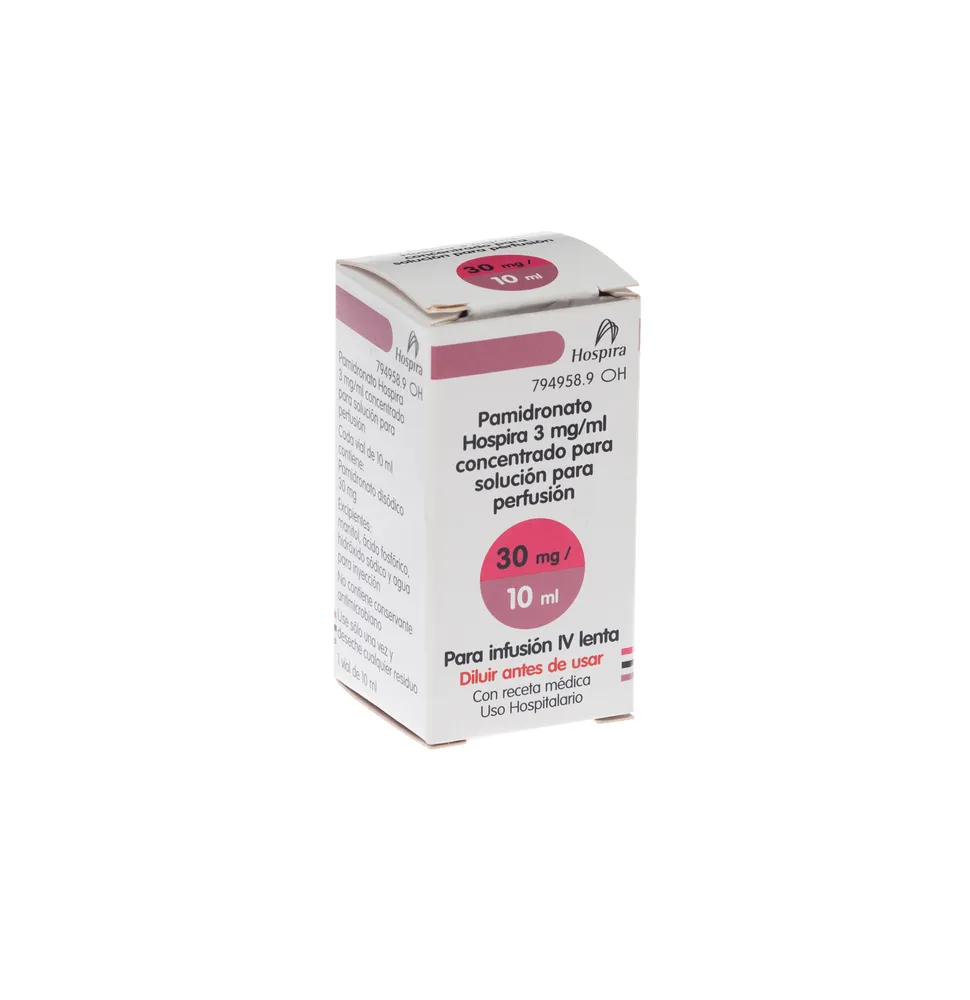
Table of Contents
- Package leaflet: Information for the user
- Introduction
- 1. What Pamidronato Hospira is and what it is used for
- 2. What you need to know before using Pamidronato Hospira
- 3. How to use Pamidronato Hospira
- 4. Possible adverse effects
- 5. Storage of Pamidronate Hospira
- 6. Contents of the container and other information
Package leaflet: Information for the user
Introduction
Package leaflet: information for the user
Pamidronate Hospira 3 mg/ml concentrate for solution for infusion
Pamidronate Hospira 6 mg/ml concentrate for solution for infusion
Pamidronate Hospira 9 mg/ml concentrate for solution for infusion
Pamidronate disodium
Read all of this leaflet carefully before you start using this medicine, because it contains important information for you.
- Keep this leaflet. You may need to read it again.
- If you have any questions, ask your doctor or pharmacist.
- This medicine has been prescribed for you only and must not be given to other people, even if they have the same symptoms as yours, as it may harm them.
- If you experience any adverse effects, consult your doctor or pharmacist, even if such effects are not listed in this leaflet. See section 4.
Contents of this leaflet:
- What Pamidronate Hospira is and what it is used for
- What you need to know before using Pamidronate Hospira
- How to use Pamidronate Hospira
- Possible side effects
- How to store Pamidronate Hospira
- Contents of the pack and other information
1. What Pamidronato Hospira is and what it is used for
Pamidronato Hospira belongs to a group of medicines called bisphosphonates. The mechanism of action of pamidronate is that it binds to bone and reduces bone destruction.
This medicine is used to help lower elevated levels of calcium in the blood caused by tumours, and to reduce bone loss that may occur in patients with certain types of cancer, for example, breast cancer or multiple myeloma. If you are unsure why you are being given this medicine, please ask your doctor.
2. What you need to know before using Pamidronato Hospira
Do not use Pamidronato Hospira:
- ?If you are allergic to pamidronate disodium or to any of the excipients of this medicine (see section 6) or to other bisphosphonates (the group to which Pamidronato Hospira belongs).
Warnings and precautions:
Talk to your doctor, pharmacist, or nurse before starting treatment with Pamidronato Hospira
-
If you have or have ever had thyroid problems.
-
If you have kidney disease.
-
If you have heart problems.
-
If you have blood disorders (anemia, leucopenia (low white blood cell count), and thrombocytopenia (low platelet count)).
-
Pamidronato Hospira may cause eye irritation.
-
The use of Pamidronato Hospira is not recommended in children.
-
If you have or have ever had pain, swelling, or numbness in the jaw, a feeling of heaviness in the jaw, or if you have had a loose tooth. Your doctor may recommend that you have a dental examination before starting treatment with Pamidronato Hospira.
-
If you are receiving dental treatment or are scheduled to undergo a dental procedure, inform your dentist that you are being treated with Pamidronato Hospira and inform your doctor about your dental treatment.
While receiving treatment with Pamidronato Hospira, you should maintain good oral hygiene (including regular tooth brushing) and attend periodic dental check-ups.
Contact your doctor and dentist immediately if you experience any oral or dental problems, such as a loose tooth, pain or swelling, non-healing sores, or discharge, as these could be signs of osteonecrosis of the jaw.
Patients receiving chemotherapy and/or radiotherapy, taking steroids, undergoing dental procedures, not receiving routine dental care, suffering from gum disease, who smoke, or who have received treatment with a bisphosphonate (used to treat or prevent bone disorders) may have an increased risk of developing osteonecrosis of the jaw.
While being treated with Pamidronato Hospira, your doctor will monitor your response to treatment at regular intervals.
Children and adolescents
There are no clinical data available in the pediatric and adolescent population (under 18 years of age).
Use of Pamidronato Hospira with other medicines
- Pamidronato Hospira should not be used with other bisphosphonates (the group to which Pamidronato Hospira belongs) or with other medicines that lower calcium levels.
- Other medicines that affect your kidneys (your doctor or nurse will know which ones)
- Thalidomide (used in the treatment of multiple myeloma)
Tell your doctor or pharmacist if you are taking, have recently taken, or might need to take any other medicines.
Pregnancy, breast-feeding and fertility
If you are pregnant or breastfeeding, think you may be pregnant, or are planning to become pregnant, consult your doctor or pharmacist before using this medicine.
There are no clinical data on the use of Pamidronato Hospira concentrate for solution for infusion during pregnancy. Animal studies have shown harmful effects on offspring (skeletal abnormalities). The potential risk in humans is unknown.
Pamidronate should not be used during pregnancy unless absolutely necessary.
Breast-feeding is not recommended while being treated with Pamidronato Hospira concentrate for solution for infusion.
Driving and using machines
If you feel drowsy or dizzy after receiving pamidronate disodium, do not drive or operate machinery requiring special attention until these effects have passed.
Pamidronato Hospira contains sodium:
This medicine contains less than 1 mmol of sodium (23 mg) per maximum dose (90 mg); i.e., it is essentially “sodium-free”.
However, if a saline solution (0.9% w/v sodium chloride solution) is used to dilute Pamidronato Hospira before administration, the sodium dose received would be higher.
3. How to use Pamidronato Hospira
Pamidronato Hospira will be administered by slow intravenous infusion (into a vein), never by rapid injection. Your doctor will decide the correct dose based on your condition. The infusion may take from one to several hours, depending on the dose. Your doctor will determine how many infusions you need and how often they should be given.
The recommended dose per full treatment ranges from 15 mg to 90 mg.
If you have any further questions about the use of this product, ask your doctor or pharmacist.
4. Possible adverse effects
Like all medicines, this medicine may cause adverse effects, although not everyone will experience them.
The most common adverse effects are a decrease in blood calcium levels and flu-like symptoms and fever (an increase in body temperature of 1–2 °C) that occur at the beginning of treatment and may last for about 48 hours.
Some patients may experience increased bone pain when starting treatment. This usually improves within a few days. If it does not improve, inform your doctor.
Your doctor may immediately stop the administration of Pamidronato Hospira if you experience symptoms of angioedema, such as swelling of the face, tongue or throat, difficulty swallowing, hives, and breathing difficulties (uncommon: may affect up to 1 in 100 people).
If you experience any of the following adverse effects, symptoms of anaphylactic shock (a severe allergic reaction), contact your doctor immediately:
- Chest tightness, breathing difficulties, widespread rash, hives, skin and mucous membrane swelling, sudden drop in blood pressure. (Uncommon adverse effect: may affect up to 1 in 10,000 people).
Other possible adverse effects include:
Very common (may affect more than 1 in 10 people):
- Fever and flu-like symptoms, some of which may be accompanied by malaise, stiffness, fatigue, and feeling of suffocation.
- Decreased levels of calcium and phosphatase in the blood.
Common (may affect up to 1 in 10 people):
- Decrease in white blood cell count (lymphopenia),
- Anaemia, reduction in the number of platelets in the blood (thrombocytopenia),
- Decreased levels of potassium and magnesium in the blood,
- Headache,
- Insomnia,
- Numbness,
- Feeling unwell,
- Vomiting,
- Diarrhoea,
- Constipation, stomach pain, loss of appetite,
- Transient bone pain, joint pain, muscle pain, muscle spasms, generalised pain, pain,
- Redness or inflammation at the injection site,
- Tender or painful veins, sometimes accompanied by localised bleeding spots,
- High blood pressure,
- Tingling sensation in hands and feet,
- Numbness,
- Conjunctivitis, skin rash,
- Increased serum creatinine (a blood test to measure kidney function).
Uncommon (may affect up to 1 in 100 people):
- Allergic reaction,
- Bronchospasm,
- Seizures (tremors),
- Agitation,
- Dizziness,
- Lethargy,
- Eye inflammation that may cause pain and redness,
- Low blood pressure,
- Feeling of fullness in the stomach, indigestion,
- Itching,
- Muscle cramps,
- Bone tissue death (osteonecrosis),
- Altered liver function,
- Increased serum and blood urea,
- Acute kidney failure.
Rare (may affect up to 1 in 1,000 people):
- Kidney problems,
- Atypical fractures of the femur bone, which may rarely occur, particularly in patients receiving long-term treatment for osteoporosis.
Tell your doctor if you notice pain, weakness, or discomfort in your thigh, hip, or groin, as these may be early signs indicating a possible femur fracture.
Very rare (may affect up to 1 in 10,000 people):
- Development of burning sensations, sores, and herpes (reactivation of Herpes Virus),
- Decrease in white blood cell count (leucopenia),
- Increased levels of potassium and sodium in the blood,
- Confusion,
- Heart failure,
- Breathing problems,
- Lung disease,
- Kidney problems (especially in patients with pre-existing kidney conditions),
- Blood in the urine,
- Visual hallucinations (seeing things that are not there),
- Vision problems/eye pain,
- Lung inflammation that may cause cough, breathing difficulties, and wheezing,
- Anaphylactic shock (severe allergic reaction).
- Speak to your doctor if you experience ear pain, ear discharge, and/or ear infection. This may indicate ear damage.
Frequency not known: frequency cannot be estimated from the available data
- Irregular heart rhythm (atrial fibrillation) has been observed in patients receiving pamidronate. It is not entirely clear whether pamidronate causes this irregular heart rhythm. You should inform your doctor if you experience an irregular heartbeat during treatment with pamidronate.
- Redness around the eye area.
- Pseudotumour cerebri, a disorder associated with the nervous system.
- Pain in the mouth, teeth, and/or jaw, swelling or sores that do not heal in the mouth or jaw, discharge, numbness or heaviness sensation in the jaw, or loose tooth. These could be signs of bone damage in the jaw (osteonecrosis). Inform your doctor and dentist immediately if you experience these symptoms while receiving treatment with Pamidronato Hospira or after stopping treatment.
Reporting of adverse effects
If you experience any adverse effects, consult your doctor or pharmacist, even if they are possible adverse effects not listed in this leaflet. You may also report them directly via the Spanish Pharmacovigilance System for Human Medicines: www.notificaRAM.es. By reporting adverse effects, you can help provide more information on the safety of this medicine.
5. Storage of Pamidronate Hospira
Keep this medicine out of the sight and reach of children.
Do not use this medicine after the expiry date which is stated on the container after EXP. The expiry date refers to the last day of the month indicated.
Do not store above 25°C.
The diluted product should be used immediately. If this is not possible, storage times should not exceed 24 hours at a temperature of 2°C–8°C.
Medicines must not be disposed of via wastewater or household waste. Ask your pharmacist how to dispose of medicines and packaging that you no longer need. This will help protect the environment.
6. Contents of the container and other information
Composition of Pamidronate Hospira
- The active substance is pamidronate disodium. Each milliliter (ml) of solution contains 3 mg, 6 mg, or 9 mg of pamidronate disodium.
- The other components are: mannitol, phosphoric acid, sodium hydroxide, and water for injections.
Appearance of the product and contents of the container
Pamidronate Hospira concentrate for solution for infusion (sterile concentrate) is a clear, colourless solution.
Pamidronate Hospira 3 mg/ml
Clear 5 ml vials presented in packs of 5 vials or 4 vials (5 × 5 ml).
Clear 10 ml vials presented in packs of 1 vial or 4 vials (1 × 10 ml).
Pamidronate Hospira 6 mg/ml and 9 mg/ml
Clear 10 ml vials presented in packs of 1 vial or 4 vials (1 × 10 ml).
Not all pack sizes may be marketed.
Marketing Authorization Holder
Pfizer, S.L.
Avenida de Europa, 20 B
Parque Empresarial La Moraleja
28108 Alcobendas (Madrid)
Spain
Manufacturer
Pfizer Service Company BV
Hermeslaan 11
1932 Zaventem
Belgium
This medicinal product is authorized in the European Economic Area member states under the following names:
Austria | Pamidronat Dinatrium Pfizer | Luxembourg | Pamidronate disodique Hospira 3 mg/ml, 6 mg/ml, 9 mg/ml solution à diluer pour perfusion | |
Belgium | Pamidronate disodique Hospira 3 mg/ml, 6 mg/ml, 9 mg/ml concentraat voor oplossing voor infusie Pamidronate disodique Hospira 3 mg/ml, 6 mg/ml, 9 mg/ml solution à diluer pour perfusion Pamidronate disodique Hospira 3 mg/ml, 6 mg/ml, 9 mg/ml Konzentrat zur Herstellung einer Infusionslösung | Norway | Pamidronatdinatrium Pfizer | |
Denmark | Pamidronatdinatrium Pfizer | Portugal | Pamidran | |
France | Pamidronate de sodium Hospira | Spain | Pamidronato Hospira | |
Iceland | Pamidronatdinatrium Pfizer | Sweden | Pamidronatdinatrium Pfizer |
This summary was reviewed in 09/2025
Updated and detailed information on this medicinal product is available on the website of the Spanish Agency of Medicines and Health Products (AEMPS) http://www.aemps.gob.es/
This information is intended exclusively for healthcare professionals
Administration:
For intravenous use only as an infusion. Pamidronic acid disodium must never be administered as a bolus injection. The solution must be diluted before use and should be infused slowly. The concentration of pamidronic acid disodium in the infusion solution must not exceed 90 mg/250 ml. Only clear, particle-free solutions should be used. For single use only. Any unused portion of the solution should be discarded.
Incompatibilities:
Pamidronic acid forms complexes with divalent cations and must not be added to intravenous solutions containing calcium.
Storage and expiration:
Chemical and physical stability has been demonstrated in 0.9% sodium chloride and 5% glucose for 24 hours when stored at 2 – 8°C. From a microbiological standpoint, the product should be used immediately. If not used immediately, the time and storage conditions prior to use are the responsibility of the user and should normally not exceed 24 hours at a temperature between 2°C and 8°C.