Openvas Plus 40 mg/12.5 mg film-coated tablets
Spain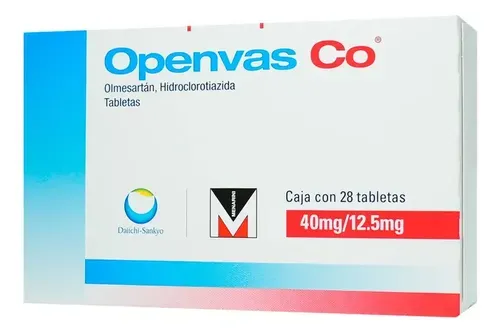
Table of Contents
Package leaflet: Information for the user
Introduction
Package leaflet: information for the user
Openvas Plus 40 mg/12.5 mg film-coated tablets
Olmesartan medoxomil/Hydrochlorothiazide
Read all of this leaflet carefully before you start taking this medicine, because it contains important information for you.
- Keep this leaflet. You may need to read it again.
- If you have any questions, ask your doctor or pharmacist.
- This medicine has been prescribed for you only. Do not pass it on to other people, even if they have the same symptoms as you, because it may harm them.
- If you experience any adverse effects, talk to your doctor or pharmacist, even if they are adverse effects not listed in this leaflet. See section 4.
Contents of the leaflet
- What Openvas Plus is and what it is used for
- What you need to know before taking Openvas Plus
- How to take Openvas Plus
- Possible side effects
- How to store Openvas Plus
- Contents of the pack and other information
1. What Openvas Plus is and what it is used for
Openvas Plus contains two active substances, olmesartan medoxomil and hydrochlorothiazide, which are used in the treatment of high blood pressure (hypertension):
-
Olmesartan medoxomil belongs to a group of medicines called angiotensin II receptor antagonists. It lowers blood pressure by relaxing blood vessels.
-
Hydrochlorothiazide belongs to a group of medicines called thiazide diuretics. It lowers blood pressure by helping the body get rid of excess fluid, increasing urine production by the kidneys.
Openvas Plus will only be prescribed if treatment with Openvas (olmesartan medoxomil) alone has not adequately controlled your blood pressure. The combined administration of both active substances in Openvas Plus contributes to greater blood pressure reduction than when each substance is given alone.
You may already be taking medicines to treat high blood pressure, but your doctor may consider it necessary for you to take Openvas Plus to lower it further.
High blood pressure can be controlled with medicines such as Openvas Plus tablets. Your doctor has likely also advised you to make certain lifestyle changes to help lower your blood pressure (for example, losing weight, quitting smoking, reducing alcohol consumption, and reducing salt intake). Your doctor may also have recommended that you exercise regularly, such as walking or swimming. It is important to follow your doctor's advice.
2. What you need to know before taking Openvas Plus
Do not take Openvas Plus
- If you are allergic to olmesartan medoxomil or hydrochlorothiazide, or to any of the other ingredients of this medicine (listed in section 6), or to substances similar to hydrochlorothiazide (sulfonamides).
- If you are more than 3 months pregnant. (It is also advisable to avoid Openvas Plus at the beginning of pregnancy – see Pregnancy section).
- If you have kidney problems.
- If you have diabetes or renal insufficiency and are being treated with a blood pressure-lowering medicine containing aliskiren.
- If you have low levels of potassium or sodium in your blood, high levels of calcium or uric acid in your blood (with symptoms of gout or kidney stones) that do not improve with treatment.
- If you have moderate or severe liver problems, yellowing of the skin or eyes (jaundice), or problems with bile drainage from the gallbladder (biliary obstruction, for example, gallstones).
If you think any of these apply to you, or you are unsure, do not take the tablets. Speak to your doctor and follow their advice.
Warnings and precautions
Talk to your doctor before starting to take Openvas Plus.
Before taking the tablets, tell your doctor if you are taking any of the following medicines used to treat high blood pressure (hypertension):
- An angiotensin-converting enzyme inhibitor (ACE inhibitor) (e.g. enalapril, lisinopril, ramipril), particularly if you have kidney problems related to diabetes.
- Aliskiren.
Your doctor may monitor your kidney function, blood pressure, and blood electrolyte levels (e.g. potassium) at regular intervals.
See also the information under the heading “Do not take Openvas Plus”.
Before taking the tablets, tell your doctor if you have any of the following health conditions:
- Kidney transplant.
- Liver disease.
- Heart failure or problems with heart valves or heart muscle.
- Vomiting (with dizziness) or diarrhoea that is severe or lasts for several days.
- Treatment with high doses of medicines that increase urine elimination (diuretics), or if you are on a low-salt diet.
- Problems with the adrenal glands (e.g. primary hyperaldosteronism).
- Diabetes.
- Lupus erythematosus (an autoimmune disease).
- Allergy or asthma.
- If you have had skin cancer or develop an unexpected skin lesion during treatment. Treatment with hydrochlorothiazide, particularly long-term use at high doses, may increase the risk of certain types of non-melanoma skin cancer and lip cancer. Protect your skin from sun exposure and UV radiation while taking Openvas Plus.
- If you have previously experienced respiratory or lung problems (such as inflammation or fluid in the lungs) after taking hydrochlorothiazide. If you develop shortness of breath or severe difficulty breathing after taking Openvas Plus, contact your doctor immediately.
Contact your doctor if you experience any of the following symptoms:
- Severe, persistent diarrhoea causing significant weight loss. Your doctor will assess your symptoms and decide how to proceed with your blood pressure treatment.
- Decreased vision or eye pain. These could be symptoms of fluid accumulation in the vascular layer of the eye (choroidal effusion) or increased intraocular pressure, which may occur from hours to weeks after taking Openvas Plus. This may lead to permanent vision impairment if not treated.
Your doctor may want to see you more frequently and perform some tests if you have any of these problems.
Consult your doctor if you experience abdominal pain, nausea, vomiting, or diarrhoea after taking Openvas Plus. Your doctor will decide whether to continue treatment. Do not stop taking Openvas Plus on your own.
Openvas Plus may cause an increase in blood fat levels and uric acid levels (which can cause gout – painful joint swelling). Your doctor will likely perform blood tests from time to time to monitor these potential changes.
Changes in blood levels of certain chemicals called electrolytes may occur. Your doctor will likely perform blood tests periodically to monitor this possible change. Some signs of electrolyte imbalance include: thirst, dry mouth, muscle pain or cramps, tired muscles, low blood pressure (hypotension), feeling weak, sluggish, fatigued, drowsy, restless, nauseous, vomiting, reduced need to urinate, rapid heartbeat. Tell your doctor if you notice any of these symptoms.
As with any other medicine that lowers blood pressure, excessive lowering of blood pressure in patients with impaired blood flow to the heart or brain may lead to a heart attack or stroke. Therefore, your doctor will carefully monitor your blood pressure.
If you are scheduled for tests of parathyroid function, you must stop taking Openvas Plus before the tests are performed.
Athletes should be aware that this medicine contains a component that may result in a positive doping test.
Inform your doctor if you are pregnant or think you might be pregnant. Use of Openvas Plus is not recommended at the beginning of pregnancy, and it must not be taken if you are more than 3 months pregnant, as it may cause serious harm to your baby if taken during this stage (see Pregnancy section).
Children and adolescents
Openvas Plus is not recommended for children and adolescents under 18 years of age.
Taking Openvas Plus with other medicines
Tell your doctor or pharmacist if you are taking, have recently taken, or might need to take any other medicines.
In particular, inform your doctor or pharmacist about any of the following medicines:
- Other blood pressure-lowering medicines (antihypertensives), as they may enhance the effect of Openvas Plus.
Your doctor may need to adjust your dose and/or take other precautions:
If you are taking an angiotensin-converting enzyme inhibitor (ACE inhibitor) or aliskiren (see also information under the headings “Do not take Openvas Plus” and “Warnings and precautions”).
-
Medicines that may alter potassium levels in the blood when used together with Openvas Plus. These include:
-
Potassium supplements (as well as salt substitutes containing potassium).
-
Medicines that increase urine elimination (diuretics).
-
Heparin (used to thin the blood).
-
Laxatives.
-
Steroids.
-
Adrenocorticotropic hormone (ACTH).
-
Carbenoxolone (a medicine used to treat mouth and stomach ulcers).
-
Sodium penicillin G (an antibiotic also known as sodium benzylpenicillin).
-
Some painkillers such as aspirin or salicylates.
- Lithium (a medicine used to treat mood disorders and certain types of depression) may have increased toxicity when used together with Openvas Plus. If you need to take lithium, your doctor will monitor lithium levels in your blood.
- Non-steroidal anti-inflammatory drugs (NSAIDs) (medicines used to relieve pain, swelling, and other symptoms of inflammation, including arthritis), when used together with Openvas Plus, may increase the risk of kidney failure and reduce the effect of Openvas Plus.
- Sleeping pills, sedatives, and antidepressants used with Openvas Plus may cause a sudden drop in blood pressure when standing up.
- Certain muscle relaxants such as baclofen and tubocurarine.
- Amifostine and other cancer treatments such as cyclophosphamide or methotrexate.
- Cholestyramine and colestipol, medicines used to lower blood fat levels.
- Colesevelam hydrochloride, a medicine that lowers blood cholesterol levels, as it may reduce the effect of Openvas Plus. Your doctor may advise you to take Openvas Plus at least 4 hours before colesevelam hydrochloride.
- Anticholinergic medicines such as atropine and biperiden.
- Medicines such as thioridazine, chlorpromazine, levomepromazine, trifluoperazine, cyamemazine, sulpiride, amisulpride, pimozide, sultopride, tiapride, droperidol, or haloperidol, used to treat certain psychiatric disorders.
- Certain heart medicines such as quinidine, hydroquinidine, disopyramide, amiodarone, sotalol, or digitalis.
- Medicines such as mizolastine, pentamidine, terfenadine, dofetilide, ibutilide, or injectable erythromycin, which may alter heart rhythm.
-
Oral antidiabetic medicines such as metformin, or insulin, used to lower blood sugar levels.
-
Beta-blockers and diazoxide, medicines used to treat high blood pressure or low blood sugar, respectively, since Openvas Plus may enhance the blood sugar-raising effect of these medicines.
-
Methyldopa, a medicine used to treat high blood pressure.
-
Medicines such as noradrenaline, used to increase blood pressure and reduce heart rate.
-
Difeminal, used to treat slow heartbeat or reduce sweating.
-
Medicines such as probenecid, sulfinpyrazone, and allopurinol, used to treat gout.
-
Calcium supplements.
-
Amantadine, an antiviral medicine.
-
Cyclosporine, a medicine used to prevent organ transplant rejection.
-
Antibiotics from the tetracycline group or sparfloxacin.
-
Amphotericin, a medicine used to treat fungal infections.
-
Some antacids used to treat excess stomach acid, such as aluminium and magnesium hydroxide, as they may slightly reduce the effect of Openvas Plus.
-
Cisapride, used to increase stomach and intestinal motility.
-
Halofantrine, used to treat malaria.
Taking Openvas Plus with food and drink
Openvas Plus can be taken with or without food.
Be cautious when drinking alcohol while taking Openvas Plus, as some people may feel weakness or dizziness. If this happens, avoid alcohol, including wine, beer, or alcoholic soft drinks.
Patients of Black African origin
As with other similar medicines, the blood pressure-lowering effect of Openvas Plus is somewhat reduced in patients of Black African origin.
Pregnancy and breastfeeding
Pregnancy
Inform your doctor if you are pregnant or think you might be pregnant. Your doctor will advise you to stop taking Openvas Plus before becoming pregnant or as soon as you know you are pregnant, and will recommend an alternative medicine. Use of Openvas Plus is not recommended during pregnancy, and it must not be taken after 3 months of pregnancy, as it may cause serious harm to your baby if used from the third month of pregnancy onwards.
Breastfeeding
Inform your doctor if you are breastfeeding or about to start breastfeeding. Openvas Plus is not recommended for breastfeeding mothers, and your doctor may choose an alternative treatment if you wish to breastfeed.
If you are pregnant or breastfeeding, think you may be pregnant, or plan to become pregnant, consult your doctor or pharmacist before using this medicine.
Use in athletes
Athletes are advised that this medicinal product contains a component (hydrochlorothiazide) that may result in a positive analytical finding in doping controls.
Driving and use of machines
You may feel drowsy or dizzy while undergoing treatment for high blood pressure. If this occurs, do not drive or operate machinery until these symptoms have resolved. Consult your doctor.
Openvas Plus contains lactose
This medicine contains lactose. If your doctor has informed you of an intolerance to certain sugars, consult him before taking this medicine.
3. How to take Openvas Plus
Follow exactly the instructions for use of this medicine given by your doctor. If in doubt, consult your doctor or pharmacist again.
The recommended dose is 1 tablet of Openvas Plus 40 mg/12.5 mg daily. If blood pressure is not adequately controlled, your doctor may change the dose to 1 tablet of Openvas Plus 40 mg/25 mg daily.
Take the tablets with water. If possible, take your dose at the same time each day, for example, with breakfast. It is important that you continue taking Openvas Plus until your doctor tells you to stop.
If you take more Openvas Plus than you should
If you take more tablets than you should, or if a child accidentally ingests one or more tablets, contact your doctor immediately or go to the nearest hospital emergency department and bring the medicine package with you.
In case of overdose or accidental ingestion, contact your doctor or pharmacist immediately, or call the Toxicology Information Service at telephone number 91 562 04 20, indicating the medicine and the amount ingested.
If you forget to take Openvas Plus
If you forget to take a dose, take your usual dose the next day. Do not take a double dose to make up for the missed dose.
If you stop taking Openvas Plus
It is important to continue taking Openvas Plus unless your doctor tells you to stop treatment.
If you have any further questions about the use of this medicine, ask your doctor or pharmacist.
4. Possible adverse effects
Like all medicines, this medicine can cause adverse effects, although not everyone experiences them.
However, the following adverse effects may be serious:
-
In rare cases, allergic reactions may occur that can affect the entire body, with swelling of the face, mouth and/or larynx, together with itching and skin rash. If this happens to you, stop taking Openvas Plus and consult your doctor immediately.
-
Openvas Plus may cause a marked drop in blood pressure in susceptible patients or as a result of an allergic reaction. Fainting or dizziness may occur infrequently. If this happens to you, stop taking Openvas Plus, consult your doctor immediately, and remain lying down in a horizontal position.
-
Frequency not known: If you experience yellowing of the whites of the eyes, dark urine, or skin itching—even if you started treatment with Openvas Plus some time ago—contact your doctor immediately. Your doctor will evaluate your symptoms and decide how to proceed with your blood pressure treatment.
Openvas Plus is a combination of two active substances. The following information first describes the adverse effects reported so far with the Openvas Plus combination (in addition to those already mentioned), and secondly, the known adverse effects of each of the two active substances when used separately.
These are other known adverse effects reported so far with Openvas Plus:
If these effects occur, they are often mild and you do not need to stop treatment.
Frequent adverse effects (may affect up to 1 in 10 people):
Dizziness, weakness, headache, fatigue, chest pain, swelling of ankles, feet, legs, hands, or arms.
Uncommon adverse effects (may affect up to 1 in 100 people):
Rapid or strong heartbeat (palpitations), rash, eczema, vertigo, cough, indigestion, abdominal pain, nausea, vomiting, diarrhea, muscle cramps, muscle pain, joint pain, pain in arms and legs, back pain, erectile dysfunction in men, blood in urine.
Uncommonly, the following changes in blood test results have also been observed:
Increased blood fat levels, increased blood urea or uric acid, increased creatinine, increased or decreased blood potassium levels, increased blood calcium levels, increased blood glucose levels, increased liver function test values. Your doctor will monitor you with a blood test and advise you whether any action is needed.
Rare adverse effects (may affect up to 1 in 1,000 people):
Feeling unwell, disturbances in consciousness, skin swelling (hives), acute renal failure.
Rarely, the following changes in blood test results have also been observed:
Increased blood urea nitrogen, decreased haemoglobin and haematocrit values. Your doctor will monitor you with a blood test and advise you whether any action is needed.
Additional adverse effects reported with olmesartan medoxomil or hydrochlorothiazide used alone, but not with Openvas Plus or at a higher frequency:
Olmesartan medoxomil:
Frequent adverse effects (may affect up to 1 in 10 people):
Bronchitis, cough, nasal congestion and discharge, sore throat, abdominal pain, indigestion, diarrhea, nausea, gastroenteritis, joint or bone pain, back pain, blood in urine, urinary tract infection, flu-like symptoms, pain.
Frequent changes in blood test results include:
Increased blood fat levels, increased blood urea or uric acid, increased liver or muscle function test levels.
Uncommon adverse effects (may affect up to 1 in 100 people):
Rapid allergic reactions affecting the whole body, which may cause breathing difficulties and a rapid drop in blood pressure that may even lead to fainting (anaphylactic reactions), facial swelling, angina (chest pain or discomfort, known as angina pectoris), feeling unwell, allergic skin rash, itching, exanthema (skin rash), skin swelling (hives).
Uncommonly, the following changes in blood test results have also been observed:
Reduction in the number of a type of blood cells called platelets (thrombocytopenia).
Rare adverse effects (may affect up to 1 in 1,000 people):
Worsening of kidney function, lack of energy, intestinal angioedema: swelling in the intestine causing symptoms such as abdominal pain, nausea, vomiting, and diarrhea.
Rarely, the following changes in blood test results have also been observed:
Increased blood potassium levels.
Hydrochlorothiazide:
Very frequent adverse effects (may affect more than 1 in 10 people):
Changes in blood tests including: increased blood fat levels and increased uric acid levels.
Frequent adverse effects (may affect up to 1 in 10 people):
Confusion, abdominal pain, stomach discomfort, bloating sensation, diarrhea, nausea, vomiting, constipation, glucose in urine.
Changes in blood test results include:
Increased levels of creatinine, urea, calcium, and blood glucose; decreased levels of chloride, potassium, magnesium, and sodium in blood; increased serum amylase (hyperamylasemia).
Uncommon adverse effects (may affect up to 1 in 100 people):
Decreased or loss of appetite, severe breathing difficulty, skin anaphylactic reactions (hypersensitivity reactions), worsening of pre-existing myopia, erythema, photosensitivity skin reactions, itching, purple spots or patches on the skin due to minor bleeding (purpura), skin swelling (hives).
Rare adverse effects (may affect up to 1 in 1,000 people):
Inflammation and pain of the salivary glands, decreased number of white blood cells, decreased number of platelets in blood, anaemia, bone marrow depression, restlessness, depression, sleep problems, feeling of loss of interest (apathy), tingling and numbness, seizures, yellowish vision, blurred vision, dry eyes, irregular heartbeat, inflammation of blood vessels, blood clots (thrombosis or embolism), lung inflammation, fluid accumulation in the lungs, pancreatitis, jaundice, gallbladder infection, symptoms of lupus erythematosus such as skin rash, joint pain, and coldness in hands and fingers, skin allergic reactions, skin peeling and blistering, non-infectious kidney inflammation (interstitial nephritis), fever, muscle weakness (which may sometimes impair movement).
Very rare adverse effects (may affect up to 1 in 10,000 people):
Electrolyte imbalance that may cause abnormally low blood chloride levels (hypochloremic alkalosis), intestinal obstruction (paralytic ileus).
Acute breathing difficulty (symptoms include severe shortness of breath, fever, weakness, and confusion).
Adverse effects with unknown frequency (frequency cannot be estimated from available data):
Reduced vision or eye pain (possible signs of fluid accumulation in the vascular layer of the eye (choroidal effusion) or acute angle-closure glaucoma).
Skin and lip cancer (non-melanoma skin cancer).
Reporting of adverse effects
If you experience any adverse effect, talk to your doctor or pharmacist, even if it is a possible adverse effect not listed in this leaflet. You can also report them directly via the Spanish Pharmacovigilance System for Human Medicines: https://www.notificaram.es. By reporting adverse effects, you can help provide more information on the safety of this medicine.
5. Storage of Openvas Plus
Keep this medicine out of the sight and reach of children.
No special storage conditions are required.
Do not use this medicine after the expiry date stated on the packaging and on the blister after "EXP". The expiry date is the last day of the month indicated.
Medicines must not be disposed of via wastewater or household waste. Unused containers and medicines should be returned to the SIGRE collection point at your pharmacy. If you have any doubts, please ask your pharmacist how to dispose of containers and medicines you no longer need. This will help protect the environment.
6. Contents of the pack and other information
Composition of Openvas Plus
The active substances are:
Openvas Plus 40 mg/12.5 mg: each film-coated tablet contains 40 mg of olmesartan medoxomil and 12.5 mg of hydrochlorothiazide.
The other components are: microcrystalline cellulose, lactose monohydrate*, low-substituted hypromellose, hypromellose, magnesium stearate, titanium dioxide (E171), talc, hypromellose, and iron (III) oxides (E172).
- See previous section “Openvas Plus contains lactose”
Nature of the product and pack contents
Openvas Plus 40 mg/12.5 mg film-coated tablets are yellowish-red, oval tablets, 15 x 7 mm, with the imprint “C23” on one side.
Openvas Plus film-coated tablets are available in packs of 14, 28, 30, 56, 84, 90, 98, 10 x 28 and 10 x 30 tablets, and in containers with single-dose pre-cut blisters of 10, 50 and 500 tablets.
Not all pack sizes are marketed.
Marketing Authorization Holder:
DAIICHI SANKYO ESPAÑA, S.A.
Paseo del Club Deportivo nº1,
Edificio 14, Planta baja izquierda
28223 Pozuelo de Alarcón - Madrid
Manufacturer:
Daiichi Sankyo Europe GmbH
Luitpoldstrasse 1
85276 Pfaffenhofen
Germany
or
Berlin-Chemie AG
Glienicker Weg 125, D-12489 Berlin
Germany
or
Menarini – Von Heyden GmbH
Leipziger Strasse 7-13
01097 Dresden
Germany
This medicinal product is authorized in the Member States of the European Economic Area under the following names:
Germany: Olmes Plus
Italy: Plaunazide
Spain: Openvas Plus
Date of the most recent review of this leaflet: January 2025.
Other sources of information
Detailed and up-to-date information on this medicinal product is available on the website of the Spanish Agency for Medicines and Health Products (AEMPS) http://www.aemps.gob.es/.