Micafungin Sandoz 100 mg powder for concentrate for infusion solution EFG
Spain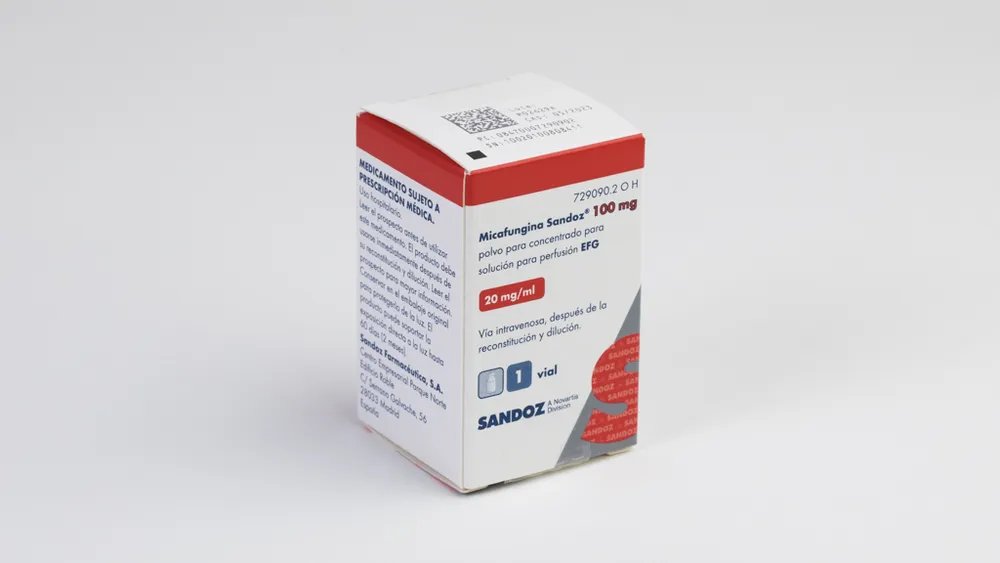
Table of Contents
- Package leaflet: Information for the user
- Introduction
- 1. What is Micafungin Sandoz and what is it used for?
- 2. What you need to know before using Micafungin Sandoz
- 3. How to use Micafungin Sandoz
- 4. Possible adverse effects
- 5. Storage of Micafungin Sandoz
- 6. Contents of the pack and other information
Package leaflet: Information for the user
Introduction
Package leaflet: information for the user
Micafungin Sandoz 50 mg powder for concentrate for solution for infusion EFG
Micafungin Sandoz 100 mg powder for concentrate for solution for infusion EFG
Read all of this leaflet carefully before you start using this medicine, because it contains important information for you.
- Keep this leaflet, as you may need to read it again.
- If you have any questions, ask your doctor or pharmacist.
- If you experience any side effects, talk to your doctor or pharmacist, even if they are side effects not listed in this leaflet. See section 4.
Leaflet contents
-
What Micafungin Sandoz is and what it is used for
-
What you need to know before using Micafungin Sandoz
-
How to use Micafungin Sandoz
-
Possible side effects
-
Storage of Micafungin Sandoz
-
Contents of the pack and other information
1. What is Micafungin Sandoz and what is it used for?
Micafungin Sandoz contains the active substance micafungin. Micafungin is an antifungal medicine used to treat infections caused by fungal cells.
This medicine is used to treat fungal infections caused by fungi or yeasts called Candida. Micafungin is effective in treating systemic infections (those that have spread throughout the body). It interferes with the production of a component of the fungal cell wall. Fungi require an intact cell wall to survive and grow. Micafungin causes defects to form in the fungal cell wall, thereby preventing the fungus from growing and surviving.
When no other antifungal treatment options are available, your doctor may prescribe micafungin under the following circumstances (see section 2):
- To treat a serious fungal infection in adults, adolescents, and children, including neonates, known as invasive candidiasis (an infection that has spread into the body).
- To treat adults and adolescents ≥ 16 years of age with a fungal infection of the oesophagus when intravenous treatment is appropriate.
- To prevent Candida infection in patients undergoing bone marrow transplantation or in patients expected to have neutropenia (low levels of neutrophils, a type of white blood cell) lasting for 10 days or more.
2. What you need to know before using Micafungin Sandoz
Do not use Micafungin Sandoz
- if you are allergic to micafungin, to other echinocandins (Cancidas or Ecalta), or to any of the other components of this medicine (listed in section 6).
Warnings and precautions

Talk to your doctor or pharmacist before using Micafungin Sandoz:
- if you are allergic to any medicine
- if you have hemolytic anemia (anemia caused by the breakdown of red blood cells) or hemolysis (breakdown of red blood cells).
- if you have kidney problems (renal failure or abnormal kidney function tests). In such cases, your doctor may decide to monitor your kidney function more closely.
Micafungin may also cause severe skin rash and inflammation of mucous membranes (Stevens-Johnson syndrome, toxic epidermal necrolysis).
Using Micafungin Sandoz with other medicines
Inform your doctor or pharmacist if you are taking, have recently taken, or might need to take any other medicines.
It is especially important to inform your doctor if you are taking amphotericin B deoxycholate or itraconazole (antifungal antibiotics), sirolimus (an immunosuppressant), or nifedipine (a calcium channel blocker used to treat high blood pressure). Your doctor may decide to adjust the dose of these medicines.
Using Micafungin Sandoz with food and drink
Since this medicine is administered intravenously (into the vein), there are no restrictions regarding food or drink.
Pregnancy and breastfeeding
If you are pregnant or breastfeeding, think you may be pregnant, or are planning to become pregnant, consult your doctor or pharmacist before using this medicine.
Micafungin should not be used during pregnancy unless strictly necessary. If you are taking micafungin, you must not breastfeed.
Driving and using machines
Micafungin is unlikely to affect your ability to drive or operate machinery. However, some people may feel dizzy when taking this medicine, and if this happens to you, you should not drive or use any machines or tools. Please inform your doctor if you experience any effect that could impair your ability to drive or use machinery.
Micafungin Sandoz contains sodium
This medicine contains less than 23 mg of sodium (1 mmol) per dose unit; hence, it is essentially “sodium-free”.
3. How to use Micafungin Sandoz
Micafungin Sandoz must be prepared and administered by a physician or other healthcare professional. Micafungin Sandoz must be given by slow intravenous infusion (into the vein) once daily. Your doctor will determine the daily dose of micafungin you will receive.
Use in adults, adolescents ≥ 16 years of age, and elderly patients
- The usual dose for the treatment of invasive Candida infection is 100 mg daily for patients weighing 40 kg or more and 2 mg/kg daily for patients weighing less than 40 kg.
- The dose for the treatment of esophageal Candida infection is 150 mg daily for patients weighing more than 40 kg and 3 mg/kg daily for patients weighing 40 kg or less.
- The usual dose for prevention of invasive Candida infections is 50 mg daily for patients weighing more than 40 kg and 1 mg/kg daily for patients weighing 40 kg or less.
Use in children > 4 months of age and adolescents < 16 years of age
- The usual dose for the treatment of invasive Candida infection is 100 mg daily for patients weighing 40 kg or more and 2 mg/kg daily for patients weighing less than 40 kg.
- The usual dose for prevention of invasive Candida infections is 50 mg daily for patients weighing more than 40 kg and 1 mg/kg daily for patients weighing 40 kg or less.
Use in children and newborns < 4 months of age
- The usual dose for the treatment of invasive Candida infection is 4 to 10 mg/kg daily.
- The usual dose for prevention of invasive Candida infections is 2 mg/kg daily.
If you receive more Micafungin Sandoz than you should
Your doctor will monitor your response and the status of your condition to determine the appropriate dose of Micafungin Sandoz. However, if you are concerned that you have received too much of this medicine, contact your doctor, another healthcare professional, or call the Toxicology Information Service immediately at telephone number 91 562 04 20, indicating the medication and the amount received.
If you miss your dose of Micafungin Sandoz
Your doctor will monitor your response and the status of your condition to determine the appropriate treatment with Micafungin Sandoz. However, if you are concerned that you have missed a dose, contact your doctor or another healthcare professional immediately.
If you have any further questions about the use of this medicine, ask your doctor or pharmacist.
4. Possible adverse effects
Like all medicines, this medicine can cause adverse effects, although not everyone will experience them.
If you experience an allergic reaction or a severe skin reaction (e.g., blistering and peeling of the skin), you must inform your doctor or nurse immediately.
Micafungin may cause the following adverse effects:
Frequent (may affect up to 1 in 10 people):
- abnormal blood test results (reduction in white blood cell count [leucopenia, neutropenia]), reduction in red blood cell count (anaemia),
- low potassium levels in blood (hypokalaemia), low magnesium levels in blood (hypomagnesaemia), low calcium levels in blood (hypocalcaemia),
- headache,
- inflammation of the vein wall (at the injection site),
- nausea (feeling unwell), vomiting, diarrhoea, abdominal pain,
- abnormal liver function tests (increased alkaline phosphatase, increased aspartate aminotransferase, increased alanine aminotransferase),
- increased bilirubin in blood (hyperbilirubinaemia),
- rash,
- fever,
- chills.
Uncommon (may affect up to 1 in 100 people):
- abnormal blood test results (reduction in blood cells [pancytopenia]), reduction in platelet count (thrombocytopenia), increase in a specific type of white blood cells called eosinophils, low albumin levels in blood (hypoalbuminaemia),
- hypersensitivity,
- increased sweating,
- low sodium levels in blood (hyponatraemia), high potassium levels in blood (hyperkalaemia), low phosphate levels in blood (hypophosphataemia), anorexia (eating disorder),
- insomnia (difficulty sleeping), anxiety, confusion,
- drowsiness, tremor, dizziness, altered sense of taste,
- increased heart rate, stronger heartbeat, irregular heartbeat,
- high or low blood pressure, skin redness,
- difficulty breathing,
- indigestion, constipation,
- liver failure, increased liver enzymes (gamma-glutamyl transferase), jaundice (yellowing of the skin or whites of the eyes due to liver or blood problems), reduced bile flow to the intestine (cholestasis), enlarged liver, liver inflammation,
- itchy rash (urticaria), pruritus, skin redness (erythema),
- abnormal kidney function tests (increased blood creatinine, increased blood urea), worsening of renal failure,
- increased levels of an enzyme called lactate dehydrogenase,
- blood clot formation at injection site, injection site inflammation, injection site pain, fluid accumulation in the body.
Rare (may affect up to 1 in 1,000 people):
- anaemia caused by breakdown of red blood cells (haemolytic anaemia), breakdown of red blood cells (haemolysis).
Not known (frequency cannot be estimated from available data):
- blood coagulation disorders,
- shock (allergic),
- liver cell damage including death,
- kidney abnormalities, acute renal failure.
Other adverse effects in children and adolescents
The following reactions have been reported more frequently in paediatric patients than in adults:
Frequent (may affect up to 1 in 10 people):
- reduced platelet count in blood (thrombocytopenia),
- increased heart rate (tachycardia),
- high or low blood pressure,
- increased bilirubin in blood (hyperbilirubinaemia), enlarged liver,
- acute renal failure, increased blood urea.
Reporting of adverse effects
If you experience any adverse effects, consult your doctor or pharmacist, even if they are possible adverse effects not listed in this leaflet. You may also report them directly via the Spanish Pharmacovigilance System for Human Medicines: https://www.notificaram.es. By reporting adverse effects, you can help provide more information on the safety of this medicine.
5. Storage of Micafungin Sandoz
Keep this medicine out of the sight and reach of children.
Do not use this medicine after the expiry date stated on the vial and packaging. The expiry date refers to the last day of the month indicated.
Store in the original packaging to protect from light. The product may withstand direct light exposure for up to 60 days (2 months).
The reconstituted concentrate and the diluted infusion solution must be used immediately, as they contain no preservatives to prevent bacterial contamination. Only a properly trained healthcare professional who has fully read and understood the instructions should prepare this medicine for use.
Do not use the diluted infusion solution if it appears cloudy or if a precipitate has formed.
To protect from light, the vial or infusion bag containing the diluted infusion solution should be placed in a sealed, opaque bag.
The vial is for single use only. Therefore, any unused reconstituted concentrate must be immediately discarded.
6. Contents of the pack and other information
Composition of Micafungin Sandoz
- The active substance is micafungin (as sodium salt). Each vial contains 50 mg or 100 mg of micafungin (as sodium salt).
- The other components are lactose monohydrate, anhydrous citric acid (for pH adjustment) and sodium hydroxide (for pH adjustment) (see section 2).
Appearance of the product and contents of the pack
Micafungin Sandoz 50 mg or 100 mg powder for concentrate for solution for infusion is a white to off-white lyophilized powder.
Micafungin Sandoz is supplied in a carton containing 1 clear glass vial (type I) of 10 ml with a grey isobutylene-isoprene rubber stopper and aluminium seal with a blue plastic flip-off cap for Micafungin Sandoz 50 mg and a red plastic flip-off cap for Micafungin Sandoz 100 mg. The vial is sealed with a protective film against UV rays.
Marketing Authorization Holder and Manufacturer
Marketing Authorization Holder
Sandoz Farmacéutica, S.A.
Centro Empresarial Parque Norte
Edificio Roble
C/ Serrano Galvache, 56
28033 Madrid
Spain
Manufacturer
BAG Health Care GmbH
Amtsgerichtsstrasse 1 - 5
35423 Lich, Hessen
Germany
or
Galenicum Health, S.L.U
Sant Gabriel, 50
Esplugues de Llobregat
08950 Barcelona
Spain
or
SAG MANUFACTURING, S.L.U.
Ctra. N-I, km 36
28750 San Agustín del Guadalix
Madrid – Spain
or
Lek Pharmaceuticals d.d.
Verovskova ulica 57
1526 Ljubljana
Slovenia
This medicinal product is authorized in the Member States of the European Economic Area under the following names:
Malta | Micafungin Sandoz |
Austria | Micafungin Sandoz 50 mg – Powder for concentrate for solution for infusion. Micafungin Sandoz 100 mg – Powder for concentrate for solution for infusion. |
Germany | Micafungin HEXAL 50 mg Powder for concentrate for solution for infusion. ENR: 2203965 Micafungin HEXAL 100 mg Powder for concentrate for solution for infusion. ENR: 2203966 |
Spain | Micafungin Sandoz 50 mg powder for concentrate for solution for infusion EFG Micafungin Sandoz 100 mg powder for concentrate for solution for infusion EFG |
Finland | Micafungin Sandoz 50 mg for infusion concentrate, for solution Micafungin Sandoz 100 mg for infusion concentrate, for solution |
Croatia | Micafungin Sandoz 50 mg powder for concentrate for infusion solution Micafungin Sandoz 100 mg powder for concentrate for infusion solution |
Poland | Micafungin Sandoz |
Sweden | Micafungin Sandoz 50 mg powder for concentrate for infusion solution, solution Micafungin Sandoz 100 mg powder for concentrate for infusion solution, solution |
Slovenia | Micafungin Sandoz 50 mg powder for concentrate for infusion solution Micafungin Sandoz 100 mg powder for concentrate for infusion solution |
Date of the most recent review of this summary: June 2020.
Other sources of information
Detailed and up-to-date information on this medicinal product is available on the website of the Spanish Agency of Medicines and Health Products (AEMPS) http://www.aemps.gob.es/
This information is intended for healthcare professionals only:
Instructions for use and handling (see also section 3. How to use Micafungina Sandoz)
Micafungina Sandoz is reconstituted and diluted as follows:
- Remove the plastic cap from the vial and disinfect the stopper with alcohol.
- Slowly and aseptically inject 5 ml of sodium chloride 9 mg/ml (0.9%) solution for infusion or glucose 50 mg/ml (5%) solution for infusion (taken from a 100 ml bottle/bag) into each vial, directing the stream along the inner wall. Although foaming may occur with the concentrate, care should be taken to minimize foam formation. Reconstitute a sufficient number of micafungin vials to obtain the required dose in mg (see table below).
- Gently rotate the vial. DO NOT SHAKE. The powder will dissolve completely. The concentrate should be used immediately. The vial is for single use only. Therefore, any unused reconstituted concentrate must be discarded immediately.
- Withdraw all of the reconstituted concentrate from each vial and return it to the infusion bottle/bag from which the diluent was originally taken. The diluted solution for infusion should be used immediately. Chemical and physical in-use stability has been demonstrated for 24 hours when stored at 25 °C, provided it is protected from light and the dilution has been performed as described above.
- Carefully invert the infusion bottle/bag to disperse the diluted solution, but DO NOT SHAKE, to avoid foam formation. The solution should not be used if it is cloudy or if a precipitate has formed.
- The infusion bottle/bag containing the diluted solution should be placed in an opaque sealed bag to protect it from light.
Preparation of the infusion solution
Dose (mg) | Micafungin vial to use (mg/vial) | Volume of sodium chloride 9 mg/ml (0.9%) or glucose 50 mg/ml (5%) added per vial | Volume (concentration) of reconstituted powder | Standard infusion (diluted to 100 ml) Final concentration |
50 | 1 x 50 | 5 ml | Approx. 5 ml (10 mg/ml) | 0.5 mg/ml |
100 | 1 x 100 | 5 ml | Approx. 5 ml (20 mg/ml) | 1.0 mg/ml |
150 | 1 x 100 + 1 x 50 | 5 ml | Approx. 10 ml | 1.5 mg/ml |
200 | 2 x 100 | 5 ml | Approx. 10 ml | 2.0 mg/ml |