Irbesartan/hydrochlorothiazide Stada 300 mg/25 mg film-coated tablets EFG
Spain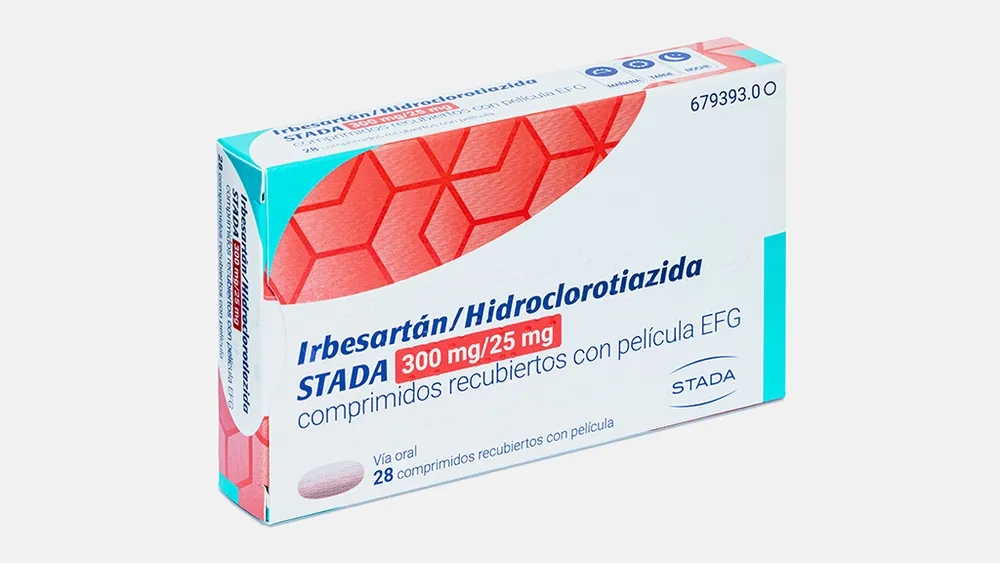
Table of Contents
- Package leaflet: Information for the user
- Introduction
- 1. What is Irbesartán/Hidroclorotiazida Stada and what is it used for?
- 2. What you need to know before taking Irbesartán/Hidroclorotiazida Stada
- 3. How to take Irbesartan/Hydrochlorothiazide Stada
- 4. Possible adverse effects
- 5. Storage of Irbesartan/Hydrochlorothiazide Stada
- 6. Package contents and other information
Package leaflet: Information for the user
Introduction
Package leaflet: information for the patient
Irbesartan/Hydrochlorothiazide Stada 150 mg/12.5 mg film-coated tablets EFG
Irbesartan/Hydrochlorothiazide Stada 300 mg/12.5 mg film-coated tablets EFG
Irbesartan/Hydrochlorothiazide Stada 300 mg/25 mg film-coated tablets EFG
Read the entire leaflet carefully before you start taking this medicine because it contains important information for you.
-
Keep this leaflet. You may need to read it again.
-
If you have any questions, ask your doctor or pharmacist.
-
This medicine has been prescribed for you only and must not be given to other people, even if they have the same symptoms as you, because it could be harmful to them.
-
If you experience any adverse effects, consult your doctor or pharmacist, even if they are adverse effects not listed in this leaflet. See section 4.
Leaflet contents:
-
What Irbesartan/Hydrochlorothiazide Stada is and what it is used for
-
What you need to know before taking Irbesartan/Hydrochlorothiazide Stada
-
How to take Irbesartan/Hydrochlorothiazide Stada
-
Possible side effects
-
How to store Irbesartan/Hydrochlorothiazide Stada
-
Contents of the pack and other information
1. What is Irbesartán/Hidroclorotiazida Stada and what is it used for?
Irbesartán/Hidroclorotiazida Stada is a combination of two active substances, irbesartan and hydrochlorothiazide. Irbesartan belongs to a group of medicines known as angiotensin-II receptor antagonists. Angiotensin-II is a substance produced in the body that binds to receptors in blood vessels, causing them to constrict. This leads to an increase in blood pressure. Irbesartan blocks angiotensin-II from binding to these receptors, relaxing blood vessels and thereby lowering blood pressure. Hydrochlorothiazide belongs to a group of medicines (called thiazide diuretics) that reduce blood pressure by increasing the amount of urine produced.
The two active substances in this medicine work together to achieve a greater reduction in blood pressure than either of them alone.
Irbesartán/hydrochlorothiazide is used to treat high blood pressure when treatment with irbesartan alone or hydrochlorothiazide alone does not provide adequate control of your blood pressure.
2. What you need to know before taking Irbesartán/Hidroclorotiazida Stada
DO NOT take Irbesartán/Hidroclorotiazida Stada
-
if you are allergic to irbesartan or to any of the other ingredients of this medicine (listed in section 6).
-
if you are allergic to hydrochlorothiazide or to any other sulfonamide-derived medicine
-
if you are more than 3 months pregnant. (In any case, it is better to avoid taking this medicine also during early pregnancy – see Pregnancy section)
-
if you have severe liver or kidney problems
-
if you have difficulty urinating
-
if your doctor finds that you have persistently high calcium levels or low potassium levels in your blood
-
if you have diabetes or renal insufficiency and are being treated with an antihypertensive medicine containing aliskiren
Warnings and precautions
Talk to your doctor before starting treatment with Irbesartán/Hidroclorotiazida if any of the following apply to you:
-
if you have excessive vomiting or diarrhea
-
if you have kidney problems or have had a kidney transplant
-
if you have heart problems
-
if you have liver problems
-
if you have diabetes
-
if you have low blood sugar levels (symptoms may include sweating, weakness, hunger, dizziness, trembling, headache, flushing or paleness, numbness, rapid and strong heartbeat), especially if you are being treated for diabetes
-
if you have systemic lupus erythematosus (also known as lupus or SLE)
-
if you have primary aldosteronism (a condition related to excessive production of the hormone aldosterone, which causes sodium retention and, in turn, increased blood pressure).
-
if you are taking any of the following medicines used to treat high blood pressure:
-
an angiotensin-converting enzyme (ACE) inhibitor (e.g. enalapril, lisinopril, ramipril), particularly if you have kidney problems related to diabetes
-
aliskiren
-
if you have had skin cancer or develop an unexpected skin lesion during treatment. Treatment with hydrochlorothiazide, particularly long-term use at high doses, may increase the risk of certain types of non-melanoma skin cancer and lip cancer. Protect your skin from sun exposure and UV radiation while taking irbesartan/hydrochlorothiazide.
-
if you have previously experienced breathing or lung problems (such as inflammation or fluid in the lungs) after taking hydrochlorothiazide. If you develop shortness of breath or severe difficulty breathing after taking irbesartan/hydrochlorotiazida, seek medical attention immediately.
Your doctor may monitor your kidney function, blood pressure, and blood electrolyte levels (e.g. potassium) at regular intervals.
See also the information under the heading “DO NOT take Irbesartán/Hidroclorotiazida Stada”.
If you think you are pregnant (or might be), you should inform your doctor. Use of irbesartan/hydrochlorothiazide is not recommended during early pregnancy, and under no circumstances should it be used after the third month of pregnancy, as it may cause serious harm to your baby if used at this stage (see Pregnancy section).
You should also inform your doctor:
-
if you are on a low-salt diet
-
if you experience any of the following signs: feeling thirsty, dry mouth, general weakness, drowsiness, muscle pain or cramps, nausea, vomiting, or rapid heartbeat, as these may indicate an excessive effect of hydrochlorothiazide (contained in irbesartan/hydrochlorothiazide)
-
if you experience increased skin sensitivity to sunlight with symptoms of sunburn (such as redness, itching, swelling, blisters) occurring more quickly than usual
-
if you are going to have surgery (a surgical procedure) or will receive anesthetics.
-
if you experience vision loss or eye pain in one or both eyes while taking irbesartan/hydrochlorothiazida. These could be symptoms of fluid accumulation in the vascular layer of the eye (choroidal effusion) or increased eye pressure (glaucoma), which may occur within hours to weeks after taking irbesartan/hydrochlorothiazida. This may lead to permanent vision loss if not treated. If you previously had an allergy to penicillin or sulfonamides, you may have a higher risk of developing this condition. You should stop taking irbesartan/hydrochlorothiazida and seek immediate medical attention.
Consult your doctor if you experience abdominal pain, nausea, vomiting, or diarrhea after taking irbesartan/hydrochlorothiazida. Your doctor will decide whether to continue treatment. Do not stop taking irbesartan/hydrochlorothiazida on your own.
Doping tests: The hydrochlorothiazide contained in this medicine may lead to positive results in doping controls.
Use in children and adolescents
Irbesartán/hidroclorotiazida must not be given to children and adolescents (under 18 years of age).
Other medicines and Irbesartán/Hidroclorotiazida Stada
Tell your doctor or pharmacist if you are taking, have recently taken, or might need to take any other medicines.
Diuretics such as hydrochlorothiazide contained in irbesartan/hydrochlorothiazide may interact with other medicines. You must not take preparations containing lithium together with irbesartan/hydrochlorothiazide without medical supervision.
Your doctor may need to adjust your dose and/or take other precautions:
If you are taking an angiotensin-converting enzyme (ACE) inhibitor or aliskiren (see also information under the headings "DO NOT take Irbesartán/Hidroclorotiazida Stada" and "Warnings and precautions").
You may need blood tests if you are taking:
-
potassium supplements
-
salt substitutes containing potassium
-
potassium-sparing medicines or other diuretics (tablets that increase urine production)
-
certain laxatives
-
medicines used to treat gout
-
vitamin D supplements
-
medicines to control heart rhythm
-
medicines for diabetes (oral agents such as repaglinide or insulin)
-
carbamazepine (a medicine used to treat epilepsy)
It is also important to inform your doctor if you are taking other medicines to lower your blood pressure, steroids, cancer treatments, painkillers, medicines for arthritis, or cholestyramine or colestipol resins to reduce blood cholesterol.
Taking Irbesartán/Hidroclorotiazida Stada with food and drink
Irbesartán/hidroclorotiazida can be taken with or without food.
Due to the hydrochlorothiazide contained in irbesartán/hidroclorotiazida, drinking alcohol during treatment with this medicine may increase the likelihood of dizziness upon standing, especially when rising from a sitting position.
Pregnancy, breast-feeding and fertility
Pregnancy
If you think you are pregnant (or might be), you must inform your doctor. Generally, your doctor will advise you to stop taking irbesartán/hidroclorotiazida before becoming pregnant or as soon as you become pregnant, and will recommend an alternative medicine. Irbesartán/hidroclorotiazida is not recommended during early pregnancy and must not be used from the third month of pregnancy onwards, as it may cause serious harm to your baby if used from that stage.
Breast-feeding
Inform your doctor if you are planning to start or are currently breast-feeding. Irbesartán/hidroclorotiazida is not recommended for breastfeeding mothers, and your doctor may decide to prescribe a different treatment that is more suitable if you wish to breast-feed, especially if your baby is a newborn or was born prematurely.
Driving and using machines
It is unlikely that irbesartán/hidroclorotiazida will affect your ability to drive or operate machinery. However, during treatment for high blood pressure, dizziness or fatigue may occasionally occur. If you experience these symptoms, talk to your doctor before driving or using machines.
Irbesartán/Hidroclorotiazida Stada contains lactose and sodium.
If your doctor has told you that you have an intolerance to certain sugars (e.g. lactose), consult your doctor before taking this medicine.
This medicine contains less than 1 mmol of sodium (23 mg) per tablet; therefore, it is essentially “sodium-free”.
3. How to take Irbesartan/Hydrochlorothiazide Stada
Follow exactly the instructions for use of this medicine provided by your doctor. If in doubt, consult your doctor or pharmacist again.
Dosage
Irbesartan/Hydrochlorothiazide Stada 150 mg/12.5 mg film-coated tablets EFG
The recommended dose of irbesartan/hydrochlorothiazide is one or two tablets per day. Generally, your doctor will prescribe irbesartan/hydrochlorothiazide when previous treatments have not sufficiently lowered your blood pressure. Your doctor will advise you on how to switch from previous treatments to irbesartan/hydrochlorothiazide.
Irbesartan/Hydrochlorothiazide Stada 300 mg/12.5 mg film-coated tablets EFG and Irbesartan/Hydrochlorothiazide Stada 300 mg/25 mg film-coated tablets EFG
The recommended dose of irbesartan/hydrochlorothiazide is one tablet per day. Generally, your doctor will prescribe irbesartan/hydrochlorothiazide when previous treatments have not sufficiently lowered your blood pressure. Your doctor will advise you on how to switch from previous treatments to irbesartan/hydrochlorothiazide.
Method of administration
This medicine is administered orally. The tablets should be swallowed with sufficient liquid (e.g. a glass of water). You may take irbesartan/hydrochlorothiazide with or without food. You should try to take your daily dose at the same time each day. It is important that you continue taking irbesartan/hydrochlorothiazide until your doctor advises otherwise.
Maximum blood pressure-lowering effect should be achieved within 6–8 weeks after starting treatment.
If you take more Irbesartan/Hydrochlorothiazide Stada than you should
If you accidentally take too many tablets, consult your doctor or pharmacist immediately, go to a healthcare center, or call the Toxicology Information Service at 91 5620420, indicating the medicine and the amount ingested. It is recommended to bring the medicine packaging and leaflet.
Children must not take Irbesartan/Hydrochlorothiazide Stada
Irbesartan/hydrochlorothiazide must not be given to children under 18 years of age. If a child swallows any tablets, contact your doctor immediately.
If you forget to take Irbesartan/Hydrochlorothiazide Stada
If you accidentally miss a dose, simply take your usual dose at the next scheduled time. Do not take a double dose to make up for missed doses.
If you have any further questions about the use of this medicine, ask your doctor or pharmacist.
4. Possible adverse effects
Like all medicines, this medicine can cause adverse effects, although not everyone will experience them.
Some of these effects may be serious and may require medical attention.
Rarely, cases of skin allergic reactions (rash, urticaria) have been reported in patients treated with irbesartan, as well as localized swelling of the face, lips and/or tongue.
Very rare (may affect up to 1 in 10,000 people): acute breathing difficulty (signs include severe shortness of breath, fever, weakness, and confusion).
If you experience any of the above symptoms or develop shortness of breath, stop taking irbesartan/hydrochlorothiazide and contact your doctor immediately.
Adverse effects reported in clinical studies for patients treated with the combination of irbesartan and hydrochlorothiazide were:
Frequent adverse effects (may affect up to 1 in 10 people):
- nausea/vomiting
- urinary abnormalities
- fatigue
- dizziness (including dizziness upon standing up from a lying or sitting position)
- blood tests may show elevated levels of an enzyme that measures muscle and heart function (creatine kinase) or elevated levels of substances that measure kidney function (blood urea nitrogen, creatinine).
If any of these adverse effects cause you problems, consult your doctor.
Uncommon adverse effects (may affect up to 1 in 100 people):
- diarrhoea
- low blood pressure
- fainting
- tachycardia
- hot flushes
- swelling
- sexual dysfunction (alterations in sexual function)
- blood tests may show low levels of sodium and potassium in your blood.
If any of these adverse effects cause you problems, consult your doctor.
Adverse effects reported since marketing of the irbesartan/hydrochlorothiazide combination
Some undesirable effects have been reported since the marketing of irbesartan/hydrochlorothiazide. Adverse reactions with unknown frequency include: headache, tinnitus, cough, taste disturbance, indigestion, joint and muscle pain, abnormal liver function, kidney function problems, elevated potassium levels in your blood, and allergic reactions such as rash, urticaria, swelling of the face, lips, mouth, tongue or throat. Rare cases of jaundice (yellowing of the skin and/or whites of the eyes) have also been reported.
As with all fixed combinations of two active substances, adverse effects associated with each individual component cannot be excluded.
Adverse effects associated solely with irbesartan
In addition to the adverse effects described above, chest pain, severe allergic reactions (anaphylactic shock), reduced number of red blood cells (anaemia – symptoms may include tiredness, headaches, shortness of breath during exercise, dizziness and paleness), reduced number of platelets (a blood cell essential for blood clotting), and low blood sugar levels have also been observed.
Rare adverse effects (may affect up to 1 in 1,000 people):
- intestinal angioedema: swelling in the intestine presenting symptoms such as abdominal pain, nausea, vomiting and diarrhoea
Adverse effects associated with hydrochlorothiazide in monotherapy
Loss of appetite; stomach irritation; stomach cramps; constipation; jaundice (yellowing of the skin and/or whites of the eyes); inflammation of the pancreas characterized by severe upper stomach pain, often with nausea and vomiting; sleep disorders; depression; blurred vision; lack of white blood cells, which may lead to frequent infections and fever; reduced number of platelets (blood cells essential for blood clotting), reduced number of red blood cells (anaemia) characterized by tiredness, headaches, shortness of breath during exercise, dizziness and paleness; kidney disease; lung disorders including pneumonia or fluid accumulation in the lungs; increased skin sensitivity to sunlight; inflammation of blood vessels; a skin disease characterized by peeling of the skin all over the body; cutaneous lupus erythematosus, identified by a rash that may appear on the face, neck and scalp; allergic reactions; muscle weakness and spasms; irregular heartbeat; drop in blood pressure after a change in body position; swelling of the salivary glands; high blood sugar levels; sugar in the urine; increases in certain types of blood fats; high levels of uric acid in the blood, which may cause gout.
Frequency not known (cannot be estimated from available data): skin and lip cancer (non-melanoma skin cancer), decreased vision or eye pain due to increased pressure (possible signs of fluid accumulation in the vascular layer of the eye (choroidal effusion) or acute angle-closure glaucoma).
It is known that adverse effects associated with hydrochlorothiazide may increase with higher doses of hydrochlorothiazide.
Reporting of adverse effects
If you experience any type of adverse effect, talk to your doctor or pharmacist, even if it is a possible adverse effect not listed in this leaflet. You can also report them through the Spanish Pharmacovigilance System for Human Medicines: https://www.notificaram.es. By reporting adverse effects, you can help provide more information on the safety of this medicine.
5. Storage of Irbesartan/Hydrochlorothiazide Stada
Keep this medicine out of the sight and reach of children.
Do not use this medicine after the expiry date stated on the carton and blister after EXP. The expiry date refers to the last day of the month indicated.
Do not store above 30°C.
Medicines should not be disposed of via wastewater or household waste. Dispose of unused medicines and their containers at the SIGRE collection point at your pharmacy. Ask your pharmacist how to properly dispose of medicines and packaging you no longer need. This will help protect the environment.
6. Package contents and other information
Composition of Irbesartan/Hydrochlorothiazide Stada
- The active substances are irbesartan and hydrochlorothiazide.
Irbesartan/Hydrochlorothiazide Stada 150 mg/12.5 mg film-coated tablets EFG
Each film-coated tablet contains 150 mg of irbesartan and 12.5 mg of hydrochlorothiazide.
Irbesartan/Hydrochlorothiazide Stada 300 mg/12.5 mg film-coated tablets EFG
Each film-coated tablet contains 300 mg of irbesartan and 12.5 mg of hydrochlorothiazide.
Irbesartan/Hydrochlorothiazide Stada 300 mg/25 mg film-coated tablets EFG
Each film-coated tablet contains 300 mg of irbesartan and 25 mg of hydrochlorothiazide.
- The other components are monohydrate lactose, pregelatinized corn starch, copovidone, sodium croscarmellose (E468), colloidal anhydrous silica (E551), magnesium stearate (E470b), hypromellose (E464), titanium dioxide (E171), talc, macrogol 8000, yellow iron oxide (E172), red iron oxide (E172) and black iron oxide (E172).
Appearance of the product and contents of the pack
Irbesartan/Hydrochlorothiazide Stada film-coated tablets are pink, oblong and biconvex tablets.
Irbesartan/Hydrochlorothiazide Stada 150 mg/12.5 mg
Pack sizes of 7, 10, 14, 28, 30, 50, 56, 90, 98 and 100 film-coated tablets.
Irbesartan/Hydrochlorothiazide Stada 300 mg/12.5 mg and Irbesartan/Hydrochlorothiazide Stada 300 mg/25 mg
Pack sizes of 7, 10, 14, 28, 30, 50, 56, 90, 98, 100, 126 and 154 film-coated tablets.
Only some pack sizes may be commercially available.
Marketing Authorization Holder and Manufacturer
Marketing Authorization Holder
Laboratorio STADA, S.L.
Frederic Mompou, 5
08960 Sant Just Desvern
(Barcelona) Spain
Manufacturer
STADA Arzneimittel AG,
Stadastr. 2-18,
D-61118 Bad Vilbel,
Germany
or
Centrafarm Services B.V.
Van de Reijtstraat 31-E
4814 NE Breda
The Netherlands
or
STADA M&D SRL
Str. Trascaului nr. 10,
Municipiul Turda,
Judet Cluj 401135,
Romania
This medicinal product is authorized in the Member States of the European Economic Area under the following names:
Germany: Irbesartan/HCT STADA 150 mg/12.5 mg; 300 mg/12.5 mg; 300 mg/25 mg Filmtabletten
Belgium: Irbesartan/HCT EG 150 mg/12.5 mg; 300 mg/12.5 mg; 300 mg/25 mg filmomhulde tabletten
Denmark: Irbesartan/Hydrochlorthiazid STADA 150 mg/12.5 mg; 300 mg/12.5 mg; 300 mg/25 mg filmovertrukne tabletter
Spain: Irbesartán/Hidroclorotiazida STADA 150 mg/12.5 mg; 300 mg/12.5 mg; 300 mg/25 mg comprimidos recubiertos con película EFG
France: Irbesartan/Hydrochlorothiazide EG 150 mg/12.5 mg; 300 mg/12.5 mg; 300 mg/25 mg comprimé pelliculé
Luxembourg: Irbesartan/HCT EG 150 mg/12.5 mg; 300 mg/12.5 mg; 300 mg/25 mg comprimés pelliculés
The Netherlands: Irbesartan/Hydrochlorothiazide STADA 150 mg/12.5 mg; 300 mg/12.5 mg; 300 mg/25 mg filmomhulde tabletten
Portugal: Irbesartan + Hidroclorotiazida STADA
Sweden: Irbesartan/Hydrochlorothiazid STADA 150 mg/12.5 mg; 300 mg/12.5 mg; 300 mg/25 mg filmdragerade tabletter
Date of the most recent review of this leaflet: February 2025
Detailed information on this medicinal product is available on the website of the Spanish Agency of Medicines and Health Products (AEMPS) http://www.aemps.gob.es/