Feoxan 400 mg tablets EFG
Spain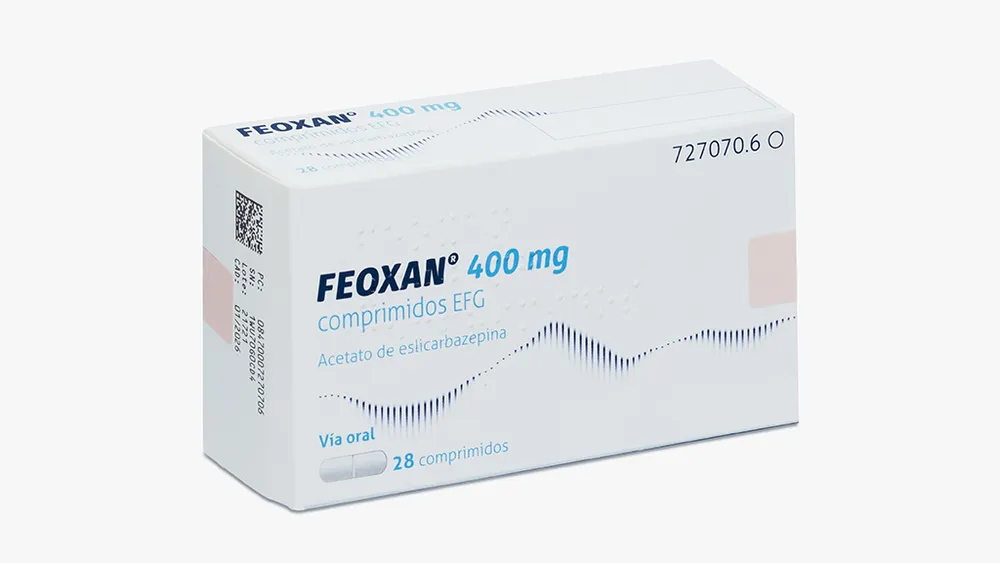
Table of Contents
Patient Information Leaflet
Introduction
Patient Information Leaflet
Feoxan 200 mg tablets EFG
Feoxan 400 mg tablets EFG
Feoxan 800 mg tablets EFG
eslicarbazepine acetate
Read the entire leaflet carefully before you start taking this medicine, as it contains important information for you.
- Keep this leaflet as you may need to read it again.
- If you have any questions, ask your doctor or pharmacist.
- This medicine has been prescribed for you only and must not be given to other people, even if they have the same symptoms as you, since it may harm them.
- If you experience any adverse effects, consult your doctor or pharmacist, even if they are adverse effects not listed in this leaflet. See section 4.
Leaflet Contents:
- What Feoxan is and what it is used for
- What you need to know before taking Feoxan
- How to take Feoxan
- Possible side effects
- How to store Feoxan
- Contents of the pack and other information
1. What Feoxan is and what it is used for
Feoxan contains the active substance eslicarbazepine acetate.
Eslicarbazepine belongs to a group of medicines called antiepileptics, used to treat epilepsy, a condition in which affected individuals experience repeated seizures or convulsions.
Eslicarbazepine is used:
- as a single medication (monotherapy) in adult patients with newly diagnosed epilepsy;
- together with other antiepileptic medicines (adjunctive therapy) in adult, adolescent, and pediatric patients over 6 years of age who experience seizures (convulsions) originating in one part of the brain (partial seizures). These seizures may or may not be followed by a seizure affecting the entire brain (secondary generalization).
Your doctor has prescribed eslicarbazepine to reduce the number of seizures.
2. What you need to know before taking Feoxan
Do not take Feoxan:
- if you are allergic to eslicarbazepine acetate, to other carboxamide derivatives (e.g. carbamazepine or oxcarbazepine, medicines used to treat epilepsy), or to any of the other ingredients of this medicine (listed in section 6);
- if you have a certain type of heart rhythm disorder (second- or third-degree atrioventricular (AV) block).
Warnings and precautions
Talk to your doctor or pharmacist before starting eslicarbazepine.
Tell your doctor immediately:
- if you develop blisters or peeling of the skin and/or mucous membranes, rash, difficulty swallowing or breathing, or swelling of the lips, face, eyelids, throat, or tongue. These could be signs of an allergic reaction;
- if you experience confusion, worsening of seizures, or decreased level of consciousness, which could be signs of low blood levels of salts.
Tell your doctor:
- if you have kidney problems. Your doctor may need to adjust your dose. Eslicarbazepine is not recommended in patients with severe renal impairment;
- if you have liver problems. Eslicarbazepine is not recommended in patients with severe hepatic impairment;
- if you are taking any medicine that may cause an abnormality in the ECG (electrocardiogram) called PR interval prolongation. If you are unsure whether your medicines may cause this effect, discuss it with your doctor;
- if you have heart disease such as heart failure or heart attack, or any heart rhythm disorders;
- if you have seizures that begin with a widespread electrical discharge affecting both sides of the brain.
A small number of people taking antiepileptic medicines have had suicidal thoughts or thoughts about self-harm. If this happens to you while taking eslicarbazepine, contact your doctor immediately.
Eslicarbazepine may cause dizziness and/or drowsiness, especially at the beginning of treatment. Take special care while taking eslicarbazepine to avoid accidental injury, such as falls.
Use special caution with eslicarbazepine.
In post-marketing experience, serious and potentially life-threatening skin reactions have been reported in patients treated with eslicarbazepine, including Stevens-Johnson syndrome/toxic epidermal necrolysis, and drug reaction with eosinophilia and systemic symptoms (DRESS).
If you develop a severe rash or other skin symptoms (see section 4), stop taking eslicarbazepine and consult your doctor or seek immediate medical attention.
In patients of Thai and Han Chinese ethnic origin, the risk of severe skin reactions associated with carbamazepine or chemically related compounds can be predicted by a blood test. Your doctor may advise you on whether such a blood test is necessary before starting eslicarbazepine.
Children
Eslicarbazepine must not be given to children aged 6 years or younger.
Taking Feoxan with other medicines
Tell your doctor or pharmacist if you are taking, have recently taken, or might need to take any other medicines. This is important because some medicines may interfere with how eslicarbazepine works, or eslicarbazepine may interfere with the effect of other medicines. Inform your doctor if you are taking:
- phenytoin (a medicine used to treat epilepsy), as dose adjustment may be required;
- carbamazepine (a medicine used to treat epilepsy), as your dose may need to be adjusted, and the following side effects of eslicarbazepine may occur more frequently: double vision, abnormal coordination, and dizziness;
- hormonal contraceptives (such as the contraceptive pill), as eslicarbazepine may reduce their effectiveness;
- simvastatin (a medicine used to lower cholesterol levels), as your dose may need to be adjusted;
- rosuvastatin, a medicine used to lower cholesterol levels;
- the anticoagulant warfarin;
- monoamine oxidase inhibitor (MAOI) antidepressants;
- do not take oxcarbazepine (a medicine used to treat epilepsy) together with eslicarbazepine, as it is unknown whether it is safe to take these two medicines together.
See the section “Pregnancy and breastfeeding” for recommendations on contraception.
Pregnancy and breastfeeding
The use of eslicarbazepine acetate is not recommended if you are pregnant, as the effects of eslicarbazepine acetate on pregnancy and the unborn child are unknown.
If you are planning a pregnancy, talk to your doctor before stopping contraception and before becoming pregnant. Your doctor may decide to change your treatment.
There is limited data on the use of eslicarbazepine acetate in pregnant women.
Studies have shown an increased risk of congenital malformations and neurological development problems (brain development) in children of women taking antiepileptic medicines, particularly when more than one antiepileptic medicine is taken at the same time.
If you are pregnant or think you might be pregnant, inform your doctor immediately. You must not stop taking your medicine without first discussing it with your doctor. Stopping your medication without medical advice may cause seizures, which could be dangerous for you and your unborn child. Your doctor may decide to change your treatment.
If you are a woman of childbearing potential and are not planning to become pregnant, you must use an effective method of contraception during treatment with eslicarbazepine acetate. Eslicarbazepine acetate may affect the effectiveness of hormonal contraceptives, such as the contraceptive pill, making them less effective at preventing pregnancy. Therefore, you are advised to use other safe and effective forms of contraception while taking eslicarbazepine. Talk to your doctor, who will discuss with you the most appropriate type of contraception to use while taking eslicarbazepine acetate. If treatment with eslicarbazepine acetate is discontinued, you should continue using an effective method of contraception until the end of the current menstrual cycle. If you take eslicarbazepine acetate during pregnancy, your baby may also be at risk of bleeding problems immediately after birth. Your doctor may give you and your baby a medicine to prevent this.
Do not breast-feed while taking eslicarbazepine acetate. It is unknown whether it passes into breast milk.
Driving and using machines
Eslicarbazepine may cause dizziness, drowsiness, and affect your vision, especially at the beginning of treatment. If this occurs, do not drive or operate any tools or machinery.
3. How to take Feoxan
Follow exactly the instructions for using this medicine as given by your doctor. If you are unsure, consult your doctor or pharmacist again.
Adults
Starting dose
400 mg once daily for one or two weeks before increasing to the maintenance dose. Your doctor will decide whether you should take this dose for one or two weeks.
Maintenance dose
The usual maintenance dose is 800 mg once daily.
Depending on your response to eslicarbazepine, the dose may be increased to 1,200 mg once daily. If you are taking eslicarbazepine alone (monotherapy), your doctor may consider increasing your dose to 1,600 mg once daily.
Patients with renal problems
If you have kidney problems, you are generally given a lower dose of eslicarbazepine. Your doctor will determine the correct dose for you. Eslicarbazepine is not recommended if you have severe kidney problems.
Elderly patients (over 65 years of age)
If you are an elderly person and are taking eslicarbazepine as monotherapy, the 1,600 mg dose is not suitable for you.
Children over 6 years of age
Starting dose
The starting dose is 10 mg per kg of body weight once daily for one or two weeks, before increasing to the maintenance dose.
Maintenance dose
Depending on the response to eslicarbazepine, the dose may be increased by 10 mg per kg of body weight at intervals of one or two weeks, up to a maximum of 30 mg per kg of body weight. The maximum dose is 1,200 mg once daily.
Children ≥ 60 kg
Children with a body weight of 60 kg or more should take the same dose as adults.
The oral suspension, another pharmaceutical form of the medicine, may be more suitable for administration in children. Please consult your doctor or pharmacist.
Method and route of administration
Eslicarbazepine is administered orally. Swallow the tablet with a glass of water. Eslicarbazepine may be taken with or without food.
If you take more Feoxan than you should
If you accidentally take more eslicarbazepine than you should, you may be at risk of having more seizures; or you may feel that your heartbeat is irregular or faster. Contact your doctor or go immediately to a hospital if you experience any of these symptoms. Take the medicine package with you so the doctor knows what you have taken.
In case of overdose or accidental ingestion, contact your doctor or pharmacist immediately or call the Toxicology Information Service at telephone number: 91 562 04 20, indicating the medicine and the amount ingested.
If you forget to take Feoxan
If you forget to take a tablet, take it as soon as you remember and continue as usual. Do not take a double dose to make up for forgotten doses.
If you stop taking Feoxan
Do not suddenly stop taking the tablets. If you do, you may be at risk of having more seizures. Your doctor will decide for how long you should take eslicarbazepine. If your doctor decides to discontinue treatment with eslicarbazepine, your dose will usually be gradually reduced. It is important that you complete the treatment as instructed by your doctor; otherwise, your symptoms may worsen.
If you have any further questions about the use of this medicine, ask your doctor or pharmacist.
4. Possible adverse effects
Like all medicines, this medicine can cause adverse effects, although not everyone will experience them.
The following adverse effects may be very serious. If they occur, stop taking eslicarbazepine and contact a doctor or go to a hospital immediately, as you may require urgent medical treatment:
- blistering or peeling of the skin and/or mucous membranes, rash, difficulty swallowing or breathing, swelling of the lips, face, eyelids, throat or tongue. These could be signs of an allergic reaction.
The very common adverse effects (may affect more than 1 in 10 people) are:
- dizziness or drowsiness
The common adverse effects (may affect up to 1 in 10 people) are:
- feeling unsteady, or of spinning or floating
- nausea or vomiting
- headache
- diarrhoea
- double or blurred vision
- difficulty concentrating
- feeling tired or lack of energy
- tremor
- skin rash
- blood tests showing low sodium levels
- decreased appetite
- difficulty sleeping
- difficulty coordinating movements (ataxia)
- weight gain
The uncommon adverse effects (may affect up to 1 in 100 people) are:
- clumsiness in movements
- allergy
- constipation
- seizures
- underactive thyroid gland. Symptoms include reduced levels of thyroid hormones (detected in blood tests), intolerance to cold, enlarged tongue, brittle nails or hair, and low body temperature
- liver problems (such as increased liver enzymes)
- high blood pressure or a marked increase in blood pressure
- low blood pressure, or reduced blood pressure upon standing
- blood tests showing low levels of salts (including chloride), or a reduction in the number of red blood cells
- dehydration
- changes in eye movements, blurred vision or red eyes
- falls
- thermal burns
- memory problems or forgetfulness
- crying, feeling depressed, nervousness or confusion, lack of interest or emotions
- inability to speak, write, or understand spoken or written language
- agitation
- attention deficit/hyperactivity
- irritability
- mood changes or hallucinations
- difficulty speaking
- nosebleeds
- chest pain
- tingling or numbness in any part of the body
- migraine
- burning sensation
- abnormal sensation to touch
- changes in sense of smell
- ringing in the ears
- difficulty hearing
- swelling of arms and legs
- heartburn, stomach discomfort, abdominal pain, bloating and abdominal discomfort or dry mouth
- black stools
- swollen gums or toothache
- sweating or dry skin
- itching
- skin changes (e.g. skin redness)
- hair loss
- urinary tract infection
- general malaise, weakness or chills
- weight loss
- muscle pain, limb pain, muscle weakness
- bone metabolism disorder
- increased bone proteins
- flushing, cold extremities
- slower or irregular heartbeat
- extreme drowsiness
- sedation
- motor neurological disorder where muscles contract, causing twisting movements, repetitive movements or abnormal postures. Symptoms include tremors, pain and cramps
- drug toxicity
- anxiety
Adverse effects with unknown frequency (cannot be estimated from available data) are:
-
Lethargy, confusion, muscle spasms or a significant worsening of seizures (possible symptoms of low sodium levels in the blood due to inappropriate antidiuretic hormone (ADH) secretion).
- Reduction in platelets, increasing the risk of bleeding or bruising.
-
Severe back or stomach pain (caused by inflammation of the pancreas).
-
Reduction in white blood cells, making infections more likely.
-
Red spots or circular lesions, often with central blisters on the trunk, skin peeling, mouth, throat, nose, genital or eye ulcers, red and inflamed eyes, possibly preceded by fever and/or flu-like symptoms (Stevens-Johnson syndrome / toxic epidermal necrolysis).
-
Initially flu-like symptoms, facial rash, generalized rash, high body temperature, elevated liver enzymes, blood abnormalities (eosinophilia), enlarged lymph nodes and other body conditions (drug reaction with eosinophilia and systemic symptoms, also known as DRESS or drug hypersensitivity syndrome).
-
Severe allergic reaction causing swelling of the face, throat, hands, feet, ankles or lower legs.
-
Hives (itchy skin rash).
Use of eslicarbazepine is associated with an ECG (electrocardiogram) abnormality called PR interval prolongation. Adverse effects related to this ECG abnormality may occur (e.g. fainting and slowed heart rate).
Bone disorders including osteopenia and osteoporosis (thinning of the bones) and fractures have been reported with structurally related antiepileptic medicines such as carbamazepine and oxcarbazepine. Speak with your doctor or pharmacist if you are on long-term antiepileptic treatment, have a history of osteoporosis, or are taking steroids.
Reporting of adverse effects
If you experience any adverse effects, consult your doctor or pharmacist, even if they are possible adverse effects not listed in this leaflet. You may also report them directly via the Spanish Pharmacovigilance System for Human Medicines: https://www.notificaram.es. By reporting adverse effects, you can help provide more information on the safety of this medicine.
5. Storage of Feoxan
Keep this medicine out of the sight and reach of children.
Do not use this medicine after the expiry date stated on the blister, vial, and carton after the letters EXP. The expiry date refers to the last day of the month indicated.
No special storage conditions are required.
Medicines should not be disposed of via wastewater or household waste. Dispose of unused medicines and their containers at the SIGRE Point at your pharmacy. Ask your pharmacist how to dispose of medicines and containers you no longer need. This will help protect the environment.
6. Contents of the pack and other information
Composition of Feoxan
- The active substance is eslicarbazepine acetate.
Feoxan 200 mg: each tablet contains 200 mg of eslicarbazepine acetate.
Feoxan 400 mg: each tablet contains 400 mg of eslicarbazepine acetate.
Feoxan 800 mg: each tablet contains 800 mg of eslicarbazepine acetate.
- The other components are croscarmellose sodium, povidone K30 and magnesium stearate.
Appearance of the product and contents of the container
Feoxan 200 mg tablets are white to off-white, oblong, biconvex tablets, scored on both sides, with an approximate length of 11.8 mm and an approximate thickness of 3.9 mm. The tablet can be divided into equal doses.
Feoxan 400 mg tablets are white to off-white, oblong, biconvex tablets, scored on both sides, with an approximate length of 15.0 mm and an approximate thickness of 4.9 mm. The tablet can be divided into equal doses.
Feoxan 800 mg tablets are white to off-white, oblong, biconvex tablets, scored on both sides, with an approximate length of 18.9 mm and an approximate thickness of 6.1 mm. The tablet can be divided into equal doses.
The tablets are packed in transparent or opaque blisters, packed in cardboard boxes containing 20, 28, 30, 60 or 90 tablets.
Only certain pack sizes may be marketed.
Marketing Authorization Holder and Manufacturer
Marketing Authorization Holder
Laboratorio STADA, S.L.
Frederic Mompou, 5
08960 Sant Just Desvern (Barcelona)
Spain
Manufacturer
G.L. Pharma GmbH
Schlossplatz 1
8502 Lannach
Austria
or
Delorbis Pharmaceuticals Ltd.
17 Athinon Street
Ergates Industrial Area 2643 Ergates
2081 Lefkosia
Cyprus
or
STADA Arzneimittel AG
Stadastrasse 2-18
61118 Bad Vilbel
Germany
Date of the most recent revision of this leaflet: June 2019
Detailed and up-to-date information on this medicine is available on the website of the Spanish Agency of Medicines and Medical Devices (AEMPS) http://www.aemps.gob.es/.