Etoricoxib Krka 30 mg film-coated tablets EFG
Spain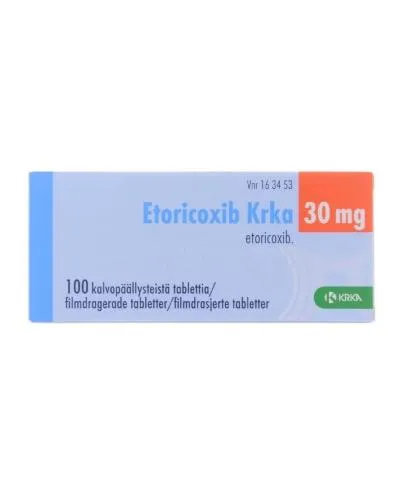
Table of Contents
Package leaflet: Information for the user
Introduction
Package leaflet: information for the user
Etoricoxib Krka 30 mg film-coated tablets EFG
Etoricoxib Krka 60 mg film-coated tablets EFG
Etoricoxib Krka 90 mg film-coated tablets EFG
Etoricoxib Krka 120 mg film-coated tablets EFG
Read all of this leaflet carefully before you start taking this medicine because it contains important information for you.
- Keep this leaflet. You may need to read it again.
- If you have any questions, ask your doctor or pharmacist.
- This medicine has been prescribed for you only. Do not pass it on to others. It may harm them, even if their symptoms are the same as yours.
- If you get any side effects, talk to your doctor or pharmacist. This includes any side effects not listed in this leaflet. See section 4.
Contents of the leaflet
- What Etoricoxib Krka is and what it is used for
- What you need to know before taking Etoricoxib Krka
- How to take Etoricoxib Krka
- Possible side effects
- How to store Etoricoxib Krka
- Contents of the pack and other information
1. What Etoricoxib Krka is and what it is used for
What is Etoricoxib Krka?
- Etoricoxib Krka contains the active substance etoricoxib. Etoricoxib belongs to a group of medicines known as selective COX-2 inhibitors. These belong to a family of medicines called non-steroidal anti-inflammatory drugs (NSAIDs).
What is Etoricoxib Krka used for?
- Etoricoxib Krka helps reduce pain and swelling (inflammation) in the joints and muscles of people aged 16 years and older with osteoarthritis, rheumatoid arthritis, ankylosing spondylitis and gout.
- Etoricoxib Krka is also used for the short-term treatment of moderate pain following dental surgery in people aged 16 years and older.
What is osteoarthritis?
Osteoarthritis is a disease of the joints. It causes the gradual breakdown of the cartilage that cushions the ends of bones. This leads to swelling (inflammation), pain, tenderness, stiffness and loss of function.
What is rheumatoid arthritis?
Rheumatoid arthritis is a long-term inflammatory disease of the joints. It causes pain, stiffness, swelling and progressive loss of mobility in affected joints. It can also cause inflammation in other parts of the body.
What is gout?
Gout is a disease characterized by sudden and recurring attacks of very painful inflammation and redness in the joints. It is caused by deposits of mineral crystals in the joint.
What is ankylosing spondylitis?
Ankylosing spondylitis is an inflammatory disease affecting the spine and large joints.
2. What you need to know before taking Etoricoxib Krka
Do not take Etoricoxib Krka:
- if you are allergic (hypersensitive) to etoricoxib or to any of the other ingredients of this medicine (listed in section 6)
- if you are allergic to non-steroidal anti-inflammatory drugs (NSAIDs), including aspirin and COX-2 inhibitors (see section 4, Possible side effects)
- if you currently have a stomach or duodenal ulcer or gastrointestinal bleeding
- if you have severe liver disease
- if you have severe kidney disease
- if you are or may be pregnant, or are breastfeeding your child (see "Pregnancy, breastfeeding and fertility")
- if you are under 16 years of age
- if you have inflammatory bowel disease, such as Crohn's disease, ulcerative colitis or colitis
- if you have uncontrolled high blood pressure (consult your doctor or nurse if you are unsure whether your blood pressure is adequately controlled)
- if your doctor has diagnosed you with heart problems, including heart failure (moderate or severe), angina (chest pain)
- if you have had a myocardial infarction, surgical revascularization, or peripheral arterial disease (poor circulation in legs or feet due to narrowed or blocked arteries)
- if you have had any type of stroke (including transient ischaemic attack or ischaemic stroke).
Etoricoxib may slightly increase your risk of heart attack and stroke, and therefore should not be used in patients who have already experienced heart problems or stroke.
If you think any of these situations apply to you, do not take the tablets until you have consulted your doctor.
Warnings and precautions
Talk to your doctor or pharmacist before taking Etoricoxib Krka if:
- You have a history of stomach ulcers or gastrointestinal bleeding.
- You are dehydrated, for example, due to a prolonged illness with vomiting or diarrhoea.
- You have swelling due to fluid retention.
- You have a history of heart failure or any other form of heart disease.
- You have a history of high blood pressure. Etoricoxib may increase blood pressure in some people, especially at high doses, and your doctor may want to monitor your blood pressure periodically.
- You have a history of liver or kidney disease.
- You are being treated for an infection. Etoricoxib may mask or hide fever, which is a sign of infection.
- You have diabetes, high cholesterol, or are a smoker, as these may increase your risk of developing heart disease.
- You are a woman trying to become pregnant.
- You are over 65 years of age.
If you are unsure whether any of the above situations apply to you, talk to your doctor before taking etoricoxib to confirm whether this medicine is suitable for you.
Etoricoxib works equally well in young and adult patients. If you are over 65 years of age, your doctor may wish to monitor you more closely. Dose adjustment is not necessary in patients over 65 years of age.
Children and adolescents
Do not give this medicine to children or adolescents under 16 years of age.
Other medicines and Etoricoxib Krka
Inform your doctor or pharmacist if you are taking, have recently taken, or might need to take any other medicines, including those obtained without a prescription.
In particular, if you are taking any of the following medicines, your doctor may wish to monitor you to ensure your treatments remain effective once you start taking etoricoxib:
-
medicines that thin your blood (anticoagulants), such as warfarin
-
rifampicin (an antibiotic)
-
methotrexate (a medicine used to suppress the immune system and often used in rheumatoid arthritis)
-
cyclosporine or tacrolimus (medicines used to suppress the immune system)
-
lithium (a medicine used to treat certain types of depression)
-
medicines used to help control high blood pressure and heart failure known as ACE inhibitors and angiotensin receptor blockers, for example enalapril and ramipril, losartan and valsartan
-
diuretics ("water pills")
-
digoxin (a medicine for heart failure and irregular heartbeat)
-
minoxidil (a medicine used to treat high blood pressure)
-
oral tablets or solution of salbutamol (a medicine for asthma)
-
oral contraceptives (the combination may increase your risk of adverse effects)
-
hormone replacement therapy (the combination may increase your risk of adverse effects)
-
aspirin – the risk of stomach ulcers is higher if you take Etoricoxib with aspirin.
-
Aspirin for prevention of heart attack or stroke:
Etoricoxib may be taken with low-dose aspirin. If you are currently taking low-dose aspirin to prevent heart attack or stroke, do not stop taking aspirin without first talking to your doctor.
- Aspirin and other non-steroidal anti-inflammatory drugs (NSAIDs):
do not take high-dose aspirin or other NSAIDs while taking Etoricoxib.
Taking Etoricoxib Krka with food and drink
The onset of action of etoricoxib may be faster when taken on an empty stomach.
Pregnancy, breastfeeding and fertility
Pregnancy
Etoricoxib tablets should not be taken during pregnancy. Do not take the tablets if you are pregnant, think you may be pregnant, or plan to become pregnant. If you become pregnant, stop taking the tablets and consult your doctor. Speak to your doctor if you have any doubts or need further information.
Breastfeeding
It is not known whether etoricoxib is excreted in human milk. If you are breastfeeding or plan to breastfeed, consult your doctor before taking etoricoxib. If you are taking etoricoxib, you should not breastfeed.
Fertility
Etoricoxib is not recommended for use in women attempting to become pregnant.
Driving and using machines
Dizziness and somnolence have been reported in some patients taking etoricoxib.
Do not drive if you experience dizziness or somnolence.
Do not use tools or machines if you experience dizziness or somnolence.
Etoricoxib Krka contains sodium
This medicine contains less than 1 mmol (23 mg) of sodium per tablet, which is essentially "sodium-free".
3. How to take Etoricoxib Krka
Follow exactly the instructions given by your doctor for taking this medicine. If in doubt, consult your doctor or pharmacist again.
Do not take more than the recommended dose for your condition. Your doctor will want to review your treatment from time to time. It is important that you use the lowest dose that controls your pain and that you do not take etoricoxib for longer than necessary. This is because the risk of heart attacks and strokes may increase after long-term treatment, especially with high doses.
Different doses of this medicine are available, and depending on your condition, your doctor will prescribe the tablet with the dose appropriate for you.
The recommended dose is:
Osteoarthritis
The recommended dose is 30 mg once daily, increasing up to a maximum of 60 mg once daily if necessary.
Rheumatoid arthritis
The recommended dose is 60 mg once daily, increasing up to a maximum of 90 mg once daily if necessary.
Ankylosing spondylitis
The recommended dose is 60 mg once daily, which may be increased up to a maximum of 90 mg once daily if necessary.
Acute pain situations
Etoricoxib should only be used during the period of acute pain.
Gout
The recommended dose is 120 mg once daily, which should only be used during the period of acute pain and limited to a maximum of 8 days of treatment.
Postoperative dental surgery pain
The recommended dose is 90 mg once daily, limited to a maximum of 3 days of treatment.
Patients with liver problems
- If you have mild liver disease, you should not take more than 60 mg per day.
- If you have moderate liver disease, you should not take more than 30 mg per day.
Use in children and adolescents
Children or adolescents under 16 years of age must not take etoricoxib tablets.
Patients over 65 years of age
No dose adjustment is necessary in patients over 65 years of age. As with other medicines, caution should be exercised in elderly patients.
Method of administration
Etoricoxib is administered orally. Take the tablets once daily. Etoricoxib can be taken with or without food.
If you take more Etoricoxib Krka than you should
You must never take more tablets than your doctor has prescribed. If you take too many etoricoxib tablets, seek immediate medical attention.
In case of overdose or accidental ingestion, you may also call the Toxicology Information Service at phone number 91 562 04 20, indicating the medication and the amount taken. It is recommended to bring the medication packaging and leaflet to the healthcare professional.
If you forget to take Etoricoxib Krka
It is important that you take etoricoxib as directed by your doctor. If you miss a dose, simply resume your regular dosing schedule the next day. Do not take a double dose to make up for a missed dose.
If you have any further questions about the use of this medicine, ask your doctor or pharmacist.
4. Possible adverse effects
Like all medicines, this medicine can cause adverse effects, although not everyone will experience them.
If you develop any of the following signs, stop taking Etoricoxib Krka and speak to your doctor immediately (see section 2: "What you need to know before taking Etoricoxib Krka"):
- difficulty breathing, chest pain or worsening ankle swelling
- yellowing of the skin and eyes (jaundice) – these are signs of liver problems
- severe or persistent stomach pain or black stools
- an allergic reaction – which may include skin problems such as ulcers or blistering, or swelling of the face, lips, tongue or throat that may cause difficulty breathing
Very common (may affect more than 1 in 10 people)
- stomach pain
Common (may affect up to 1 in 10 people)
- dry socket (inflammation and pain following tooth extraction)
- swelling of the legs and/or feet due to fluid retention (oedema)
- dizziness, headache
- palpitations (fast or irregular heartbeat), irregular heart rhythm (arrhythmia)
- high blood pressure
- wheezing or difficulty breathing (bronchospasm)
- constipation, gas (excess wind), gastritis (inflammation of the inner lining of the stomach), heartburn, diarrhoea, indigestion (dyspepsia)/stomach discomfort, nausea, vomiting, inflammation of the oesophagus, mouth ulcers
- changes in blood tests related to your liver
- bruising
- weakness and fatigue, flu-like illness
Uncommon (may affect up to 1 in 100 people)
- gastroenteritis (inflammation of the gastrointestinal tract affecting both the stomach and small intestine/stomach flu), cold, urinary tract infection
- changes in laboratory test results (reduced number of red blood cells, reduced number of white blood cells, decreased platelets)
- hypersensitivity (allergic reaction including hives, which may be severe enough to require immediate medical attention)
- increased or decreased appetite, weight gain
- anxiety, depression, reduced mental sharpness; seeing, feeling or hearing things that are not real (hallucinations)
- altered taste, inability to sleep, numbness or tingling, drowsiness
- blurred vision, eye irritation and redness
- ringing in the ears, dizziness (sensation of spinning while standing still)
- abnormal heart rhythm (atrial fibrillation), rapid heart rate, heart failure, sensation of tightness, pressure or heaviness in the chest (angina), myocardial infarction
- flushing, stroke, mini-stroke (transient ischaemic attack), severe increase in blood pressure, inflammation of blood vessels
- cough, shortness of breath, nosebleed
- stomach swelling, changes in bowel habits, dry mouth, stomach ulcer, inflammation of the inner lining of the stomach which may become severe and lead to bleeding, irritable bowel syndrome, inflammation of the pancreas
- facial swelling, skin rash or itching, skin redness
- muscle cramp/spasm, muscle pain/stiffness
- elevated potassium levels in your blood, changes in blood or urine tests related to your kidneys, serious kidney problems
- chest pain
Rare (may affect up to 1 in 1,000 people)
- angioedema (allergic reaction with swelling of the face, lips, tongue, and/or throat which may cause difficulty breathing or swallowing, which may be severe enough to require immediate medical attention), anaphylactic/anaphylactoid reactions including shock (severe allergic reaction requiring immediate medical attention)
- confusion, restlessness
- liver problems (hepatitis)
- low sodium levels in blood
- liver impairment, yellowing of the skin and/or eyes (jaundice)
- severe skin reactions
Reporting of adverse effects:
If you experience any adverse effect, talk to your doctor or pharmacist, even if it is a possible adverse effect not listed in this leaflet. You can also report them directly via the Spanish Pharmacovigilance System for Human Medicines: https://www.notificaram.es. By reporting adverse effects, you can help provide more information on the safety of this medicine.
5. Storage of Etoricoxib Krka
Keep this medicine out of the sight and reach of children.
Do not use this medicine after the expiry date stated on the packaging after EXP. The expiry date refers to the last day of the month indicated.
No special storage conditions are required.
Medicines must not be disposed of via wastewater drains or household waste. Return unused medicines and their containers to the SIGRE Point at your pharmacy. If you are unsure, ask your pharmacist how to dispose of medicines and containers you no longer need. This will help protect the environment.
6. Contents of the pack and other information
Composition of Etoricoxib Krka
-
The active substance is etoricoxib. Each film-coated tablet contains 30 mg, 60 mg, 90 mg or 120 mg of etoricoxib.
-
The other components (excipients) are: microcrystalline cellulose, calcium hydrogen phosphate (anhydrous), sodium croscarmellose, sodium stearyl fumarate, colloidal anhydrous silica in the core, poly(vinyl alcohol), titanium dioxide (E171), macrogol 3000, talc, yellow iron oxide E172 (in Etoricoxib Krka 30 mg film-coated tablets EFG), and red iron oxide E172 (in Etoricoxib Krka 90 mg film-coated tablets EFG and Etoricoxib Krka 120 mg film-coated tablets EFG). See section 2 “Etoricoxib Krka contains sodium”.
Appearance of the product and contents of the pack
Etoricoxib Krka film-coated tablets are available in four strengths:
Etoricoxib Krka 30 mg film-coated tablets EFG: white or almost white, round (diameter: 6 mm), slightly biconvex film-coated tablet with bevelled edges.
Etoricoxib Krka 60 mg film-coated tablets EFG: slightly yellow, round (diameter: 8 mm), biconvex film-coated tablet with bevelled edges, marked with "60" on one side.
Etoricoxib Krka 90 mg film-coated tablets EFG: pink, round (diameter: 9 mm), biconvex film-coated tablet with bevelled edges, marked with "90" on one side.
Etoricoxib Krka 120 mg film-coated tablets EFG: brownish-red, round (diameter: 10 mm), slightly biconvex film-coated tablets with bevelled edges, scored on one side. The score line is not intended to divide the tablet into equal doses.
Pack sizes:
30 mg film-coated tablets
Blister packs containing 7, 14, 28, 30, 56, 60, 84, 98 or 100 tablets.
60 mg film-coated tablets
Blister packs containing 7, 14, 20, 28, 30, 50, 56, 60, 84, 98 or 100 tablets.
90 mg film-coated tablets
Blister packs containing 5, 7, 14, 20, 28, 30, 50, 56, 60, 84, 98 or 100 tablets.
120 mg film-coated tablets
Blister packs containing 5, 7, 14, 20, 28, 30, 56, 60, 84, 98 or 100 tablets.
Only some pack sizes may be marketed.
Marketing Authorization Holder
KRKA, d.d., Novo mesto, Šmarješka cesta 6, 8501 Novo mesto, Slovenia
Manufacturer
KRKA, d.d., Novo mesto, Šmarješka cesta 6, 8501 Novo mesto, Slovenia
or
TAD Pharma GmbH, Heinz-Lohmann-Straße 5, 27472 Cuxhaven, Germany
For more information about this medicinal product, please contact the local representative of the Marketing Authorization Holder:
KRKA Farmacéutica, S.L., Calle de Anabel Segura, 10, 28108 Alcobendas, Madrid, Spain
This medicinal product is authorized in the Member States of the European Economic Area and in the United Kingdom (Northern Ireland) under the following names:
Belgium, Denmark, Spain, Finland, Ireland, Iceland, Norway, Sweden | Etoricoxib Krka |
Bulgaria, Czech Republic, Hungary, Poland, Romania, Slovenia, Slovakia | Roticox |
Germany | Etoriax |
Estonia, Croatia | Etoxib |
Lithuania, Latvia | Bericox |
Portugal | Etoricoxib TAD |
United Kingdom (Northern Ireland) | Etoricoxib |
Date of the last review of this leaflet: December 2021
Detailed information on this medicine is available on the website of the Spanish Agency for Medicines and Health Products (AEMPS) (http://www.aemps.gob.es/)