Echinamed tablets
Spain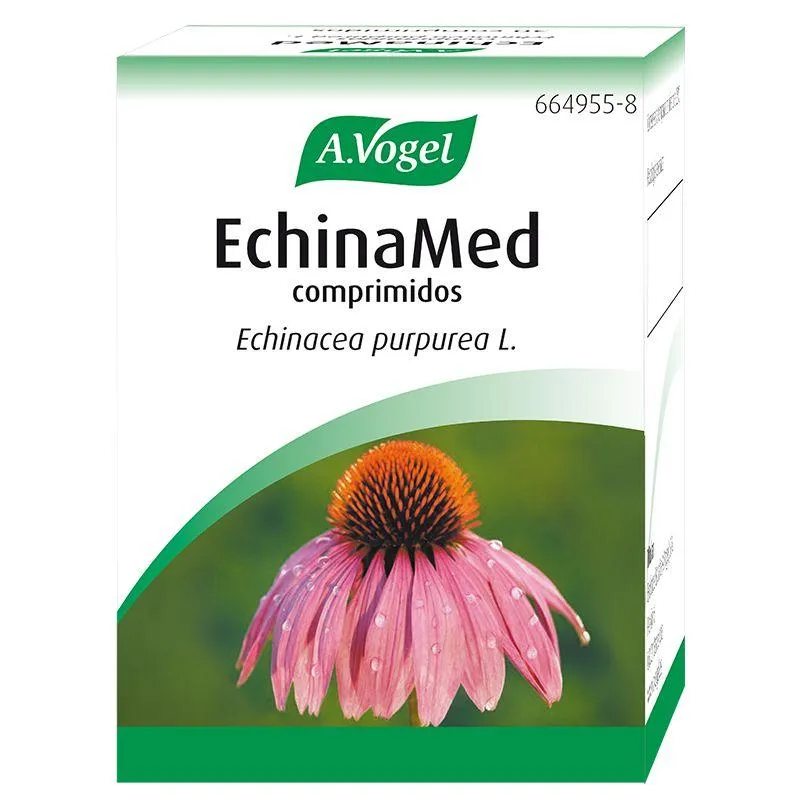
Table of Contents
Package leaflet: Information for the user
Introduction
Package leaflet: information for the user
EchinaMed tablets
Read the entire leaflet carefully because it contains important information for you.
This medicine can be obtained without a prescription, for the treatment of minor conditions without the intervention of a doctor. However, to achieve the best results, it must be used carefully.
- Keep this leaflet as you may need to read it again.
- If you need advice or further information, consult your pharmacist.
- If symptoms worsen or persist beyond ten days, you should consult a doctor.
- If you consider any of the adverse effects you experience to be severe, or if you notice any adverse effects not listed in this leaflet, inform your doctor or pharmacist.
Contents of the leaflet
- What EchinaMed is and what it is used for
- Before taking EchinaMed
- How to take EchinaMed
- Possible adverse effects
- How to store EchinaMed
- Further information
1. What EchinaMed is and what it is used for
It is indicated for the treatment of the common cold.
EchinaMed belongs to a group of medicines known as plant-derived immunostimulants. It works by stimulating the body's defenses.
2. Before taking EchinaMed
Do not take EchinaMed if you:
- Are allergic to plants of the Asteraceae (Compositae) family or to any of the components of the product.
- Have tuberculosis.
- Have a tendency to allergies with symptoms such as urticaria, eczema, or asthma.
- Suffer from an autoimmune disease.
- Have conditions that reduce your resistance to infection (e.g. AIDS).
- Are undergoing treatment with immunosuppressants (e.g. treatment to prevent organ rejection after transplantation).
- Are receiving treatment that reduces your response to infections (e.g. chemotherapy or radiotherapy for cancer treatment).
- Suffer from diseases characterized by low white blood cell count, such as agranulocytosis.
Do not administer to children under 1 year of age.
Take special care with EchinaMed
If your symptoms worsen during treatment or if you develop high fever, consult a doctor or pharmacist.
There is a possible risk of anaphylactic reaction in atopic patients. These patients should consult their doctor before taking this medicine.
Administration to children under 12 years of age is not recommended, as efficacy has not been sufficiently proven.
This medicine contains sucrose. Patients with known hereditary fructose intolerance, glucose or galactose malabsorption, or sucrase-isomaltase deficiency must not take this medicine.
This medicine contains sorbitol. Patients with hereditary fructose intolerance should not take this medicine.
Pregnancy and Breastfeeding
No studies have been conducted on the use of this medicine during pregnancy or breastfeeding; therefore, its use is not recommended unless otherwise advised by a physician.
IMPORTANT FOR WOMEN
If you are pregnant or think you might be pregnant, consult your doctor before taking this medicine. Taking medicines during pregnancy may be dangerous for the embryo or fetus and should be monitored by your doctor.
Driving and use of machines:
No studies have been conducted on the effect of EchinaMed on the ability to drive vehicles or operate machinery; however, based on its activity, it is unlikely that such abilities would be impaired.
Taking other medicines:
There is no evidence that extracts of Echinacea purpurea interact with other medicines; however, due to its activity, it is not recommended to take this medicine concomitantly with immunosuppressants such as cyclosporine and methotrexate.
Inform your doctor or pharmacist if you are taking or have recently taken any other medicines, including those obtained without a prescription.
3. How to take EchinaMed
Follow these instructions unless your doctor has given you different advice. Remember to take your medicine.
EchinaMed is a medicine taken by mouth.
The recommended daily dose for adults, elderly patients, and children over 12 years of age is 1 tablet 3 times a day.
The tablets should be taken with water before main meals or may also be dissolved in the mouth.
Begin treatment at the first sign of a cold. Do not take this medicine for longer than 10 days.
If you think that the effect of this medicine is too strong or too weak, inform your doctor or pharmacist.
If you take more EchinaMed than you should:
In case of overdose or accidental ingestion, go to a medical center or contact the
Toxicology Information Service, telephone 91 562 0420, indicating the medicine and the amount ingested.
If you forget to take EchinaMed:
Do not take a double dose to make up for missed doses.
4. Possible adverse effects
VERY IMPORTANT: make sure you have read section 2. Before Taking
EchinaMed, from this leaflet, before reading this section 4.
Do not take EchinaMed if you are allergic to plants from the Asteraceae (Compositae) family.
Like all medicines, EchinaMed can have adverse effects. Discontinue treatment and consult your doctor if any of the following occur:
Allergic reactions such as:
- Rash
- Urticaria
- Inflammatory skin disorders (Stevens-Johnson syndrome)
- Skin swelling due to fluid accumulation
- Facial swelling (Quincke's edema)
- Reduced airflow to the lungs (bronchospasm)
- Asthma and severe allergic reactions (anaphylactic shock)
This medicine may trigger allergic reactions in patients who are prone to allergies.
Association with autoimmune diseases has been reported, such as:
- Inflammation of the brain and spinal cord (disseminated encephalitis)
- Painful nodules along the spine (erythema nodosum)
- Decreased platelet count (immunothrombocytopenia)
- Destruction of blood cells by antibodies (Evans' syndrome)
- Dry eyes and mouth with renal tubular dysfunction (Sjögren's syndrome)
Leukopenia may occur with long-term use (more than 8 weeks).
The frequency of these adverse effects is unknown.
If you consider any of the effects you experience to be severe, or if you notice any adverse effects not listed in this leaflet, inform your doctor or pharmacist.
Reporting of adverse effects:
If you experience any type of adverse effect, consult your doctor, pharmacist, or nurse, even if it is a possible adverse effect not listed in this leaflet. You may also report them directly through the Spanish System for Pharmacovigilance of Human Medicines: https://www.notificaram.es.
By reporting adverse effects, you can help provide more information on the safety of this medicine.
5. Storage of EchinaMed
This medicine does not require special storage conditions.
It should be stored in the original packaging.
Keep out of the reach and sight of children.
Do not use EchinaMed after the expiry date stated on the package.
Medicines must not be disposed of via wastewater or household waste. Ask your pharmacist how to dispose of medicines and packaging that you no longer need.
This will help protect the environment.
6. Additional Information
One tablet of EchinaMed contains the following active substances:
- 17.7 mg of dry extract from the fresh aerial parts of Echinacea purpurea, equivalent to 1140 mg of hydroethanolic extract.
- 0.9 mg of dry extract from the fresh root of Echinacea purpurea, equivalent to 60 mg of hydroethanolic extract.
Extraction solvent: ethanol 57.3% (m/m)
The other components are excipients:
Mannitol (E 421)
Medium-chain triglycerides
Sucrose esters of fatty acids (E 473)
Sorbitol (E 420)
Sodium croscarmellose
Magnesium stearate (of vegetable origin)
Pack size
Pack containing 30 tablets.
Marketing Authorization Holder
Bioforce España A.Vogel, S.A.
Platón 6,
08021-Barcelona
Spain
Tel 93 201 99 22
Fax 93 209 03 19
Manufacturer
- VOGEL B.V.
J.P. Broekhovenstraat 16, Elburg
The Netherlands
This summary of product characteristics was approved in: July 2023
Detailed and up-to-date information on this medicinal product is available on the website of the Spanish Agency for Medicines and Health Products (AEMPS) http://www.aemps.gob.es/