Durvitan 300 mg prolonged-release hard capsules
Spain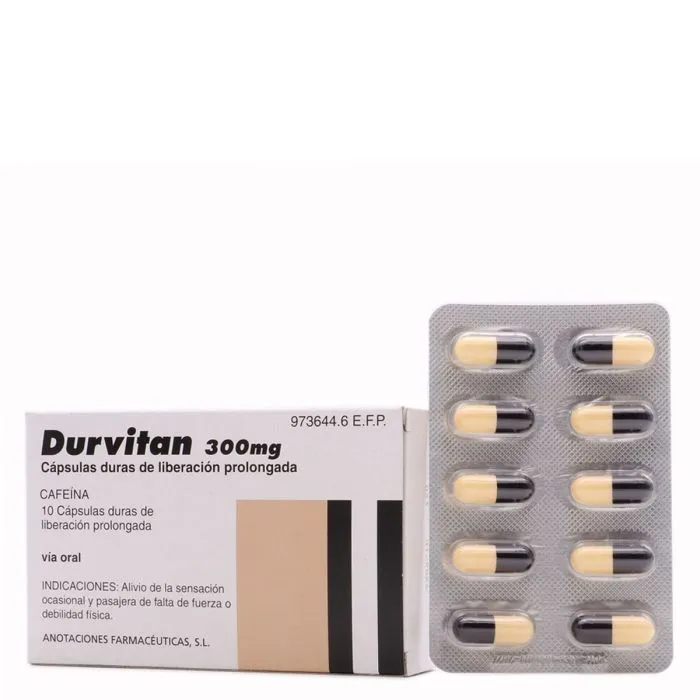
Table of Contents
- Patient Information Leaflet
- Introduction
- This medicine is available without a prescription. To achieve the best results, it must be used correctly.
- 1. What Durvitan 300 mg is and what it is used for
- 2. Before taking Durvitan 300 mg
- **Take special care with Durvitan 300 mg**
- **Use of other medicines**
- **Pregnancy**
- 3. How to take Durvitan 300 mg
- 4. Possible adverse effects
- 5. Storage of DURVITAN 300 mg
- 6. ADDITIONAL INFORMATION
Patient Information Leaflet
Introduction
Patient Information Leaflet
DURVITAN 300 mg
Prolonged-release hard capsules
(Caffeine)
Read the entire leaflet carefully because it contains important information for you.
This medicine is available without a prescription. To achieve the best results, it must be used correctly.
- Keep this leaflet as you may need to read it again.
- If you need advice or more information, consult your pharmacist.
- If symptoms worsen or persist after 7 days, consult your doctor.
- If you consider any of the side effects you experience to be severe, or if you notice any side effects not listed in this leaflet, inform your doctor or pharmacist.
Leaflet contents:
- What DURVITAN 300 mg is and what it is used for.
- Before taking DURVITAN 300 mg.
- How to take DURVITAN 300 mg.
- Possible side effects.
- Storage of DURVITAN 300 mg.
- Additional information.
1. What Durvitan 300 mg is and what it is used for
Caffeine has a stimulating effect on the nervous system.
It is indicated for the relief of occasional and transient feelings of weakness or physical fatigue.
2. Before taking Durvitan 300 mg
Do not take Durvitan 300 mg
- If you are allergic (hypersensitive) to caffeine (or derivatives of it, such as aminophylline, theophylline, etc.) or to any of the other components of this medicine.
- In mental disorders associated with nervous excitement, epilepsy, states of anxiety, and insomnia (difficulty sleeping).
In severe disorders of the liver, heart, stomach or duodenal ulcer, or high blood pressure.
Take special care with Durvitan 300 mg
- If you have any liver, thyroid, or stomach disease or disorder, you should consult your doctor before taking this medicine.
- You should consult your doctor before taking this medicine if you have or have had heart conditions or disorders (cardiac arrhythmia, myocardial ischemia, angina pectoris, etc.), especially when performing physical exercise or when at high altitudes.
- If you are diabetic, you should be aware that caffeine may increase blood sugar levels.
- If you are sensitive to other xanthines such as theophylline, aminophylline, etc., you should consult your doctor before taking this medicine.
- You should not take this medicine within 6 hours of going to sleep.
- This medicine must not replace normal sleep or rest.
Use of other medicines
Inform your doctor or pharmacist if you are taking or have recently taken any other medicines, including those obtained without a prescription.
In particular, if you are taking any of the following medicines, it may be necessary to adjust the dose of some of these medicines or even discontinue treatment:
- Anti-infective agents of the quinolone group (for example: oxolinic acid, ciprofloxacin), linezolid, and erythromycin.
- Oral contraceptives.
- Antidepressants, such as monoamine oxidase inhibitors (MAOIs) or lithium.
- Barbiturates (used as hypnotics—for sleep disorders—sedatives, and anticonvulsants).
- Adrenergic bronchodilators and theophylline (used to treat bronchial asthma).
- Cimetidine (used to treat excessive gastric secretion and stomach ulcers).
- Disulfiram (used in alcohol aversion therapy).
- Phenytoin (used to treat epilepsy).
- Furazolidone (an antidiarrheal).
- Iron (used to treat anemia).
- Mexiletine (used for heart rhythm disorders [cardiac arrhythmias]).
- Procarbazine (an anticancer agent).
- Selegiline (used to treat Parkinson's disease).
- Thyroxine (used to treat thyroid disorders).
Interference with diagnostic tests:
If you are due to have any diagnostic tests (blood or urine analysis, etc.), inform your doctor that you are taking this medicine, as it may alter the results of such tests.
Additionally, diabetic patients should be aware that caffeine may increase blood glucose levels.
Taking Durvitan 300 mg with food and drinks
Limit your consumption of beverages containing caffeine (coffee, tea, chocolate, and cola drinks) while taking this medicine.
Pregnancy
Consult your doctor or pharmacist before using any medication.
Important for women If you are pregnant or think you might be pregnant, consult your doctor before taking this medicine. Taking medicines during pregnancy can be harmful to the embryo or fetus, and must be monitored by your doctor. |
Breast-feeding
Consult your doctor or pharmacist before taking any medicine.
Intake of Durvitan 300 mg should be avoided, as although caffeine passes into breast milk in small amounts (approximately 1%), it may accumulate in the infant.
Use in children
Do not use this medicine in children under 12 years of age.
Driving and use of machines
No effects on the ability to drive or operate machinery have been reported at the recommended doses.
Important information about some of the components of Durvitan ̣300 mg
This medicine contains sucrose. If your doctor has informed you of an intolerance to certain sugars, consult him before taking this medicine.
3. How to take Durvitan 300 mg
Follow these instructions unless your doctor has given you different ones. Consult your doctor or pharmacist if you have any doubts.
The patient should be aware that there are other sources of caffeine (coffee, tea, chocolate, cola drinks) that may produce an effect similar to that of this medicine. Therefore, it is recommended to moderate the consumption of these beverages while taking Durvitan 300 mg.
For oral use.
- Adults and children over 12 years of age:
Take 1 capsule with water or food. If necessary, up to 3 capsules may be taken per day, with at least 6 hours between each dose.
Do not take the last dose within 6 hours of going to bed, to avoid possible insomnia.
Do not take more than 3 capsules per day, divided into several doses.
- Children under 12 years of age: this medicine must not be used in this population.
- Patients with liver disease: must consult their doctor before taking this medicine.
If you notice that your symptoms worsen or persist for more than 7 days, you should consult your doctor.
If you take more Durvitan 300 mg than you should:
If you have taken more Durvitan 300 mg than you should have, consult your doctor or pharmacist immediately.
Symptoms of overdose are characterized by an initial phase of excitation, followed by dizziness, vomiting, diarrhoea, abdominal pain, and convulsions. Overdose treatment is most effective when administered within the first 4 hours after ingestion of this medicine.
In case of overdose or accidental ingestion, go to your doctor or call the Toxicology Information Service (telephone: 91.5620420), indicating the medicine and the amount ingested.
4. Possible adverse effects
Like all medicines, Durvitan 300 mg can have adverse effects, although not everyone experiences them.
Very commonly (in more than 1 in 10 patients): insomnia, restlessness, and agitation may occur.
Commonly (in less than 1 in 10 but more than 1 in 100 patients): nausea, vomiting, diarrhoea, stomach pain, headache, tinnitus, disorientation, heart rhythm disorders, irritability, hot flushes, rapid breathing, and excessive urination may occur.
With high doses, anxiety and distress may appear.
In some cases, hyperglycaemia or hypoglycaemia (increased or decreased blood glucose levels) may also occur.
Treatment must be stopped immediately if the patient experiences any episodes of dizziness or palpitations.
If you consider any of the adverse effects you experience to be severe, or if you notice any adverse effects not listed in this leaflet, inform your doctor or pharmacist.
5. Storage of DURVITAN 300 mg
Keep out of the reach and sight of children.
No special storage conditions are required.
Expiry
Do not use this medicine after the expiry date stated on the container. The expiry date is the last day of the month indicated.
Medicines must not be disposed of via wastewater or household waste. Ask your pharmacist how to dispose of medicines and packaging that you no longer need. This will help protect the environment.
6. ADDITIONAL INFORMATION
Composition of Durvitan 300 mg
- Each prolonged-release hard capsule contains 300 milligrams of caffeine as the active substance.
- The other components (excipients) are: corn starch, sucrose, povidone, shellac glaze, and talc.
Appearance of the product and contents of the pack
Prolonged-release hard capsules.
Packaged in boxes containing 1 blister with 10 prolonged-release hard capsules.
Marketing Authorization Holder
Anotaciones Farmacéuticas, S.L.
Carretera de Sant Cugat a Rubí, km1 1.
08174 Sant Cugat del Vallés. Barcelona (Spain)
Manufacturer
Sincrofarm, S.L.
C/ Mercurio, 10. Pol. Ind. Almeda
08940 - Cornellá de Llobregat. Barcelona (Spain).
This leaflet was last approved in: April 2007