Dermatrans 15 mg/24 h transdermal patch
Spain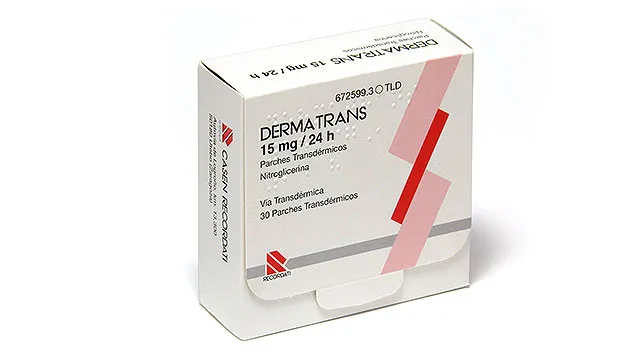
Table of Contents
Package leaflet: Information for the user
Introduction
PACKAGE LEAFLET: INFORMATION FOR THE USER
Dermatrans 5 mg/24 h, transdermal patch
Dermatrans 10 mg/24 h, transdermal patch
Dermatrans 15 mg/24 h, transdermal patch
Glycerol trinitrate
Read the entire leaflet carefully before you start using this medicine, because it contains important information for you.
- Keep this leaflet, as you may need to read it again.
- If you have any questions, consult your doctor, pharmacist, or nurse.
- This medicine has been prescribed for you and you should not give it to other people, even if they have the same symptoms, as it may harm them.
- If you experience any adverse effects, inform your doctor, pharmacist, or nurse, even if they are adverse effects not listed in this leaflet. See section 4.
Leaflet contents:
- What Dermatrans is and what it is used for
- What you need to know before using Dermatrans
- How to use Dermatrans
- Possible adverse effects
- How to store Dermatrans
- Contents of the pack and other information
1. What Dermatrans is and what it is used for
Dermatrans patches contain the active substance glyceryl trinitrate, a vasodilator used in heart conditions, which belongs to a group of medicines called organic nitrates.
Dermatrans patches are applied to the skin, after which the active substance passes continuously through your skin into your body.
Dermatrans is indicated for the prevention of angina attacks, either alone or in combination with other antianginal therapy.
Angina typically presents as chest pain or tightness, although it may also be felt in the neck or arm. The pain occurs when the heart is not receiving sufficient oxygen. Dermatrans is not indicated for the treatment of acute attacks. For the treatment of acute attacks, you should use your usual sublingual tablet or sublingual spray.
Dermatrans patches are for external use only.
2. What you need to know before using Dermatrans
Do not use Dermatrans:
- if you are allergic to the active substance or to any of the other components of this medicine (listed in section 6);
- if you have or have recently had shock associated with very low blood pressure;
- if you suffer from headaches (cephalalgia), vomiting, or seizures associated with increased intracranial pressure, including those caused by head trauma;
- if you have heart failure due to obstruction, such as narrowing of the aortic or atrioventricular orifice of the heart (aortic stenosis or mitral stenosis, respectively), or fibrotic thickening of the thin sac-like membrane surrounding the heart (constrictive pericarditis);
- if you are taking medications for erectile dysfunction (e.g., sildenafil or any other PDE-5 inhibitor). Nitrates must not be administered to patients treated with sildenafil or any other medication used to treat erectile dysfunction. Patients currently receiving nitrates must not take sildenafil or any other medication for the treatment of erectile dysfunction. The combination of a nitrate with sildenafil or any other PDE-5 inhibitor may cause a profound and sudden drop in blood pressure, which may lead to fainting, loss of consciousness, or even a heart attack (see also "Use of other medicines");
- if you are taking medicines containing riociguat, a soluble guanylate cyclase stimulator;
- if you have severe low blood pressure (systolic arterial blood pressure of 90 mm Hg);
- if you have severe reduction in blood volume due to significant blood loss or loss of other body fluids (severe hypovolemia);
- if you have severe anemia;
- if you have toxic fluid accumulation in the lungs (toxic pulmonary edema).
Warnings and precautions
Consult your doctor, pharmacist, or nurse before using Dermatrans:
-
if you are stopping treatment. Discontinuation of treatment with Dermatrans should be gradual, by replacing it with gradually decreasing doses of long-acting oral nitrates;
-
if you are scheduled for magnetic resonance imaging, electrical stimulation of your heart to restore normal heart rhythm (defibrillation or cardioversion), or heat treatment (diathermy), you must remove the Dermatrans patch before undergoing these procedures.
-
if you have or have recently had a heart attack (myocardial infarction) or if you rapidly develop symptoms of heart failure (acute heart failure), such as difficulty breathing, extreme fatigue, or swelling of the legs. Your doctor may request laboratory tests to assess your cardiovascular function.
- if you experience a significant drop in blood pressure or suffer collapse or shock while being treated with Dermatrans, the patch must be removed;
- if you experience chest pain (acute anginal attacks) or if your heart does not receive sufficient blood flow and oxygen (unstable angina) or in case of heart attack (myocardial infarction). Dermatrans must not be used as immediate treatment for these conditions;
- if you experience severe headache or abnormally low blood pressure (hypotension). This may occur if the initial dose is too high. It is advisable to increase the dose gradually until the optimal effect is achieved;
- if you are taking other nitrates or sublingual glyceryl trinitrate, as your body may develop resistance to the effects of these substances after repeated exposure (cross-tolerance);
- if you have or have previously had abnormally low blood pressure induced by glyceryl trinitrate. In this case, you may experience a slow heart rate (paradoxical bradycardia) and worsening angina;
- if you have optic nerve disease (angle-closure glaucoma);
- if you have insufficient blood oxygenation (hypoxemia) due to severe anemia or lung disease, or reduced blood supply to your heart (ischemic heart failure).
-
Patients with these medical conditions often suffer from ventilation/perfusion imbalance, an index of respiratory function. In such patients, glyceryl trinitrate could worsen the ventilation/perfusion imbalance and cause further reduction in blood oxygenation;
-
if your angina is caused by thickening of the heart muscle (hypertrophic cardiomyopathy). Nitrates may worsen this type of angina;
-
if you experience an increase in the frequency of anginal attacks during patch-free intervals. Your doctor may consider additional antianginal therapy;
-
if you develop skin sensitization (itching, burning, inflammation), treatment must be discontinued and you should consult your doctor.
Use of other medicines
Concomitant administration of medications for erectile dysfunction (e.g., sildenafil or any other PDE-5 inhibitor) enhances the blood pressure-lowering effects of nitrates and must therefore be avoided (see also "Do not use Dermatrans").
Concomitant treatment with riociguat, a soluble guanylate cyclase stimulator, should be avoided, as its combined use may cause hypotension (see also "Do not use Dermatrans").
Concomitant treatment with:
- Medications used to lower high blood pressure, such as calcium antagonists, ACE inhibitors (for treatment of congestive heart failure), beta-blockers (used to manage cardiac arrhythmias), diuretics (to increase fluid elimination from the body), and other antihypertensives,
- tricyclic antidepressants (medications for the treatment of depressive disorders),
- neuroleptics (medications used to treat psychosis),
- major tranquilizers (sedatives),
- alcohol consumption, and concomitant use of amifostine (a cytoprotective agent in chemotherapy and radiotherapy),
- and acetylsalicylic acid (an NSAID),
may enhance the blood pressure-lowering effects of Dermatrans.
Concomitant use of dihydroergotamine may reduce the effect of Dermatrans.
Non-steroidal anti-inflammatory drugs (NSAIDs), except acetylsalicylic acid, may reduce the therapeutic response to Dermatrans.
Inform your doctor or pharmacist if you are using, have recently used, or might need to use any other medicines.
Fertility, pregnancy, and breastfeeding
Dermatrans must not be used during pregnancy, especially during the first three months, unless specifically prescribed by your doctor.
Due to limited information on the presence of glyceryl trinitrate in breast milk, a risk to the infant cannot be excluded. Your doctor will decide whether to discontinue breastfeeding or the use of Dermatrans.
There are no data available on the effect of Dermatrans on human fertility.
If you are pregnant or breastfeeding, think you may be pregnant, or plan to become pregnant, consult your doctor before using this medicine.
Driving and use of machines
Especially at the beginning of treatment or during dose adjustment, Dermatrans may affect your ability to drive or operate machinery, as it may reduce reaction time or rarely cause hypotension upon standing, dizziness, and, in exceptional cases, fainting after an overdose.
If you experience these effects, you must not drive or operate machinery.
3. How to use Dermatrans
Follow exactly the administration instructions for this medicine as given by your doctor or pharmacist. If in doubt, consult your doctor or pharmacist again.
The recommended dose is one Dermatrans patch once daily. You should carefully apply the patch to your skin and wear it for 12–16 hours, after which you should remove the patch and leave a patch-free interval of 8–12 hours. You must change your Dermatrans patch according to the instructions provided by your doctor. Your doctor will advise you on how long the patch should remain on the skin and the duration of the patch-free interval.
Use in children and adolescents
Dermatrans must not be used in children and adolescents under 18 years of age.
How long you should use Dermatrans
Treatment with Dermatrans may be continued for several years; however, your doctor should review you periodically to decide whether to continue treatment or modify the therapeutic regimen.
How to apply the patch
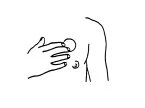 The patch should be applied to clean, dry skin, avoiding areas with cuts, skin lesions, or imperfections, and not over areas where cream, moisturizer, or talcum powder has recently been applied. It is recommended to apply Dermatrans transdermal patches to the skin of the chest (see Figure 1) or the outer upper arm, on areas free of redness or irritation, and to rotate application sites. The area may be shaved if necessary. Avoid areas that form folds or are subject to friction during movement.
Figure 1
Do not apply two consecutive patches to the same site.
Once the Dermatrans patch is removed from the pouch, it should be applied immediately to the skin as described below:
(I) Open the pouch along the notch.
Do not use scissors (see Figure 2).
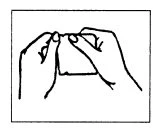
Figure 2
(II) Hold the patch by the tab with your thumb and
index finger (see Figure 3).
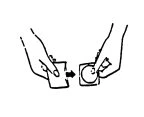 Figure 3
(III) With the other hand, peel off the protective liner
(see Figure 4). Do not touch the adhesive side of the
patch, as this may impair adhesion.
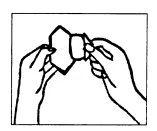
Figure 4
(IV) Apply the exposed side of the patch to the skin and
remove the remaining part of the protective liner. Press
firmly for about 10 seconds over the entire surface of the
patch. Run your fingers over the edges again to ensure
secure adhesion.
Wash your hands before and after applying Dermatrans.
To remove a patch, simply lift it from the edge and gently pull until it detaches. After use, fold the patch in half with the adhesive side inward and dispose of it in a trash container where children cannot reach it.
What to do if the patch falls off
If Dermatrans is applied correctly, it is very unlikely that the patch will fall off. However, if the patch does fall off, replace it with a new one and continue with your usual dosing schedule for the next patch.
If you use more Dermatrans than you should
If you apply excessive doses of glyceryl trinitrate, you may experience a severe drop in blood pressure, increased heart rate, or collapse and fainting, as well as disturbances in hemoglobin (methemoglobinemia).
If you or someone else applies too many patches at once, carefully remove the patches and thoroughly wash the underlying skin to reduce absorption. If you experience low blood pressure or collapse, it is recommended to elevate your legs or, if necessary, apply compression bandages to the legs.
If you forget to change the patch
If you forget to change the patch at the scheduled time, change it as soon as possible and then continue with your original dosing schedule for the next patch.
If you stop using Dermatrans
When you discontinue treatment with Dermatrans, you may experience a recurrence of angina attacks.
If you have any further questions about the use of this product, ask your doctor, pharmacist, or nurse.
4. Possible adverse effects
Like all medicines, Dermatrans may have adverse effects, although not everyone experiences them.
The following adverse effects have been reported:
Very common (affects more than 1 in 10 patients):
- Nausea
- Vomiting
Common (affects between 1 and 10 in 100 patients):
- Headache
Uncommon (affects between 1 and 10 in 1,000 patients):
- Skin inflammation due to contact (contact dermatitis)
- Redness and irritation of the skin at the patch application site
- Itching
- Burning sensation
Rare (affects between 1 and 10 in 10,000 patients):
- Increased heart rate (tachycardia)
- Decrease in blood pressure upon standing (orthostatic hypotension), which may present as transient episodes of dizziness
- Flushing
- Increased heart rate as a laboratory parameter
Very rare (affects fewer than 1 in 10,000 patients):
- Dizziness
- Fainting (syncope)
Adverse effects of unknown frequency:
- Abnormal heartbeat (palpitations)
- Generalized skin rash (Generalized rash)
Reporting of adverse effects
If you experience any type of adverse effect, consult your doctor, pharmacist, or nurse, even if it is a possible adverse effect not listed in this leaflet. You may also report them directly via the Spanish Pharmacovigilance System for Human Medicines: https://www.notificaram.es. By reporting adverse effects, you can help provide more information on the safety of this medicine.
5. Storage of Dermatrans
Keep this medicine out of the sight and reach of children.
Do not store above 25°C. Dermatrans must be stored in its original intact sachet.
Do not use this medicine after the expiry date stated on the packaging and sachets. The expiry date refers to the last day of the month indicated.
Medicines must not be disposed of via wastewater drains or household waste. Return any unused medicines and their packaging to the SIGRE collection point at your pharmacy. If you are unsure, ask your pharmacist how to dispose of medicines and packaging you no longer need. This will help protect the environment.
6. Contents of the pack and other information
Composition of Dermatrans
Dermatrans patches contain the active substance glyceryl trinitrate and are available in three concentrations:
Dermatrans 5 mg/24 h: contains 15.70 mg of the active substance glyceryl trinitrate and releases approximately 5 mg of glyceryl trinitrate per day (0.2 mg/h); the release area of the patch is 6.38 cm². The identification code printed on the foil is NR5.
Dermatrans 10 mg/24 h: contains 31.37 mg of the active substance glyceryl trinitrate and releases approximately 10 mg of glyceryl trinitrate per day (0.4 mg/h); the release area of the patch is 12.75 cm². The identification code printed on the foil is NR10.
Dermatrans 15 mg/24 h: contains 47.04 mg of the active substance glyceryl trinitrate and releases approximately 15 mg of glyceryl trinitrate per day (0.6 mg/h); the release area of the patch is 19.12 cm². The identification code printed on the foil is NR15.
The other ingredients are an adhesive substance (acrylate-vinyl acetate copolymer), an adhesion promoter (hydroabietyl phthalate), and a cross-linking agent (butyl titanate polymer), which have been spread together with the active substance onto a backing layer (lacquered polypropylene film). The adhesive layer is covered by a two-sided aluminized and siliconized protective foil, which is removed prior to use.
Nature of the product and contents of the pack
Dermatrans are adhesive transdermal patches. Each patch is individually sealed in a protective pouch.
Pack sizes: 15 and 30 patches. Only certain pack sizes may be commercially available.
Marketing Authorisation Holder and Manufacturer
Marketing Authorisation Holder:
CASEN RECORDATI S.L.
Autovía de Logroño, km. 13,300 UTEBO
50180 (ZARAGOZA)
Manufacturer:
ROTTAPHARM LTD.
Damaastown, Industrial Park
15 Mulhuddart, County Dublin, Ireland
or
LTS Lohmann Therapie Systeme AG
Lohmannstraße 2
56626 Andernach
Germany
This medicinal product is authorised in the Member States of the European Economic Area under the following names:
Country Name
Ireland Dermatrans
Italy Dermatrans
Spain Dermatrans
Date of the most recent review of this leaflet: December 2022.
Detailed and up-to-date information on this medicinal product is available on the website of the Spanish Agency for Medicines and Health Products (AEMPS) http://www.aemps.gob.es/