Briviact 75 mg film-coated tablets
Spain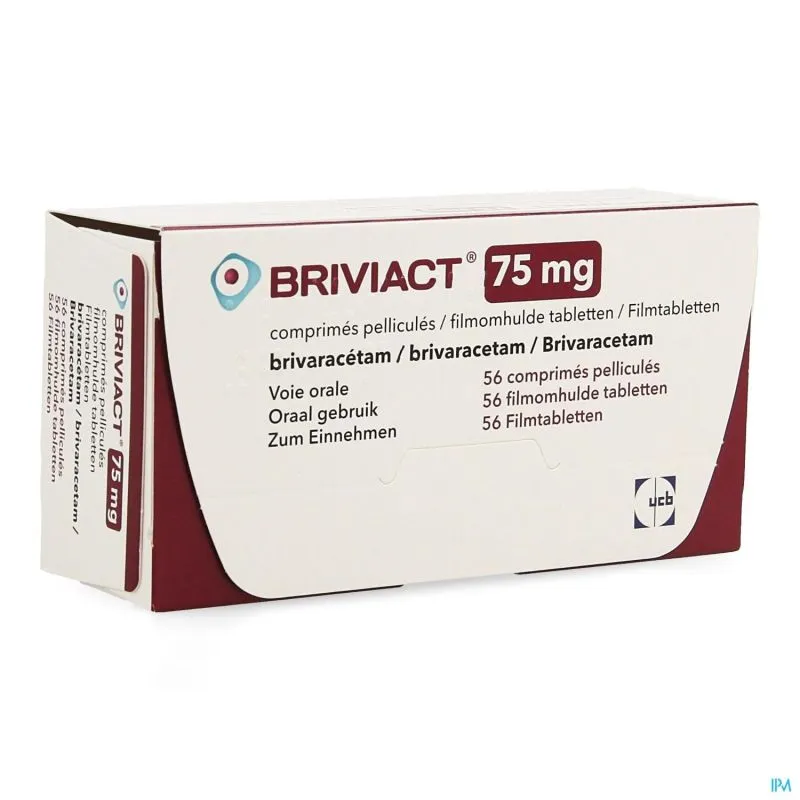
Table of Contents
Package leaflet: Information for the user
Introduction
Package leaflet: information for the patient
Briviact 10 mg film-coated tablets
Briviact 25 mg film-coated tablets
Briviact 50 mg film-coated tablets
Briviact 75 mg film-coated tablets
Briviact 100 mg film-coated tablets
brivaracetam
Read the entire leaflet carefully before you start taking this medicine, because it contains important information for you.
- Keep this leaflet, as you may need to read it again.
- If you have any questions, ask your doctor or pharmacist.
- This medicine has been prescribed for you only; do not pass it on to other people, even if they have the same symptoms as you, because it may harm them.
- If you experience any adverse effects, consult your doctor or pharmacist, even if they are adverse effects not listed in this leaflet. See section 4.
Leaflet contents
- What Briviact is and what it is used for
- What you need to know before taking Briviact
- How to take Briviact
- Possible side effects
- How to store Briviact
- Contents of the pack and other information
1. What Briviact is and what it is used for
What Briviact is
Briviact contains the active substance brivaracetam. It belongs to a group of medicines called "antiepileptic drugs". These medicines are used for the treatment of epilepsy.
What Briviact is used for
- Briviact is used in adults, adolescents, and children from 2 years of age.
- It is used to treat a type of epilepsy characterized by partial seizures with or without secondary generalization.
- Partial seizures are seizures that begin by affecting only one side of the brain. These partial seizures may spread to larger areas on both sides of the brain – this is called "secondary generalization".
- Your doctor has prescribed this medicine to reduce the number of seizures.
- Briviact is used in combination with other medicines for the treatment of epilepsy.
2. What you need to know before starting Briviact
Do not take Briviact
- if you are allergic to brivaracetam, to other chemically related compounds such as levetiracetam or piracetam, or to any of the other ingredients of this medicine (listed in section 6). If you are unsure, consult your doctor or pharmacist before taking Briviact.
Warnings and precautions
Talk to your doctor or pharmacist before starting Briviact:
- If you have had thoughts of harming yourself or of suicide. A small number of people taking antiepileptic medicines such as Briviact have experienced thoughts of self-harm or suicide. If you have any such thoughts, contact your doctor immediately.
- If you have liver problems: your doctor may need to adjust your dose.
Children
Briviact is not recommended for use in children under 2 years of age.
Taking Briviact with other medicines
Inform your doctor or pharmacist if you are taking, have recently taken, or might need to take any other medicines.
In particular, inform your doctor if you are taking any of the following medicines, as your Briviact dose may need to be adjusted:
- Rifampicin, a medicine used to treat bacterial infections.
- St John’s wort (also known as Hypericum perforatum), a herbal medicine used to treat depression and anxiety, as well as other conditions.
Taking Briviact with alcohol
- The use of this medicine with alcohol is not recommended.
- If you drink alcohol while taking Briviact, the negative effects of alcohol may increase.
Pregnancy and breastfeeding
Women of childbearing age should discuss the use of contraception with their doctor.
If you are pregnant or breastfeeding, think you may be pregnant, or are planning to become pregnant, consult your doctor or pharmacist before using this medicine.
Briviact is not recommended during pregnancy, as the effects of Briviact on pregnancy and the fetus are unknown.
Breastfeeding is not recommended while taking Briviact, as Briviact is excreted in breast milk.
Do not stop treatment without first consulting your doctor. Stopping treatment could increase the number of your seizures and harm your baby.
Driving and using machines
- You may feel drowsy, dizzy or tired while taking Briviact.
- These effects are more common at the beginning of treatment or after a dose increase.
- Do not drive, ride a bicycle, or use any tools or machinery until you know how this medicine affects you.
Briviact contains lactose and sodium
Briviact film-coated tablets contain:
- lactose (a type of sugar) – If your doctor has informed you that you have an intolerance to certain sugars, consult with him before taking this medicine.
- sodium – This medicine contains less than 23 mg of sodium (1 mmol) per tablet; essentially “sodium-free”.
3. How to take Briviact
Follow exactly the instructions for using this medicine as given by your doctor. If in doubt, consult your doctor or pharmacist again. Other forms of this medicine may be more suitable for some patients, e.g., children (if whole tablets cannot be swallowed, for example). Please consult your doctor or pharmacist.
You will take Briviact together with other medicines to treat epilepsy.
Dosage
Your doctor will determine the correct daily dose for you. Take the daily dose divided into two equal doses, approximately 12 hours apart.
Adolescents and children weighing 50 kg or more, and adults
- The recommended dose ranges from 25 mg to 100 mg twice daily. Your doctor may later decide to adjust your dose to find the best dose for you.
Adolescents and children weighing between 20 kg and less than 50 kg
- The recommended dose ranges from 0.5 mg to 2 mg per kg of body weight, twice daily. Your doctor may later decide to adjust the dose to find the best dose for you.
Children weighing between 10 kg and less than 20 kg
The recommended dose ranges from 0.5 mg to 2.5 mg per kg of body weight, twice daily. Your child's doctor may later decide to adjust the dose to find the best dose for your child.
Patients with liver problems
If you have liver problems:
- As an adolescent or child weighing 50 kg or more, or as an adult, the maximum dose you will take is 75 mg twice daily.
- As an adolescent or child weighing between 20 kg and less than 50 kg, the maximum dose you will take is 1.5 mg per kg of body weight twice daily.
- As a child weighing between 10 kg and less than 20 kg, the maximum dose your child will take is 2 mg per kg of body weight twice daily.
How to take Briviact tablets
- Swallow the tablet whole with liquid.
- The medicine can be taken with or without food.
Duration of Briviact treatment
Briviact is a long-term treatment – continue taking Briviact until your doctor tells you to stop.
If you take more Briviact than you should
If you take more Briviact than you should, consult your doctor. You may feel dizzy and drowsy.
You may also experience any of the following symptoms: feeling unwell, sensation of spinning, problems maintaining balance, anxiety, feeling very tired, irritability, aggression, difficulty sleeping, depression, thoughts or attempts of harming yourself or suicide.
If you forget to take Briviact
- If you forget to take a dose, take it as soon as you remember.
- Take your next dose at the time you would normally take it.
- Do not take a double dose to make up for the forgotten dose.
- If you are unsure what to do, consult your doctor or pharmacist.
If you stop taking Briviact
- Do not stop treatment with this medicine unless your doctor tells you to do so. This is because stopping treatment could increase the number of seizures you have.
- If your doctor decides to stop your treatment, they will give you instructions for gradually withdrawing Briviact. This will help prevent your seizures from returning or worsening.
If you have any further questions about the use of this medicine, ask your doctor or pharmacist.
4. Possible adverse effects
Like all medicines, this medicine can cause adverse effects, although not everyone will experience them.
Very common: may affect more than 1 in 10 patients.
- drowsiness or dizziness.
Common: may affect up to 1 in 10 patients.
- influenza (flu)
- feeling very tired (fatigue)
- seizures, sensation of spinning (vertigo)
- feeling nauseous and vomiting, constipation
- depression, anxiety, difficulty sleeping (insomnia), irritability
- nose and throat infections (such as "common cold"), cough
- decreased appetite
Uncommon: may affect up to 1 in 100 patients.
- allergic reactions
- abnormal thoughts and/or loss of contact with reality (psychotic disorder), aggression, restlessness (agitation)
- thoughts or attempts of self-harm or suicide: inform your doctor immediately
- a decrease in white blood cells (called 'neutropenia') – detected in blood tests
Other adverse effects in children
Common: may affect up to 1 in 10 patients.
- restlessness and hyperactivity (psychomotor hyperactivity)
Reporting of adverse effects
If you experience any type of adverse effect, consult your doctor or pharmacist, even if it is a possible adverse effect not listed in this leaflet. You may also report them directly through the national reporting system included in Appendix V. By reporting adverse effects, you can help provide more information on the safety of this medicine.
5. Briviact Storage
- Keep this medicine out of the sight and reach of children.
- Do not use this medicine after the expiry date which is stated on the outer packaging after EXP and on the blister after EXP. The expiry date refers to the last day of the month indicated.
- This medicine does not require any special storage conditions.
- Medicines must not be disposed of via wastewater or household waste. Ask your pharmacist how to dispose of medicines and packaging that you no longer need. This will help protect the environment.
6. Contents of the pack and other information
Composition of Briviact
- The active substance is brivaracetam.
- Each film-coated tablet contains 10 mg, 25 mg, 50 mg, 75 mg, or 100 mg of brivaracetam.
The other components are:
Core
Croscarmellose sodium, lactose monohydrate, betadex, anhydrous lactose, magnesium stearate.
Tablet coating
- 10 mg film-coated tablets: poly(vinyl) alcohol, titanium dioxide (E171), macrogol (3350), talc.
- 25 mg film-coated tablets: poly(vinyl) alcohol, titanium dioxide (E171), macrogol (3350), talc, yellow iron oxide (E172), black iron oxide (E172).
- 50 mg film-coated tablets: poly(vinyl) alcohol, titanium dioxide (E171), macrogol (3350), talc, yellow iron oxide (E172), red iron oxide (E172).
- 75 mg film-coated tablets: poly(vinyl) alcohol, titanium dioxide (E171), macrogol (3350), talc, yellow iron oxide (E172), red iron oxide (E172), black iron oxide (E172).
- 100 mg film-coated tablets: poly(vinyl) alcohol, titanium dioxide (E171), macrogol (3350), talc, yellow iron oxide (E172), black iron oxide (E172).
Nature of the product and pack contents
Briviact 10 mg are film-coated tablets, white to off-white in colour, round, 6.5 mm in diameter, marked on one side with “u 10”.
Briviact 25 mg are film-coated tablets, grey in colour, oval, 8.9 mm x 5.0 mm, marked on one side with “u 25”.
Briviact 50 mg are film-coated tablets, yellow in colour, oval, 11.7 mm x 6.6 mm, marked on one side with “u 50”.
Briviact 75 mg are film-coated tablets, purple in colour, oval, 13.0 mm x 7.3 mm, marked on one side with “u 75”.
Briviact 100 mg are film-coated tablets, grey-green in colour, oval, 14.5 mm x 8.1 mm, marked on one side with “u 100”.
Briviact tablets are packed in PVC/PCTFE - aluminium blisters contained in cardboard boxes with either 14, 56, 14 x 1 or 100 x 1 film-coated tablets, or in multiple packs containing 168 (3 x 56) film-coated tablets.
All pack sizes are available in PVC/PCTFE - aluminium blisters.
Not all pack sizes may be marketed.
Marketing Authorisation Holder and Manufacturer
Marketing Authorisation Holder
UCB Pharma, S.A., Allée de la Recherche 60, B-1070, Bruxelles, Belgium.
Manufacturer
UCB Pharma, S.A., Chemin du Foriest, B-1420 Braine-l’Alleud, Belgium.
For further information on this medicinal product, please contact the local representative of the Marketing Authorisation Holder:
Belgium/Belgium/Belgium UCB Pharma SA/NV Tel/Tel: + 32 / (0)2 559 92 00 | Lithuania UCB Pharma Oy Finland Tel: + 358 9 2514 4221 (Finland) |
Bulgaria UCB Pharma Ltd. Tel: + 359 (0) 2 962 30 49 | Luxembourg/Luxembourg UCB Pharma SA/NV Tel/Tel: + 32 / (0)2 559 92 00 (Belgium/Belgium) |
Czech Republic UCB s.r.o. Tel: + 420 221 773 411 | Hungary UCB Magyarország Kft. Tel.: + 36-(1) 391 0060 |
Denmark UCB Nordic A/S Tlf: + 45 / 32 46 24 00 | Malta Pharmasud Ltd. Tel: + 356 / 21 37 64 36 |
Germany UCB Pharma GmbH Tel: + 49 /(0) 2173 48 4848 | Netherlands UCB Pharma B.V. Tel.: + 31 / (0)76-573 11 40 |
Estonia UCB Pharma Oy Finland Tel: + 358 9 2514 4221 (Finland) | Norway UCB Nordic A/S Tlf: + 47 / 67 16 5880 |
Greece UCB Α.Ε. Tel: + 30 / 2109974000 | Austria UCB Pharma GmbH Tel: + 43-(0)1 291 80 00 |
Spain UCB Pharma, S.A. Tel: + 34 / 91 570 34 44 | Poland UCB Pharma Sp. z o.o. / VEDIM Sp. z o.o. Tel: + 48 22 696 99 20 |
France UCB Pharma S.A. Tél: + 33 / (0)1 47 29 44 35 | Portugal UCB Pharma (Pharmaceutical Products), Lda Tel: + 351 / 21 302 5300 |
Croatia Medis Adria d.o.o. Tel: +385 (0) 1 230 34 46 | Romania UCB Pharma Romania S.R.L. Tel: + 40 21 300 29 04 |
Ireland UCB (Pharma) Ireland Ltd. Tel: + 353 / (0)1-46 37 395 | Slovenia Medis, d.o.o. Tel: + 386 1 589 69 00 |
Iceland Vistor hf. Simi: + 354 535 7000 | Slovakia UCB s.r.o., organizational unit Tel: + 421 (0) 2 5920 2020 |
Italy UCB Pharma S.p.A. Tel: + 39 / 02 300 791 | Finland/Suomi UCB Pharma Oy Finland Puh/Tel: + 358 9 2514 4221 |
Cyprus Lifepharma (Z.A.M.) Ltd Tel: + 357 22 05 63 00 | Sweden UCB Nordic A/S Tel: + 46 / (0) 40 29 49 00 |
Latvia UCB Pharma Oy Finland Tel: + 358 9 2514 4221 (Finland) | United Kingdom (Northern Ireland) UCB (Pharma) Ireland Ltd. Tel: + 353 / (0)1-46 37 395 |
Date of the most recent review of this leaflet:
Other sources of information
Detailed information on this medicine is available on the European Medicines Agency website: http://www.ema.europa.eu