Boi-K effervescent tablets
Spain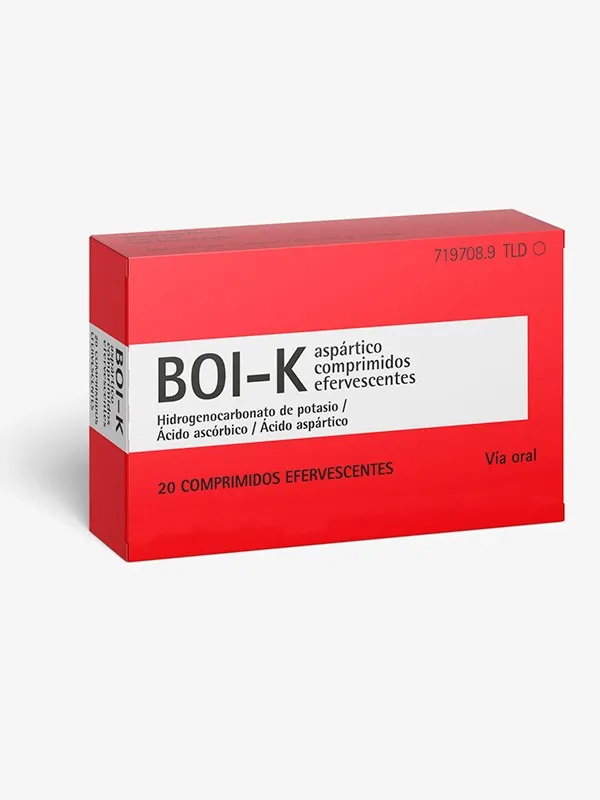
Table of Contents
- Package leaflet: Information for the user
- Introduction
- 1. What BOI-K effervescent tablets are and what they are used for
- 2. Before taking BOI-K effervescent tablets
- 3. How to take BOI-K effervescent tablets
- 4. Possible adverse effects
- 5. Storage of BOI-K effervescent tablets
- 6. Additional Information
Package leaflet: Information for the user
Introduction
Package leaflet: INFORMATION FOR THE USER
Boi-k effervescent tablets
Potassium hydrogen carbonate / Ascorbic acid
Read the entire leaflet carefully before you start taking this medicine.
- Keep this leaflet, as you may need to read it again.
- If you have any questions, ask your doctor or pharmacist.
- This medicine has been prescribed for you and should not be given to other people, even if they have the same symptoms, as it may harm them.
- If you think any of the side effects you experience is serious or if you notice any side effects not listed in this leaflet, inform your doctor or pharmacist.
Leaflet contents:
- What Boi-k effervescent tablets are and what they are used for
- Before taking Boi-k effervescent tablets
- How to take Boi-k effervescent tablets
- Possible side effects
- How to store Boi-k effervescent tablets
- Further information
1. What BOI-K effervescent tablets are and what they are used for
BOI-K belongs to a group of medicines called "mineral supplements".
BOI-K is used in the following situations:
Treatment and prophylaxis of hypokalemia (potassium deficiency) in situations such as:
-
Potassium loss caused by treatment with diuretics (medications to increase urine elimination), corticosteroids and related derivatives (medications to reduce inflammation).
-
Potassium loss caused by vomiting, diarrhea, kidney problems, hyperaldosteronism (excessive production of the hormone aldosterone), and excessive sweating (due to climate or physical exercise).
-
Situations involving inadequate potassium intake, such as: states of malnutrition, potassium-deficient diets.
Treatment of digitalis intoxication (heart medications)
Situations where additional vitamin C intake is required.
2. Before taking BOI-K effervescent tablets
Do not take BOI-K effervescent tablets:
-
If you are allergic (hypersensitive) to potassium hydrogen carbonate, ascorbic acid or any of the other components of BOI-K.
-
If you have excess potassium in the blood (hyperkalemia).
-
If you have any of the following gastrointestinal conditions (of the stomach and intestine): intestinal obstruction, digestive tract stenosis, paralytic ileus, or any other condition that hinders or prevents passage through the stomach or intestine.
-
If you have peptic ulcer or gastrointestinal bleeding, as excess potassium may cause gastrointestinal perforation.
-
If you have severe renal insufficiency, as accumulation of potassium in the kidneys may occur.
-
If you have a disease characterized by reduced urine production.
-
If you have Addison's disease (a condition in which the production of certain hormones called cortisol and aldosterone is reduced).
Take special care with BOI-K effervescent tablets:
- If you have or have had kidney stones or gout.
- During treatment, your doctor should monitor your blood potassium levels, especially in elderly patients, or in patients with heart disease or renal insufficiency.
- If you are being treated with amiloride, triamterene, or spironolactone—types of diuretics (medications to increase urine elimination)—hyperkalemia (high blood potassium levels) may occur.
- If you are being treated with digitalis (medications for heart problems), BOI-K may increase the toxicity of digitalis.
- If you have ever had a peptic ulcer, as oral administration of potassium (a component of BOI-K) may cause gastrointestinal mucosal irritation.
If you take vitamin C (ascorbic acid) in amounts exceeding 1 g per day, diarrhea, kidney stones (renal calculi), and abdominal cramps (stomach pain) may occur. There is also a risk of stone formation and acute gout attacks in individuals predisposed to these conditions.
Throughout treatment, your doctor may assess whether periodic electrocardiogram (ECG) monitoring is necessary, as potassium administration should be discontinued if ECG abnormalities occur.
Use in elderly patients
Your doctor should monitor your blood potassium levels to rule out renal insufficiency.
In any of these situations, inform your doctor before taking BOI-K.
Use of other medicines:
Inform your doctor or pharmacist if you are currently using, or have recently used, any other medicines, including those obtained without a prescription, homeopathic remedies, herbal medicines, and other health-related products, as it may be necessary to interrupt treatment or adjust the dosage.
Consult your doctor if you are taking BOI-K together with any of the following medicines:
- Amiloride, triamterene, or spironolactone (medications to increase urine elimination), ACE inhibitors (angiotensin-converting enzyme inhibitors: medications for treating high blood pressure), angiotensin II receptor antagonists (medications for treating high blood pressure), NSAIDs (non-steroidal anti-inflammatory drugs: medications for pain and inflammation), β-blockers (medications used to treat heart rhythm disorders and high blood pressure), cyclosporine (a medication used in transplant patients), heparin (to prevent blood clotting). These medications may promote potassium accumulation and lead to hyperkalemia (high blood potassium levels).
- Stimulant laxatives, corticosteroids, amphotericin B (an antifungal antibiotic), aminoglycosides (gentamicin), penicillins (penicillin, carbenicillin, mezlocillin, piperacillin, ticarcillin), or polymyxin B. These medications may increase potassium loss, potentially causing hypokalemia (low blood potassium levels).
- Digitalis (medications for heart problems), as BOI-K may increase their toxicity.
- Parenteral calcium salts, because heart rhythm disturbances may occur.
- Insulin or bicarbonate, because they may cause hypokalemia (low blood potassium levels).
- High-dose vitamin C (ascorbic acid) may alter the effects of the following medications: antidepressants, anticoagulants (to make blood less thick), high-dose salicylates (medications to relieve pain and reduce fever), sulfonamides (a type of antibiotic), trimethoprim/sulfamethoxazole (a combination antibiotic), or hormonal contraceptives.
Never take another medication on your own initiative without medical advice, as some combinations should be avoided and in other cases dosage adjustments may be necessary.
Interference with diagnostic tests
If you are scheduled to undergo any diagnostic tests (blood or urine tests, including dipstick tests), inform your doctor that you are being treated with BOI-K, as it may alter test results.
Pregnancy and breastfeeding:
Consult your doctor or pharmacist before using any medication.
Inform your doctor if you are pregnant, trying to become pregnant, or breastfeeding.
Pregnancy
BOI-K is not expected to cause adverse reactions in the mother or fetus, provided that the recommended daily intake of potassium and vitamin C is not exceeded.
Administration of high-dose potassium or vitamin C during pregnancy is not recommended unless strictly necessary.
Breastfeeding
The effect of high-dose potassium is unknown; therefore, its administration in high doses is not recommended unless strictly necessary.
Driving and using machines
BOI-K does not affect the ability to drive or operate machinery.
Important information about some of the components of BOI-K
This medicine contains lactose and sucrose. If your doctor has informed you that you have an intolerance to certain sugars, consult with him before taking this medicine.
3. How to take BOI-K effervescent tablets
Follow exactly the administration instructions for BOI-K provided by your doctor. If you have any doubts, consult your doctor or pharmacist.
BOI-K is administered orally.
The usual dose is:
Adults:
From 2 to 6 tablets per day.
Patients with renal insufficiency:
A dose adjustment may be necessary depending on the degree of renal impairment.
Instructions for correct administration:
It is recommended to divide the daily dose into 2 or 3 doses, taken during or immediately after meals, to reduce gastrointestinal irritation.
The effervescent tablet must be dissolved in a small amount of water and taken alone or mixed with fruit juices, broth, etc., preferably during or immediately after meals.
If you take more BOI-K effervescent tablets than you should:
If you have taken more BOI-K than you should, consult your doctor or pharmacist immediately or contact the Toxicology Information Service (Telephone: 91 562 04 20), and bring the container with any remaining medicine so the doctor can identify what has been taken.
Symptoms of potassium salt overdose may include: abdominal pain, nausea and vomiting, diarrhea and ulcers, chest tightness, hyperkalemia (excess potassium in the blood), difficulty breathing, and cardiac failure.
Treatment in patients with an overdose of an oral potassium supplement is usually symptomatic and may require only temporary discontinuation of the treatment.
If you forget to take BOI-K effervescent tablets:
If you forget to take a dose, take it as soon as you remember, unless it is almost time for your next dose. Do not take a double dose to make up for a missed dose.
If you have any further questions about the use of this product, ask your doctor or pharmacist.
4. Possible adverse effects
Like all medicines, BOI-K may produce adverse effects, although not everyone will experience them.
If you consider any of the adverse effects you experience to be severe, or if you notice any adverse effects not listed in this leaflet, inform your doctor or pharmacist.
The frequency terminology used below corresponds to the following definitions: Very common (≥1/10), common (≥1/100, <1/10), uncommon (≥1/1,000, <1/100), rare (≥1/10,000, <1/1,000), very rare (<1/10,000), frequency not known (cannot be estimated from the available data).
The adverse effects of potassium hydrogenocarbonate are generally mild and transient. The adverse effects are:
- Very common: nausea, vomiting, diarrhoea, flatulence (excess gas), abdominal pain, and gastric hyperacidity.
- Common: peptic ulcer, gastrointestinal haemorrhage, intestinal obstruction, or intestinal perforation.
- Rare: exanthematous eruptions (skin irritation) may occur.
- Frequency not known: severe hyperkalaemia (excess potassium in the blood) may occur.
If you take doses of vitamin C (ascorbic acid) exceeding 1 g per day, diarrhoea, kidney stones, and abdominal cramps may occur. There is also a risk of kidney stone formation and precipitation of acute gout attacks in individuals predisposed to them.
If you consider any of the adverse effects you experience to be severe, or if you notice any adverse effects not listed in this leaflet, inform your doctor or pharmacist.
5. Storage of BOI-K effervescent tablets
Keep BOI-K out of the reach and sight of children.
Expiry
Do not use BOI-K after the expiry date stated on the packaging after EXP. The expiry date refers to the last day of the month indicated.
No special storage conditions are required.
Medicines should not be disposed of via wastewater drains or household waste. Dispose of unused medicines and their packaging at the SIGRE collection point at your pharmacy. If in doubt, ask your pharmacist how to dispose of medicines and packaging you no longer need. This will help protect the environment.
6. Additional Information
Composition of Boi-k effervescent tablets
The active substances are potassium hydrogen carbonate and ascorbic acid. Each BOI-K effervescent tablet contains 1,001 mg of potassium hydrogen carbonate and 250 mg of ascorbic acid.
The other components are: anhydrous citric acid, sodium benzoate (E-211), macrogol 6000, sodium saccharin, sucrose, lemon flavor, monohydrate lactose.
Appearance of the product and contents of the pack
Boi-k effervescent tablets are presented as white, circular effervescent tablets with a flat surface and lemon scent.
Boi-k effervescent tablets are available in packs containing 20 or 50 tablets.
If a yellowish discoloration of the tablets appears, this does not indicate loss of their therapeutic potassium activity.
Marketing Authorization Holder and Manufacturer
Holder
IONFARMA, S.L.U.
Perú, 228
08020 Barcelona, Spain.
Manufacturer
Laboratorios ERN, S.A.
Gorgs Lladó, 188
08210 Barberà del Vallès – Barcelona
Spain
This leaflet was approved in April 2012
Detailed and up-to-date information on this medicinal product is available on the website of the Spanish Agency for Medicines and Health Products (AEMPS) http://www.aemps.gob.es/