Atenolol Normon 50 mg film-coated tablets EFG
Spain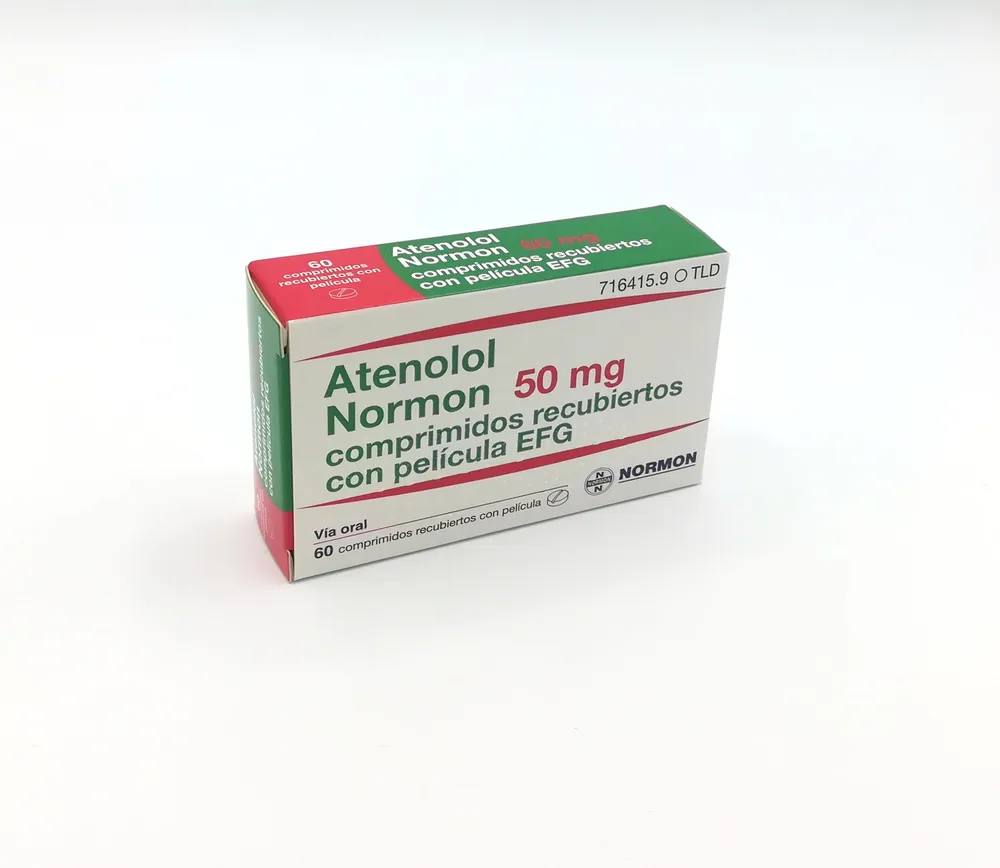
Table of Contents
Package leaflet: Information for the user
Introduction
Package leaflet: information for the user
Atenolol Normon 50 mg film-coated tablets EFG
atenolol
Read all of this leaflet carefully before you start taking this medicine, because it contains important information for you.
- Keep this leaflet, as you may need to read it again.
- If you have any questions, ask your doctor or pharmacist.
- This medicine has been prescribed for you only, and you should not give it to other people, even if they have the same symptoms as you, because it could harm them.
- If you experience any adverse reactions, consult your doctor or pharmacist, even if they are adverse reactions not listed in this leaflet. See section 4.
Contents of the leaflet
- What Atenolol Normon is and what it is used for
- What you need to know before taking Atenolol Normon
- How to take Atenolol Normon
- Possible side effects
- How to store Atenolol Normon
Contents of the pack and other information
1. What Atenolol Normon is and what it is used for
Atenolol belongs to a group of medicines called beta-blockers, which act on the heart and circulatory system.
Atenolol is indicated for the treatment of high blood pressure, to help prevent chest pain (angina), to maintain regular heartbeats, and also to protect the heart during and after a heart attack.
2. What you need to know before taking Atenolol Normon
-
Do not take Atenolol Normon:
-
If you are allergic to atenolol or to any of the other ingredients of this medicine (listed in section 6).
-
if you have or have had heart conditions such as uncontrolled heart failure or heart block (a disorder of heart conduction).
-
if you have ever experienced very slow or very irregular heartbeats, very low blood pressure, or circulatory failure.
-
if you have ever been diagnosed with phaeochromocytoma (a tumour of the adrenal glands).
-
if you have been fasting.
-
if you have been diagnosed with metabolic acidosis (a metabolic disorder causing excessive blood acidity).
-
These tablets are for your use only and must not be given to anyone else.
-
Warnings and precautions
Talk to your doctor or pharmacist before you start taking Atenolol Normon.
-
If you have health problems such as asthma or breathing difficulties, diabetes, circulatory disorders, or heart, kidney, or thyroid problems.
-
If you have ever been told you have a specific type of chest pain (angina) called Prinzmetal's angina.
-
If you are pregnant, think you may be pregnant, or are breastfeeding. See "Pregnancy and breastfeeding".
-
If you have ever had an allergic reaction to anything, for example, an insect sting.
-
You may notice that your pulse is slower while taking these tablets. This is normal, but if you are concerned, inform your doctor.
-
If you are diabetic, atenolol may alter your normal response to low blood sugar, which usually includes an increased heart rate. Atenolol may also increase the risk of severe hypoglycaemia when used with certain types of antidiabetic medicines called sulphonylureas (e.g., gliquidone, gliclazide, glibenclamide, glipizide, glimepiride or tolbutamide).
-
If you are admitted to hospital, inform healthcare staff, and especially the anaesthetist, that you are being treated with atenolol.
-
Stop taking your tablets only if your doctor tells you to, and in that case, do so only gradually.
-
Children and adolescents
Should not be used in children. See "Do not take Atenolol Normon".
- Taking Atenolol Normon with other medicines
Tell your doctor or pharmacist if you are taking, have recently taken, or might need to take any other medicines, including those obtained without a prescription, homeopathic remedies, herbal medicines, and other health-related products, as it may be necessary to interrupt treatment or adjust the dose of one of them. Some medicines may affect the action of others. In particular, inform your doctor if you are taking:
- Disopyramide or amiodarone (for irregular heartbeats).
- Other treatments for hypertension or angina (particularly verapamil, diltiazem, nifedipine, clonidine). If you are taking clonidine for hypertension or to prevent migraine, do not stop treatment with clonidine or atenolol without first consulting your doctor.
- Treatment for heart failure (digoxin).
- Anti-inflammatory medicines for pain relief (such as indometacin or ibuprofen).
- Nasal decongestants or other cold remedies you may have purchased yourself from a pharmacy.
- Insulin or oral antidiabetic medicines such as drugs called sulphonylureas (e.g., gliquidone, gliclazide, glibenclamide, glipizide, glimepiride or tolbutamide)
See "Warnings and precautions".
- Pregnancy and breastfeeding
If you are pregnant or breastfeeding, think you may be pregnant, or plan to become pregnant, consult your doctor or pharmacist before using this medicine.
Pregnancy
There are insufficient data on the safety of atenolol during the first month of pregnancy. Your doctor will decide whether treatment during the second and third trimesters is beneficial for you.
Breastfeeding
Inform your doctor if you are being treated with atenolol at the time of delivery or during breastfeeding, as your baby may be at risk of low blood sugar and slow heart rate.
Atenolol passes into breast milk.
Driving and using machines
It is unlikely that these tablets will adversely affect these abilities. However, some patients may occasionally experience dizziness and fatigue while being treated with atenolol; therefore, if you experience these effects, you should not drive or operate machinery.
- Use in athletes
Athletes should be aware that this medicine contains a component that may result in a positive analytical finding in doping control tests.
- Atenolol Normon contains sodium
This medicine contains less than 23 mg of sodium (1 mmol) per tablet; hence, it is essentially "sodium-free".
3. How to take Atenolol Normon
Follow exactly the instructions for use of this medicine given by your doctor or pharmacist. If in doubt, consult your doctor or pharmacist again.
Remember to take your medicine
Your doctor will tell you how long you need to take atenolol. Do not stop treatment before your doctor advises you to do so.
Usual dose for adults:
Your doctor will decide the dose of atenolol you should take each day, depending on your condition. The table included below shows the usual total daily dose for an adult. The dose is normally taken once daily.
High blood pressure | 50 mg to 100 mg (1 or 2 tablets of 50 mg) once daily |
Chest pain (angina) | 100 mg (2 tablets of 50 mg) once daily or 1 tablet of 50 mg twice daily |
Irregular heartbeats | 50 mg to 100 mg (1 to 2 tablets of 50 mg) once daily |
Protection after a heart attack | 100 mg (2 tablets of 50 mg) once daily |
- Swallow the tablet whole with water.
- Try to take your tablet at the same time each day.
- Do not stop taking your tablets even if you feel well, unless your doctor tells you otherwise; in that case, you should stop gradually.
If you take more Atenolol Normon than you should:
If you take a larger dose than normal, contact your doctor or nearest hospital.
In case of overdose or accidental ingestion, contact the Toxicology Information Service
(Tel. 91 562 04 20). It is recommended to bring the medicine package and leaflet to the healthcare professional.
- If you forget to take Atenolol Normon
If you miss a dose, take it as soon as you remember. Do not take a double dose to make up for forgotten doses.
4. Possible adverse effects
Like all medicines, this medicine can cause adverse effects, although not everyone experiences them.
Common (may affect up to 1 in 10 patients)
- Slower heartbeats.
- Cold fingers of hands and feet.
- Nausea.
- Diarrhea.
- Fatigue.
Uncommon (may affect up to 1 in 100 patients)
- Sleep disorders.
Rare (may affect up to 1 in 1,000 patients)
- Heart block (which may cause an abnormal heartbeat, dizziness, fatigue, or fainting).
- Worsening of breathing difficulties, if you have or have had asthma.
- Shortness of breath and/or swelling of the ankles, if you also have heart failure.
- Worsening of your arterial circulation, if you already suffer from some degree of circulatory insufficiency.
- Numbness and spasms in the fingers of the hands, followed by heat and pain (Raynaud's phenomenon).
- Mood changes.
- Nightmares.
- Confusion.
- Psychosis or hallucinations (mental disorders).
- Headache.
- Dizziness, especially when standing up.
- Tingling sensation in the hands.
- Impotence.
- Dry mouth.
- Dry eyes.
- Vision disorders.
- Hair loss.
- Skin rash, including worsening of psoriasis.
- Thrombocytopenia (increased tendency to bruise).
- Purpura (purple spots on the skin).
- Jaundice (which may appear as yellowing of the skin and eyes).
Very rare (may affect up to 1 in 10,000 patients)
- Very rarely, changes in certain blood cells or blood components may occur. Your doctor may wish to perform a blood test to check whether atenolol has had any effect on the blood.
Frequency not known (cannot be estimated from the available data)
- Lupus-like syndrome (a disease in which the immune system produces antibodies that mainly attack the skin and joints).
Reporting of adverse effects
If you experience any type of adverse effect, consult your doctor or pharmacist, even if it is a possible adverse effect not listed in this leaflet. You may also report them directly through the Spanish Pharmacovigilance System for Human Medicines: https://www.notificaram.es. By reporting adverse effects, you can help provide more information on the safety of this medicine.
5. Storage of Atenolol Normon
Keep this medicine out of the sight and reach of children.
No special storage conditions are required. Store in the original packaging.
Do not use this medicine after the expiry date stated on the packaging and on the blister (after "EXP"). The expiry date refers to the last day of the month indicated.
Medicines must not be disposed of via wastewater or household waste. Dispose of unused medicines and their packaging at the SIGRE collection point at your pharmacy. If you have any doubts, ask your pharmacist how to dispose of medicines and packaging you no longer need. This will help protect the environment.
6. Contents and additional information
Composition of Atenolol Normon
The active substance is atenolol. Each coated tablet contains 50 mg of atenolol.
The other components are: microcrystalline cellulose (E-460i), pregelatinized corn starch, sodium carboxymethyl starch (type A) (derived from potato starch), magnesium stearate (E-470b), talc (E-553b), titanium dioxide (E-171), macrogol 6000, ammonium methacrylate copolymer type A and propylene glycol (E-1520).
Appearance of the product and contents of the pack
Atenolol Normon is presented as film-coated tablets, white or slightly cream-colored, round, biconvex, with a break line and printed on one side, blank on the other.
Atenolol Normon is available in packs of 30 and 60 tablets.
Marketing Authorization Holder and Manufacturer
LABORATORIOS NORMON, S.A.
Ronda de Valdecarrizo, 6 – 28760 Tres Cantos – Madrid (SPAIN)
Date of the most recent revision of this leaflet: April 2019
Other sources of information
Detailed information on this medicinal product is available on the website of the Spanish Agency for Medicines and Health Products (AEMPS) http://www.aemps.gob.es
You can access detailed information about this medicine by scanning with your mobile phone (smartphone) the QR code included in the leaflet and packaging. You can also access this information at the following internet address:
https://cima.aemps.es/cima/dochtml/p/61492/P_61492.html