Iodixol
Ukraine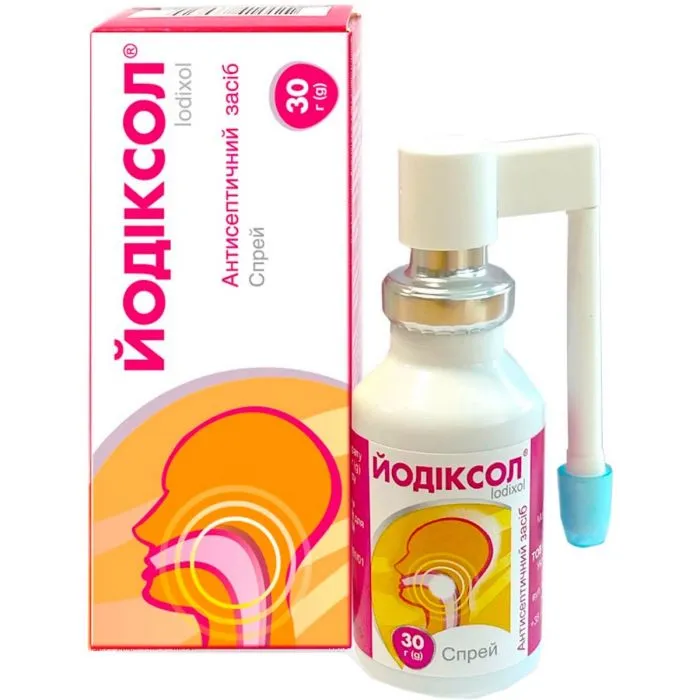
Table of Contents
INSTRUCTIONS FOR MEDICAL USE OF THE MEDICINAL PRODUCT IODIXOL® (Iodixol)
Composition:
Active ingredient: povidone-iodine;
30 g of the preparation contains 2.55 g of povidone-iodine;
Excipients: allantoin; propylene glycol; levomenthol; ethanol (96 %); citric acid monohydrate; sodium phosphate dodecahydrate; purified water.
Pharmaceutical form. Spray.
Main physicochemical characteristics: the preparation is dispensed from the container as an aerosol jet having a specific odor and consisting of dispersed droplets of dark brown liquid in the air.
Pharmacotherapeutic group. Preparations used in throat diseases. Antiseptics. Povidone-iodine. ATC code R02A A15.
Pharmacological properties.
Pharmacodynamics. Antiseptic agent. Povidone-iodine is a water-soluble complex of iodine with a synthetic non-toxic polymer – povidone. Upon contact with the skin and mucous membranes, iodine is released, exerting a pronounced antiseptic effect due to its high oxidizing capacity. As a result, the drug produces pronounced bactericidal, fungicidal, sporicidal, and selective antiviral activity, and is active against protozoa.
Pharmacokinetics. Not studied.
Clinical characteristics.
Indications.
Treatment of infectious and inflammatory diseases of the oral cavity and pharynx: catarrhal and follicular angina; streptococcal angina (in combination with antibiotic therapy); acute and chronic tonsillitis; glossitis; aphthous stomatitis.
Contraindications.
Hypersensitivity to iodine or other components of the drug; dermatitis herpetiformis Duhring; hyperthyroidism; adenoma or thyroid gland dysfunction; decompensated cardiac, renal, or hepatic insufficiency; radioactive iodine diagnostics or therapy (within 2 weeks before and after the procedure).
Interaction with other medicinal products and other forms of interaction.
The use of the drug together with other agents intended for the oral cavity and pharynx (especially with hydrogen peroxide) is not recommended; Iodixol® is incompatible with reducing agents, alkaloid salts, and cationic antiseptics.
The use of povidone-iodine should be avoided in patients receiving lithium therapy. Povidone-iodine should not be used simultaneously with agents containing chlorhexidine or silver sulfadiazine due to possible partial inactivation. Povidone-iodine interacts with strong alkalis, sodium thiosulfate, sodium metabisulfite, and thimerosal. The drug must not be used simultaneously with these substances.
All interactions are visually manifested by discoloration of the solution, indicating reduced efficacy of the drug. Concurrent use of povidone-iodine and lithium preparations may cause a synergistic hypothyroid effect.
The drug should not be used simultaneously with disinfectants containing mercury, enzyme-containing ointments, or tincture of benzoin; the solution is incompatible with oxidizing agents, alkali metal salts, and substances with acidic reaction.
Due to its oxidizing properties, povidone-iodine may interfere with the results of certain diagnostic tests, such as occult blood detection in feces or urine, or glucose detection in urine. It may affect the results of certain diagnostic tests (e.g., thyroid scintigraphy, determination of protein-bound iodine, measurement of radioactive iodine); it may compete with iodine used in thyroid therapy. Prolonged use of the drug should be avoided in patients receiving lithium preparations.
Special precautions for use.
The product contains 20% ethanol (96%) and does not contain sugar.
The product is not intended for internal use.
Do not inhale or swallow the product.
In laryngitis, the product should be used only in exceptional cases.
The brown color of the solution indicates its effectiveness. Discoloration of the solution indicates reduced efficacy of the product.
The use of povidone-iodine may interfere with thyroid scintigraphy. Povidone-iodine should not be used within 1–2 weeks prior to thyroid scintigraphy.
Since the development of hyperthyroidism cannot be excluded, prolonged use (more than 14 days) of povidone-iodine or its use in the indicated amounts in patients (especially elderly patients) with latent thyroid dysfunction is permissible only after careful assessment of the benefit-risk ratio. Such patients should be monitored for early signs of hyperthyroidism and appropriate evaluation of thyroid function, even after discontinuation of the product (for up to 3 months).
Avoid contact with eyes. If the solution comes into contact with eyes, rinse thoroughly with water.
The product may stain the mucous membranes of the oral cavity, teeth, skin, and clothing. Stains on mucous membranes, teeth, and skin can be removed using alcohol solutions. Stains on clothing can be removed using diluted ammonia (ammonium spirit), sodium thiosulfate, or soapy water.
If possible, dental prostheses and similar devices should be removed from the mouth before applying the product.
Do not heat the product before use.
Use during pregnancy or breastfeeding.
Since metabolites of the active substance cross the placenta and are excreted in breast milk, the product should not be used during these periods.
Ability to affect reaction speed when driving or operating machinery. Unknown.
Method of Administration and Dosage.
The spray is intended for topical application to the mucous membranes of the oral cavity and pharynx.
Before use, remove the protective cap and attach the spray nozzle to the mechanical pump stem. Before the first use, press the spray nozzle several times until a fine mist appears. Before each subsequent use, perform 2–3 actuations to ensure the solution reaches the spray nozzle and is properly dispensed; then the medication can be used.
For the treatment of angina and tonsillitis, insert the spray nozzle 2–3 cm into the oral cavity, close the mouth, hold breath, and press the spray nozzle fully twice with the index finger so that one spray is directed to the right side and the second to the left side.
For the treatment of glossitis or aphthous stomatitis, position the spray nozzle close to the affected area and administer the required number of sprays (1–3 actuations) to thoroughly moisten the affected site.
The medication should generally be used 2–4 times daily; if necessary, every 4 hours.
The duration of treatment depends on the nature and severity of the disease and is determined individually by the physician.
After use, remove the spray nozzle from the mechanical pump and rinse it thoroughly with hot water. Replace the protective cap on the mechanical pump.
During spraying, hold the container in an upright position so that the spray nozzle is on top.
The container must not be used in an inverted position.
Children.
Iodexol® may be used in children aged 6 to 12 years only under medical supervision. In children aged 12 years and older, the medication should be used with caution due to the potential risk of laryngospasm.
Significant systemic absorption of iodine may occur in children following local application of povidone-iodine. Povidone-iodine should be used with caution in pediatric patients, as elevated plasma iodine levels may increase the risk of renal impairment. Thyroid function should be monitored.
Overdose.
When used correctly as a topical agent in the oral cavity or pharynx, overdose has not been reported.
Symptoms. However, ingestion of a large amount of the solution may lead to acute poisoning. According to available data, initial symptoms may include a metallic taste in the mouth, nausea, vomiting, abdominal pain, and diarrhea. Within 1–3 days, anuria, swelling of the glottis leading to asphyxia, aspiration pneumonia, or pulmonary edema may develop. In some cases, severe circulatory disturbances may occur.
Treatment. In case of overdose, appropriate therapy is required. Administer activated charcoal and induce vomiting. Initial treatment includes standard measures to prevent further absorption of iodine from the gastrointestinal tract. The patient should consume milk and starch mucilage. If the esophagus is not damaged, gastric lavage may be performed. Additionally, administer activated charcoal and a 1–5% solution of sodium thiosulfate, which promotes the reduction of iodine to iodide. There is no specific antidote. Treatment is symptomatic.
Side effects.
The most common local allergic reactions are itching, burning, hyperemia, urticaria, dry mouth, redness and skin rash. With prolonged use of the drug, iodine-induced hyperthyroidism may develop, mainly in patients with pre-existing thyroid disease, as well as renal dysfunction, acute renal failure, changes in serum electrolyte levels (hypernatremia) and osmolarity, and metabolic acidosis.
Prolonged local use of povidone-iodine may occasionally cause neutropenia.
Hypersensitivity symptoms occur only rarely; urticaria may occur, very rarely angioneurotic edema, and in isolated cases, anaphylactic shock. In individual cases, transient burning sensation at the site of application (most commonly in children) or dryness in the oral cavity may occur.
Prolonged use of povidone-iodine may lead to iodism (metallic taste in the mouth, increased salivation, swelling of the eyes or larynx, pulmonary edema, skin rashes, gastrointestinal disturbances).
Shelf life. 2 years.
The drug should not be used after the expiry date stated on the packaging.
Storage conditions.
Store at a temperature not exceeding 25 °C. To protect from light, the container should be kept in the outer carton.
Keep out of reach of children.
Packaging.
30 g in a plastic container with a mechanical pump and spray nozzle. One container per cardboard box.
Availability. Over-the-counter (without prescription).
Manufacturer. LLC "Micropharm".
Manufacturer's address and place of business.
20, Shevchenka Street, Kharkiv, 61013, Ukraine.