Ursomax
Ukraine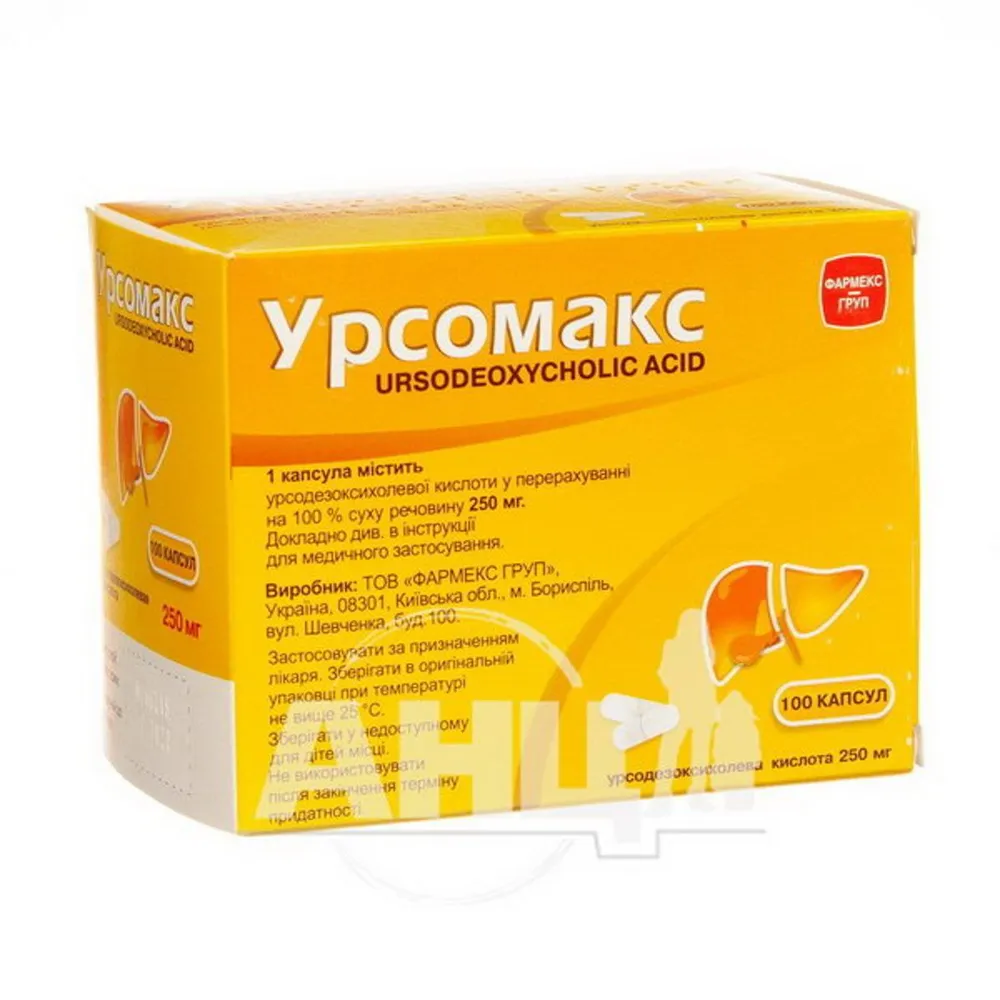
Table of Contents
INSTRUCTIONS FOR MEDICAL USE OF THE MEDICINAL PRODUCT URSOMAX (URSOMAX)
Composition:
Active substance: ursodeoxycholic acid;
1 capsule contains ursodeoxycholic acid (calculated as 100% dry substance) 250 mg;
Excipients: maize starch, hydroxypropylcellulose, sodium croscarmellose, colloidal silicon dioxide, magnesium stearate, gelatin.
Pharmaceutical form. Capsules.
Main physicochemical properties: hard gelatin capsules size 0, body and cap white in color. The contents of the capsule – granules or powder white or almost white in color.
Pharmacotherapeutic group.
Agents used in the treatment of liver and biliary tract diseases. Agents used in biliary pathology. ATC code A05AA02.
Agents used in liver diseases, lipotropic agents. ATC code A05B.
Pharmacological Properties
Pharmacodynamics
A small amount of ursodeoxycholic acid is naturally present in human bile.
When administered orally, it reduces the cholesterol saturation of bile by inhibiting cholesterol absorption in the intestine and decreasing cholesterol secretion into bile. Through cholesterol dispersion and formation of liquid crystals, gradual dissolution of gallstones may occur.
According to current knowledge, the therapeutic effect of ursodeoxycholic acid in liver diseases and cholestasis is attributed to the relative replacement of lipophilic, detergent-like toxic bile acids with the hydrophilic, cytoprotective, and non-toxic ursodeoxycholic acid, as well as to improved secretory function of hepatocytes and modulation of immunoregulatory processes.
Pediatric Use
Cystic Fibrosis
Clinical reports provide data on long-term use of ursodeoxycholic acid (for periods of up to 10 years) in the treatment of children with hepatobiliary complications associated with cystic fibrosis.
Evidence suggests that ursodeoxycholic acid therapy may reduce bile duct proliferation, halt the progression of histological changes, and even reverse hepatobiliary abnormalities, provided treatment is initiated at an early stage of cystic fibrosis. For optimal therapeutic efficacy, treatment with ursodeoxycholic acid should begin as soon as the diagnosis of cystic fibrosis is confirmed.
Pharmacokinetics
After oral administration, ursodeoxycholic acid is rapidly absorbed in the small intestine and the upper segment of the ileum via passive transport, and in the terminal ileum via active transport. The extent of absorption typically ranges between 60–80%. Following absorption, the bile acid undergoes nearly complete hepatic conjugation with the amino acids glycine and taurine, after which it is excreted into bile. The first-pass hepatic clearance is up to 60%.
Depending on the daily dose and the underlying liver disorder or condition, the more hydrophilic ursodeoxycholic acid accumulates in bile. Concurrently, a relative reduction in other, more lipophilic bile acids is observed.
Under the influence of intestinal bacteria, partial degradation occurs, forming 7-ketolithocholic acid and lithocholic acid. Lithocholic acid is hepatotoxic and may cause parenchymal liver damage in several animal species. In humans, only a small amount is absorbed; this is sulfated in the liver, thereby detoxified, prior to being excreted in bile and ultimately in feces.
The biological half-life of ursodeoxycholic acid ranges from 3.5 to 5.8 days.
Clinical characteristics.
Indications.
For dissolution of radiolucent cholesterol gallstones up to 15 mm in diameter in patients with a functioning gallbladder, regardless of the presence of gallstone(s) in it.
For the treatment of biliary reflux gastritis.
For symptomatic treatment of primary biliary cirrhosis (PBC) in the absence of decompensated liver cirrhosis.
For the treatment of hepatobiliary disorders in cystic fibrosis in children aged 6 to 18 years.
Contraindications.
Hypersensitivity to any component of the medicinal product.
Acute inflammation of the gallbladder or bile ducts.
Obstruction of the bile ducts (obstruction of the common bile duct or cystic duct).
Frequent episodes of biliary colic.
Radiopaque calcified gallstones.
Impaired contractility of the gallbladder.
Failed portoenterostomy or lack of adequate bile flow in children with biliary atresia.
Interaction with other medicinal products and other types of interactions.
Ursomax 250 mg capsules must not be used concomitantly with cholestyramine, colestipol, or antacid preparations containing aluminium hydroxide and/or smectite, as these agents bind ursodeoxycholic acid in the intestine and thereby interfere with its absorption and efficacy. If treatment with agents containing any of these substances is necessary, they should be taken at least 2 hours before or 2 hours after taking Ursomax 250 mg capsules.
Ursomax 250 mg capsules may enhance intestinal absorption of cyclosporine. In patients receiving cyclosporine, the physician should monitor blood levels of this substance and adjust the cyclosporine dose if necessary.
In individual cases, Ursomax 250 mg capsules may reduce absorption of ciprofloxacin.
It has been reported that concomitant administration of ursodeoxycholic acid (500 mg/day) and rosuvastatin (20 mg/day) may lead to a slight increase in rosuvastatin plasma concentration. The clinical significance of this interaction, as well as its relevance to other statins, is unknown.
Ursodeoxycholic acid reduces the maximum plasma concentration (Cmax) and area under the curve (AUC) for the calcium antagonist nifedipine. Careful monitoring is recommended when nifedipine and ursodeoxycholic acid are used concomitantly. An increase in nifedipine dosage may be required.
In addition, reduced therapeutic effect of dapsone has been reported.
These data, together with in vitro findings, suggest that ursodeoxycholic acid may potentially induce cytochrome P450 3A enzymes. However, in a well-designed interaction study with budesonide, a known substrate of cytochrome P450 3A, no such effect was observed.
Estrogenic contraceptives, as well as lipid-lowering agents, may enhance hepatic cholesterol secretion and thus promote gallstone formation, which is an opposing effect to that of ursodeoxycholic acid used for gallstone dissolution.
Special precautions for use
Ursomax 250 mg capsules should be taken under medical supervision.
During the first 3 months of therapy, the physician should monitor liver function parameters (aspartate aminotransferase, alanine aminotransferase, and gamma-glutamyl transferase) every 4 weeks, and thereafter every 3 months. This allows assessment of treatment response in patients with primary biliary cirrhosis and timely detection of potential liver function abnormalities, especially in patients with advanced-stage primary biliary cirrhosis.
Use for dissolution of cholesterol gallstones
To evaluate the therapeutic effect and to detect early calcification of gallstones, visualization of the gallbladder (oral cholecystography) with radiographic examination in both upright and supine positions (ultrasound monitoring) should be performed 6–10 months after initiation of treatment, depending on stone size.
Ursomax 250 mg capsules must not be used if the gallbladder is not visualized on radiographic imaging, or in cases of gallstone calcification, impaired gallbladder contractility, or frequent biliary colic.
Women receiving Ursomax 250 mg capsules for dissolution of gallstones should use an effective non-hormonal method of contraception, as hormonal contraceptives may increase the risk of gallstone formation.
Treatment of patients with advanced-stage primary biliary cirrhosis (PBC)
Rare cases of hepatic decompensation have been reported, which may partially regress after discontinuation of therapy.
In patients with PBC, worsening of symptoms may very rarely occur at the beginning of treatment, such as increased pruritus. In such cases, the dose of Ursomax 250 mg capsules should be reduced to one capsule (250 mg) daily; the dose may then be gradually increased as described in the section "Dosage and administration".
If diarrhea occurs, the dosage should be reduced; if diarrhea persists, treatment should be discontinued.
Use during pregnancy or breastfeeding
Animal studies have not shown any effect of ursodeoxycholic acid on fertility. Data on effects on human fertility are lacking.
Data on the use of ursodeoxycholic acid in pregnant women are insufficient. Animal studies indicate reproductive toxicity at early stages of pregnancy. Ursomax capsules should not be used during pregnancy except in cases of clear medical necessity. Women of childbearing potential should only take the medication if they are using reliable contraceptive methods.
It is recommended to use non-hormonal contraceptives or low-estrogen oral contraceptives. Patients receiving 250 mg ursodeoxycholic acid capsules for dissolution of gallbladder stones should use effective non-hormonal contraception, as hormonal oral contraceptives may promote gallstone formation. Pregnancy should be excluded before starting treatment.
Available data from several reported cases of use in breastfeeding mothers indicate that the concentration of ursodeoxycholic acid in breast milk is extremely low; therefore, adverse effects in breastfed infants are not expected.
Ability to affect driving and operating machinery
No effects on the ability to drive or operate machinery have been observed.
Dosage and Administration
There are no age restrictions for the use of UrsoMax. For patients weighing less than 47 kg or who have difficulty swallowing UrsoMax capsules, an alternative dosage form of ursodeoxycholic acid—suspension—is available.
For dissolution of cholesterol gallstones
Approximately 10 mg of ursodeoxycholic acid per kg of body weight:
Table 1
| Body weight |
Number of capsules |
| up to 60 kg 61–80 kg 81–100 kg over 100 kg |
2 3 4 5 |
Capsules should be taken whole, without chewing, with water, once daily in the evening before bedtime.
The medication should be taken regularly.
The time required for dissolution of gallstones usually ranges from 6 to 24 months. If no reduction in the size of gallstones is observed after 12 months of treatment, continuing therapy is not advisable.
The effectiveness of treatment should be monitored every 6 months using ultrasound or X-ray imaging. Additional examinations should be performed to determine whether calcification of the stones has occurred over time. If calcification has occurred, treatment should be discontinued.
For the treatment of biliary reflux gastritis.
1 capsule of UrsoMax 250 mg once daily with some liquid in the evening before bedtime.
Usually, for the treatment of gastritis with bile reflux, UrsoMax 250 mg capsules are taken for 10–14 days. The duration of treatment depends on the patient's condition. The physician should make an individual decision regarding treatment duration in each case.
For symptomatic treatment of primary biliary cirrhosis.
The daily dose depends on body weight and ranges from 3 to 7 capsules (14 ± 2 mg of ursodeoxycholic acid per kg of body weight).
During the first 3 months of treatment, UrsoMax 250 mg capsules should be taken by dividing the daily dose into 3 doses throughout the day. After improvement in liver function parameters, the daily dose may be taken once daily in the evening.
Table 2
| Body weight (kg) |
Daily dose (mg/kg body weight) |
Capsules |
|||
| first 3 months |
thereafter |
||||
| morning |
afternoon |
evening |
evening (once daily) |
||
| 47–62 |
12–16 |
1 |
1 |
1 |
3 |
| 63–78 |
13–16 |
1 |
1 |
2 |
4 |
| 79–93 |
13–16 |
1 |
2 |
2 |
5 |
| 94–109 |
14–16 |
2 |
2 |
2 |
6 |
| over 110 |
2 |
2 |
3 |
7 |
|
Capsules should be swallowed whole with liquid. Regular administration must be maintained.
The use of Ursomax 250 mg capsules in primary biliary cirrhosis may be unlimited in duration.
In patients with primary biliary cirrhosis, clinical symptoms may rarely worsen at the beginning of treatment; for example, pruritus may intensify. If this occurs, therapy should be continued by taking 1 capsule of Ursomax 250 mg daily, followed by gradual dose escalation (increasing the daily dose by 1 capsule weekly) until the prescribed dosage regimen is reached.
Use in children
For children with cystic fibrosis aged 6 to 18 years, the dose is 20 mg/kg/day, divided into 2–3 doses, with subsequent dose increase up to 30 mg/kg/day if necessary.
Table 3
| Body weight (kg) |
Daily dose (mg/kg) |
Uromax, capsules, 250 mg |
||
| Morning |
Day |
Evening |
||
| 20–29 |
17–25 |
1 |
-- |
1 |
| 30–39 |
19–25 |
1 |
1 |
1 |
| 40–49 |
20–25 |
1 |
1 |
2 |
| 50–59 |
21–25 |
1 |
2 |
2 |
| 60–69 |
22–25 |
2 |
2 |
2 |
| 70–79 |
22–25 |
2 |
2 |
3 |
| 80–89 |
22–25 |
2 |
3 |
3 |
| 90–99 |
23–25 |
3 |
3 |
3 |
| 100–109 |
23–25 |
3 |
3 |
4 |
| >110 |
3 |
4 |
4 |
|
Children.
For dissolution of cholesterol gallstones, treatment of biliary reflux gastritis, and symptomatic treatment of PBC:
There are no absolute age restrictions for the use of Ursomax in children; however, capsules are not recommended for children with body weight below 47 kg. If a child's body weight is less than 47 kg and/or if the child has difficulty swallowing, ursodeoxycholic acid in suspension form is recommended.
For treatment of hepatobiliary disorders in cystic fibrosis:
Use in children aged 6 to 18 years.
Overdose.
In cases of overdose, diarrhea may occur. Other symptoms of overdose are unlikely because absorption of ursodeoxycholic acid decreases with increasing dose, and therefore a larger portion is excreted in feces.
If diarrhea occurs, the dose should be reduced; in cases of persistent diarrhea, therapy should be discontinued.
No specific treatment is required; consequences of diarrhea should be managed symptomatically, with restoration of fluid and electrolyte balance.
Additional information regarding special patient groups
Long-term high-dose therapy with ursodeoxycholic acid (28–30 mg/kg/day) in patients with primary sclerosing cholangitis (use not registered indication) has been associated with a higher incidence of serious adverse events.
Side effects.
Gastrointestinal disorders: Cases of paste-like stools or diarrhea have been reported during treatment with ursodeoxycholic acid.
Very rarely, severe abdominal pain localized in the right hypochondrium has been observed during treatment of primary biliary cirrhosis.
Hepatobiliary system disorders.
Very rarely, gallstone calcification may occur during treatment with ursodeoxycholic acid.
During therapy for advanced stages of primary biliary cirrhosis, very rarely decompensation of liver cirrhosis may develop, which partially regressed after discontinuation of treatment.
Immune system disorders.
Very rarely, allergic reactions including rash and urticaria may occur.
Shelf life. 4 years.
Storage conditions.
Store in the original packaging at a temperature not exceeding 25 °C. Keep out of reach and sight of children.
Packaging.
10 capsules in a blister pack. 1, 5, or 10 blisters per pack.
Prescription category.
Prescription only.
Manufacturer.
LLC "FARMEKS GROUP".
Manufacturer's location and address of place of business.
100, Shevchenka St., Boryspil, Kyiv region, 08301, Ukraine.