Tuberculin ppd rt 23 ssi
Ukraine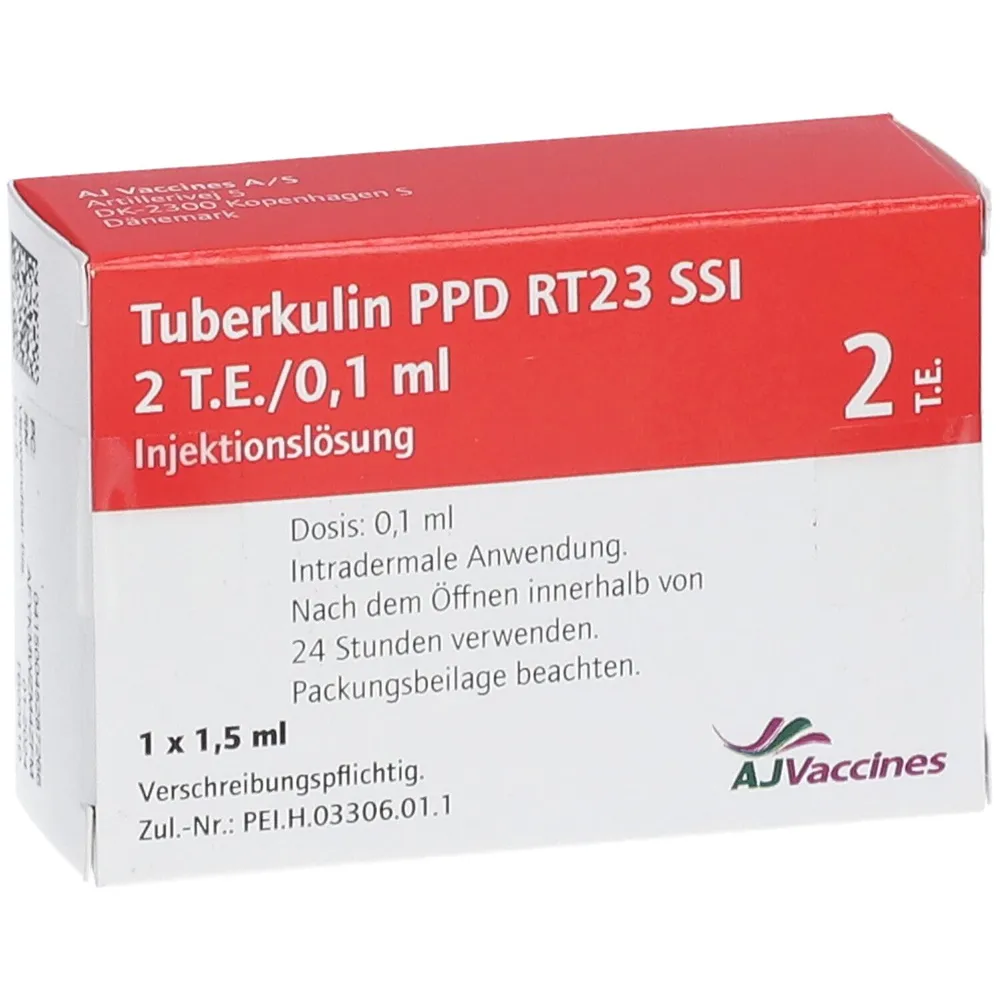
Table of Contents
INSTRUCTIONS FOR MEDICAL USE OF THE MEDICINAL PRODUCT TUBERCULIN PPD RT 23 SSI
Composition:
Active substance: tuberculin PPD RT 23
One dose (0.1 ml) contains: 0.04 mcg of tuberculin PPD RT 23 (2 TU)
One vial (1.5 ml) contains: 15 doses of Tuberculin PPD RT 23 SSI (2 TU/0.1 ml)
Excipients: disodium hydrogen phosphate dihydrate, sodium chloride, potassium dihydrogen phosphate, potassium hydroxyquinoline sulfate, polysorbate 80, water for injections.
Pharmaceutical form. Solution for injection.
Main physicochemical properties:
Tuberculin PPD RT 23 SSI is a clear, colorless to pale yellow solution free from foreign particles.
Pharmacotherapeutic group. Tuberculosis diagnostic agents. Tuberculin.
ATC Code V04CF01.
Pharmacological properties / immunological and biological properties.
Pharmacodynamics. The active ingredient of the product induces, when performing an intradermal diagnostic test, a specific delayed-type allergic reaction in infected or vaccinated individuals, manifested as a local reaction—hyperemia and infiltration (papule).
Pharmacokinetics.
Not applicable.
Clinical characteristics.
Indications.
The drug is intended for performing the intradermal tuberculin test (Mantoux test) with 2 TU PPD RT 23:
- for diagnosis of tuberculosis and identification of risk groups with latent tuberculosis infection;
- for selection of populations eligible for BCG revaccination;
- for determining tuberculosis infection prevalence in the population (or the state of increased sensitivity to tuberculin, if post-vaccination allergy is present but does not indicate actual infection).
Contraindications.
Skin diseases; acute illness or exacerbation of chronic disease,
including: allergic conditions, bronchial asthma, idiosyncrasy with pronounced skin manifestations, rheumatism in acute or subacute phases; epilepsy.
The Mantoux test must not be performed in child groups under quarantine due to childhood infections.
Tuberculin PPD RT 23 SSI should not be administered:
- to individuals with known hypersensitivity (Type I) to the active substance or to excipients;
- to individuals with a history of severe local reaction (e.g., vesicles, skin necrosis) following previous Mantoux testing. Skin necrosis at the injection site usually resolves within several days.
Special precautions.
When using a multidose vial, a new single-use auto-disable syringe with a sterile needle must be used each time the drug is withdrawn. The drug must be extracted from the vial under strict adherence to aseptic techniques.
Any unused medicinal product or waste material must be disposed of in accordance with current regulatory and legal requirements in Ukraine.
Tuberculin PPD RT 23 SSI does not contain live microorganisms.
Interaction with other medicinal products and other types of interactions.
Various medical and biological factors may lead to false-negative tuberculin reactions, such as patient age, nutritional status; or conditions such as renal failure, diabetes mellitus, presence of malignant tumors, HIV infection, sarcoidosis; or immunosuppressive influences (e.g., corticosteroid therapy). Viral infections (particularly measles, mumps, mononucleosis, varicella, and influenza) may reduce tuberculin reactivity for several months.
Reduced tuberculin reactivity may occur following live vaccine administration (e.g., measles, mumps, and rubella vaccines). This diminished response may result in a false-negative test outcome. Therefore, an interval of at least 4–6 weeks should be maintained between any prophylactic vaccination and the diagnostic Mantoux test.
Most patients co-infected with HIV and Mycobacterium tuberculosis do not exhibit tuberculin sensitivity. In patients with severe forms of tuberculosis (e.g., miliary tuberculosis), the tuberculin reaction may be diminished.
Prior BCG vaccination or recent infection with non-tuberculous mycobacteria may lead to cross-sensitization and result in a false-positive reaction to the Mantoux tuberculin test.
Special precautions for use.
Traceability
To improve the traceability of biological medicinal products, the name and batch number of the administered product should be clearly documented.
Although anaphylactic reactions are very rare during the Mantoux tuberculin test, standard emergency measures for the treatment of anaphylaxis must always be readily available. Medical supervision of the individual is required for 30 minutes after tuberculin administration due to the possibility of immediate-type allergic reactions.
An interval of at least 1 month should be maintained between any prophylactic vaccination, biological diagnostic test, and the Mantoux test. The Mantoux test must not be performed in child groups under quarantine due to childhood infections.
A medical examination prior to the Mantoux test is mandatory.
The Mantoux test is administered by a specially designated nurse appointed by a physician and holding a certification document permitting the performance of tuberculin testing by the intradermal method. The results of the tuberculin test may be evaluated by a physician or by a specially trained nurse who performed the test, under the supervision of a physician. The results of the Mantoux test must be recorded in the established documentation forms, indicating the manufacturer of the tuberculin, batch number, control number, and expiration date; date and time of tuberculin test administration; and injection site location.
Tuberculin PPD RT 23 SSI must not be administered subcutaneously or intramuscularly. If no papule forms, the needle was inserted too deeply. The test should be repeated on the other arm or, on the same arm, at least 4 cm from the site of the first injection, as directed by a physician.
This medicinal product contains less than 1 mmol (39 mg)/dose of potassium, i.e., essentially "potassium-free".
This medicinal product contains less than 1 mmol (23 mg)/dose of sodium, i.e., essentially "sodium-free".
Use during pregnancy or breastfeeding.
Reproductive studies on Tuberculin PPD RT 23 SSI have not been conducted in animals.
The use of the Mantoux tuberculin skin test with Tuberculin PPD RT 23 SSI during pregnancy and lactation is safe.
Fertility. There are no clinical or preclinical data on the potential effect of Tuberculin PPD RT 23 SSI on male or female fertility.
Ability to affect reaction speed when driving or operating machinery.
Studies on the ability to affect reaction speed when driving or operating machinery have not been conducted.
Tuberculin PPD RT 23 SSI does not affect reaction speed when driving or operating machinery.
Method of administration and dosage.
Method of administration
Tuberculin PPD RT 23 SSI is administered intradermally.
Before performing tuberculin testing (Mantoux test), the vial should be carefully inspected. Remove the plastic cap from the aluminum crimp cap of the vial. Disinfect the rubber stopper with a cotton ball moistened with 70% ethyl alcohol. Using a sterile needle № 0.8×40 and a single-use sterile syringe, draw up the required amount of tuberculin (0.2 mL – two doses). Then attach to the syringe a sterile needle for intradermal injection, expel excess liquid until the 0.1 mL mark onto a sterile cotton pad, and inject strictly intradermally 0.1 mL of the preparation (one dose) into the inner surface of the forearm. Tuberculin (0.1 mL) should be administered using a 1.0 mL syringe fitted with a short beveled needle (size 0.5×16 or 0.4×13). A separate syringe and needle must be used for each individual. When autodisable syringes are used, it is possible to draw up one dose – 0.1 mL of tuberculin solution – into the syringe.
The Mantoux test must be performed under strict aseptic conditions as follows: the skin of the middle third of the inner surface of the forearm is disinfected with 70% ethyl alcohol and dried with a sterile cotton ball. The injection should be administered into the middle third of the forearm (the reaction may be weaker near the wrist or elbow crease). The skin is gently stretched, and the needle is inserted into the superficial layer of the skin, almost parallel to its surface, with the bevel facing upward. The needle should remain visible through the epidermis. The preparation is injected slowly, forming a papule 8–10 mm in diameter, which should persist for approximately 10 minutes. If no papule forms, the needle was inserted too deeply, and the test should be repeated on the other arm as directed by a physician.
The reaction to the injection is evaluated 48–72 hours after administration. Final assessment is performed at 72 hours. A positive reaction is defined by the presence of an indurated area (papule) with a diameter of 5 mm or greater, surrounded by erythema. Only skin induration (infiltrate) is measured. The diameter of the induration is measured perpendicular to the long axis of the forearm using a flexible, transparent plastic ruler.
Recommendations for evaluating Mantoux test results in Ukraine
| Assessment of the Mantoux test reaction Diameter of infiltration in millimeters (mm) |
||
| Negative |
Doubtful |
Positive |
| 0–1 mm |
2–4 mm or hyperemia of any size in the absence of a papule |
5 mm or more |
Reactions of 15–16 mm are considered pronounced; hyperergic reactions are defined as the presence of a papule of 17 mm or more in children and adolescents and 21 mm or more in adults, as well as the presence of vesiculonecrotic reaction, lymphangitis, and regional lymphadenitis, regardless of papule size.
Dosage
For performing the Mantoux test with 2 TU, a single dose of 0.1 mL of the drug Tuberculin PPD RT 23 SSI is used.
Children. Administered to children aged 2 months and older (see section "Indications").
Overdose.
Adverse reactions associated with overdose of the drug are unknown.
Adverse reactions
The most common adverse reactions following administration of Tuberculin PPD RT 23 SSI are pain, itching, and irritation at the injection site.
There is extensive clinical experience with Tuberculin PPD RT 23 SSI, and its safety profile is well established (see table below).
Adverse reactions are classified according to frequency of occurrence:
Very common: ≥ 1/10
Common: ≥ 1/100 to < 1/10
Uncommon: ≥ 1/1000 to < 1/100
Rare: ≥ 1/10000 to < 1/1000
Very rare: < 1/10000
Not known: cannot be estimated from the available data.
Table of adverse reactions
| System organ class |
Frequency |
Adverse reactions |
|
| Disorders of the blood and lymphatic system |
Uncommon |
Lymphadenopathy |
|
| Immune system disorders |
Very rare |
Hypersensitivity, including anaphylactic reactions |
|
| Nervous system disorders |
Not known |
Headache |
|
| Skin and subcutaneous tissue disorders |
Rare |
Skin necrosis |
|
| Not known |
Urticaria |
||
| General disorders and administration site reactions |
Common |
Injection site pain Injection site pruritus Injection site irritation |
|
| Rare |
Injection site vesicles |
||
| Uncommon |
Increased body temperature |
||
| Not known |
Injection site ulcer |
||
Reporting of Adverse Reactions
Reporting adverse reactions after drug registration is of great importance. It allows continuous monitoring of the benefit-risk balance of the medicinal product. Healthcare and pharmaceutical professionals, as well as patients or their legal representatives, should report all suspected adverse reactions and lack of efficacy via the Automated Information System for Pharmacovigilance at the following link: https://aisf.dec.gov.ua.
Shelf life
3 years.
From a microbiological standpoint, after the first opening of the multidose vial, the medicinal product should be used immediately.
If the medicinal product is not used immediately, storage time and conditions must not exceed 24 hours at a temperature of 2 to 8 °C.
Storage conditions
Store in a refrigerator at a temperature of 2 to 8 °C.
Store in the original packaging, protected from light.
Keep out of reach of children.
Storage conditions after first opening of the vial (see section “Shelf life”).
Incompatibilities
In the absence of compatibility studies, this medicinal product must not be mixed with other medicinal products.
Packaging
1.5 ml of injectable solution containing 2 TU/0.1 ml (15 doses) of Tuberculin PPD RT23 SSI in clear type I glass vials (Eur. Ph.) with a chlorobutyl rubber stopper and an aluminum seal with a polypropylene “flip-off” cap.
1 or 10 vials with the medicinal product, together with the instructions for medical use, are placed into a cardboard box.
Prescription status
Prescription only.
Manufacturer/Marketing Authorisation Holder
AJ Vaccines A/S
AJ Vaccines A/S
Address of manufacturer and place of business
Artillerivej 5, København S, 2300, Denmark
Artillerivej 5, København S, 2300, Denmark