Cytocin®
Ukraine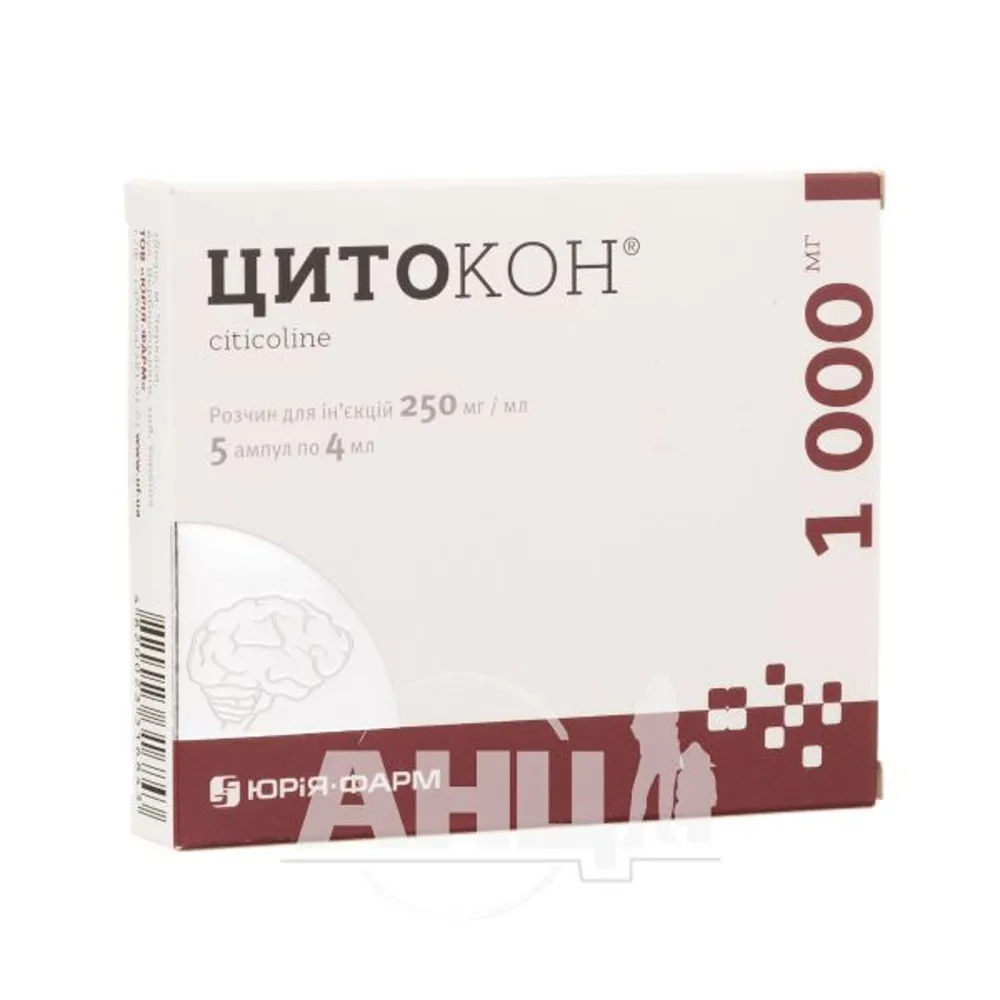
Table of Contents
INSTRUCTIONS FOR MEDICAL USE OF THE MEDICINAL PRODUCT CYTOCON® (CITOCON)
Composition:
Active substance: citicoline;
1 ml contains sodium citicoline equivalent to citicoline 125 mg or 250 mg;
1 ampoule (4 ml) contains citicoline 500 mg or 1000 mg;
Excipients: water for injections, concentrated hydrochloric acid, sodium hydroxide.
Pharmaceutical form. Solution for injection.
Main physicochemical characteristics: clear, colorless liquid.
Pharmacotherapeutic group. Psychostimulants and nootropic agents.
ATC code N06BX06.
Pharmacological Properties
Pharmacodynamics
Citicoline stimulates the biosynthesis of structural phospholipids in neuronal membranes, thereby improving membrane functions, including the activity of ion-exchange pumps and neurotransmitter receptors. Due to its membrane-stabilizing effect, citicoline possesses anti-edematous properties and thus reduces cerebral edema. Research findings indicate that citicoline inhibits the activity of certain phospholipases, prevents the residual generation of free radicals, protects membrane systems from damage, and maintains the integrity of the antioxidant defense system.
Citicoline reduces the volume of damaged tissue by preventing cell death through modulation of apoptotic mechanisms and enhances cholinergic neurotransmission. It also exerts a preventive neuroprotective effect in focal cerebral strokes.
Citicoline promotes rapid functional recovery in patients with acute cerebrovascular disorders by reducing ischemic brain tissue damage, as confirmed by radiological study results.
In traumatic brain injuries, citicoline shortens the duration of the recovery period and reduces the severity of post-traumatic syndrome.
Citicoline contributes to improved cerebral function, reduces the degree of amnesia, and improves the condition in cognitive, sensory, and motor disorders observed in cerebral ischemia.
Pharmacokinetics
Citicoline is well absorbed after oral administration, as well as following intramuscular and intravenous administration. After administration, a significant increase in plasma choline levels is observed. Following oral intake, the drug is almost completely absorbed. Studies have shown that bioavailability is practically equivalent after oral and parenteral administration.
The drug is metabolized in the intestine and liver, forming choline and cytidine. After administration, citicoline is taken up by brain tissues, where choline acts on phospholipids and cytidine acts on cytidine nucleotides and nucleic acids. Citicoline rapidly reaches brain tissue and actively incorporates into cell membranes, cytoplasm, and mitochondria, stimulating phospholipid metabolism.
Only a negligible amount of the administered dose is excreted in urine and feces (less than 3%). Approximately 12% of the administered dose is excreted via the respiratory tract. Elimination of the drug through urine and the respiratory tract occurs in two phases: the first phase—rapid elimination (in urine—within the first 36 hours; via respiratory tract—within the first 15 hours), and the second phase—slow elimination. The majority of the administered dose is incorporated into metabolic processes.
Clinical characteristics.
Indications.
Stroke, acute phase of cerebral circulation disorders, and treatment of complications and consequences of cerebral circulation disorders.
Traumatic brain injury and its neurological consequences.
Cognitive disorders and behavioral disturbances due to chronic vascular and degenerative cerebral disorders.
Contraindications.
Hypersensitivity to citicoline or to any of the excipients.
Increased parasympathetic nervous system tone.
Interaction with other medicinal products and other forms of interaction.
Citicoline enhances the effect of levodopa. The drug should not be administered simultaneously with medicinal products containing meclofenoxate.
Special precautions for use.
When administered intravenously, the drug should be given slowly (over 3–5 minutes depending on the dose administered).
When administered intravenously by drip infusion, the infusion rate should be 40–60 drops per minute.
In case of persistent intracranial hemorrhage, the dose should not exceed 1000 mg per day and the intravenous infusion rate (30 drops per minute).
Use during pregnancy or breastfeeding.
There is insufficient data on the use of citicoline in pregnant women. Data regarding excretion of citicoline in breast milk are lacking, and the effect of the drug on the fetus is unknown. During pregnancy or breastfeeding, the medicinal product should be prescribed only when the expected therapeutic benefit for the mother outweighs the potential risk to the fetus.
Ability to affect reaction speed when driving or operating machinery.
In individual cases, certain adverse reactions from the central nervous system may affect the ability to drive or operate complex machinery.
Dosage and Administration.
The recommended dose for adults is from 500 mg to 2000 mg per day depending on the severity of symptoms.
The drug is intended for intramuscular or intravenous administration.
For intravenous administration, the drug may be administered slowly by injection (over 3–5 minutes depending on the dose administered) or by infusion (rate of 40–60 drops per minute).
Maximum daily dose – 2000 mg.
The duration of treatment depends on the course of the disease and is determined by the physician.
Elderly patients do not require dose adjustment.
The injection solution is intended for single use only. The drug should be used immediately after opening the ampoule. Any unused portion must be discarded.
The drug may be mixed with all isotonic solutions for intravenous administration, as well as with hypertonic glucose solution.
If necessary, treatment may be continued with the oral solution form of the drug.
Children.
Experience with use in children is limited.
Overdose.
Cases of overdose have not been reported.
Side effects.
Side effects occur very rarely (˂ 1/10000), including isolated cases.
Central and peripheral nervous system disorders: severe headache, vertigo, hallucinations.
Cardiovascular system disorders: arterial hypertension, arterial hypotension, tachycardia.
Respiratory system disorders: dyspnea.
Gastrointestinal disorders: nausea, vomiting, diarrhea.
Immune system disorders: allergic reactions, including: rash, hyperemia, exanthema, urticaria, purpura, pruritus, angioneurotic edema, anaphylactic shock.
General disorders: chills, local reactions at the injection site.
Shelf life. 2 years.
Storage conditions.
Store at a temperature not exceeding 30°C. Keep out of reach of children.
Incompatibility.
Do not use solvents not specified in the section "Administration and dosage".
Packaging.
4 ml in an ampoule. 5 ampoules in a contour cell pack; 1 contour cell pack in a carton.
Prescription status. Prescription only.
Manufacturer.
Yuria-Pharm LLC.
Manufacturer's address and location of business activity.
108, Kobzarska St., Cherkasy, Cherkasy region, 18030, Ukraine. Tel.: (044) 281-01-01.