Cerezyme® 400 u
Ukraine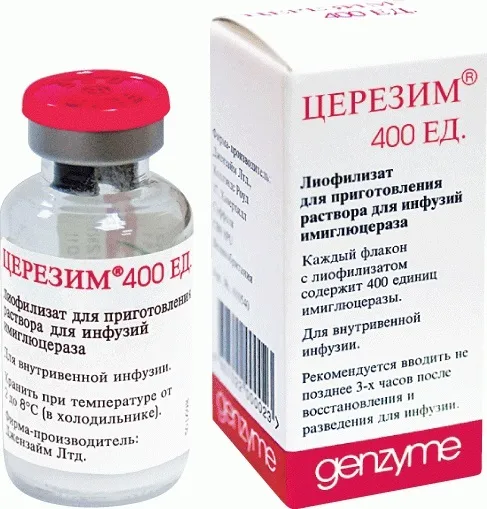
Table of Contents
INSTRUCTIONS FOR MEDICAL USE OF THE MEDICINAL PRODUCT CEREZYME® 400 U (CEREZYME® 400 U)
Composition:
Active substance:
imiglucerase;
One vial contains 400 U* of imiglucerase**;
One ml of solution contains 40 U (approximately 1.0 mg) of imiglucerase (400 U/10 ml);
Excipients:
mannitol (E 421), sodium citrate, citric acid monohydrate, polysorbate 80.
* 1 unit (U) is defined as the amount of enzyme that catalyzes the hydrolysis of 1 μmol of the synthetic substrate para-nitrophenyl β-D-glucopyranoside (pNP-Glc) per minute at 37 °C.
Pharmaceutical form.
Powder for solution for infusion concentrate.
Main physicochemical properties:
lyophilized powder, white or almost white.
Pharmacotherapeutic group.
Agents affecting the digestive system and metabolic processes. Enzymes. ATC code A16AB02.
Pharmacological Properties.
Pharmacodynamics.
Mechanism of action . Gaucher disease is a rare recessive inherited metabolic disorder caused by deficiency of the lysosomal enzyme acid β-glucosidase. This enzyme hydrolyzes glucocerebroside, a major lipid component of cell membranes, into glucose and ceramide.** Imiglucerase is a modified form of human acid β-glucosidase produced by recombinant DNA technology using Chinese Hamster Ovary cells, with mannose modification to target macrophages.
Pharmacodynamic effects . Imiglucerase (recombinant macrophage-targeted β-glucocerebrosidase) replaces deficient enzyme activity by hydrolyzing glucocerebroside, thereby correcting the primary pathophysiology and preventing secondary complications.Cerezyme® 400 IU reduces the size of the spleen and liver, improves or normalizes thrombocytopenia and anemia, improves or normalizes bone mineral density and bone marrow burden, and reduces or eliminates bone pain and bone crises. Cerezyme® 400 IU decreases resting energy expenditure. Cerezyme® 400 IU has demonstrated improvement in both mental and physical aspects of quality of life in Gaucher disease. Cerezyme® 400 IU reduces the level of chitotriosidase—a biomarker of glucocerebroside accumulation in macrophages and treatment response. In children, Cerezyme® 400 IU normalizes pubertal development, enabling achievement of normal growth and normal bone mineral density in adulthood.
Clinical efficacy and safety . The rate and extent of response to Cerezyme® 400 IU treatment depend on the administered dose.Improvements in organ systems with faster turnover, such as hematological parameters, generally occur more rapidly than in systems with slower metabolism, such as bone.
In the ICGG Gaucher Registry analysis of a large patient group (n=528) with type 1 Gaucher disease, a time- and dose-dependent effect was observed for hematological and visceral parameters (platelet count, hemoglobin concentration, spleen and liver volume) with doses of 15, 30, and 60 IU/kg body weight administered every 2 weeks. Patients receiving 60 IU/kg every 2 weeks showed faster improvement and greater maximum treatment effect compared to those receiving lower doses.
Similarly, in the ICGG Gaucher Registry bone mineral density analysis using dual-energy X-ray absorptiometry (DXA) in 342 patients after 8 years of treatment, normal bone mineral density was achieved with Cerezyme® 400 IU at a dose of 60 IU/kg every 2 weeks, but this effect was not observed with lower doses of 15 and 30 IU/kg every 2 weeks (Wenstrup et al, 2007).
In a study involving two patient groups receiving Cerezyme® 400 IU at average doses of 80 IU/kg every 4 weeks and 30 IU/kg every 4 weeks, respectively, and with a baseline bone marrow burden score ≥ 6, a higher proportion of patients in the higher-dose group (33%; n=22) achieved a reduction of at least 2 points in this score after 24 months of treatment compared to the lower-dose group (10%; n=13) (de Fost et al, 2006).
Treatment with Cerezyme® 400 IU at 60 IU/kg every 2 weeks demonstrated improvement in bone pain as early as 3 months, reduction in bone crises by 12 months, and improvement in bone mineral density by 24 months of treatment (Sims et al, 2008).
The standard infusion frequency is every 2 weeks (see section "Dosage and administration"). Maintenance therapy with infusion frequency every 4 weeks (Q4), using the same cumulative (total) dose as every 2 weeks (Q2), was studied in adult patients with stable type 1 Gaucher disease. Changes from baseline in hemoglobin, platelet count, liver and spleen volume, bone crisis, and bone involvement constituted the predefined composite endpoint; achievement or maintenance of established therapeutic goals for hematological and visceral parameters constituted an additional endpoint. At 24 months, 63% of patients in the Q4 group and 81% in the Q2 group reached the composite endpoint; the difference was not statistically significant considering the 95% confidence interval (-0.357, 0.058). Additionally, 89% of patients in the Q4 group and 100% in the Q2 group reached endpoints based on therapeutic goals; the difference was not statistically significant considering the 95% confidence interval (-0.231, 0.060). The Q4 infusion schedule may be considered as a treatment option for some adult patients with stable residual type 1 Gaucher disease, but clinical data on this are limited.
No specific controlled clinical studies have been conducted on the effect of Cerezyme® 400 IU on neurological manifestations of Gaucher disease. Therefore, no conclusions can be drawn regarding the efficacy of enzyme replacement therapy for neurological symptoms.
Physicians are required to register patients with Gaucher disease, including those with chronic neuronopathy, in the "ICGG Gaucher Registry". Data on these patients will be collected anonymously in this Registry. The purpose of the "ICGG Gaucher Registry" is to improve understanding of Gaucher disease and to evaluate the efficacy of enzyme replacement therapy, ultimately contributing to improved safety and effectiveness of Cerezyme® 400 IU.
Preclinical safety studies. Standard preclinical pharmacological safety studies, single and repeated dose toxicity studies, and genotoxicity studies of imiglucerase revealed no special hazard for humans.
Pharmacokinetics. Steady-state enzyme activity of imiglucerase at four doses (7.5, 15, 30, 60 IU/kg) is achieved within 30 minutes after initiation of a 1-hour intravenous infusion of Cerezyme® 400 IU. Termination of the infusion results in a rapid decline in plasma enzyme activity, with a half-life of imiglucerase ranging from 3.6 to 10.4 minutes. The mean plasma clearance value is 14.5 ± 4.0 (range: 9.8 – 20.3) ml/min/kg. The mean volume of distribution of imiglucerase, corrected for body weight, is 0.12 ± 0.02 (range: 0.09 – 0.15) L/kg.
These data are not considered dose- or infusion-rate-dependent, as only 1 or 2 patients were evaluated at each dose and infusion rate.
Clinical characteristics.
Indications. Cerezyme® 400 U (imiglucerase) is indicated for long-term enzyme replacement therapy in patients with a confirmed diagnosis of non-neuronopathic (type 1) or chronic neuronopathic (type 3) Gaucher disease who have clinically significant non-neurological manifestations of the disease, including:
Non-neurological manifestations of Gaucher disease include:
- anemia (after exclusion of other causes, including iron deficiency);
- thrombocytopenia;
- bone disease (after exclusion of other causes, including vitamin D deficiency);
- hepatomegaly or splenomegaly.
Contraindications. Hypersensitivity to the active substance or to any of the excipients of the medicinal product.
Interaction with other medicinal products and other forms of interaction.
Studies on interactions with other medicinal products have not been conducted.
Special precautions.
Hypersensitivity.
Following screening with a solid-phase immunoassay (ELISA) and subsequent confirmatory radioimmunoprecipitation assay, it has been established that IgG antibodies to imiglucerase develop in approximately 15 % of patients during the first year of therapy. Antibodies to Cerezyme® 400 IU typically develop within the first 6 months and rarely occur after 12 months of treatment. Patients suspected of reduced therapeutic efficacy require periodic monitoring for the development of IgG antibodies to imiglucerase.
Patients with antibodies to imiglucerase have an increased risk of hypersensitivity reactions (see section "Adverse reactions"). If a patient has a history of hypersensitivity reactions, testing for antibodies to imiglucerase is recommended. Like any other intravenously administered protein product, Cerezyme® 400 IU may cause severe, life-threatening allergic-type hypersensitivity reactions, although such reactions are rare. If such a reaction occurs, administration of Cerezyme® 400 IU must be stopped immediately; appropriate medical treatment should be initiated. Emergency medical support should be provided in accordance with current medical standards.
Patients in whom antibodies to or hypersensitivity reactions to Ceredase (alglucerase) have been identified should be closely monitored when treated with Cerezyme® 400 IU (imiglucerase).
Sodium.
This medicinal product contains 41 mg of sodium per vial, equivalent to 2 % of the WHO recommended maximum daily intake of 2 g sodium for an adult. The drug is administered as 0.9 % sodium chloride solution for intravenous infusion (see section "Dosage and administration"). This should be taken into account for patients on a sodium-restricted diet.
Pulmonary hypertension.
Pulmonary hypertension is a known complication of Gaucher disease. Patients who have undergone splenectomy are at increased risk of developing pulmonary hypertension. Therapy with Cerezyme® 400 IU generally reduces the need for splenectomy, and early treatment with Cerezyme® 400 IU has been associated with a lower risk of developing pulmonary hypertension. Monitoring for pulmonary hypertension is recommended following diagnosis of Gaucher disease and throughout follow-up. Patients diagnosed with pulmonary hypertension should receive appropriate doses of Cerezyme® 400 IU to ensure control of the underlying Gaucher disease, and the need for additional specific treatment of pulmonary hypertension should be evaluated.
Use during pregnancy or breastfeeding.
Pregnancy.
Limited data (mainly from spontaneous reports and published case series) on over 150 pregnant women treated with Cerezyme® 400 IU suggest that the use of the drug is beneficial for maintaining control of Gaucher disease during pregnancy. Available data do not confirm any teratogenic effects on the fetus, although statistical power to detect such effects is low. Rare cases of embryonic death/fetal loss have been reported, but it is not known whether these events are related to Cerezyme® 400 IU treatment or to the underlying Gaucher disease itself.
No studies have been conducted to evaluate the effects of Cerezyme® 400 IU on pregnancy, fetal development, parturition, or postnatal development in animals. It is unknown whether Cerezyme® 400 IU crosses the placenta or affects fetal development.
For pregnant patients with Gaucher disease and for women planning pregnancy, a risk-benefit assessment of treatment should be performed on a case-by-case basis for each pregnancy.
Women with Gaucher disease may experience periods of increased disease activity during pregnancy and the postpartum period. This includes an increased risk of bone pathology, worsening of cytopenia, bleeding, and increased need for blood transfusions. Pregnancy and breastfeeding are known to stress maternal calcium homeostasis and accelerate bone turnover, which may contribute to bone complications in Gaucher disease.
Women who have not previously been treated should be advised to consider initiating treatment before becoming pregnant to achieve optimal health status. For women already receiving treatment with Cerezyme® 400 IU, continuation of therapy during pregnancy should be considered. Close monitoring of pregnancy and clinical manifestations of Gaucher disease is necessary to individualize dosing according to patient needs and response to therapy. Cerezyme® 400 IU should be used with caution in pregnant women.
Breastfeeding.
It is unknown whether the active substance of the drug is excreted in human breast milk; however, enzymes are likely to be degraded in the infant's gastrointestinal tract. Caution should be exercised when administering Cerezyme® 400 IU to breastfeeding women.
Effects on ability to drive and use machines.
Cerezyme® 400 IU has no effect or negligible effect on the ability to drive vehicles or operate machinery.
Method of Administration and Dosage
Treatment of the patient must be conducted under the supervision of a physician experienced and knowledgeable in the management of Gaucher disease.
Dosing.
Due to the heterogeneous and multisystem nature of Gaucher disease, the dose of Cerezyme® 400 IU is determined individually for each patient, based on clinical manifestations of the disease. After assessing the individual patient's response to all relevant clinical features of the disease, the dosage and frequency of administration may be adjusted according to specific treatment goals: to maintain already achieved optimal parameters for all clinical manifestations or to further improve those clinical parameters that have not yet normalized.
Various dosing regimens have demonstrated efficacy for some or all non-neurological manifestations of the disease. Administration of an initial dose of 60 IU/kg every 2 weeks results in improvement of hematological and visceral parameters within 6 months of initiating therapy, and continued treatment with Cerezyme® 400 IU halts progression or reduces the severity of skeletal involvement.
Administration of the lowest dose of 15 IU/kg body weight every 2 weeks leads to improvement in hematological parameters and reduction in organomegaly, but does not affect skeletal symptoms.
The standard treatment regimen is a single intravenous infusion of Cerezyme® 400 IU every 2 weeks (this is also the frequency at which most clinical data have been obtained).
The efficacy of Cerezyme® 400 IU in patients with neurological symptoms, including those with chronic neuronopathic Gaucher disease, has not been studied. Therefore, no specific dosing regimen can be recommended for these manifestations (see section "Pharmacological Properties. Pharmacodynamics").
Method of Administration.
After reconstitution and dilution (see "Preparation of Infusion Solution Using Aseptic Techniques"), the drug is administered by intravenous infusion. During initial infusions of Cerezyme® 400 IU, the infusion rate should not exceed 0.5 IU per 1 kg of patient body weight per minute. In subsequent infusions, the infusion rate may be increased, but must not exceed 1 IU per 1 kg of body weight per minute. Any increase in infusion rate should only be performed under physician supervision.
Home infusions may be considered for patients who have tolerated treatment with Cerezyme® 400 IU well over several months. The decision to allow home infusions should be made only after careful evaluation and in accordance with the recommendations of the treating physician. Home infusions of Cerezyme® 400 IU by the patient or a caregiver require appropriate training by a medical professional at a clinic. The patient or caregiver must be instructed in the infusion technique and in maintaining a treatment log. Patients who experience adverse reactions during infusions must immediately stop administration and contact their physician. Subsequent infusions may need to be administered in a clinical setting. When administering the drug at home, the dose and infusion rate must remain unchanged and must not be modified without physician supervision.
Healthcare professionals are requested to register patients with Gaucher disease, including those with chronic neuronopathic manifestations, in the "ICGG Gaucher Registry" (see section "Pharmacological Properties. Pharmacodynamics").
Preparation of Infusion Solution Using Aseptic Techniques.
The vial is intended for single use only.
The lyophilized powder for concentrate for infusion solution should be reconstituted with water for injection and then diluted with 0.9% sodium chloride solution for intravenous infusion.
Determine the number of vials required based on the individual dosing regimen for the specific patient, and remove the vials from the refrigerator.
Minor dose adjustments may occasionally be necessary to avoid partial use of vial contents. The dose may be rounded to the nearest full vial content value, but the total monthly amount of imiglucerase administered must strictly correspond to the dose individually calculated for each patient.
Reconstitution. Reconstitute the vial contents by adding 10.2 mL of water for injection to the powder. Do not inject the water forcefully; gently swirl the vial to dissolve, avoiding foaming. Upon reconstitution, approximately 10.6 mL of solution (pH approximately 6.1) is obtained. After reconstitution, a clear, colorless solution without particles should be formed.Next, the solution is diluted. Before further dilution, visually inspect each vial designated for infusion to ensure absence of foreign particles and any discoloration. Do not use the infusion solution if it contains particulate matter, foreign particles, or has changed color.
After reconstitution, the solution should be diluted immediately before infusion. Storage of the reconstituted solution for later use is not permitted. The prepared solution must be used immediately.
Dilution. Reconstituted Cerezyme® 400 IU contains 40 IU of imiglucerase per 1 mL. From each vial designated for administration, withdraw 10 mL of solution (equivalent to 400 IU of imiglucerase) and transfer to a separate sterile container. Dilute the entire drug solution with 0.9% sodium chloride solution for intravenous injection to a final volume of 100–200 mL, and gently mix the prepared solution. Administration. The diluted solution should be administered through a 0.2-micron in-line filter with low protein binding to prevent passage of any protein particles. This does not result in loss of imiglucerase activity.The diluted Cerezyme® 400 IU solution should be administered to the patient no later than 3 hours after preparation.
The diluted solution in 0.9% sodium chloride remains chemically stable for 24 hours when stored at 2–8°C, protected from light. The degree of microbial contamination depends on adherence to aseptic techniques during the preparation of the infusion solution.
Since Cerezyme® 400 IU does not contain preservatives, any unused medication or residual solution must be discarded according to local requirements.
Cerezyme® 400 IU is administered intravenously by infusion over 1–2 hours. The infusion rate should follow the general recommendation: not more than 1 IU of imiglucerase per 1 kg of patient body weight per minute.
To avoid discarding residual solution in the vial, it may be added to the single dose determined for each patient, provided that the total monthly amount of imiglucerase administered strictly corresponds to the individually calculated dose.
Children. Dose adjustment is not required when administering the drug to children.
Overdose. There have been no reports of overdose to date. The drug has been administered at doses up to 240 IU/kg body weight every 2 weeks.
Adverse reactions.
The adverse effects are listed in the table below and classified by organ systems and frequency of occurrence (common (≥ 1/100 to < 1/10), uncommon (≥ 1/1000 to < 1/100), and rare (≥ 1/10000 to < 1/1000). Within each group, adverse effects are listed in order of decreasing severity of complications.
|
Organ system classes |
Frequency |
Adverse reactions |
|
Nervous system disorders |
Uncommon |
Dizziness, headache, paresthesia* |
|
Cardiac disorders |
Uncommon |
Tachycardia*, cyanosis* |
|
Vascular disorders |
Uncommon |
Flushing*, hypotension* |
|
Respiratory, thoracic and mediastinal disorders |
Common |
Dyspnea*, cough* |
|
Gastrointestinal disorders |
Uncommon |
Nausea, vomiting, abdominal cramps, diarrhea |
|
Immune system disorders |
Common |
Hypersensitivity reactions |
|
Rare |
Anaphylactoid reactions |
|
|
Skin and subcutaneous tissue disorders |
Common |
Urticaria/angioneurotic edema*, pruritus*, rash* |
|
Musculoskeletal and connective tissue disorders |
Uncommon |
Arthralgia, back pain* |
|
General disorders and administration site conditions |
Uncommon |
Discomfort at injection site, burning sensation at injection site, swelling at injection site or sterile abscess, chest discomfort*, sweating, chills, fatigue |
Hypersensitivity symptoms were observed in approximately 3% of patients overall (indicated by «*» in the table above). These symptoms occurred during or shortly after administration of the drug. These symptoms are usually responsive to antihistamines and/or corticosteroids. The appearance of such hypersensitivity signs requires discontinuation of the drug and consultation with a physician.
Reporting suspected adverse reactionsReporting of suspected adverse reactions after drug approval is an important procedure. It allows continuous monitoring of the benefit-risk balance of the medicinal product. Healthcare professionals are requested to report all suspected adverse reactions to the State Expert Center of the Ministry of Health of Ukraine.
Shelf life.
3 years.
Storage conditions.
Keep out of reach of children.
The native product should be stored in a refrigerator at a temperature of 2 to 8 °C.
Incompatibility.
In the absence of compatibility studies, Cerezyme® 400 U must not be mixed with other medicinal products.
Packaging.
In 20 ml vials; 1 or 5 vials per cardboard box.
Prescription category.
Prescription only.
Manufacturer.
Genzyme Ireland Limited / Genzyme Ireland Limited.
Location of manufacturer
and address of its
place of business
.
IDA Industrial Park, Old Kilmeaden Road, Waterford, Ireland /
IDA Industrial Park, Old Kilmeaden Road, Waterford, Ireland.
Marketing Authorization Holder.
Sanofi B.V., the Netherlands / Sanofi B.V., the Netherlands.