Tractocil
Ukraine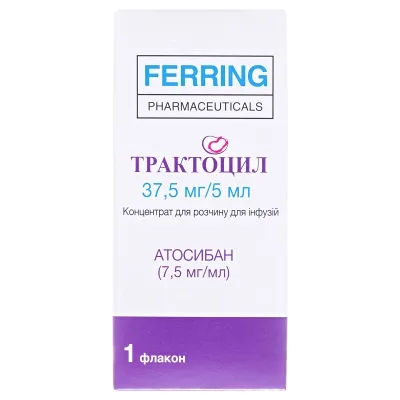
Table of Contents
INSTRUCTIONS FOR MEDICAL USE OF THE MEDICINAL PRODUCT TRACTOCILE®
Composition:
Active substance: atosiban;
1 ml of solution contains atosiban acetate, calculated as atosiban, 7.5 mg;
Excipients: mannitol (E 421), diluted hydrochloric acid, water for injections.
Pharmaceutical form. Concentrate for solution for infusion.
Main physicochemical properties: clear, colorless solution, free from visible particles.
Pharmacotherapeutic group. Other gynecological preparations. Atosiban.
ATC code G02C X01.
Pharmacological properties.
Pharmacodynamics.
Atosiban is a synthetic peptide and a competitive antagonist of human oxytocin at the receptor level. By binding to oxytocin receptors, it reduces the frequency of uterine contractions and myometrial tone, resulting in suppression of uterine contractions. Atosiban also binds to vasopressin receptors, thereby inhibiting vasopressin's effects.
In cases of preterm labor, atosiban at recommended doses suppresses uterine contractions and provides functional uterine quiescence. Uterine relaxation begins almost immediately after administration of atosiban. Within 10 minutes, myometrial contractile activity significantly decreases, and a stable functional uterine quiescence (fewer than 4 contractions per hour) is maintained for up to 12 hours.
Pharmacokinetics.
In healthy non-pregnant women receiving atosiban as an infusion (from 10 to 300 mcg/min over 12 hours), steady-state plasma concentrations increased proportionally with dose. Drug clearance, volume of distribution, and elimination half-life were independent of dose.
In pregnant women receiving atosiban as an intravenous infusion (300 mcg/min for 6–12 hours) due to preterm labor, steady-state plasma concentration was reached within 1 hour after the start of infusion (mean 442 ± 73 ng/mL, range 298–533 ng/mL).
After infusion cessation, plasma concentration of the drug rapidly declines, with initial (tα) and terminal (tβ) half-life values of 0.21 ± 0.01 and 1.7 ± 0.3 hours, respectively. Mean drug clearance is 41.8 ± 8.2 L/h. Mean volume of distribution is 18.3 ± 6.8 L.
Plasma protein binding of atosiban in pregnant women ranges from 46% to 48%.
Atosiban crosses the placenta. Two metabolites have been identified in human plasma and urine. The ratio of the concentration of the main metabolite M1 (des-(ornithine, glycine-NH2)-[Mpa, D-tyrosine(Et)2, threonine]-oxytocin) to atosiban concentration in plasma was 1.4 and 2.8 at 2 hours during infusion and after its discontinuation, respectively. It is unknown whether M1 accumulates in tissues. Atosiban is detected in urine in very low amounts, with urinary concentration approximately 50 times lower than that of M1. The percentage of atosiban excreted in feces is unknown. The main metabolite M1 is approximately 10 times less potent than atosiban in inhibiting oxytocin-induced uterine contractions in vitro. Metabolite M1 is excreted into breast milk.
Clinical Characteristics.
Indications.
Tractocile is used for the prevention of preterm labor in pregnant women who meet all of the following criteria:
- regular uterine contractions lasting at least 30 seconds and occurring more than 4 times within 30 minutes;
- cervical dilation from 1 to 3 cm (0–3 cm in nulliparous women) and cervical effacement greater than 50%;
- maternal age over 18 years;
- gestational age between 24 and 33 completed weeks;
- normal fetal heart rate.
Contraindications.
Tractocile should not be used in the following cases:
- gestational age less than 24 or more than 33 completed weeks;
- premature rupture of membranes at a gestational age over 30 weeks;
- abnormal fetal heart rate;
- intrauterine growth restriction and abnormal fetal heart rate (FHR);
- antepartum uterine bleeding requiring immediate delivery;
- eclampsia and severe pre-eclampsia requiring immediate delivery;
- intrauterine fetal death;
- suspicion of intrauterine infection;
- placenta previa;
- placental abruption;
- any other conditions affecting either mother or fetus, where continuation of pregnancy poses a risk;
- hypersensitivity to the active substance or excipients in medical history.
Interaction with other medicinal products and other forms of interaction.
In vitro studies have shown that atosiban is not a substrate of the cytochrome P450 system and does not inhibit the metabolism of drugs by enzymes of this system; therefore, it is unlikely that atosiban will be involved in drug interactions mediated by cytochrome P450.
A drug interaction study with labetalol and betamethasone was conducted in healthy female volunteers. No clinically significant interaction between atosiban and betamethasone or labetalol was observed.
Other drug interaction studies with antibiotics, ergot alkaloids, and antihypertensive agents have not been conducted.
Special precautions for use.
When using atosiban in patients in whom premature rupture of the fetal membranes is possible, the benefits of delaying delivery should outweigh the potential risk of developing chorioamnionitis.
There is no experience with the use of atosiban in patients with impaired liver or kidney function.
Atosiban is not used in cases of abnormal placental attachment.
Experience with the use of atosiban in multiple pregnancies, as well as at gestational ages from 24 to 27 weeks, is limited due to the small number of patients treated with the drug. Therefore, the benefit of atosiban in these groups has not been established.
Repeated administration of Tractocile is possible, but no more than 3 times (due to lack of clinical experience).
In cases of intrauterine growth restriction, the decision regarding continuation or repeat administration of Tractocile depends on the assessment of fetal maturity.
During administration of atosiban and in case of persistent recurrence of uterine contractions, monitoring of uterine contractions and fetal heart rate should be performed.
As an oxytocin antagonist, atosiban may theoretically enhance uterine relaxation and provoke postpartum uterine bleeding; therefore, blood loss during delivery should be continuously evaluated. However, during clinical studies, inadequate postpartum uterine contractions were not observed.
Multiple pregnancy and the use of tocolytic drugs, such as calcium channel blockers and beta-mimetics, are known to be associated with an increased risk of pulmonary edema. Therefore, atosiban should be used with caution in cases of multiple pregnancy and/or concomitant use of other tocolytics.
Use during pregnancy or breastfeeding.
Atosiban should be used only in diagnosed cases of preterm labor between 24 and 33 completed weeks of gestation.
If a woman is breastfeeding a previously born child during pregnancy, breastfeeding should be discontinued during treatment with Tractocile due to oxytocin excretion in breast milk, which may promote uterine contractions and counteract the effect of tocolytic therapy.
During clinical trials, no effect of atosiban on lactation was observed. It has been demonstrated that small amounts of atosiban pass into breast milk.
Embryo-fetal toxicity studies did not reveal any toxic effects of atosiban.
Fertility and early embryogenesis studies have not been conducted.
Ability to affect reaction rate when driving vehicles or operating machinery.
The effect on the ability to drive vehicles and operate complex machinery has not been evaluated due to the inappropriate clinical setting.
Administration and Dosage
Treatment with Tractocile must be prescribed and supervised by a qualified physician experienced in the management of preterm labor.
Tractocile is administered intravenously in 3 consecutive stages:
- initially, Tractocile, injection solution, is administered as an intravenous bolus at an initial dose of 6.75 mg;
- immediately after, a continuous infusion of Tractocile, concentrate for infusion solution, at a high dose of 300 mcg/min (loading infusion) is administered for 3 hours;
- thereafter, a continuous infusion of the concentrate at a lower dose of 100 mcg/min is administered for up to 45 hours.
The total duration of treatment should not exceed 48 hours.
The total dose of the drug over the entire treatment course should not exceed 330.75 mg of atosiban.
Intravenous administration should be initiated immediately after diagnosis of preterm labor. After administration of the bolus injection, the infusion should be started immediately. If uterine contractility persists despite Tractocile therapy, alternative treatment should be considered.
Data on the use of the drug in patients with hepatic or renal impairment are lacking. Renal impairment does not require dosage adjustment, as only a negligible amount of atosiban is excreted in urine. Atosiban should be used with caution in patients with hepatic impairment.
Dosage method for bolus administration and subsequent infusion.
| Stage |
Regimen |
Injection / infusion rate |
Atosiban dose |
| 1 |
Intravenous bolus injection of 0.9 ml |
Within 1 minute |
6.75 mg |
| 2 |
Intravenous loading infusion over 3 hours |
24 ml/h (300 µg/min) |
54 mg (18 mg/h) |
| 3 |
Continuing maintenance infusion for up to 45 hours |
8 ml/h (100 µg/min) |
up to 270 mg (6 mg/h) |
Repeated Administration
If repeated administration of atosiban is required, it should also be initiated with a bolus injection of the injection solution, followed by the infusion concentrate solution.
Repeated treatment can be initiated at any time after the first treatment and can be repeated up to 3 times (see section "Special Instructions for Use").
Preparation of the Intravenous Solution
Before administration, the vials should be visually inspected for the presence of particles and any change in solution color.
After opening the concentrate vial, dilution should be performed immediately. The diluted solution for intravenous administration must be used within 24 hours after preparation.
For intravenous infusion administered immediately after the bolus dose, the concentrate should be diluted in one of the following solutions:
- 0.9% sodium chloride solution,
- Ringer's lactate solution,
- 5% glucose solution.
From a 100 mL container, remove 10 mL of the appropriate solution and discard it. Add 10 mL of Tractocile concentrate (2 vials of 5 mL each) to obtain a concentration of 75 mg of atosiban in 100 mL.
The resulting solution should be clear, colorless, and free of particles.
The initial loading infusion should be administered at a rate of 24 mL/hour (i.e., 18 mg/hour) for 3 hours under appropriate medical supervision in an obstetric unit. After 3 hours, the infusion rate should be reduced to 8 mL/hour.
To continue the infusion, prepare the next 100 mL using the method described above.
The quantity of the drug must be recalculated to maintain the specified proportion if a container of different volume is used.
To ensure accurate dosing, the infusion rate must be calibrated in drops per minute on the intravenous infusion device. An intravenous micro-infusion pump (infusomat) may provide a convenient range of infusion rates within the recommended doses of Tractocile.
Children
Not applicable to children.
Overdose
Several cases of overdose have been reported, none of which were associated with specific symptoms. There is no known specific antidote in case of overdose.
Side effects.
Possible adverse reactions in the mother have been described during clinical trials. Overall, adverse reactions occurred in 48% of patients treated with atosiban during clinical studies. The observed adverse reactions were generally mild in severity. Nausea was the most frequently reported event (14%).
Clinical trials did not reveal any specific adverse reactions to atosiban in newborns. Adverse reactions in neonates were within normal ranges and comparable to those observed in placebo and beta-mimetic treatment groups.
Adverse reactions are categorized by frequency as follows: very common (≥ 1/10), common (≥ 1/100 to < 1/10), uncommon (≥ 1/1000 to < 1/100), rare (≥ 1/10000 to < 1/1000).
Within each frequency group, adverse reactions are listed in order of decreasing severity.
Immune system disorders: rare – allergic reaction.
Metabolism and nutrition disorders: common – hyperglycaemia.
Psychiatric disorders: uncommon – insomnia.
Nervous system disorders: common – headache, dizziness.
Cardiac disorders: common – tachycardia, hypotension, flushing.
Gastrointestinal disorders: very common – nausea; common – vomiting.
Skin and subcutaneous tissue disorders: uncommon – pruritus, rash.
Reproductive system and breast disorders: rare – uterine haemorrhage, uterine atony.
General disorders and administration site conditions: common – injection site reaction; uncommon – hyperthermia.
Respiratory events such as dyspnoea and pulmonary oedema, particularly in combination with concomitant administration of other tocolytic agents such as calcium antagonists and beta-mimetics, and/or multiple gestation, have been reported during the post-marketing period.
Shelf life. 4 years.
Storage conditions. Store in a refrigerator (at 2–8 °C) in the original packaging. Keep out of the reach of children.
After opening the concentrate vial, dilution should be performed immediately. The diluted solution for intravenous infusion should be used within 24 hours after preparation.
Incompatibilities.
Due to lack of compatibility studies, this medicinal product must not be mixed with any other medicinal products. If another medicinal product needs to be administered simultaneously, the same cannula or a different intravenous injection site may be used. This allows continuous independent control of infusion rates.
Packaging. 5 ml concentrate for solution for infusion in a vial; 1 vial in a cardboard box.
Prescription status. Prescription only.
Manufacturer.
Ferring GmbH, Germany / Ferring GmbH, Germany.
Manufacturer's address and place of business.
Wittland 11, 24109 Kiel, Germany / Wittland 11, 24109 Kiel, Germany.