Tolperil-zdorovya
Ukraine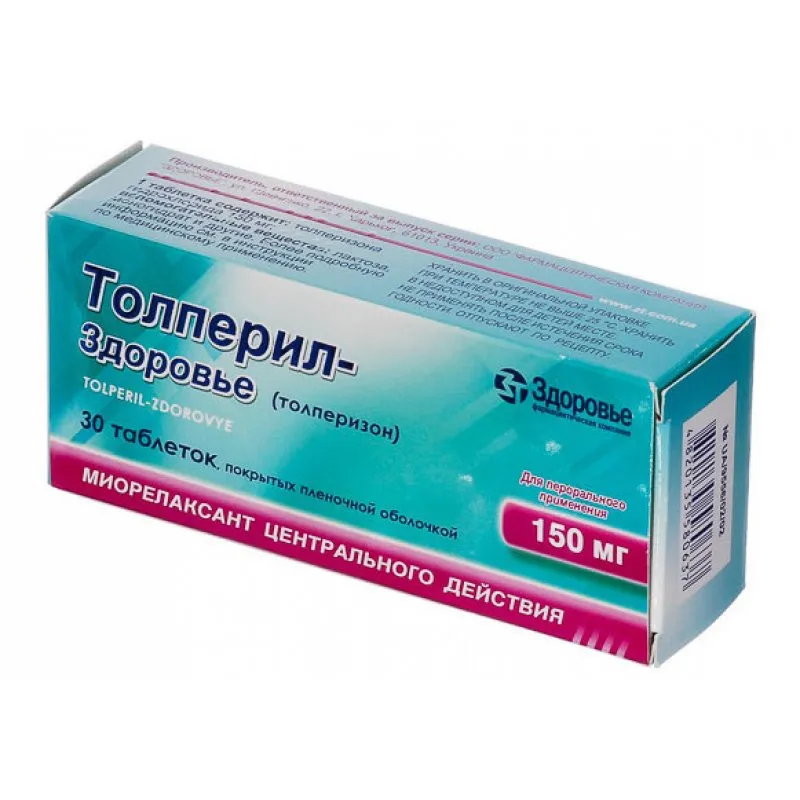
Table of Contents
INSTRUCTIONS FOR MEDICAL USE OF THE MEDICINAL PRODUCT TOLOPERIL-ZDOROVYE (TOLPERIL-ZDOROVYE)
Composition:
Active substance: tolperisone;
One tablet contains tolperisone hydrochloride 50 mg or 150 mg;
Excipients: microcrystalline cellulose; lactose monohydrate; stearic acid; potato starch; corn starch; talc; citric acid monohydrate; colloidal anhydrous silicon dioxide; hypromellose; titanium dioxide (E 171); polyethylene glycol 6000.
Pharmaceutical form. Film-coated tablets.
Main physicochemical properties: film-coated tablets, white or almost white, round-shaped, biconvex.
Pharmacological properties.
Pharmacodynamics.
Tolperisone is a centrally-acting muscle relaxant. The mechanism of action of tolperisone has not been fully elucidated.
It has high affinity for nervous tissue, reaching the highest concentrations in the brainstem, spinal cord, and peripheral nervous system.
The most significant effect of tolperisone is its inhibitory action on the spinal reflex pathway. This effect, likely in combination with inhibition of descending motor pathways, accounts for the therapeutic benefit of tolperisone.
The chemical structure of tolperisone is similar to that of lidocaine. Like lidocaine, it exerts a membrane-stabilizing effect and reduces the electrical excitability of motor neurons and primary afferent fibers. Tolperisone dose-dependently inhibits the activity of voltage-dependent sodium channels. Consequently, the amplitude and frequency of action potentials are reduced.
An inhibitory effect on voltage-dependent calcium channels has also been demonstrated. In addition to its membrane-stabilizing action, tolperisone may also inhibit neurotransmitter release.
Furthermore, tolperisone possesses some weak α-adrenergic antagonist properties and exerts an antimuscarinic effect.
Clinical efficacy and safety. The efficacy of tolperisone in the treatment of muscle spasm following stroke has been demonstrated. It is known that treatment with tolperisone leads to a highly significant reduction in spasticity.
Data indicate that in patients with cerebral impairment, the efficacy of tolperisone, as measured by the Barthel index, is comparable to that of baclofen.
Data on the efficacy of tolperisone in elevated muscle tone in patients with musculoskeletal disorders other than post-stroke muscle spasm are conflicting. While some studies have reported positive results based on certain test parameters, others have found no advantage of tolperisone in such conditions.
Pharmacokinetics. After oral administration, tolperisone is well absorbed in the small intestine. Maximum plasma concentration is reached within 0.5–1.5 hours after intake. Due to pronounced first-pass metabolism, the bioavailability of tolperisone is approximately 20%. A fatty meal increases the bioavailability of the drug by approximately 100% and the maximum plasma concentration by approximately 45%, compared to administration on an empty stomach. The time to reach maximum concentration is thereby prolonged by approximately 30 minutes. Tolperisone is extensively metabolized in the liver and kidneys. The drug is almost completely excreted by the kidneys (more than 99%) as metabolites. The pharmacological activity of the metabolites is unknown. The elimination half-life of tolperisone after oral administration is approximately 2.5 hours.
Preclinical safety data. Based on studies of pharmacological safety, repeated-dose toxicity, genotoxicity, and toxic effects on reproductive function, no specific risk for humans has been identified.
Adverse effects were observed only at doses substantially exceeding the maximum recommended human doses, indicating limited relevance for clinical use.
Embryotoxic effects were observed in rats and rabbits following oral administration of the drug at doses of 500 mg/kg and 250 mg/kg body weight, respectively. However, these doses are many times higher than the recommended therapeutic doses for humans.
Clinical characteristics.
Indications.
Symptomatic treatment of muscle spasm in adults following stroke.
Contraindications.
-
Hypersensitivity to the active substance or to eperisone, which is chemically similar, or to any of the excipients.
-
Myasthenia gravis.
-
Breastfeeding period.
Interaction with other medicinal products and other types of interactions.
Pharmacokinetic studies of drug interactions with dextromethorphan, a CYP2D6 substrate, have demonstrated that concomitant administration of tolperisone increases plasma concentrations of drugs primarily metabolized by cytochrome CYP2D6, including thioridazine, tolterodine, venlafaxine, atomoxetine, desipramine, dextromethorphan, metoprolol, nebivolol, and perphenazine. No significant inhibition or induction of other CYP isoenzymes (2B6, 2C8, 2C9, 2C19, 1A2, 3A4) has been observed.
An increase in tolperisone exposure is not expected when administered concomitantly with other CYP2D6 substrates and/or other drugs, due to the diversity of tolperisone's metabolic pathways.
When tolperisone is taken on an empty stomach, its bioavailability decreases; therefore, food intake should be considered when prescribing the drug.
Tolperisone enhances the effect of niflumic acid; hence, dose reduction of niflumic acid, as well as other NSAIDs, may be required when used concomitantly.
Although tolperisone is a centrally-acting agent, the likelihood of developing a sedative effect with its use is low. However, when co-prescribed with other centrally-acting muscle relaxants, consideration should be given to reducing the dose of tolperisone.
Special precautions for use.
Hypersensitivity reactions have been observed. Their severity ranges from mild skin reactions to severe systemic reactions, including anaphylactic shock. Symptoms of hypersensitivity reactions may include erythema, rash, urticaria, pruritus, angioneurotic edema, tachycardia, arterial hypotension, or dyspnea.
Women with a history of hypersensitivity to other drugs or allergic conditions have a higher risk of hypersensitivity reactions when using tolperisone.
Patients should be advised to pay attention to their condition in order to detect possible symptoms of allergy. Patients must be informed that if symptoms of allergy occur, they should discontinue tolperisone immediately and seek urgent medical attention.
After an episode of hypersensitivity to tolperisone, the drug must not be re-administered.
The product contains lactose. If the patient has known intolerance to certain sugars, consultation with a physician is necessary before taking this medicinal product.
Use during pregnancy or breastfeeding.
Data indicate that tolperisone has no teratogenic effects in animals. Due to the lack of significant clinical data on the use of this drug, it should not be used during pregnancy.
Since it is unknown whether tolperisone passes into breast milk, the use of the drug during breastfeeding is contraindicated.
Ability to affect reaction speed when driving or operating machinery.
Given the possibility of developing dizziness, somnolence, attention disturbances, epilepsy, or blurred vision, the drug should be used with caution when driving or operating machinery.
Dosage and Administration
The medication should be taken after meals, with a glass of water. Inadequate food intake may reduce the bioavailability of tolperisone.
Adults: Depending on individual needs and tolerability – 150–450 mg/day in three divided doses.
The duration of treatment is determined individually.
Patients with impaired renal/hepatic function: Experience with tolperisone in patients with renal or hepatic impairment is limited, and a higher frequency of adverse effects has been observed in such patients. Therefore, in cases of moderate renal or hepatic impairment, individual dose titration is recommended with careful monitoring of the patient's condition and control of renal/hepatic function. Tolperisone is not recommended in patients with severe renal or hepatic impairment.
Children: The safety and efficacy of tolperisone in children have not been established.
Overdose.
Data regarding overdose are limited. Symptoms of overdose may primarily include drowsiness, gastrointestinal manifestations (nausea, vomiting, epigastric pain), tachycardia, arterial hypertension, bradykinesia, and vertigo. In severe cases, seizures and coma have been reported.
Treatment: symptomatic and supportive therapy. There is no specific antidote.
Side effects.
The drug is usually well tolerated, as it has a very good safety profile. The most commonly occurring adverse reactions were those affecting the skin, and systemic disorders of the nervous and gastrointestinal systems. Approximately 50–60% of adverse reactions associated with tolperisone use were hypersensitivity reactions. Overall, these reactions were mild and resolved spontaneously. However, life-threatening hypersensitivity reactions have also occurred.
Blood and lymphatic system disorders: anemia, lymphadenopathy.
Immune system disorders: hypersensitivity reaction, anaphylactic reaction, anaphylactic shock.
Nervous system disorders: headache, dizziness, somnolence, attention disturbances, tremor, seizures, hypesthesia, paresthesia, sleep disorders, confusion, lethargy (increased drowsiness), insomnia, decreased activity, depression.
Sensory organ disorders: visual disturbances, tinnitus, vertigo.
Vascular disorders: hypotension, skin hyperemia.
Cardiac disorders: angina pectoris, tachycardia, palpitations, decreased blood pressure, bradycardia.
Respiratory system disorders: dyspnea, epistaxis, tachypnea.
Gastrointestinal disorders: nausea, vomiting, abdominal discomfort, diarrhea, dryness of the oral mucosa, dyspepsia, epigastric pain, constipation, flatulence, mild liver injury.
Skin disorders: allergic dermatitis, hyperhidrosis, pruritus, urticaria, rash.
Musculoskeletal system disorders: muscle weakness, myalgia, discomfort/pain in limbs, osteopenia.
Renal and urinary system disorders: enuresis, proteinuria.
General disorders: asthenia, discomfort, increased fatigue, polydipsia, anorexia, feeling of intoxication, feeling of warmth, irritability, thirst, chest discomfort.
Laboratory findings: increased blood bilirubin concentration, changes in liver enzyme activity, decreased platelet count, leukocytosis, increased blood creatinine concentration.
Shelf life. 3 years.
Storage conditions. Store in the original packaging at a temperature not exceeding 25°C.
Keep out of reach of children.
Packaging. Tablets, 10×3 tablets in blisters, in a cardboard box.
Prescription category. Prescription only.
Manufacturer.
LIMITED LIABILITY COMPANY "CORPORATION "ZDOROV'YA".
LIMITED LIABILITY COMPANY "FARMEKS GROUP".
Manufacturer's address and location of business activity.
22, Shevchenka Street, Kharkiv, Kharkiv region, 61013, Ukraine.
(LIMITED LIABILITY COMPANY "CORPORATION "ZDOROV'YA")
100, Shevchenka Street, Boryspil, Kyiv region, 08301, Ukraine.
(LIMITED LIABILITY COMPANY "FARMEKS GROUP")