Tokkata
Ukraine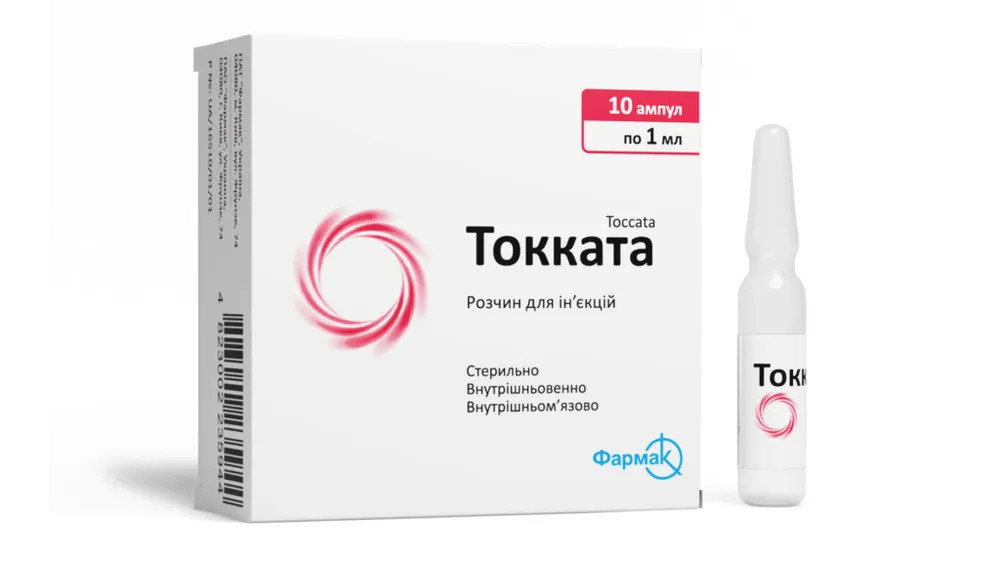
Table of Contents
INSTRUCTIONS FOR MEDICAL USE OF THE MEDICINAL PRODUCT TOCCATA (TOCCATA)
Composition:
Active substances: tolperisone hydrochloride, lidocaine hydrochloride;
1 ml of solution contains: tolperisone hydrochloride – 100 mg, lidocaine hydrochloride – 2.5 mg;
Excipients: methylparaben (E 218), diethylene glycol monoethyl ether, 0.1 M solution of hydrochloric acid, water for injections.
Pharmaceutical form. Injection solution.
Main physicochemical properties: clear, colorless or slightly greenish liquid.
Pharmacotherapeutic group.
Muscle relaxants with central mechanism of action.
ATC code M03BX04.
Pharmacological Properties
Pharmacodynamics
Tolperisone is a centrally-acting muscle relaxant. The mechanism of action of tolperisone is not fully understood.
It has high affinity for nervous tissue, reaching the highest concentrations in the brainstem, spinal cord, and peripheral nervous system.
The most significant effect of tolperisone is its inhibitory action on the spinal reflex pathway. This effect, likely combined with inhibition of descending motor pathways, underlies the therapeutic benefit of tolperisone.
The chemical structure of tolperisone is similar to that of lidocaine. Like lidocaine, it exerts a membrane-stabilizing effect and reduces the electrical excitability of motor neurons and primary afferent fibers. Tolperisone dose-dependently inhibits the activity of voltage-dependent sodium channels. Consequently, the amplitude and frequency of action potentials are reduced.
Inhibitory effects on voltage-dependent calcium channels have also been demonstrated. In addition to its membrane-stabilizing action, tolperisone may also inhibit neurotransmitter release.
Furthermore, tolperisone has some weakly expressed alpha-adrenergic antagonist properties and exerts antimuscarinic effects.
Clinical Efficacy and Safety
The efficacy of tolperisone in the treatment of muscle spasticity following stroke has been established.
In a randomized, double-blind, placebo-controlled study involving 120 patients with post-stroke muscle spasm, treatment with tolperisone resulted in a highly significant reduction in spasticity as measured by the Ashworth scale, which was the primary endpoint. According to the overall assessment of efficacy by investigators and physicians, tolperisone was superior to placebo (p <0.001). The mean improvement on the Ashworth scale was 32% in the overall patient population treated (intention-to-treat, ITT) and 42% in the subgroup receiving tolperisone at a dose of 300–450 mg/day. Although tolperisone showed higher efficacy than placebo in functional test assessments, the differences were not statistically significant.
In a randomized, double-blind comparative study involving 48 patients with brain injury, the efficacy of tolperisone, as measured by the Barthel Index, was comparable to that of baclofen. However, tolperisone was superior to baclofen in improving scores on the Rivermead Motor Assessment Scale (RMAS).
Data on the efficacy of tolperisone in increased muscle tone in patients with musculoskeletal disorders other than post-stroke muscle spasm are conflicting. Some studies have reported positive results in certain functional tests, while others have failed to demonstrate any advantage of tolperisone in such conditions.
The safety profile of tolperisone is based on data from clinical trials involving patients with increased muscle tone of various etiologies, as well as on spontaneous reports of adverse reactions.
Pharmacokinetics
Tolperisone undergoes extensive metabolism in the liver and kidneys. It is excreted by the kidneys, with more than 99% eliminated as metabolites. The pharmacological activity of metabolites is unknown. After intravenous administration, the elimination half-life is approximately 1.5 hours.
Preclinical Safety Data
Based on preclinical studies of pharmacological safety, repeated-dose toxicity, genotoxicity, and effects on reproductive function, no specific risk to humans has been identified.
Observed effects in preclinical studies occurred only at doses substantially exceeding the maximum recommended human doses, suggesting limited relevance to clinical use.
Embryotoxic effects were observed in rats and rabbits following oral administration of the drug at doses of 500 mg/kg body weight and 250 mg/kg body weight, respectively. However, these doses are many times higher than the recommended therapeutic doses for humans.
Clinical characteristics.
Indications.
Muscle spasticity, including post-stroke spasticity, in cases where the injectable form is the treatment of choice.
Contraindications.
Hypersensitivity to the active substances or to eperisone, which is chemically similar to tolperisone, as well as to any of the excipients or to other amide-type local anesthetics.
Myasthenia gravis.
Breastfeeding period.
Pediatric age.
Interaction with other medicinal products and other types of interactions.
Pharmacokinetic studies of drug interactions with dextromethorphan, a CYP2D6 substrate, have demonstrated that concomitant administration of tolperisone increases plasma concentrations of drugs primarily metabolized by cytochrome CYP2D6, particularly thioridazine, tolterodine, venlafaxine, atomoxetine, desipramine, dextromethorphan, metoprolol, nebivolol, and perphenazine.
In vitro studies in human liver microsomes and hepatocytes showed no significant inhibition or induction of other CYP isoenzymes (CYP2B6, CYP2C8, CYP2C9, CYP2C19, CYP1A2, CYP3A4).
Concomitant use with other CYP2D6 substrates and/or other drugs is not expected to increase tolperisone exposure due to the multiple metabolic pathways of tolperisone.
Although tolperisone is a centrally-acting agent, the likelihood of developing a sedative effect with its use is low. When administered concomitantly with other centrally-acting muscle relaxants, consideration should be given to reducing the dose of tolperisone.
Tolperisone potentiates the effects of niflumic acid; therefore, when used concomitantly with tolperisone, the dose of niflumic acid, as well as other NSAIDs, should be reduced.
Special precautions for use.
Do not prescribe the injectable form of the medicine to children.
Hypersensitivity reactions.
During post-marketing surveillance, hypersensitivity reactions have been most frequently reported with tolperisone use. These reactions range from mild skin reactions to severe systemic reactions, including anaphylactic shock. Symptoms of hypersensitivity reactions may include erythema, rash, urticaria, pruritus, angioneurotic edema, tachycardia, hypotension, or dyspnea.
Women with a history of hypersensitivity to other drugs or allergic conditions may have a higher risk of hypersensitivity reactions when taking tolperisone.
Patients should be aware of the possible development of allergic reactions. If symptoms of allergy occur, tolperisone should be discontinued immediately and medical help should be sought without delay.
After an episode of hypersensitivity to tolperisone, the drug must not be re-administered.
The medicine contains lidocaine; therefore, in patients with known hypersensitivity to lidocaine or to other amide-type local anesthetics, the use of injectable Tokkata is contraindicated due to the risk of cross-allergic reactions.
The medicine contains methylparaben (E 218), which may cause allergic reactions (possibly delayed) and, in rare cases, bronchospasm.
Use during pregnancy or breastfeeding.
Animal studies have shown that tolperisone has no teratogenic effects.
Due to the lack of significant clinical data on the use of this medicine, Tokkata should not be used during pregnancy.
Since it is unknown whether tolperisone passes into breast milk, the use of Tokkata during breastfeeding is contraindicated.
Effects on ability to drive or operate machinery.
Given the possible occurrence of symptoms such as dizziness, somnolence, attention disturbances, epilepsy, or blurred vision, the medicine should be used with caution when driving or operating machinery.
Method of Administration and Dosage
For parenteral use only.
For use in adults only. Administer 100 mg intramuscularly twice daily or as a slow intravenous injection of 100 mg once daily.
The injection solution must not be used in children.
The duration of treatment is determined by the physician depending on the nature of the disease course and treatment efficacy.
Patients with renal impairment
Experience with the use of the drug in patients with kidney damage is limited, and a higher frequency of adverse effects has been observed in such patients. Therefore, in cases of moderate kidney impairment, individual dose titration is recommended with careful monitoring of the patient's condition and kidney function. Tolperisone is not recommended for use in patients with severe kidney impairment.
Patients with hepatic impairment
Experience with the use of the drug in patients with liver damage is limited, and a higher frequency of adverse reactions has been observed in such patients. Therefore, in cases of moderate liver impairment, individual dose titration is recommended with careful monitoring of the patient's condition and liver function. Tolperisone is not recommended for use in patients with severe liver impairment.
Children. Tokkata injection solution must not be used in children.
Overdose
Data regarding tolperisone overdose are insufficient.
Symptoms of overdose may primarily include drowsiness, gastrointestinal manifestations (nausea, vomiting, epigastric pain), tachycardia, arterial hypertension, bradykinesia, and vertigo. In severe cases, seizures and coma have been reported.
There is no specific antidote for tolperisone. In case of overdose, symptomatic treatment is recommended.
Adverse reactions
Adverse reactions are listed by system organ classes according to the Medical Dictionary for Regulatory Activities (MedDRA), using MedDRA frequency definitions: very common (≥ 1/10), common (≥ 1/100, < 1/10), uncommon (≥ 1/1000, < 1/100), rare (≥ 1/10000, < 1/1000), very rare (< 1/10000), and frequency not known (cannot be estimated from the available data).
According to post-marketing surveillance data, approximately 50–60% of adverse reactions associated with tolperisone use are hypersensitivity reactions. Most of these reactions were non-serious and resolved spontaneously. Life-threatening hypersensitivity reactions occurred in isolated cases.
| System organ classes |
Common (≥1/100, <1/10) |
Uncommon (≥1/1000, <1/100) |
Rare (≥1/10000, <1/1000) |
Very rare (<1/10000) |
| Blood and lymphatic system disorders |
Anaemia Lymphadenopathy |
|||
| Immune system disorders |
Hypersensitivity reaction Anaphylactic reaction |
Anaphylactic shock |
||
| Metabolism and nutrition disorders |
Anorexia |
Polydipsia |
||
| Psychiatric disorders |
Insomnia Sleep disorders |
Decreased activity Depression |
Confusion |
|
| Nervous system disorders |
Headache Dizziness Drowsiness |
Attention disturbance Tremor Convulsions Hypoesthesia Paraesthesia Lethargy (increased drowsiness) |
||
| Eye disorders |
Visual disturbance |
|||
| Ear and labyrinth disorders |
Tinnitus Vertigo (dizziness) |
|||
| Cardiac disorders |
Angina pectoris Tachycardia Palpitations Decreased blood pressure |
Bradycardia |
||
| Vascular disorders |
Hypotension |
Facial flushing |
||
| Respiratory, thoracic and mediastinal disorders |
Dyspnoea Nosebleed Shortness of breath |
|||
| Gastrointestinal disorders |
Abdominal discomfort Diarrhoea Dry mouth Dyspepsia Nausea |
Epigastric pain Constipation Flatulence Vomiting |
||
| Hepatobiliary disorders |
Mild liver injury |
|||
| Skin and subcutaneous tissue disorders |
Allergic dermatitis Hyperhidrosis Pruritus Urticaria Rash |
|||
| Musculoskeletal and connective tissue disorders |
Muscle weakness Myalgia Limb pain |
Discomfort in limbs |
Osteopenia |
|
| Renal and urinary disorders |
Enuresis Proteinuria |
|||
| General disorders and administration site conditions |
Redness at injection site |
Asthenia Discomfort Increased fatigue |
Sensation of drunkenness Feeling of warmth Restlessness Thirst |
Chest discomfort |
| Investigations |
Decreased blood pressure Increased blood bilirubin concentration Changes in liver enzyme activity Decreased platelet count Leukocytosis |
Increased blood creatinine concentration |
Reporting of suspected adverse reactions
Reporting of adverse reactions following registration of the medicinal product is of great importance. It allows continuous monitoring of the benefit-risk balance of the medicinal product. Healthcare professionals and patients or their legal representatives are requested to report all suspected adverse reactions and lack of efficacy of the medicinal product through the Automated Pharmacovigilance Information System at the following link: https://aisf.dec.gov.ua/.
Shelf life. 2 years.
Do not use the medicinal product after the expiry date stated on the packaging.
Storage conditions. Store in the original packaging at a temperature of +2 °C to +8 °C.
Do not freeze. Keep out of reach and sight of children.
Incompatibilities.
Compatibility data are lacking; therefore, Toccatum must not be mixed with other medicinal products in the same syringe. Administer separately from other medicinal products.
Packaging. 1 ml in ampoules. 5 ampoules per blister; 1 or 2 blisters per carton.
Prescription status. Prescription only.
Manufacturer. JSC "Farmak".
Manufacturer's location and address of the place of business.
74, Kyrylivska Street, Kyiv, 04080, Ukraine.