Tesalin
Ukraine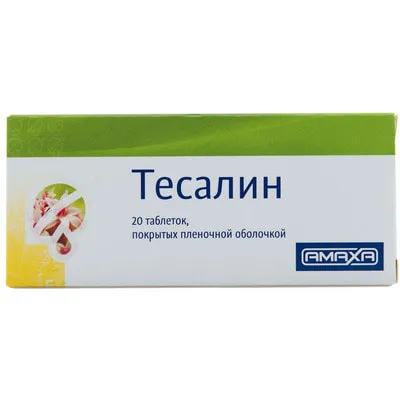
Table of Contents
INSTRUCTION FOR MEDICAL USE OF THE MEDICINAL PRODUCT TESALIN (Tesalin®)
Composition:
Active substance: native extract from leaves of hybrid butterbur (Petasites hybridus);
One tablet contains 17.8–40 mg of native extract from leaves of hybrid butterbur (Petasites hybridus) (extraction agent – carbon dioxide), corresponding to 8 mg of petasins;
Excipients: colloidal anhydrous silicon dioxide, microcrystalline cellulose, magnesium stearate, sodium starch glycolate (type A), stearic acid, hypromellose, titanium dioxide (E 171), macrogol 20,000.
Pharmaceutical form. Film-coated tablets.
Main physicochemical characteristics: round, biconvex, film-coated tablets, white to cream in color.
Pharmacotherapeutic group. Drugs acting on the respiratory system. Other drugs acting on the respiratory system.
ATC code R07AX.
Pharmacological Properties
Pharmacodynamics
Tesalin is an antiallergic and anti-inflammatory medicinal product for the treatment of allergic rhinitis. Tesalin inhibits the biosynthesis of leukotrienes and the degranulation of neutrophils and eosinophilic granulocytes.
In a randomized, double-blind, placebo-controlled study involving 18 patients suffering from allergic rhinitis induced by grass pollen, the pharmacodynamic properties of the medicinal product Tesalin were evaluated by comparing allergic rhinitis symptoms with changes in levels of inflammatory mediators. During the study, a significant reduction in symptoms of allergic rhinitis was observed, including a more rapid relief from nasal congestion after exposure to grass pollen, with treatment using Tesalin compared to placebo and desloratadine. Over 5 days of treatment, Tesalin demonstrated significant inhibition of inflammatory mediators—leukotriene B4 (6-fold and 5-fold) and interleukin-8 (6-fold)—in nasal secretions of patients, compared to desloratadine and placebo. There is no evidence of systemic immunosuppressive effects.
Pharmacokinetics
Absorption
No appropriate studies have been conducted.
Distribution
The data below refer to petasin, but conclusions regarding the distribution of the total extract cannot be drawn.
Maximum plasma concentrations of petasin (Cmax) were reached after approximately 1.6 hours (tmax), regardless of dose. Maximum plasma concentrations of petasin were 25.5 ± 14.8 ng/mL after administration of 2 tablets and 58.1 ± 26.7 ng/mL after administration of 4 tablets.
AUC (area under the pharmacokinetic concentration–time curve) was dose-proportional, amounting to 65.3 ± 35.6 ng/mL×h after administration of 2 tablets and 151.2 ± 68.2 ng/mL×h after administration of 4 tablets.
Metabolism
No appropriate studies have been conducted.
Elimination
The elimination half-life of petasin is 7.2 ± 4.6 hours (2 tablets) and 7.6 ± 3.3 hours (4 tablets).
Given that the elimination half-life is approximately 7 hours, no accumulation occurs. The dosing regimen (twice or three times daily, 1 tablet each time) can be adapted for patients according to their individual needs.
Clinical characteristics.
Indications.
For the treatment of symptoms associated with allergic rhinitis (hay fever).
Contraindications.
Hypersensitivity to the active substance or to any of the excipients, as well as to any plants of the Asteraceae/Compositae family.
Impaired liver or kidney function.
Contraindicated in patients receiving anticoagulant therapy or barbiturates.
Pregnancy and breastfeeding period.
Interaction with other medicinal products and other forms of interaction.
Interactions with other medicinal products, as well as with food or stimulants (such as coffee, tea), are not known.
In vitro pharmacological studies have shown that administration of the extract from the leaves of Euphrasia rostkovensis hybrid does not induce expression of the MDR1 and CYP3A4 genes. Furthermore, liver enzyme activity remains unchanged, i.e., neither stimulated nor inhibited. The following enzymes were tested: CYP2E1, CYP1A2, CYP2D6, CYP2C19, CYP3A4, and CYP2C9. Based on these studies, interactions with other medicinal products are not expected.
Special precautions for use
Severe liver injuries have been observed very rarely in connection with the use of medicinal products containing root extract of hybrid primrose (P. hybridus) (see section "Adverse reactions"). However, the possibility of liver injury due to the leaf extract of hybrid primrose (P. hybridus) contained in the medicinal product Tesalin cannot be excluded. During treatment, physicians and patients should pay attention to early signs of liver damage (upper abdominal pain, loss of appetite, jaundice, yellow discoloration of the sclera, etc.).
Currently, there are no clinical study results available in patients with impaired liver or kidney function. Therefore, the product is contraindicated in these patients.
This medicinal product contains less than 1 mmol (23 mg) / dose of sodium, i.e. it is practically sodium-free.
Use during pregnancy or breastfeeding
Clinical data on the use of the product during pregnancy or breastfeeding are lacking.
Preclinical animal studies did not demonstrate any direct or indirect adverse effects on pregnancy or fetal development when a dose 30 times higher than the usual human dose was administered. The potential risk in humans is unknown.
Use during pregnancy and breastfeeding is contraindicated.
Ability to influence the speed of reactions when driving vehicles or operating machinery
If dizziness or fatigue occurs during treatment with this medicinal product, patients should refrain from driving vehicles or operating machinery.
Method of Administration and Dosage.
For oral use.
The usual daily dose for adults is 2 film-coated tablets: 1 tablet in the morning and 1 tablet in the evening. In case of exposure to a large amount of allergen, the dose may be increased if necessary: 1 tablet 3 times daily. The tablet should be swallowed whole with water without chewing. The tablets can be taken regardless of the time of day and food intake.
Duration of Use
The duration of use depends on the progression of the disease or the duration of allergen exposure and is determined by a physician, but should not exceed 14 days. If symptoms persist during this period, the use of the drug should be discontinued and medical advice should be sought.
Children.
This medicinal product is not intended for use in children (under 18 years of age).
Overdose.
Acute poisoning with the medicinal product Tesalin has not been reported.
Side effects
The frequency of adverse reactions is defined as follows:
Very common: ≥ 1/10
Common: ≥ 1/100 to < 1/10
Uncommon: ≥ 1/1,000 to < 1/100
Rare: ≥ 1/10,000 to < 1/1,000
Very rare: < 1/10,000
Not known: cannot be estimated from the available data
Gastrointestinal disorders
Common: gastrointestinal discomfort (including nausea, abdominal pain / stomach pain, diarrhea).
Skin and subcutaneous tissue disorders
Uncommon: skin hypersensitivity reactions, including erythema, swelling, pruritus, eczema, urticaria, rash.
Hepatobiliary disorders
Very rare cases of severe liver injury (liver necrosis, hepatocellular injury, hepatitis, liver failure) have been reported with medicinal products containing root extract of P. hybridus. Early signs may include fatigue, dark urine, pale stools, upper abdominal pain, loss of appetite, jaundice, yellowing of the sclera. Liver injury due to the leaf extract of P. hybridus present in the medicinal product Tesalin cannot be excluded.
Nervous system disorders
Very rare: fatigue, dizziness, headache, lethargy.
Immune system disorders
Not known: hypersensitivity reactions.
Reporting of suspected adverse reactions
It is important to report suspected adverse reactions after marketing authorization of the medicinal product. This allows continuous monitoring of the benefit-risk balance of the medicinal product. Healthcare professionals should report any suspected adverse reactions via the Automated Pharmacovigilance Information System at the following link: https://aisf.dec.gov.ua.
Shelf life
3 years.
Storage conditions
Store at temperatures not exceeding 25 °C in the original packaging. Keep out of reach of children.
Packaging
10 tablets per blister; 2 or 6 blisters per cardboard box.
Pharmaceutical category
Over-the-counter (without prescription).
Manufacturer
Max Zeller Söhne AG.
Max Zeller Sohne AG.
Manufacturer's address
Seeblickstrasse 4, 8590 Romanshorn, Switzerland.
Marketing Authorization Holder
Amaxa Ltd.
Address of Marketing Authorization Holder
31 John Islip Street, London SW1P 4FE, United Kingdom.