Typher
Ukraine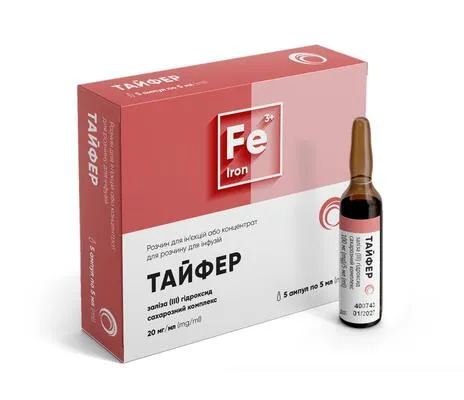
Table of Contents
INSTRUCTIONS FOR MEDICAL USE OF THE MEDICINAL PRODUCT TIPHER (TIPHER)
Composition:
Active substance: 1 ml of solution contains 20 mg of iron (as iron (III) hydroxide sucrose complex);
Excipients: sodium hydroxide, water for injections.
Pharmaceutical form. Solution for injection or concentrate for solution for infusion.
Main physicochemical properties: dark brown colloidal solution.
Pharmaco-therapeutic group. Antianaemic agents. Iron preparations. ATC code B03AC.
Pharmacological Properties
Pharmacodynamics
The active component of the medicinal product Tifer – iron sucrose – consists of polynuclear iron (III) hydroxide cores surrounded externally by a large number of non-covalently bound sucrose molecules. The average molecular weight of the complex is approximately 43 kDa. The polynuclear iron core has a structure similar to that of the core of ferritin, which is the physiological iron-containing protein. The complex is designed to allow controlled delivery of iron to proteins responsible for its transport and storage in the body (transferrin and ferritin, respectively).
After intravenous administration, the polynuclear iron core of the complex is predominantly taken up by the reticuloendothelial system of the liver, spleen, and bone marrow. In the second stage, iron is used for the synthesis of hemoglobin, myoglobin, and other iron-containing enzymes or is stored in the liver as ferritin.
Pharmacokinetics
Distribution. Ferrokinetic evaluation of iron sucrose labeled with 52Fe and 59Fe was performed in 6 patients with anemia and chronic renal insufficiency. Within the first 6–8 hours, 52Fe is taken up by the liver, spleen, and bone marrow. Radioactive iron uptake occurs in macrophages of the reticuloendothelial system of the spleen.
After intravenous administration to healthy volunteers of a single dose of iron (III) hydroxide sucrose complex containing 100 mg of iron, maximum iron concentration was observed 10 minutes after administration, reaching a mean value of 538 mmol/L. The volume of distribution in the central compartment corresponds to plasma volume (approximately 3 liters).
Metabolism. After injection, sucrose is almost completely degraded, and the polynuclear iron core is predominantly taken up by the reticuloendothelial system of the liver, spleen, and bone marrow.
Iron uptake by erythrocytes within 4 weeks after administration ranges from 68% to 97%.
Excretion. The average molecular weight of the complex is approximately 43 kDa, which is sufficiently large to prevent renal excretion. Renal excretion of iron within the first 4 hours after injection of 100 mg of iron accounts for less than 5% of the administered dose. Within 24 hours, total serum iron concentration returns to baseline (pre-dose) levels, and renal excretion of sucrose amounts to approximately 75% of the administered dose.
Pharmacokinetics in specific patient populations. It is currently unknown whether renal or hepatic insufficiency affects the pharmacological properties of iron (III) hydroxide sucrose complex (see section "Special precautions for use").
Clinical characteristics.
Indications.
The medicinal product Taefer is indicated for patients with iron deficiency under the following conditions:
-
Intolerance to oral iron preparations;
-
Presence of gastrointestinal disorders (e.g., ulcerative colitis), where oral iron preparations may provoke disease exacerbation;
-
Iron-deficiency states resistant to therapy, when control of these conditions with oral iron preparations is inadequate.
The medicinal product Taefer should be used only when indications are based on appropriate diagnostic evaluations. Relevant laboratory tests include assessment of hemoglobin, serum ferritin, and transferrin saturation levels.
Contraindications.
-
Known hypersensitivity to the active substance or to any of the excipients of the medicinal product.
-
Anemia not associated with iron deficiency (e.g., hemolytic anemia, vitamin B12 deficiency-related megaloblastic anemia, disorders of erythropoiesis, bone marrow hypoplasia, anemia caused by lead poisoning).
-
Iron overload (hemochromatosis, hemosiderosis) or hereditary disorders of iron metabolism (sideroblastic anemia, thalassemia, cutaneous porphyria).
-
First trimester of pregnancy.
Interaction with other medicinal products and other forms of interaction.
The medicinal product Taefer is indicated for patients in whom oral iron preparations cannot be administered due to intolerance, inefficacy, or presence of gastrointestinal disorders. Concomitant use of Taefer with oral iron-containing products should be avoided, as absorption of orally administered iron is reduced.
Special precautions for use.
Intravenous administration of iron-containing drugs may lead to immediate-type hypersensitivity reactions (anaphylactoid/anaphylactic reactions), which can be fatal. Such reactions have been reported even when previous administration of parenteral iron preparations was uncomplicated. Patients who have experienced hypersensitivity reactions to iron dextran should only receive Tifir under conditions of strict precautionary measures and only if absolutely necessary.
Treatment with Tifir should only be initiated by a physician after a clear indication has been established.
Tifir must be administered only if medical personnel trained in the assessment and management of anaphylactic reactions are immediately available, and if the facility is adequately equipped with resuscitation equipment. Prior to each administration of Tifir, patients should be questioned about any previous adverse reactions associated with intravenous iron preparations.
Typical symptoms of acute hypersensitivity reactions include: decreased blood pressure, tachycardia (including anaphylactic shock), respiratory symptoms (including bronchospasm, laryngeal edema, and pharyngeal edema), gastrointestinal symptoms (including abdominal cramps, vomiting), or skin manifestations (including urticaria, erythema, pruritus).
Each patient should be monitored for adverse reactions for at least 30 minutes after each intravenous iron administration. If any allergic reactions or signs of intolerance occur during infusion, treatment must be stopped immediately.
For emergency treatment of acute anaphylactic/anaphylactoid reactions, epinephrine (adrenaline) is recommended as first-line therapy (e.g., 0.3 mg intramuscularly), followed by antihistamines and/or corticosteroids (which have a delayed onset of action).
Patients with existing allergies—including drug intolerance—severe bronchial asthma, eczema, or other forms of atopy, as well as patients with immunological and inflammatory disorders (systemic lupus erythematosus, rheumatoid arthritis), are at higher risk of hypersensitivity reactions.
Parenteral administration of iron to patients with liver dysfunction should only be considered after careful risk-benefit assessment. Parenteral iron administration should be avoided in patients with liver dysfunction when iron overload could act as a triggering factor. To prevent iron overload, close monitoring of iron levels in the body is recommended.
Parenteral iron administration may adversely affect the course of bacterial or viral infections.
Parenteral iron preparations should be used with caution in patients with acute or chronic infections.
In patients with chronic infection, a benefit-risk assessment should be performed. Administration of Tifir should be discontinued in patients with bacteremia.
Paravenous leakage should be avoided, as extravasation of Tifir at the injection site may lead to pain, inflammation, tissue necrosis, and brown discoloration of the skin. In case of paravenous leakage, drug administration must be stopped immediately.
Hypotension is commonly observed following intravenous iron administration. Therefore, this medicinal product should be used with caution. The recommended infusion rate for Tifir must be strictly followed to avoid the development of arterial hypotension. A higher incidence of adverse reactions (particularly arterial hypotension) is associated with increased dose or infusion rate.
Particular caution is required when administering Tifir to patients with hepatic insufficiency, decompensated liver cirrhosis, epidemic hepatitis, Rendu-Osler disease, acute-phase infectious kidney diseases, or uncontrolled hyperparathyroidism.
Tifir contains up to 7 mg of sodium per 1 mL.
Use during pregnancy or breastfeeding.
Pregnancy.
Limited data are available on the use of iron sucrose complex in pregnant women during the first trimester. Data on the use of iron(III) hydroxide sucrose complex in pregnant women during the second and third trimesters have shown no adverse effects on maternal or fetal health.
It is currently unknown whether iron(III) hydroxide sucrose complex crosses the placenta. Iron bound to transferrin does not cross the placental barrier. Iron bound to lactoferrin is excreted into breast milk.
Studies on the impact on iron levels in newborns have not been conducted.
Tifir is contraindicated during the first trimester of pregnancy (see section "Contraindications"). Use during the second and third trimesters is possible only strictly according to medical indications.
A risk-benefit assessment should be performed before administering the drug during pregnancy, as hypersensitivity reactions may pose risks to both mother and fetus (see section "Special precautions for use"). Pre-pregnancy body weight should be considered when calculating the required iron dose to avoid overdose.
Fetal bradycardia may develop after parenteral iron administration. This is usually a transient phenomenon and may result from a maternal hypersensitivity reaction. Close monitoring of the fetus is required when intravenous iron is administered to pregnant women.
Breastfeeding period.
Data on the excretion of iron into human breast milk after intravenous administration of iron sucrose are limited. In a clinical study involving 10 healthy breastfeeding women with iron deficiency, 100 mg of iron as sucrose complex was administered. After four days of treatment, iron levels in breast milk were not elevated and did not differ from those in the control group (n = 5). An effect of iron in breast milk on the newborn/infant cannot be ruled out; therefore, a risk-benefit assessment should be performed before administering the drug.
Ability to influence reaction speed when driving or operating machinery.
Appropriate studies have not been conducted. The effect on reaction speed when driving or operating machinery is unlikely. However, if adverse reactions such as dizziness or confusion occur after administration, patients should refrain from driving or operating machinery until symptoms resolve.
Method of Administration and Dosage
The medicinal product Tiferon is administered intravenously only.
This medicinal product is not intended for subcutaneous or intramuscular administration.
Tiferon should be used only when the indication is based on appropriate diagnostic tests. Appropriate laboratory tests include assessment of parameters such as hemoglobin, serum ferritin, and transferrin saturation.
Patients must be under medical supervision during and after administration of Tiferon to monitor for signs and symptoms of hypersensitivity reactions. Appropriate emergency treatment must be readily available (see section "Special Warnings and Precautions for Use").
The total cumulative dose of the drug should be individually calculated for each patient and must not be exceeded. The dose is determined based on the patient's body weight and hemoglobin level.
If the total required dose exceeds the maximum single dose allowed (200 mg for injection or 500 mg for infusion), the administration of the drug in divided doses is recommended.
Dose Calculation
The total cumulative dose of Tiferon, equivalent to the patient's total iron deficit (mg), is determined based on the patient's hemoglobin (Hb) level and body weight. The dose is individually calculated according to the patient's total iron deficit using the Ganzoni formula:
Total iron deficit (mg) = body weight (kg) × (normal Hb level (g/L) − patient's Hb level (g/L)) × 0.24* + stored iron (mg).
For patients with body weight less than 35 kg: normal Hb level is 130 g/L; stored iron is 15 mg/kg body weight.
For patients with body weight 35 kg or more: normal Hb level is 150 g/L; stored iron is 500 mg.
* The coefficient 0.24 = 0.0034 × 0.07 × 1000 (iron content in hemoglobin = 0.34%, blood volume = 7% of body weight, coefficient 1000 = conversion from grams to milligrams).
| Total volume of medicinal product to be administered (in ml) |
= Total iron deficit (mg) 20 mg iron/ml |
Table 1
Total cumulative dose of the medicinal product Typher (ml) to be administered, based on patient's body weight and Hb level
| Body weight |
Total dose of Tifer medicinal product (20 mg iron/ml) for administration |
|||
| (kg) |
Hb 6.0 g/dL |
Hb 7.5 g/dL |
Hb 9.0 g/dL |
Hb 10.5 g/dL |
| 10 |
15.0 mL |
15.0 mL |
12.5 mL |
10.0 mL |
| 15 |
25.0 mL |
22.5 mL |
17.5 mL |
15.0 mL |
| 20 |
32.5 mL |
27.5 mL |
25.0 mL |
20.0 mL |
| 25 |
40.0 mL |
35.0 mL |
30.0 mL |
27.5 mL |
| 30 |
47.5 mL |
42.5 mL |
37.5 mL |
32.5 mL |
| 35 |
62.5 mL |
57.5 mL |
50.0 mL |
45.0 mL |
| 40 |
67.5 mL |
60.0 mL |
55.0 mL |
47.5 mL |
| 45 |
75.0 mL |
65.0 mL |
57.5 mL |
50.0 mL |
| 50 |
80.0 mL |
70.0 mL |
60.0 mL |
52.5 mL |
| 55 |
85.0 mL |
75.0 mL |
65.0 mL |
55.0 mL |
| 60 |
90.0 mL |
80.0 mL |
67.5 mL |
57.5 mL |
| 65 |
95.0 mL |
82.5 mL |
72.5 mL |
60.0 mL |
| 70 |
100.0 mL |
87.5 mL |
75.0 mL |
62.5 mL |
| 75 |
105.0 mL |
92.5 mL |
80.0 mL |
65.0 mL |
| 80 |
112.5 mL |
97.5 mL |
82.5 mL |
67.5 mL |
| 85 |
117.5 mL |
102.5 mL |
85.0 mL |
70.0 mL |
| 90 |
122.5 mL |
107.5 mL |
90.0 mL |
72.5 mL |
Table 2
Required Hb level depending on the patient's body weight
| Body weight |
Required Hb |
| < 35 kg |
13 g/dL |
| ≥ 35 kg |
15 g/dL |
To convert Hb (mM) to Hb (g/dL), multiply the first value by 1.6.
If the required total dose exceeds the maximum allowable single dose of 200 mg (injection) or 500 mg (infusion), administration should be performed in several divided doses.
Standard dosing
Adults
5–10 mL of Tifer injection solution (100–200 mg iron) 1–3 times per week. See below for administration time and dilution factor.
Children aged 3 years and older
There are only limited data on the use of the drug in children. In case of clinical necessity, it is recommended to administer no more than 0.15 mL of the medicinal product (3 mg elemental iron) per 1 kg body weight, 1–3 times per week. See below for administration time and dilution factor.
Maximum tolerated single or weekly dose
Adults
For injection: the maximum tolerated dose, administered no more than 3 times per week, is 10 mL of the medicinal product (200 mg iron), with administration duration of at least 10 minutes.
For infusion: the maximum tolerated dose administered no more than once per week is 500 mg iron (25 mL of the medicinal product) over a period of at least 3.5 hours for patients weighing more than 70 kg;
for patients weighing 70 kg or less: 7 mg iron per 1 kg body weight administered over at least 3.5 hours.
The infusion time must be strictly observed, even if the patient does not receive the maximum tolerated single dose.
If there is no improvement in hematological parameters (an increase in hemoglobin level of approximately 1 g/L per day or approximately 1.0–2.0 g/dL within 1–2 weeks after initiation of treatment), the initial diagnosis should be re-evaluated and the presence of persistent blood loss should be excluded.
Administration
Tifer medicinal product must be administered intravenously only, either by intravenous infusion, slow injection, or directly into the venous line of the hemodialysis apparatus.
The medicinal product must not be administered intramuscularly or subcutaneously.
If the required total dose exceeds the maximum allowable single dose, the total dose should be divided into several administrations.
Intravenous infusion
Immediately before administration, Tifer must be diluted only with sterile 0.9% sodium chloride solution according to the scheme specified in Table 3.
Table 3
| Dose of the medicinal product Typher (mg of iron) |
Dose of the medicinal product Typher (ml) |
Maximum volume of sterile 0.9% sodium chloride solution for dilution |
Minimum infusion time |
| 50 mg |
2.5 ml |
50 ml |
8 minutes |
| 100 mg |
5 ml |
100 ml |
15 minutes |
| 200 mg |
10 ml |
200 ml |
30 minutes |
| 300 mg |
15 ml |
300 ml |
1.5 hours |
| 400 mg |
20 ml |
400 ml |
2.5 hours |
| 500 mg |
25 ml |
500 ml |
3.5 hours |
Intravenous administration
The medicinal product may be administered intravenously by slow infusion at a rate of 1 mL of undiluted solution per minute; however, the maximum volume of solution should not exceed 10 mL (200 mg of iron) per single injection.
Paravenous leakage should be avoided, as extravasation of the medicinal product at the injection site may lead to pain, inflammation, tissue necrosis, and brown discoloration of the skin (see section "Special precautions").
Injection into the venous limb of the dialysis system
The medicinal product Taefer may be administered directly into the venous limb of the dialysis system during a hemodialysis session, strictly following the guidelines for intravenous injection.
Children
Due to insufficient data, the use of Taefer in children under 3 years of age is not recommended.
Overdose.
Overdose may result in acute iron overload, potentially manifesting as hemosiderosis. In case of overdose, symptomatic treatment is recommended and, if necessary, administration of iron-chelating agents.
Adverse Reactions
The most common adverse reaction observed during clinical trials of iron (III) hydroxide sucrose complex was dysgeusia, occurring at a rate of 4.5 events per 100 patients. Other common adverse reactions included nausea, arterial hypotension, arterial hypertension, and infusion site pain, occurring at a frequency of 1 to 2 events per 100 patients.
Among the most important serious adverse reactions associated with the use of iron (III) hydroxide sucrose complex were hypersensitivity reactions, occurring at a rate of 0.25 events per 100 patients during clinical studies. Immediate-type hypersensitivity reactions (anaphylactoid/anaphylactic reactions) occurred rarely. Overall, anaphylactoid/anaphylactic reactions are very serious adverse events that may lead to fatal outcomes (see section "Special Warnings and Precautions for Use"). Symptoms include circulatory collapse, arterial hypotension, tachycardia, respiratory symptoms (bronchospasm, laryngeal edema, pharyngeal edema), gastrointestinal symptoms (abdominal pain, vomiting), and skin symptoms (urticaria, erythema, pruritus).
Adverse reactions are classified by frequency of occurrence as follows: common (≥ 1/100 to < 1/10), rare (< 1/100 to ≥ 1/1000), very rare (< 1/1000 to ≥ 1/10000), and frequency not known (available data do not allow estimation of frequency, as these events have been reported exclusively during post-marketing surveillance).
Immune system disorders
Rare: hypersensitivity reactions.
Metabolism and nutrition disorders
Rare: iron overload.
Nervous system disorders
Common: dysgeusia, dizziness.
Rare: headache, paresthesia, hypoesthesia.
Very rare: loss of consciousness, somnolence.
Cardiac disorders
Rare: arterial hypotension and collapse, tachycardia.
Very rare: bradycardia.
Vascular disorders
Common: arterial hypotension, arterial hypertension.
Rare: thrombophlebitis, phlebitis.
Respiratory, thoracic and mediastinal disorders
Rare: dyspnea.
Renal and urinary disorders
Very rare: chromaturia.
Gastrointestinal disorders
Common: nausea.
Rare: vomiting, abdominal pain, diarrhea, constipation.
Hepatobiliary disorders
Rare: increased alanine aminotransferase, increased aspartate aminotransferase, increased gamma-glutamyl transferase.
Very rare: increased blood lactate dehydrogenase.
Skin and subcutaneous tissue disorders
Rare: pruritus, rash.
Musculoskeletal and connective tissue disorders
Rare: muscle cramps, myalgia, arthralgia, limb pain, back pain.
General disorders and administration site conditions
Common: injection site reactions1.
Rare: chest pain, chills, asthenia, fatigue, peripheral edema, pain.
Very rare: increased sweating, pyrexia.
1 The most frequently observed adverse reactions include: pain, extravasation, irritation, reactions at the site of administration, skin discoloration, hematoma, and pruritus at the injection/infusion site.
In spontaneously reported post-marketing surveillance data, the following adverse reactions have been reported:
Frequency not known: confusion, bradycardia, thrombophlebitis.
Reporting of suspected adverse reactions
Reporting suspected adverse reactions after a medicinal product is authorized is important. It allows continued monitoring of the benefit-risk balance of the medicinal product. Healthcare professionals and patients, or their legal representatives, are encouraged to report any suspected adverse reactions and lack of efficacy to the State Expert Center of the Ministry of Health of Ukraine via the following link: https://aisf.dec.gov.ua/
Shelf life. 3 years.
Do not use the medicinal product after the expiry date stated on the packaging.
After opening the ampoule, the product should be used immediately from a microbiological point of view.
After dilution with 0.9% sodium chloride solution, the product should be used immediately from a microbiological point of view.
Storage conditions.
Store in the original packaging at a temperature not exceeding 25 °C. Do not freeze.
Keep out of the reach of children.
Incompatibilities.
The medicinal product Tifer may be mixed only with sterile 0.9% sodium chloride solution. No other intravenous solutions or therapeutic medicinal products should be added, due to the risk of precipitation and/or other pharmaceutical interactions. Compatibility with polyethylene and polyvinyl chloride containers has not been studied.
Packaging.
5 ml in ampoules. 5 ampoules per cardboard box.
Prescription category. Prescription only.
Manufacturer. RAFARM S.A.
Manufacturer's address and place of business.
Zesi Pousi Xatzis Agiou Louka, Paiania, 190 02, Greece.