Spilactone
Ukraine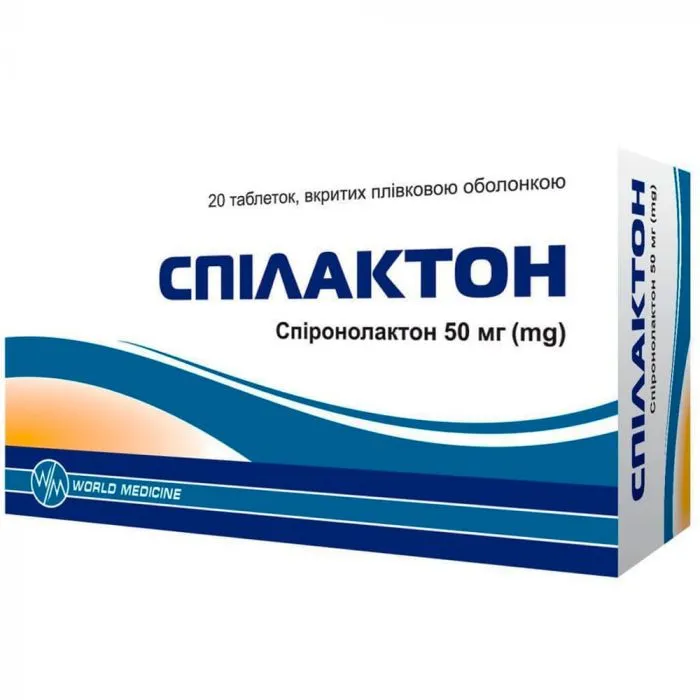
Table of Contents
INSTRUCTIONS FOR MEDICAL USE OF THE MEDICINAL PRODUCT SPYLACTONE (SPYLACTON)
Composition:
Active substance: spironolactone;
One film-coated tablet contains 25 mg, 50 mg, or 100 mg of spironolactone;
Excipients: maize starch; colloidal anhydrous silicon dioxide; povidone K30; calcium hydrogen phosphate dihydrate; magnesium stearate;
Film coating:
Tablets of 25 mg: Opadry II Yellow 85F220095 [polyvinyl alcohol; titanium dioxide (E 171); macrogol; talc; yellow iron oxide (E 172); tartrazine aluminum lake (E 102); brilliant blue FCF aluminum lake (E 110)];
Tablets of 50 mg: Opadry II Orange 85F230047 [polyvinyl alcohol; titanium dioxide (E 171); macrogol; talc; yellow iron oxide (E 172); red iron oxide (E 172)];
Tablets of 100 mg: Opadry II Orange 85F230020 [polyvinyl alcohol; titanium dioxide (E 171); macrogol; talc; yellow iron oxide (E 172); red iron oxide (E 172)].
Pharmaceutical form. Film-coated tablets.
Main physicochemical characteristics:
Tablets of 25 mg: round, biconvex film-coated tablets of light yellow to yellow color, with a dividing line on one side;
Tablets of 50 mg: round, biconvex film-coated tablets of light orange to orange color, with a dividing line on one side;
Tablets of 100 mg: round, biconvex film-coated tablets of yellowish-orange color, with a dividing line on one side.
Pharmacotherapeutic group.
Potassium-sparing diuretics. ATC code: C03D A01.
Pharmacological properties.
Pharmacodynamics.
Spironolactone is a competitive antagonist of aldosterone. It increases sodium excretion while simultaneously reducing potassium excretion in the distal renal tubules. Its action is gradual and prolonged.
Pharmacokinetics.
Spironolactone is well absorbed after oral administration and is primarily metabolized, forming active metabolites: sulfur-containing (80%) and partially canrenone (20%).
The elimination half-life (T1/2) of spironolactone is short (1.3 hours), while the elimination half-life (T1/2) of active metabolites is longer (from 2.8 to 11.2 hours). Metabolites are mainly excreted by the kidneys, the remainder through the intestine. Spironolactone and its metabolites cross the placenta and are excreted in breast milk.
When administering 100 mg of spironolactone daily for 15 days to healthy volunteers in a fasting state, Tmax was 2.6 hours, Cmax was 80 ng/mL, and T1/2 was approximately 1.4 hours. For 7-alpha-(thiomethyl)-spironolactone and canrenone, Tmax was 3.2 and 4.3 hours, Cmax was 391 ng/mL and 181 ng/mL, and T1/2 was 13.8 hours and 16.5 hours, respectively.
The renal effect of a single dose of spironolactone reaches its peak after 7 hours, and activity persists for at least 24 hours.
Clinical characteristics.
Indications.
- Congestive heart failure.
- Liver cirrhosis associated with edema and ascites.
- Malignant ascites.
- Nephrotic syndrome.
- Primary hyperaldosteronism — diagnosis and treatment.
Treatment of children should be conducted only under the supervision of a pediatrician. Data regarding use in children are limited.
Contraindications.
- Hypersensitivity to the active substance and/or excipients of the medicinal product.
- Acute renal failure, severe impairment of renal excretory function, anuria.
- Addison's disease.
- Hyperkalemia.
- Hyponatremia.
- Moderate or severe renal function impairment in children.
- Concomitant use with eplerenone or other potassium-sparing diuretics and potassium supplements — due to the risk of developing hyperkalemia.
- Breastfeeding period.
Interaction with other medicinal products and other types of interactions.
When spironolactone is used concomitantly:
With other potassium-sparing diuretics, angiotensin-converting enzyme inhibitors (ACE inhibitors), nonsteroidal anti-inflammatory drugs (NSAIDs), angiotensin II receptor antagonists, aldosterone blockers, heparin, low-molecular-weight heparins, potassium supplements, and other agents or food products capable of increasing plasma potassium levels — risk of developing severe hyperkalemia. Moreover, concomitant use of spironolactone with trimethoprim/sulfamethoxazole may lead to clinically significant hyperkalemia.
With digoxin — prolonged elimination half-life of digoxin. Spironolactone may also interfere with the assay for determining digoxin plasma concentration. When these agents are used concomitantly, response to digoxin should be monitored by methods not affected by spironolactone. Close monitoring of the patient is required, and digoxin dosage adjustment may be necessary.
With antihypertensive agents — potentiation of their effect. The dose of antihypertensive agents should be reduced when spironolactone is added to the therapeutic regimen, and further dose adjustment of antihypertensive agents should be performed as needed. Additionally, since ACE inhibitors reduce aldosterone synthesis, their regular concomitant use with spironolactone is not recommended, especially in patients with renal impairment.
With carbenoxolone — reduced efficacy of spironolactone due to sodium retention. Concomitant use of these agents should be avoided.
With nonsteroidal anti-inflammatory drugs (NSAIDs), including acetylsalicylic acid, indomethacin, and mefenamic acid — reduced diuretic activity of spironolactone due to inhibition of intrarenal prostaglandin synthesis.
With norepinephrine — spironolactone reduces vascular response to norepinephrine. Caution should be exercised during anesthesia in patients receiving spironolactone.
With antipyrine — increased metabolism of the latter.
With mitotane — spironolactone may reduce plasma levels of mitotane in patients with adrenocortical carcinoma receiving mitotane therapy. Concomitant use of these agents should be avoided.
During fluorometric analyses, spironolactone may interfere with the assessment of compounds exhibiting similar fluorescence characteristics.
Spironolactone binds to androgen receptors, which may lead to increased levels of prostate-specific antigen (PSA) in patients with prostate cancer receiving abiraterone. Therefore, concomitant use of these medicinal products is not recommended.
Special precautions for use.
Effect on water-electrolyte balance.
During administration of the medicinal product, water-electrolyte balance should be monitored regularly, especially in elderly patients and patients with impaired renal or hepatic function.
In case of renal dysfunction or excessive potassium intake, hyperkalemia may develop, which can lead to cardiac disturbances, including fatal outcomes.
If hyperkalemia occurs, administration of the medicinal product should be discontinued and, if necessary, measures taken to reduce plasma potassium levels.
It has also been reported that administration of spironolactone in some patients with decompensated liver cirrhosis may lead to reversible hyperchloremic metabolic acidosis due to hyperkalemia, even when renal function is normal.
Effect on the urinary system.
During administration of spironolactone, transient increases in blood urea nitrogen levels have been reported, particularly in patients with impaired renal function.
Use in patients with severe heart failure.
Hyperkalemia in such patients can be life-threatening. Careful monitoring of plasma potassium levels is essential during treatment. Monitoring of plasma potassium and creatinine levels is recommended one week after initiation or dose increase of spironolactone, monthly during the first 3 months of therapy, quarterly for the following year, and then every 6 months thereafter. Potassium supplements and other potassium-sparing diuretics should not be used in patients with serum potassium levels above 3.5 mmol/L. If plasma potassium levels increase to 5 mmol/L or higher, or plasma creatinine levels reach 4 mg/dL or higher, administration of the medicinal product should be discontinued.
Use in children.
Spironolactone should be used in children only under the supervision of a pediatrician, as data on use in this patient population are limited.
Potassium-sparing diuretics, including spironolactone, should be used with caution in children with hypertension and mild renal impairment due to the risk of developing hyperkalemia. The medicinal product is contraindicated in children with moderate to severe renal impairment.
The 25 mg tablet formulation contains aluminium lake of tartrazine (E 102) and aluminium lake of Yellow West FCF (E 110), which may cause allergic reactions.
Use during pregnancy or breastfeeding.
Spironolactone and its metabolites cross the placental barrier and are excreted in breast milk.
During pregnancy, the medicinal product should be used only when the expected benefit to the mother outweighs the potential risk to the fetus.
If use of the medicinal product is necessary, breastfeeding should be discontinued.
In animal studies, spironolactone has caused feminization of male fetuses.
Ability to affect reaction speed while driving or operating machinery.
Somnolence and dizziness have been reported during treatment with spironolactone. Caution should be exercised, especially at the beginning of therapy, until the patient's response to the medicinal product is established.
Dosage and Administration.
Adults.
Congestive heart failure with edema.
For reduction of edema, the initial daily dose of the drug is 100 mg administered once or in two divided doses, but may vary from 25 mg to 200 mg per day. The maintenance dose should be individually determined.
Severe heart failure (NYHA [New York Heart Association] class III–IV).
In combination with standard therapy, the recommended initial dose of the drug is 25 mg once daily when serum potassium ≤ 5.0 mEq/L and plasma creatinine ≤ 2.5 mg/dL. If the treatment is well tolerated, the dose may be increased to 50 mg once daily based on clinical indications. If the patient tolerates the drug poorly, the dose should be reduced to 25 mg every other day. Recommendations for monitoring serum potassium and creatinine levels are provided in the section "Special Instructions".
Liver cirrhosis associated with edema and ascites.
If the urinary Na+/K+ ratio is greater than 1.0, the dose of the drug is 100 mg per day. If the urinary Na+/K+ ratio is less than 1.0, the dose of the drug is 200–400 mg per day. The dose of spironolactone should be individually adjusted for each patient.
Malignant ascites.
The usual dose of the drug is 100–200 mg per day. In severe cases, the dose may be gradually increased up to 400 mg per day. The maintenance dose should be individually determined based on the clinical course of edematous syndrome.
Nephrotic syndrome.
The usual dose of the drug is 100–200 mg per day. Spironolactone does not affect the underlying pathological process. Its use is recommended only when glucocorticoid therapy is ineffective.
Diagnosis and treatment of primary hyperaldosteronism.
Spironolactone may be used as an initial diagnostic test to identify primary hyperaldosteronism in patients on a standard diet.
Long-term test: spironolactone is administered at a dose of 400 mg per day for 3–4 weeks. Correction of hypokalemia and arterial hypertension suggests the diagnosis of primary hyperaldosteronism.
Short-term test: spironolactone is administered at a daily dose of 400 mg for 4 days. If serum potassium increases during spironolactone administration and decreases after discontinuation, primary hyperaldosteronism should be considered.
After confirming the diagnosis of hyperaldosteronism with more precise testing procedures, the drug may be used at a dose of 100–400 mg/day for preoperative preparation.
Elderly patients.
Treatment with the drug should be initiated at low doses, with gradual titration to achieve the maximum effect. Caution is advised in patients with severe hepatic or renal impairment, as these conditions may alter the metabolism and excretion of spironolactone.
Children.
The initial daily dose of the drug is 1–3 mg/kg body weight, administered in several divided doses. Dosing should be adjusted based on the response to treatment and drug tolerance.
Children.
The use of the drug in children should be performed only under the supervision of a pediatrician, as data on use in this patient population are limited.
Overdose.
Symptoms.
Symptoms of acute spironolactone overdose include drowsiness, confusion, nausea, vomiting, dizziness, and diarrhea. Hyponatremia or hyperkalemia may develop. Hyperkalemia may manifest as paresthesia, weakness, flaccid paralysis, or muscle cramps, and may be difficult to clinically differentiate from hypokalemia. Electrocardiographic changes are the earliest specific signs of potassium imbalance.
Treatment.
Administration of the drug should be discontinued. Supportive therapy, including restoration of fluid and electrolyte balance, is recommended. Hyperkalemia may be treated by restricting potassium intake, using potassium-wasting diuretics, ion-exchange resins, and intravenous administration of glucose with insulin. No specific antidote has been identified.
Adverse Reactions
Adverse reactions are classified by frequency of occurrence as follows: very common (≥ 1/10), common (≥ 1/100 and < 1/10), uncommon (≥ 1/1000 and < 1/100), rare (≥ 1/10,000 and < 1/1000), very rare (< 1/10,000), and not known (frequency cannot be determined from available data).
Benign, malignant and unspecified neoplasms (including cysts and polyps):
Uncommon — benign breast tumors in males.
Blood and lymphatic system disorders:
Not known — leukopenia, agranulocytosis, thrombocytopenia.
Metabolism and nutrition disorders:
Very common — hyperkalemia; uncommon — electrolyte imbalance.
Psychiatric disorders:
Common — confusion; not known — libido changes.
Nervous system disorders:
Common — dizziness.
Gastrointestinal disorders:
Common — nausea; not known — gastrointestinal disorders.
Hepatobiliary disorders:
Uncommon — liver function abnormalities.
Immune system, skin and subcutaneous tissue disorders:
Common — itching, rash; uncommon — urticaria; not known — hypersensitivity reactions, Stevens-Johnson syndrome, toxic epidermal necrolysis, drug reaction with eosinophilia and systemic symptoms (DRESS syndrome), alopecia, hypertrichosis, pemphigoid.
Musculoskeletal and connective tissue disorders:
Common — calf muscle spasms.
Renal and urinary disorders:
Common — acute renal failure.
Reproductive system and breast disorders:
Common — menstrual dysfunction, breast pain (in males); uncommon — breast pain (in females).
General disorders and administration site conditions:
Common — malaise.
Gynecomastia may occur during treatment with spironolactone. The incidence depends on the dose and duration of treatment. Usually, gynecomastia is transient and resolves after discontinuation of the drug. In rare cases, some degree of breast enlargement may persist.
Reporting suspected adverse reactions
Reporting suspected adverse reactions after drug authorization is important. It allows continuous monitoring of the benefit-risk balance of the medicinal product. Healthcare professionals, pharmacists, patients, or their legal representatives should report all suspected adverse reactions and lack of efficacy through the Automated Pharmacovigilance Information System at: https://aisf.dec.gov.ua.
Shelf life
3 years.
Storage conditions
Store at temperatures not exceeding 25 °C, in the original packaging, in a place inaccessible to children.
Packaging
10 tablets in a blister pack. 2 blisters per cardboard box.
Prescription status
Prescription only.
Manufacturer
WORLD MEDICINE ILAC SAN. VE TIC. A.S. /
WORLD MEDICINE ILAC SAN. VE TIC. A.S.
Manufacturer's address
15 Temmuz Mahallesi Cami Yolu Caddesi No:50 Gunesli Bagcilar/Istanbul, Turkey / 15 Temmuz Mahallesi Cami Yolu Caddesi No:50 Gunesli Bagcilar/Istanbul, Turkey.
Marketing Authorization Holder
LLC "WORLD MEDICINE", Ukraine /
WORLD MEDICINE, LLC, Ukraine.