Sintorix
Ukraine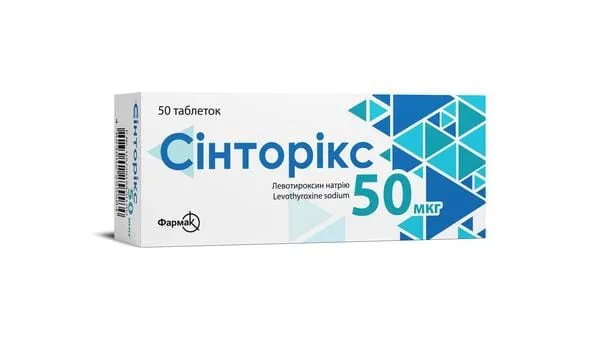
Table of Contents
INSTRUCTIONS FOR MEDICAL USE OF THE MEDICINAL PRODUCT SINTORIX (SINToRIx)
Composition:
Active substance: levothyroxine sodium;
One tablet contains levothyroxine sodium, calculated as 100% substance, 25 mcg, or 50 mcg, or 75 mcg, or 100 mcg, or 125 mcg, or 150 mcg;
Excipients: mannite (E 421), maize starch, gelatin, sodium croscarmellose, magnesium stearate.
Pharmaceutical form. Tablets.
Main physicochemical properties: tablets from white to white with a yellowish tint, round-shaped, with a flat surface, beveled edges and a score line.
Pharmacotherapeutic group. Hormone preparations for systemic use (except sex hormones and insulin). Preparations for treatment of thyroid disorders. Thyroid preparations. Levothyroxine sodium. ATC code H03A A01.
Pharmacological properties.
Pharmacodynamics. The synthetic levothyroxine contained in the medicinal product Synthorix has effects identical to those of the hormone secreted by the thyroid gland. It is converted to T3 (triiodothyronine) in peripheral organs and, like the endogenous hormone, acts on T3 receptors. There is no difference between the functions of endogenous hormone and exogenous levothyroxine.
Pharmacokinetics. After oral administration, levothyroxine is almost completely absorbed in the upper part of the small intestine. Depending on the pharmaceutical formulation of the drug, up to 80% of the administered dose is absorbed. Maximum concentration (Tmax) is reached approximately 5–6 hours after administration.
The clinical effect of the drug appears 3–5 days after oral administration. Levothyroxine rapidly binds to specific plasma transport proteins (up to 99.97%). The binding to proteins is not covalent, thus the bound hormone in plasma is able to continuously and rapidly exchange with free hormone fractions.
Due to the high degree of protein binding, levothyroxine is not removed by either hemodialysis or hemoperfusion.
The elimination half-life of the drug is 7 days. In hyperthyroidism, this period is shortened to 3–4 days, while in hypothyroidism it is prolonged to 9–10 days. The volume of distribution is 10–12 L. Approximately one-third of the total administered levothyroxine accumulates in the liver, rapidly exchanging with levothyroxine present in blood serum. Thyroid hormones are metabolized mainly in the liver, kidneys, brain, and muscles. Metabolites are excreted in urine and feces. Total metabolic clearance of levothyroxine is approximately 1.2 L of plasma per day.
Clinical characteristics.
Indications.
Synthorics 25–200 mcg
- Treatment of benign euthyroid goiter.
- Prevention of recurrences after surgical treatment of euthyroid goiter, depending on hormone levels in the postoperative period.
- Replacement therapy in hypothyroidism.
- Suppressive therapy in thyroid cancer.
Synthorics 25–100 mcg
- As an adjunctive agent during antithyroid therapy in hyperthyroidism.
Synthorics 100/150/200 mcg
- As a diagnostic agent in performing the thyroid suppression test.
Contraindications.
- Hypersensitivity to any component of the drug.
- Adrenal insufficiency, pituitary insufficiency, untreated thyrotoxicosis.
- Acute myocardial infarction, acute myocarditis, acute pancarditis.
- Combination therapy with levothyroxine and antithyroid agents during pregnancy is not recommended (see section "Use in pregnancy or breastfeeding").
Interaction with other medicinal products and other forms of interaction.
Antidiabetic agents. Levothyroxine may reduce the effect of antidiabetic drugs. Frequent monitoring of blood glucose levels is recommended at the beginning of thyroid hormone therapy, and dosage adjustment of antidiabetic agents may be necessary.
Coumarin derivatives. Levothyroxine enhances the effect of anticoagulant drugs by displacing them from plasma protein binding, increasing the risk of hemorrhage, for example, intracranial or gastrointestinal bleeding, especially in elderly patients. Therefore, laboratory monitoring of coagulation parameters should be performed regularly at the start and during concomitant therapy, and the daily dose of anticoagulants should be adjusted if necessary.
Protease inhibitors (e.g., ritonavir, indinavir, lopinavir) may affect the action of levothyroxine. Careful monitoring of thyroid hormone levels is required. Dose adjustment of levothyroxine may be necessary.
Phenytoin may affect the action of levothyroxine by displacing it from plasma protein binding, resulting in increased levels of free thyroxine (fT4) and free triiodothyronine (fT3). On the other hand, phenytoin increases hepatic metabolism of levothyroxine. Careful monitoring of thyroid hormone levels is recommended.
Cholestyramine, colestipol. Administration of ion-exchange resins such as cholestyramine and colestipol inhibits the absorption of sodium levothyroxine. Therefore, sodium levothyroxine should be taken 4–5 hours before these agents.
Aluminum-, iron-, and calcium-containing preparations. According to data from relevant literature sources, aluminum-containing drugs (antacids, sucralfate) may potentially reduce the effect of levothyroxine. Therefore, levothyroxine should be taken at least 2 hours before aluminum-containing preparations. The same applies to iron- and calcium-containing medicinal products.
Salicylates, dicoumarol, furosemide in high doses (250 mg), clofibrate, and other substances may displace sodium levothyroxine from plasma protein binding, leading to an increase in the fT4 fraction.
Proton pump inhibitors (PPIs): concomitant use with PPIs may lead to reduced absorption of thyroid hormones due to increased intragastric pH caused by PPIs.
Regular monitoring of thyroid function and clinical monitoring are recommended, with possible dose increase of thyroid hormones. Caution is also advised when PPI treatment is discontinued.
Orlistat. Concomitant use of orlistat and levothyroxine may cause development of hypothyroidism and/or worsening of hypothyroidism control. This may be due to reduced absorption of iodine salts and/or levothyroxine.
Sevelamer may reduce levothyroxine absorption. Therefore, monitoring of thyroid function parameters at the beginning and end of concomitant therapy is recommended. Dose adjustment of levothyroxine may be necessary.
Tyrosine kinase inhibitors (e.g., imatinib, sunitinib) may reduce the effectiveness of levothyroxine. Therefore, monitoring of thyroid function parameters at the beginning and end of concomitant therapy is recommended. Dose adjustment of levothyroxine may be necessary.
Propylthiouracil, glucocorticoids, beta-blockers, amiodarone, and iodine-containing contrast agents inhibit peripheral conversion of T4 to T3. Due to its high iodine content, amiodarone may promote the development of both hyperthyroidism and hypothyroidism. The drug should be prescribed with particular caution to patients with nodular goiter of undetermined etiology.
Sertraline, chloroquine/proguanil reduce the effectiveness of levothyroxine and increase serum TSH laboratory values.
Effect of drugs inducing cytochrome P-450: medicinal products that induce enzymes, such as barbiturates, carbamazepine, products containing St. John's wort (Hypericum perforatum L.), may increase hepatic clearance of levothyroxine, leading to decreased serum concentration of thyroid hormone. Thus, patients receiving thyroid replacement therapy may require an increased dose of thyroid hormones when these drugs are administered concomitantly.
Estrogens. Women taking estrogen-containing contraceptives and postmenopausal women taking hormone replacement therapy may require higher doses of levothyroxine.
Soy-containing preparations may inhibit intestinal absorption of levothyroxine. Therefore, the dose of Synthorics should be adjusted, especially at the beginning and after discontinuation of soy-containing supplements.
Effect on laboratory test results. Biotin may interfere with immunoassays of thyroid function based on biotin-streptavidin interaction, leading to falsely low or falsely high test results (see section "Special precautions for use").
Special precautions for use.
Before initiating therapy with thyroid hormones or carrying out thyroid suppression tests, it is necessary to exclude or previously treat conditions such as coronary insufficiency, angina pectoris, atherosclerosis, arterial hypertension, and pituitary insufficiency. Functional autonomy of the thyroid gland should also be excluded or appropriately treated prior to starting thyroid hormone therapy.
In cases of adrenocortical dysfunction, appropriate replacement therapy should be initiated before starting levothyroxine treatment to prevent acute adrenal insufficiency (see section "Contraindications").
Therapy with levothyroxine in patients at risk of developing psychotic disorders should be initiated with low doses, gradually increasing the dosage at the beginning of treatment. Close monitoring of the patient is recommended. If psychotic disorders develop, dose adjustment of levothyroxine should be considered.
Even minor manifestations of hyperthyroidism induced by the drug should be avoided in patients with coronary insufficiency, heart failure, or tachyarrhythmia. In treating such patients, regular monitoring of thyroid hormone levels is required.
In cases of secondary hypothyroidism, the underlying cause should be identified before initiating replacement therapy. If necessary, a course of replacement therapy for adrenal insufficiency should be administered.
In suspected cases of functional autonomy of the thyroid gland, TSH levels should be measured or thyroid scintigraphy performed before initiating treatment with the drug.
When initiating levothyroxine therapy in preterm neonates with very low body weight, hemodynamic parameters should be monitored, as circulatory disturbances may occur due to immature adrenal function.
Postmenopausal women suffering from hypothyroidism and at increased risk of osteoporosis should avoid excessively high serum levels of levothyroxine exceeding physiological levels. Therefore, laboratory parameters of thyroid function should be carefully monitored.
Levothyroxine should not be prescribed to patients with hyperthyroidism who are being treated with antithyroid drugs for hyperthyroidism.
Thyroid hormones must not be used for weight reduction. Administration of levothyroxine does not lead to weight loss in euthyroid patients. Higher doses may cause serious or even life-threatening adverse reactions. High-dose levothyroxine should not be combined with certain weight-reducing agents (e.g., sympathomimetics) (see section "Overdose").
When switching from one levothyroxine-containing product to another, careful monitoring, including clinical and biological assessments during the transition period, is required due to the potential risk of thyroid dysfunction. Some patients may require dose adjustments.
Concomitant use of orlistat and levothyroxine may lead to the development of hypothyroidism and/or deterioration in the control of hypothyroidism (see section "Interaction with other medicinal products and other forms of interaction"). Patients taking levothyroxine should consult their physician before starting, stopping, or changing orlistat treatment, as orlistat and levothyroxine must be taken at different times and levothyroxine dosage may require adjustment. Monitoring of serum hormone levels is recommended thereafter.
Use with caution in patients with diabetes mellitus and in patients taking anticoagulant medications (see section "Interaction with other medicinal products and other forms of interaction").
Effect on laboratory test results
Biotin may interfere with thyroid function tests based on biotin-streptavidin interaction, leading to falsely decreased or falsely increased test results. The risk of interference increases with higher doses of biotin.
When interpreting laboratory test results, potential biotin interference should be considered, especially if there is a lack of concordance with the clinical picture.
Patients taking biotin-containing supplements should inform laboratory personnel about the optimal timing for thyroid function testing. Alternative assays not susceptible to biotin interference should be used if available (see section "Interaction with other medicinal products and other forms of interaction").
This medicinal product contains less than 1 mmol of sodium (23 mg) per tablet, i.e., essentially sodium-free.
Use during pregnancy or breastfeeding.
During pregnancy or breastfeeding, treatment with a hypothyroidism medication should be continued. During pregnancy, an increased dose of the drug may be required. Since serum TSH levels may rise as early as week 4 of pregnancy, pregnant women taking levothyroxine should have their TSH levels checked during each trimester. Serum TSH levels in pregnant women should remain within the trimester-specific reference ranges. To correct elevated serum TSH levels, the dose of levothyroxine should be increased. As postnatal TSH levels return to pre-pregnancy values, the levothyroxine dose should be adjusted immediately after delivery to the pre-pregnancy dose. Normal serum TSH levels should be re-established within 6–8 weeks after delivery.
Pregnancy
There are no data on teratogenicity or fetotoxicity with the use of the drug at recommended therapeutic doses. However, administration of very high doses of levothyroxine during pregnancy may adversely affect the fetus and postnatal child development.
Combined therapy with levothyroxine and antithyroid agents during pregnancy is not recommended for the treatment of hyperthyroidism, as this combination requires higher doses of antithyroid drugs, which can cross the placenta and may cause hypothyroidism in the newborn. Thyroid suppression testing is not performed during pregnancy because the use of radioactive substances is contraindicated in pregnancy.
Breastfeeding
Levothyroxine passes into breast milk; however, when administered at recommended therapeutic doses, the concentration in breast milk is insufficient to cause hyperthyroidism or suppression of TSH secretion in the infant.
Ability to influence the ability to drive and use machines.
There are no data regarding the potential effect on the ability to drive or operate machinery. However, since levothyroxine is biologically identical to the natural thyroid hormone, no effect of the medicinal product Synthrex on reaction speed during driving or operating machinery is expected.
Method of administration and dosage.
Dosage.
Sintrex is available in tablets containing 25 mcg to 150 mcg of sodium levothyroxine, allowing individualized dosing for each patient according to individual needs. Therefore, patients are usually prescribed only one tablet per day.
Dosage information provided is for guidance only.
The daily dose should be determined individually, based on laboratory parameters and the clinical picture of the disease.
Since in some patients undergoing levothyroxine therapy increased concentrations of T4 and fT4 have been observed, the basal concentration of thyroid-stimulating hormone (TSH) in serum is a more reliable indicator for further dose adjustment.
Thyroid hormone therapy should be initiated at a low dose and gradually increased (every 2–4 weeks) to the required therapeutic dose.
In elderly patients, patients with coronary heart disease, and those with severe or long-standing hypothyroidism, treatment should be initiated with particular caution, starting with low doses (12.5 mcg daily). The dose should be increased gradually to the maintenance dose at longer intervals (by 12.5 mcg every 2 weeks), with regular monitoring of thyroid hormone levels. It should be noted that prescribing doses lower than the optimal dose required for full replacement therapy does not lead to complete normalization of TSH levels.
Clinical experience indicates that lower doses may be sufficient for patients with low body weight and for patients with large nodular goiter.
| Indications |
Recommended doses (sodium levothyroxine, mcg/day) |
|||||||||||||||
| Treatment of benign euthyroid goiter |
75–200 |
|||||||||||||||
| Prevention of recurrences after surgical treatment of euthyroid goiter |
75–200 |
|||||||||||||||
| Replacement therapy of hypothyroidism in adults:
|
25–50 100–200 |
|||||||||||||||
| Replacement therapy of hypothyroidism in children:
|
12.5–50 100–150 mcg/m2 body surface area |
|||||||||||||||
| As an adjunctive agent during antithyroid therapy of hyperthyroidism |
50–100 |
|||||||||||||||
| Suppressive therapy in thyroid cancer |
150–300 |
|||||||||||||||
| As a diagnostic agent in performing the thyroid suppression test |
The daily dose can be taken as a single administration. The daily dose of the medication should be taken in the morning on an empty stomach, 30 minutes before eating, with a small amount of water (half a glass of water). Sintrex should be used for life as replacement therapy in hypothyroidism, after surgical interventions (strumectomy or thyroidectomy), as well as for prevention of recurrences after removal of euthyroid goiter. Combination therapy with antithyroid agents should be initiated after achieving euthyroid state. In benign forms of euthyroid goiter, the duration of treatment ranges from 6 months to 2 years. If there is no improvement after treatment, surgical intervention or radioactive iodine therapy should be considered. Children. For newborns and infants with congenital hypothyroidism, where rapid achievement of therapeutic effect is critical, the recommended initial dose is 10–15 mcg/kg body weight per day during the first 3 months of life. After this period, the dose should be individually adjusted based on clinical parameters and serum thyroid-stimulating hormone (TSH) levels. For infants, the daily dose should be administered as a single dose, 30 minutes before the first feeding. The tablet should be dissolved in water to form a suspension, which should be prepared immediately before administration, and then mixed with a small additional amount of liquid. Overdose. Elevated T3 (triiodothyronine) levels are a reliable indicator of drug overdose, more so than increased T4 and fT4 (free thyroxine) levels in serum. As a result of overdose, symptoms characteristic of increased metabolic rate may occur (see section "Adverse Reactions"). In case of overdose, the drug should be discontinued and laboratory tests should be performed. In cases of pronounced beta-sympathomimetic effects such as tachycardia, restlessness, nervous agitation, and hyperkinesia, beta-blockers should be prescribed. In cases of significant overdose, plasmapheresis is recommended. In individual cases, seizures may occur in patients predisposed to convulsions when the individual tolerated dose of the drug has been exceeded. Levothyroxine overdose may cause symptoms of hyperthyroidism and may lead to acute psychosis, particularly in patients at risk of developing psychotic disorders. There have been several reports of sudden coronary death in patients who chronically abused (exceeded the recommended dosage of) levothyroxine over many years. Side effects.Clinical symptoms of hyperthyroidism may occur in cases of overdose, exceeding the individual tolerance dose of levothyroxine, or when the dose is rapidly increased at the beginning of treatment. Symptoms include:
In such cases, the daily dose of the drug should be reduced or treatment should be interrupted for several days. After the side effects disappear, therapy may be continued. Allergic reactions may occur in patients with hypersensitivity to the components of the drug, including skin manifestations (rash, urticaria) and respiratory tract symptoms, such as skin rash, pruritus, urticaria, dyspnea. Cases of angioneurotic edema (Quincke's edema) have been reported. Reporting suspected side effects Reporting suspected adverse reactions after drug registration is of great importance. It enables continuous monitoring of the benefit-risk balance of the medicinal product. Healthcare and pharmaceutical professionals, as well as patients or their legal representatives, are encouraged to report all suspected adverse reactions and lack of drug efficacy via the automated pharmacovigilance information system at: https://aisf.dec.gov.ua. Shelf life. 2 years. Do not use the medicinal product after the expiry date stated on the packaging. Storage conditions. No special storage conditions required. Keep out of reach of children. Packaging. 10 tablets per blister. 5 or 10 blisters per carton. Prescription status. Prescription only. Manufacturer. JSC "Farmak". Manufacturer's address and place of business. |