Prefemin
Ukraine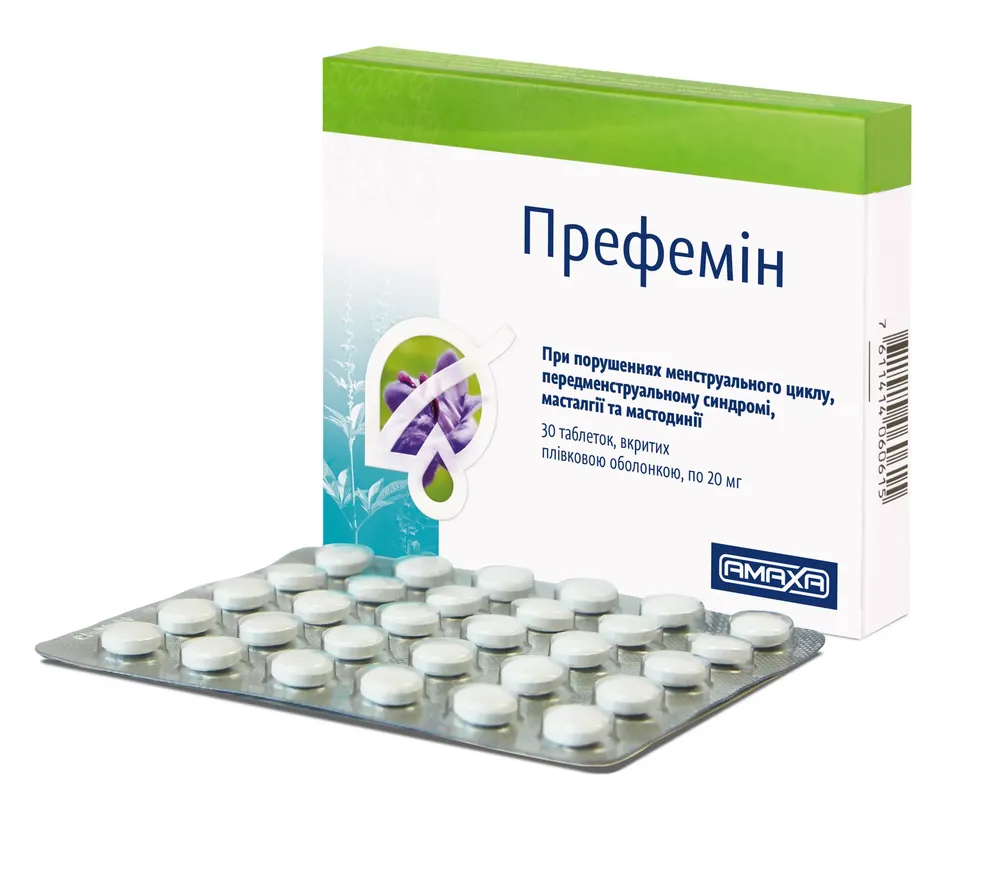
Table of Contents
INSTRUCTION FOR MEDICAL USE OF THE MEDICINAL PRODUCT Prefemin® (Prefemin)
Composition:
Active substance: 1 tablet contains 20 mg of dry native extract of common chaste tree fruit (Fructus Agni casti) (6–12:1), extracted with 60% ethanol (m/m);
Excipients: microcrystalline cellulose; lactose monohydrate; magnesium stearate; colloidal anhydrous silicon dioxide; hypromellose; macrogol 400; titanium dioxide (E 171); macrogol 20000; propylene glycol.
Pharmaceutical form. Film-coated tablets.
Main physicochemical characteristics: white, round, biconvex tablets with an aromatic odor.
Pharmacotherapeutic group. Drugs used in gynecology.
ATC code G02C X03.
Pharmacological Properties
Pharmacodynamics.
The drug is a herbal medicinal product intended for the treatment of premenstrual syndrome.
The drug exerts a normalizing effect on sex hormone levels. The dopaminergic effects of the drug lead to a reduction in prolactin production, thereby eliminating hyperprolactinemia. Elevated prolactin concentration disrupts gonadotropin secretion, which may result in disturbances in follicular maturation, ovulation, and the corpus luteum phase, ultimately leading to an imbalance between estradiol and progesterone. This hormonal imbalance causes menstrual disorders. Unlike estrogens and other hormones, prolactin also exerts a direct stimulatory effect on proliferative processes in the mammary glands, promoting the formation of connective tissue and dilation of the milk ducts. Reduction in prolactin levels leads to regression of pathological processes in the mammary glands and alleviates pain symptoms. Rhythmic production and normalization of gonadotropin hormone ratios support the normalization of the second phase of the menstrual cycle.
Pharmacokinetics.
No data available.
Clinical characteristics.
Indications.
A herbal medicinal product for the treatment of premenstrual syndrome.
Contraindications.
Hypersensitivity to the fruits of Vitex agnus-castus or to any of the excipients of the product.
Interaction with other medicinal products and other forms of interaction.
Interaction with dopamine agonists, dopamine antagonists, estrogens, and antiestrogens cannot be excluded due to possible dopaminergic and estrogenic effects of Vitex agnus-castus.
Special precautions for use
Patients who have or have had estrogen-dependent tumors, as well as those receiving dopamine agonists, dopamine antagonists, estrogens, or antiestrogens, should consult a physician before using medicinal products containing common chaste tree (Agnus castus).
Prior to administration, patients with a history of pituitary disorders should consult a physician, since fruits of the common chaste tree affect the hypothalamic-pituitary system.
In patients with prolactin-secreting pituitary tumors, treatment with fruits of the common chaste tree may mask tumor symptoms.
There are no clinical data on use in patients with severe renal or hepatic impairment.
If symptoms worsen during treatment, medical advice must be sought.
This medicinal product contains lactose. The product should not be taken by patients with hereditary galactose intolerance, lactase deficiency, or glucose-galactose malabsorption syndrome.
Prefemin helps to harmonize the hormonal balance in the female body. The harmonization process may last up to 3 months. During this period, menstrual cycle disturbances may occur.
Use during pregnancy or breastfeeding
Use during pregnancy or breastfeeding is not recommended (may cause reduced lactation).
Effect on ability to drive or operate machinery
If dizziness occurs during treatment with this medicinal product, patients should refrain from driving or operating machinery.
Dosage and method of administration.
Take 1 tablet once daily. The film-coated tablets should be swallowed whole, without chewing, with a sufficient amount of water. It is recommended to take the tablets approximately at the same time each day, for example in the morning or before bedtime, regardless of food intake. Treatment lasts continuously for 3 months, including during the menstrual period. Even after improvement of symptoms, treatment should be continued for several more weeks. If symptoms persist after 3 months of treatment, consult a physician.
Children.
Due to insufficient data, the drug is not recommended for use in children.
Overdose.
In case of overdose, symptomatic treatment should be administered.
Adverse Reactions
The assessment of adverse reactions is based on the following criteria: very common (≥1/10), common (≥1/100 to <1/10), uncommon (≥1/1000 to <1/100), rare (≥1/10,000 to <1/1000), very rare (<1/10,000), not known (cannot be estimated from available data).
Immune system: serious allergic reactions with facial swelling, dyspnea, and difficulty swallowing – frequency not known.
Nervous system: headache, dizziness – frequency not known.
Gastrointestinal tract: gastrointestinal disturbances (nausea, abdominal pain) – frequency not known.
Skin and subcutaneous tissue: allergic skin reactions (rash, urticaria), acne – frequency not known.
Reproductive system and mammary glands: menstrual disorders – frequency not known.
In individual cases, symptoms of premenstrual syndrome may be exacerbated after the first dose of the medicinal product Prefemin.
If any adverse reactions occur, discontinue use of the medication and consult a physician.
Shelf life.
3 years.
Storage conditions.
Store at a temperature not exceeding 25 °C in the original packaging. Keep out of reach of children.
Packaging.
30 film-coated tablets in a blister; 1 or 3 blisters per cardboard box.
Availability. Over-the-counter.
Manufacturer.
Max Zeller Söhne AG
Max Zeller Söhne AG
Manufacturer's address and place of business.
Seeblickstrasse 4, 8590 Romanshorn, Switzerland
Seeblickstrasse 4, 8590 Romanshorn, Switzerland
Marketing Authorization Holder.
Amaxa Ltd
Amaxa Ltd
Address of Marketing Authorization Holder.
31 John Islip Street, London SW1P 4FE, United Kingdom
31 John Islip Street, London SW1P 4FE, United Kingdom