Prednisolone
Ukraine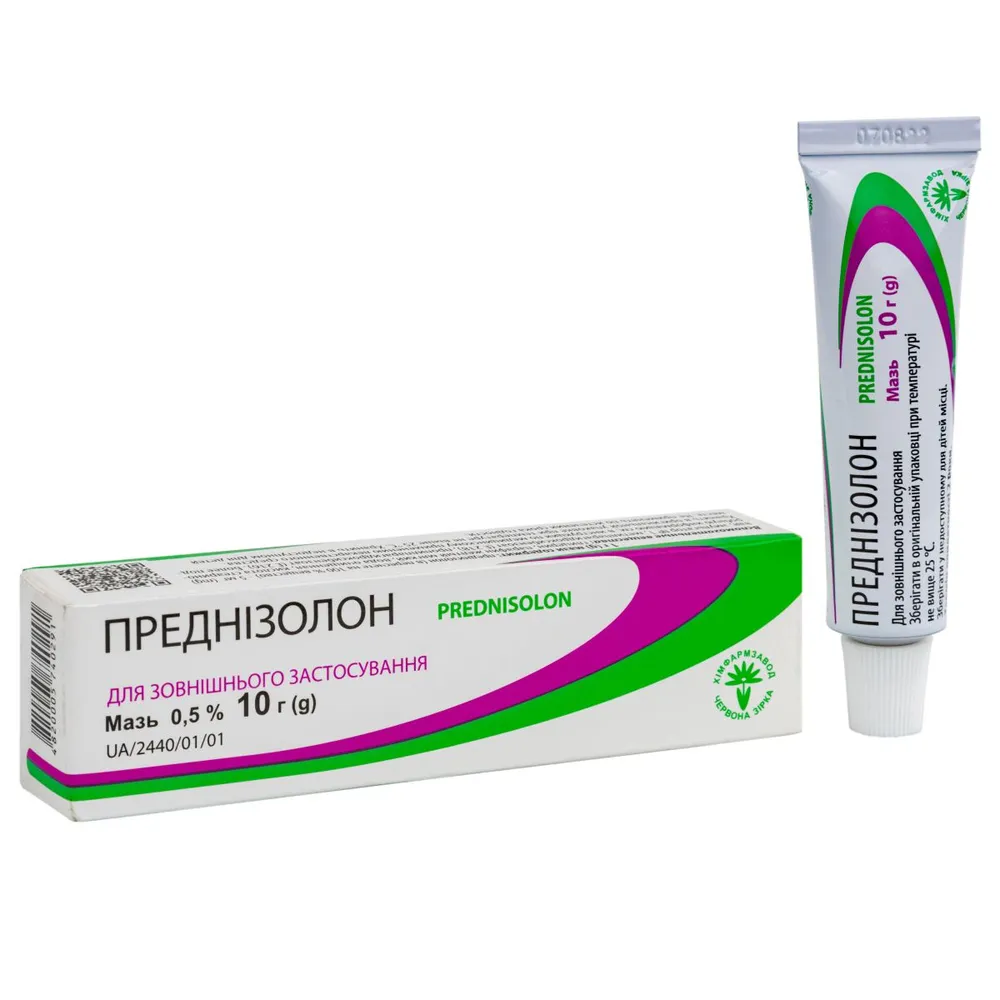
Table of Contents
INSTRUCTIONS FOR MEDICAL USE OF THE MEDICINAL PRODUCT PREDNISOLON (PREDNISOLONE)
Composition:
Active substance: prednisolone;
1 g of ointment contains: prednisolone (calculated as 100 % substance) – 5 mg;
Excipients: glycerol, yellow soft paraffin, purified water, stearic acid, emulsifier No. 1, methylparahydroxybenzoate (E 218), propylparahydroxybenzoate (E 216).
Pharmaceutical form. Ointment.
Main physicochemical properties: white-colored ointment.
Pharmacotherapeutic group.
Corticosteroids for dermatological use. Prednisolone.
ATC code D07AA03.
Pharmacological properties.
Pharmacodynamics.
Glucocorticosteroids (GCS) for local (topical) use exert anti-inflammatory, epidermostatic, antiallergic, immunosuppressive, and local anesthetic effects. The anti-inflammatory action is accompanied by vasoconstriction, reduction of itching and pain at the site of application, and inhibition of lymphocyte and macrophage migration into the inflamed area. GCS exert antimitotic and antiproliferative effects. An important aspect of the anti-inflammatory action of GCS is stimulation of lipocortin formation, which reduces the production of arachidonic acid and thereby decreases the formation of inflammatory and allergic mediators. Stabilization of cellular membranes plays a significant role in the mechanism of action of GCS. When applied topically, it practically does not produce systemic glucocorticoid or mineralocorticoid effects.
Pharmacokinetics.
After minimal absorption from the skin surface, it binds to plasma proteins, is metabolized in the liver, and excreted by the kidneys. Impaired integrity of the skin or the use of an occlusive dressing may increase the absorption of prednisolone through the skin. Prednisolone crosses the placental barrier and passes into breast milk in small amounts.
Clinical characteristics.
Indications.
In complex therapy of inflammatory and allergic skin diseases of non-microbial etiology: eczema, seborrheic dermatitis, psoriasis, lupus erythematosus, erythroderma.
Contraindications.
wound or ulcerative lesions, bacterial, viral and fungal skin infections, Cushing's syndrome, chickenpox, herpes simplex, vaccination period, skin manifestations of syphilis, cutaneous tuberculosis, skin tumors, common acne, rosacea (possible exacerbation of the disease), hypersensitivity to components of the drug, herpes zoster, perioral dermatitis, atrophic dermatitis, skin reactions after vaccination at the site of drug application.
Interaction with other medicinal products and other forms of interaction.
To prevent infectious skin lesions, prednisolone is recommended to be prescribed in combination with antibacterial and antifungal agents.
During treatment with the drug, vaccination against smallpox or other types of immunization should not be performed due to the immunosuppressive effect of glucocorticosteroids.
Due to absorption, treatment of large skin areas or prolonged therapy may cause interactions similar to those observed during systemic therapy. However, to date, no such interactions have been reported. If it is necessary to use any other medicinal products simultaneously, consult a physician.
Special precautions for use.
The medicinal product should be used at the lowest doses and for the shortest duration necessary to achieve the desired therapeutic effect. High doses should be administered under strict medical supervision in patients with a history of psychosis.
Sudden discontinuation of the drug after prolonged use is dangerous! It may lead to exacerbation of the disease and worsening of the patient's general condition. Therefore, the drug should be discontinued gradually.
In case of bacterial skin infections and/or fungal involvement, additional specific treatment with antibacterial and/or antifungal agents is required.
The product should be avoided in contact with eyes, deep open wounds, and mucous membranes.
Visual disturbances may occur during treatment with systemic or topical corticosteroid preparations. If patients experience symptoms such as blurred vision or other visual disturbances, they should consult an ophthalmologist to determine possible causes, including cataract, glaucoma, or rare conditions such as central serous chorioretinopathy (CSC), which has been reported after use of systemic or topical corticosteroid preparations.
Occlusive dressings may be used to enhance therapeutic efficacy.
When topical corticosteroids are applied over large body surface areas or for prolonged periods, especially under occlusive dressings, the risk of adverse effects significantly increases. The total skin area treated with corticosteroids (CS) should not exceed 20% of the body surface.
Treatment should be administered under medical supervision. Regular ophthalmologic monitoring and blood pressure control are required during treatment. As with systemic corticosteroid (CS) use, topical CS application may also lead to glaucoma (e.g., after high-dose use, prolonged treatment over large areas, use of occlusive dressings, or application to skin around the eyes).
Prolonged treatment with topical agents may lead to sensitization. In such cases, therapy should be discontinued and appropriate measures taken.
To minimize adverse effects, alternate corticosteroids (CS) with non-steroidal agents. CS should be used in short courses and only for managing exacerbations, not for prophylaxis. When prescribing prednisolone, the daily secretory rhythm of glucocorticosteroids—the circadian rhythm of adrenal cortex hormone secretion—should be considered: higher doses in the morning, medium doses during the day, and lower doses in the evening.
Use with caution in immunodeficient conditions (including AIDS or HIV infection).
Do not use for more than 14 days.
The product contains methylparahydroxybenzoate (E 218) and propylparahydroxybenzoate (E 216), which may cause allergic reactions, including bronchospasm.
Use during pregnancy or breastfeeding.
The medicinal product should not be administered to pregnant women.
Breastfeeding women should either discontinue breastfeeding or stop using the medicinal product, especially when high doses are required.
Ability to influence reaction rate while driving or operating machinery.
Does not influence.
Method of Administration and Dosage.
Apply externally. Apply the ointment 1–3 times daily in a uniform thin layer to the affected area, gently rubbing it into the skin.
To enhance the effect, occlusive dressings may be used on limited areas of inflammation.
The duration of treatment is 6–14 days. The drug should not be used for longer than 14 days.
When prescribing to children aged 1 year and older, the total duration of treatment should be limited to 5–7 days, and measures that enhance resorption and absorption of the steroid (warming, immobilizing, and occlusive dressings) should be avoided.
Children.
In children, the drug should be used only for a short course (5–7 days) on limited skin areas and only under medical supervision. Use in children aged 1 to 3 years is possible only if the expected therapeutic benefit outweighs the potential risk to the child.
In such cases, the total duration of treatment must be limited, and measures leading to increased resorption and absorption of the steroid (warming, immobilizing, and occlusive dressings) must be avoided. The drug should not be applied to facial skin.
In pediatric patients, suppression of adrenal gland function may develop more rapidly. In addition, decreased excretion of growth hormone may occur. With prolonged use of the drug, body weight, growth, and plasma cortisol levels should be monitored.
Overdose.
Overdose may intensify adverse reactions.
Prolonged use of the drug in large doses may lead to symptoms of hypercorticism.
Symptoms: headache, heart failure, urticaria, rash, severe itching.
Treatment: symptomatic. The drug should be discontinued and medical advice should be sought.
Emergency medical assistance is required in severe cases.
In cases of cutaneous atrophoderma associated with overdose during local application of the drug, treatment should be discontinued. Symptoms usually regress within 10–14 days.
Adverse reactions.
When using the drug, especially in patients with individual sensitivity to its components, hyperemia, swelling, itching, urticaria, rash, steroid acne, purpura, telangiectasia, burning sensation, irritation, dryness of the skin at the application site, pustules, vesicles, pain, papules at the site of application, skin fissures may occur. As with topical use of other corticosteroids, the following adverse effects (frequency not known) may be observed: skin atrophy (thinning of the skin), striae, inflammation of hair follicles (folliculitis) at the application site, perioral dermatitis, skin pigmentation changes, bacterial cellulitis, contact dermatitis, and allergic skin reactions to any component of the medicinal product. When corticosteroids are applied topically in diseases leading to thinning of the cornea or sclera, cases of perforation may occur. There is information about delayed wound healing, ptosis, mydriasis, blurred vision (see section "Special instructions"). With prolonged treatment, secondary skin infections, atrophic changes, and hypertrichosis may also develop. With prolonged use of the ointment, especially on large affected skin areas, hypercorticism may develop as a manifestation of systemic absorption of hydrocortisone. In such cases, the drug should be discontinued.
Shelf life. 2 years.
Do not use after the expiry date stated on the packaging.
Storage conditions.
Store in the original packaging at a temperature not exceeding 25 °C.
Keep out of reach of children.
Packaging.
10 g or 15 g in tubes.
1 tube per cardboard box.
Prescription status.
Prescription only.
Manufacturer.
JSC "CHEMICAL PHARMACEUTICAL PLANT "CHERVONA ZIRKA".
Manufacturer's address and location of business activity.
1 Gordienkovska Street, Kharkiv, Kharkiv region, 61010, Ukraine.