Permethrin
Ukraine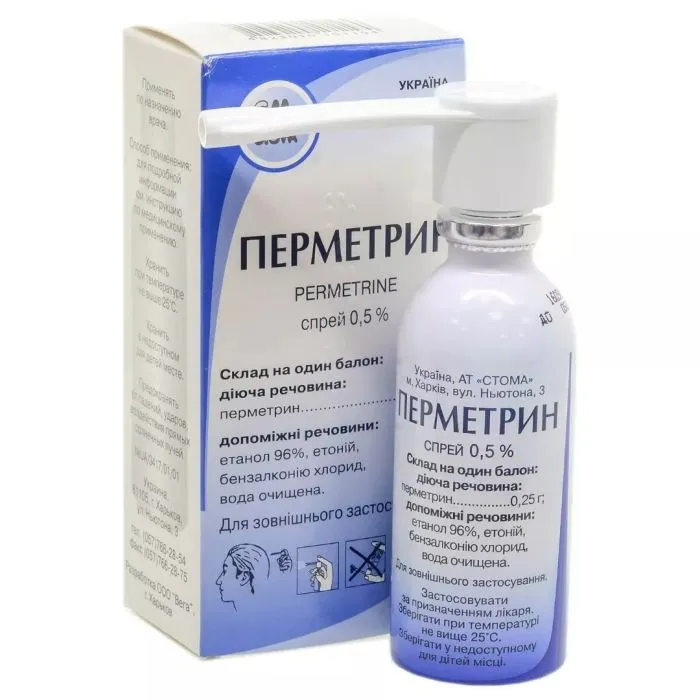
Table of Contents
INSTRUCTION FOR MEDICAL USE OF THE MEDICINAL PRODUCT PERMETHRIN
Composition:
Active substance: permethrin;
1 g of the medicinal product contains 5 mg of permethrin;
Excipients: ethanol (96%), etone, benzalkonium chloride, purified water.
Pharmaceutical form. Spray.
Main physicochemical properties: a clear, colorless or slightly yellow liquid with a characteristic alcoholic odor, contained in a bottle equipped with a pump-type valve. The medicinal product is dispensed from the bottle as a fine spray jet.
Pharmacotherapeutic group. Agents for destruction of ectoparasites, including agents against scabies mite, insecticides and repellents. Pyrethrins, including synthetic compounds. Permethrin.
ATC Code P03AC04.
Pharmacological properties.
Pharmacodynamics.
A contact-acting insecticide belonging to the group of synthetic pyrethroids. Has pediculicidal activity and exerts a lethal effect on nits, larvae, and adult forms of head and pubic lice. Disrupts the permeability of sodium channels in insect nerve cell membranes, inhibits the polarization (repolarization) process of nerve cells, resulting in a paralyzing effect.
Pharmacokinetics.
Less than 2% of the dose of permethrin is absorbed through the skin. Permethrin is highly lipophilic, and its toxicity is enhanced by organic solvents. According to animal studies, permethrin is metabolized in the liver by conjugation with glucuronides, glycine, and sulfates. The half-life is several hours. Permethrin is rapidly hydrolyzed to inactive metabolites, which are primarily excreted in urine.
Clinical characteristics.
Indications.
Pediculosis (head, pubic).
Contraindications.
Hypersensitivity to permethrin and to excipients of the medicinal product.
Hypersensitivity to plants of the chrysanthemum genus or other plants of the Asteraceae (Compositae) family.
Skin integrity impairment, inflammatory processes, and secondary skin infections.
Pregnancy or breastfeeding. Children under 3 years of age.
Permethrin is not recommended for patients with bronchial asthma or obstructive bronchitis, including in medical history, due to the risk of bronchospasm caused by inhalation of the medicinal product.
Interaction with other medicinal products and other types of interactions.
Not established.
Special precautions for use.
Before using the medicinal product, consult a physician, as cross-sensitivity may occur between synthetic pyrethroids such as permethrin.
Healthcare workers handling Permethrin must use protective gloves. Permethrin should be applied externally only.
Treatment should be carried out in a well-ventilated room or outdoors. During application, avoid contact of Permethrin with mucous membranes of the eyes, nose, mouth, and genitourinary organs. If Permethrin accidentally comes into contact with mucous membranes, they should be thoroughly rinsed with large amounts of water. After treatment, hands should be thoroughly washed with soap, and the mouth should be rinsed with running water.
To prevent re-infestation, all family members should be examined for parasites, and clothing, headwear, scarves, bed linen, combs, and hair of individuals who had contact with the infected person should be disinfected and treated.
Ineffectiveness of treatment and development of resistance.
The efficacy rates of permethrin in treating head lice vary depending on geographical location and time period. Factors contributing to treatment failure include incorrect dosing or application errors; failure to simultaneously treat family members or individuals in contact with the infected person; and re-infestation from individuals who had contact with the infected person. Furthermore, resistance to permethrin has been reported. However, a clear correlation between reduced efficacy and mutations known to cause pyrethroid resistance has not been established.
Official guidelines regarding the proper use of anti-lice products should be followed.
Use during pregnancy or breastfeeding.
Studies on the safety of Permethrin use during pregnancy or breastfeeding have not been conducted; therefore, the medicinal product should not be used during these periods.
Ability to affect reaction speed when driving or operating machinery.
Not established.
Method of Administration and Dosage
For external use only. Press the spray nozzle and apply Permethrin to the hair, rubbing it into the hair roots. When spraying Permethrin, hold the spray nozzle approximately 3 cm away from the hair.
After application, leave Permethrin on the hair for 10–40 minutes (the head may be covered with a cap), then thoroughly rinse with warm running water using soap or shampoo and dry in the usual manner. After washing, comb the hair with a fine-toothed comb to remove dead parasites. If live lice are detected 7–10 days after treatment with Permethrin, repeat the application. If infestation remains active after 14–20 days, consider alternative treatment options.
Permethrin consumption varies depending on hair thickness and length—from 10 ml to 60 ml.
For pubic pediculosis, apply the spray by short bursts onto the spray nozzle until the entire hairy area of the pubic region is completely covered.
After 30 minutes, wash the treated areas with soap and thoroughly rinse with water.
Children.
Do not use in children under 3 years of age.
Overdose.
In case of overdose, symptoms described in the section "Adverse Reactions" may intensify. If overdose occurs, discontinue use of Permethrin, wash the skin thoroughly with large amounts of warm water, and antihistamines may be used if necessary. In case of poisoning due to inhalation of Permethrin vapors, treatment should begin with moving the patient to fresh air. If Permethrin comes into contact with eyes or skin, affected areas must be rinsed thoroughly with plenty of water.
In case of accidental ingestion of Permethrin, spontaneous vomiting is highly likely; therefore, further use of emetics is not recommended due to the risk of rapidly developing seizures and coma. Absorption of Permethrin can be prevented by gastric lavage and administration of activated charcoal or a laxative. Treatment is primarily supportive and includes monitoring the patient for the development of allergic reactions.
Side effects.
From the immune system: allergic reactions, including skin rashes and swelling.
Local effects: burning sensation, stinging or prickling, skin numbness, increased itching, erythema, pain, eczema.
Shelf life. 3 years.
Storage conditions.
Keep out of reach of children. Store at a temperature not exceeding 25 °C.
Protect from falls, impacts, and exposure to direct sunlight.
Packaging.
50 g in a bottle with a pump-type valve and spray nozzle; 1 bottle per carton.
Availability. Over-the-counter (without prescription).
Manufacturer. JSC "STOMA".
Manufacturer's location and address of business activity.
Ukraine, 61105, Kharkiv, Newton Street, 3.