Onitek
Ukraine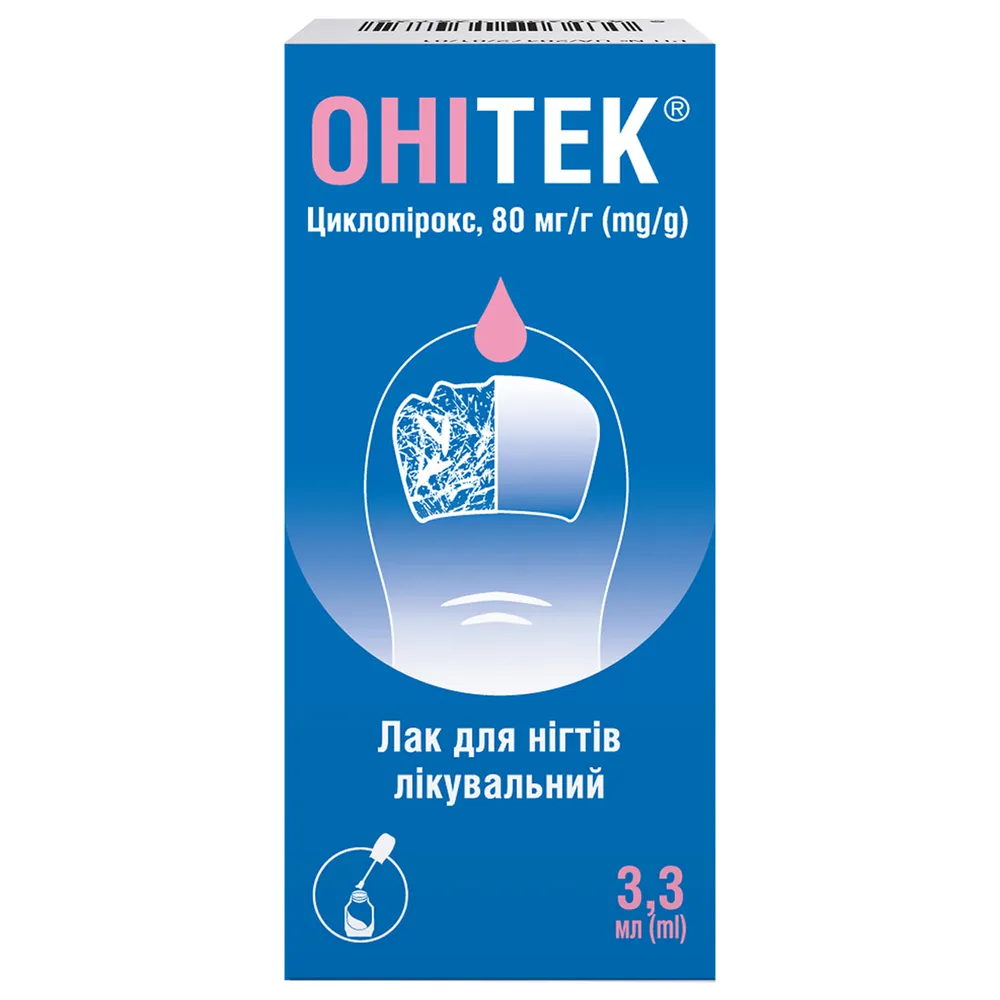
Table of Contents
- INSTRUCTIONS FOR MEDICAL USE OF THE MEDICINAL PRODUCT ONYTEC® (ONYTEC®)
- Composition:
- Pharmacological properties.
- Negative microscopy with KOH and fungal culture results, and reduction of affected nail area to ≤ 10% (including zero) of total nail area, as assessed by a blinded evaluator.
- Negative microscopy with KOH and fungal culture analysis results, as well as reduction of the affected nail area to ≤ 10% of the total area as assessed by the blinded evaluator.
- Clinical characteristics.
- Special precautions for use.
- Method of Administration and Dosage
- Adverse Reactions
INSTRUCTIONS FOR MEDICAL USE OF THE MEDICINAL PRODUCT ONYTEC® (ONYTEC®)
Composition:
Active substance: cyclopirox;
1 g of nail lacquer contains 80 mg of cyclopirox;
Excipients: ethyl acetate, 96% ethanol, cetostearyl alcohol, hydroxypropyl chitosan, purified water.
Pharmaceutical form. Therapeutic nail lacquer.
Main physicochemical properties: clear solution ranging from colorless to pale yellow.
Pharmacotherapeutic group.
Antifungal agents for dermatological use. Other topical antifungal agents. Cyclopirox. ATC code D01AE14.
Pharmacological properties.
Pharmacodynamics.
Onytec®, therapeutic nail lacquer, is an original patented ciclopirox medicinal product based on hydroxypropylchitosan that delivers the active substance to the nails.
Onytec®, therapeutic nail lacquer, exerts a local antifungal effect. The active ingredient of Onytec® is ciclopirox (a pyridone derivative). In vitro studies have demonstrated that ciclopirox exhibits fungicidal and fungistatic effects, as well as sporicidal activity. Ciclopirox acts against a broad spectrum of dermatophytes, yeasts, molds, and other fungi. For most dermatophytes (species of Trichophyton, Microsporum, Epidermophyton) and yeast fungi (Candida albicans, other Candida species), the MIC (minimum inhibitory concentration) ranges from 0.9 to 3.9 µg/mL.
Susceptible strains
| Dermatophytes |
Trichophyton rubrum, Trichophyton mentagrophytes, Trichophyton spp, Microsporum canis, Epidermophyton floccosum |
| Yeast fungi |
Candida albicans, Candida parapsilosis |
| Mold fungi |
Scopulariopsis brevicaulis, Aspergillus spp, Fusarium solani |
Clinical efficacy and safety
Onytek®, a therapeutic nail lacquer, was studied in a long-term clinical trial involving 467 patients with onychomycosis, comparing it with placebo and with another medicinal product containing the active substance ciclopirox. All study medications were applied daily to infected nails over 48 weeks. Patients were followed up for 12 weeks after treatment. Efficacy was assessed for the nail of the great toe.
Table 1
Results at the end of treatment and follow-up period (Week 60)
| Endpoint |
Onytec®, nail lacquer |
Placebo |
Comparator drug, EU |
| Complete cure* |
12.7% |
1.3% |
5.8% |
| Patients achieving therapeutic effect# |
28.7% |
14.7% |
17.3% |
| Improvement in condition§ |
46.5% |
34.7% |
39.7% |
| Reduction in nail involvement¥ |
36.3% |
16.2% |
21.8% |
* Negative microscopy with KOH (potassium hydroxide) and negative fungal culture results, and complete cure of the toenail.
Negative microscopy with KOH and fungal culture results, and reduction of affected nail area to ≤ 10% (including zero) of total nail area, as assessed by a blinded evaluator.
§ Reduction in the area of affected nails by at least 20%, as assessed by a blinded evaluator at the end of treatment compared to baseline, and negative microscopy with KOH and negative fungal culture results.
¥ Reduction of affected nail area to ≤ 10% of total nail area, as assessed by a blinded evaluator.
Onytec®, a topical antifungal nail lacquer, demonstrated superior efficacy compared to placebo and the comparator drug containing ciclopirox. The superior effect of Onytec® was observed for the primary endpoint "Complete cure" and the main secondary endpoint "Patients achieving therapeutic effect"; Onytec® exceeded the comparator drug by 119% in complete cure rate (statistically significant difference, p < 0.05) and by 66% in the number of patients achieving therapeutic effect (statistically significant difference, p < 0.05).
No systemic adverse reactions related to the medicinal product were observed during the clinical study.
Local tolerability was regularly monitored throughout the treatment period. In the Onytec® treatment group, signs and symptoms of adverse reactions were observed in 2.8% and 7.8% of patients, respectively; in the comparator drug group — in 8.6% and 16% of patients; in the placebo group — in 7.2% and 12.4% of patients. The most common sign was erythema (2.8% of patients in the Onytec® group and 8.6% in the comparator group). The most common symptom was burning sensation (2.8% of patients in the Onytec® group and 10.7% in the comparator group).
A second randomized, long-term clinical trial was conducted involving 137 patients with onychomycosis. This was a 48-week randomized study comparing Onytec®, a topical antifungal nail lacquer applied daily, with Amorolfine 5% nail lacquer (acrylate-based), applied twice weekly.
All efficacy variables (study endpoints) were evaluated on the toenail of the great toe.
The study met its primary objective, demonstrating that Onytec®, a topical antifungal nail lacquer, was non-inferior to 5% Amorolfine after 12 weeks of treatment in achieving negative fungal culture results: this rate was 78.3% with Onytec® and 64.7% with Amorolfine. The difference between treatment outcomes was 13.6% (95% confidence interval [-1.4; 28.5]).
At week 48, the proportion of patients with complete cure, successful treatment/therapeutic effect, and mycological cure in the Onytec® group remained consistently higher than in the comparator group (see Table 2):
Table 2
Treatment outcomes at the end of treatment (Week 48)
| Endpoints |
Onytek®, nail lacquer |
Amorolfine, nail lacquer 5% |
Difference (%) |
95% confidence interval for difference |
| Complete cure* |
35.0% |
11.7% |
23.3** |
8.8; 37.9 |
| Successful treatment# |
58.3% |
26.7% |
31.7** |
14.9; 48.4 |
| Mycological cure$ |
100% |
81.7% |
18.3** |
8.5; 28.1 |
* Negative microscopy with KOH and fungal culture analysis results, as well as complete cure of the toenail as assessed by the blinded evaluator.
Negative microscopy with KOH and fungal culture analysis results, as well as reduction of the affected nail area to ≤ 10% of the total area as assessed by the blinded evaluator.
$ Negative microscopy with KOH and fungal culture analysis results.
** p < 0.001.
No systemic adverse reactions related to the medicinal product were observed in this clinical study.
Onytec®, therapeutic nail lacquer, was well tolerated based on the frequency of local and general adverse reactions. Signs of irritation on the skin adjacent to the nail were observed in only 2.06% of patients in the Onytec® treatment group.
Pharmacokinetics.
Onytec®, therapeutic nail lacquer, demonstrated adequate ability to penetrate through keratin. Achieving fungicidal concentrations at the site of infection, the active ingredient causes irreversible binding to the fungal cell wall, thereby inhibiting the uptake of components necessary for cellular synthesis and the respiratory chain.
A very small amount of ciclopirox is systemically absorbed (< 2% of the applied dose; ciclopirox blood levels in a long-term study were 0.904 ng/mL (n = 163) and 1.144 ng/mL (n = 149) at 6 and 12 months of treatment, respectively). This indicates that Onytec® acts locally and the risk of systemic effects is negligible.
Clinical characteristics.
Indications.
Mild to moderate fungal infections of the nails caused by dermatophytes, yeasts, and molds, without involvement of the nail matrix/lunula.
Onytek®, therapeutic nail lacquer, is indicated for use in adults.
Contraindications.
Hypersensitivity to the active substance or to any of the excipients.
This medicinal product is not recommended for children and adolescents (under 18 years of age) due to insufficient experience of use in this age group.
Interaction with other medicinal products and other forms of interaction.
No studies on interactions with other medicinal products have been conducted. However, following the recommended application, the systemic bioavailability of ciclopirox is less than 2%, a quantity considered negligible; therefore, systemic interactions are not expected.
Special precautions for use.
Mild to moderate onychomycosis is a fungal infection affecting up to 75% of the nail surface and generally involving no more than 5 nails, without involvement of the nail matrix/lunula.
In cases of severe onychomycosis and presence of predisposing factors such as diabetes and immunological disorders, systemic therapy should be considered.
Duration of the disease, extent of infection (involvement of the nail plate), and nail thickness (> 2 mm may indicate involvement of the nail matrix and hyperkeratotic areas) may influence treatment outcomes.
If hypersensitivity occurs, treatment must be discontinued and appropriate therapy initiated.
Patients with a history of diabetes, immunological disorders, peripheral arterial disease, trauma, nail diseases or severe nail damage, skin disorders (including psoriasis or any other chronic skin disease), edema, or respiratory disorders (yellow nail syndrome) should consult a physician before initiating treatment.
In patients with a history of insulin-dependent diabetes or diabetic neuropathy, caution should be exercised regarding the risk of removal of loose infected nails by healthcare providers or patients during nail cleaning.
Avoid contact of the medicinal product with eyes and mucous membranes.
This nail lacquer is intended for topical use only.
Cosmetic nail polish or other cosmetic nail products must not be applied to treated nails.
Onytec® contains cetyl stearyl alcohol, which may cause local skin reactions (e.g., contact dermatitis).
The bottle should be closed when not in use.
This medicinal product contains 730 mg of alcohol (ethanol) per 1 g of solution. This may cause a burning sensation on damaged skin.
This medicinal product is highly flammable. Keep away from heat and open flame.
Use during pregnancy or breastfeeding.
Pregnancy. There is no clinical experience with the use of ciclopirox in pregnant women. Animal studies have not revealed any direct or indirect harmful effects on pregnancy, embryonic or fetal development, or parturition. However, adequate data on potential long-term effects on postnatal development are lacking. Due to the negligible systemic effect of ciclopirox with Onytec®, it may be used during pregnancy if needed.
Breastfeeding. There is no information on the excretion of ciclopirox or its metabolites in breast milk; however, with therapeutic doses, no effect of Onytec® on newborns/infants is expected.
Fertility. No studies on reproductive toxicity have been conducted. After oral administration in rats, a decrease in fertility parameters was observed. These findings in animals have minimal clinical relevance due to the low systemic exposure to ciclopirox following treatment with Onytec®.
Ability to affect reaction speed when driving or operating machinery.
Onytec® does not affect the ability to drive or operate machinery.
Method of Administration and Dosage
For topical application (application to the nails).
The product is applied locally to fingernails and toenails, as well as to the adjacent skin (the nail fold and the area beneath the nail plate).
Unless otherwise prescribed, Onytec®, therapeutic nail lacquer, should be applied once daily as a thin layer to the affected nail(s) after washing and thoroughly drying the nails. The therapeutic nail lacquer should be applied to the entire nail surface, including the adjacent 5 mm of skin and, if possible, under the free edge of the nail. Onytec®, therapeutic nail lacquer, dries in approximately 30 seconds. The treated nails should not be washed for six hours; therefore, it is recommended to apply the product in the evening before bedtime. Normal hygiene procedures may be resumed six hours after application.
Onytec®, therapeutic nail lacquer, does not need to be removed with solvents or abrasive materials (e.g., nail file). Instead, the nails should simply be thoroughly washed with water. If the lacquer is accidentally washed off with water, Onytec® may be reapplied.
It is recommended to regularly remove the free edge of the nail and any onycholytic debris using manicure or pedicure clippers.
Treatment should continue until complete clinical and mycological cure is achieved and until healthy nail has fully regrown. Typically, treatment duration for fingernails is approximately 6 months, and for toenails, 9–12 months.
A fungal culture test for monitoring should be performed 4 weeks after completion of treatment to avoid potential interference with test results due to any residual active substance.
Since Onytec® is a locally acting medicinal product, dosage adjustments in specific patient populations are not required.
If the condition does not respond to treatment with Onytec® and/or if one or more fingernails or toenails are affected, consideration should be given to additional therapy with oral antifungal agents.
Children. The safety and efficacy of Onytec® in children and adolescents (under 18 years of age) have not been established. Data are unavailable.
Overdose.
Onytec® is intended for topical use only. There have been no reports of overdose with this medicinal product. In case of accidental oral ingestion, appropriate gastric decontamination methods may be used.
Adverse Reactions
Adverse reactions are classified according to the following frequency criteria:
very common (≥ 1/10), common (≥ 1/100 to < 1/10), uncommon (≥ 1/1000 to < 1/100), rare (≥ 1/10,000 to < 1/1000), very rare (< 1/10,000), frequency not known (cannot be estimated from the available data).
General disorders and administration site reactions:
Very rare – erythema, desquamation, burning sensation, and pruritus at the application site.
Frequency not known – rash, eczema, allergic dermatitis outside the application site.
Transient discolouration of nails may occur (this reaction may also be considered as a manifestation of onychomycosis).
Reporting of suspected adverse reactions
Reporting of suspected adverse reactions after authorization of the medicinal product is important. It allows continued monitoring of the benefit-risk balance of the medicinal product. Healthcare professionals and patients, as well as their legal representatives, are encouraged to report any suspected adverse reactions and lack of efficacy via the Automated Pharmacovigilance Information System at the following link: https://aisf.dec.gov.ua
Shelf life. 3 years. Shelf life after first opening of the container: 6 months.
Storage conditions. Store the bottle in the original cardboard packaging to protect from light. Do not refrigerate, do not freeze. Close the bottle tightly after first opening to prevent evaporation of the contents. This medicinal product is flammable. Keep away from heat and open flame. At temperatures below 15°C, the lacquer may turn into a gel. Formation of slight flakes or minor sediment may occur, which disappear upon warming the bottle to room temperature (25°C) by rubbing between the palms until the solution becomes clear again (approximately 1 minute). This does not affect the quality and efficacy of the medicinal product. Keep out of reach and sight of children.
Packaging. 3.3 ml or 6.6 ml in a glass bottle with a screw cap and built-in brush applicator; 1 bottle per cardboard box.
Pharmaceutical classification. Over-the-counter (without prescription).
Manufacturers.
- ALFASIGMA S.P.A., Italy.
- ALMIRALL HERMAL GmbH, Germany.
Manufacturers' addresses.
- Via Enrico Fermi, 1 - 65020 Alanno (PE), Italy.
- Scholtzstrasse 1 and 3, 21465 Reinbek, Germany.
Marketing Authorization Holder. Polichem S.A.
Address of the Marketing Authorization Holder. 50, Val Flor, L-1526 Luxembourg