Novocaine
Ukraine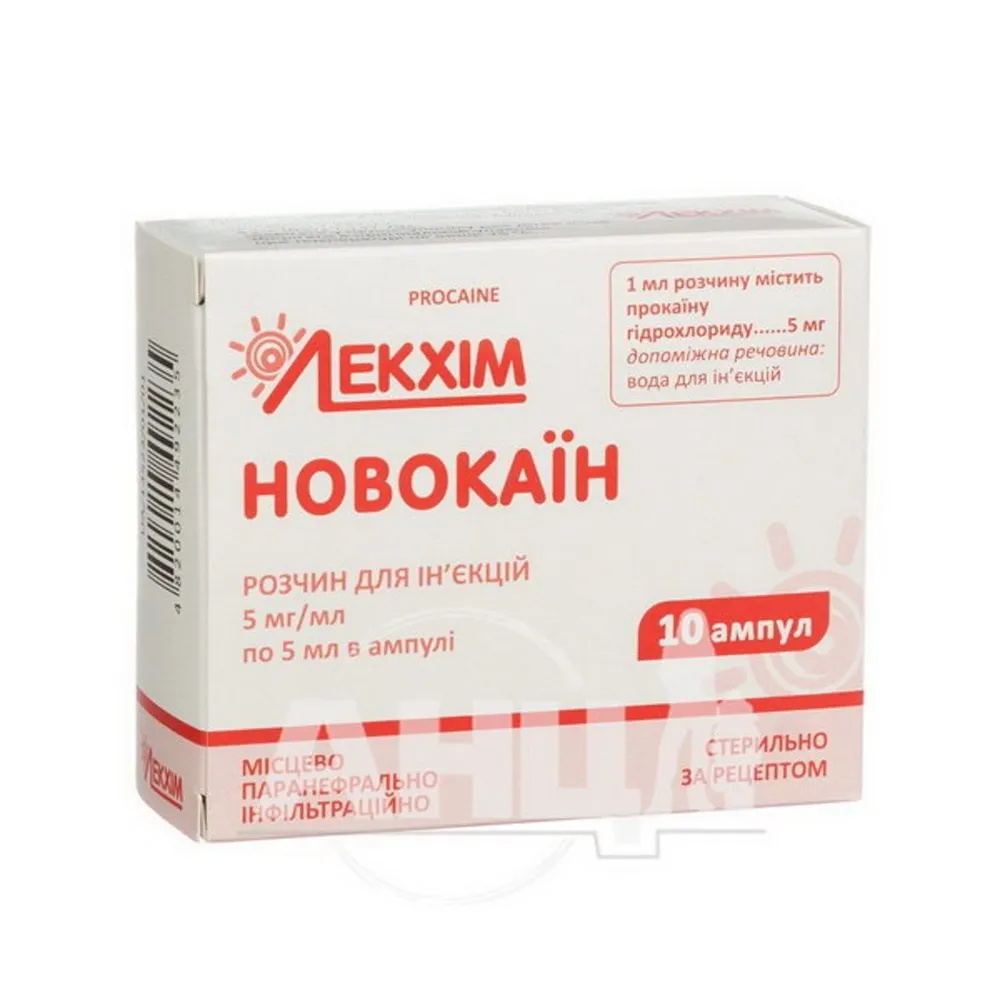
Table of Contents
INSTRUCTIONS FOR MEDICAL USE OF THE MEDICINAL PRODUCT NOVOCAIN (NOVOCAIN)
Composition:
Active substance: procaine;
1 ml of solution contains procaine hydrochloride 2.5 mg or 5.0 mg;
Excipients: diluted hydrochloric acid, water for injections.
Dosage form. Injection solution.
Main physicochemical properties: clear colorless liquid.
Pharmacotherapeutic group.
Local anesthetics. ATC code N01B A02.
Pharmacological Properties.
Pharmacodynamics.
A local anesthetic agent with moderate activity and a wide therapeutic range. The anesthetic mechanism of action is associated with blockade of sodium channels, inhibition of potassium current, competition with calcium, reduction of surface tension of the phospholipid layer of membranes, suppression of redox processes, and inhibition of impulse generation. When absorbed into the bloodstream, it reduces acetylcholine production, decreases excitability of peripheral cholinoreactive systems, exerts blocking effects on autonomic ganglia, reduces smooth muscle spasms, and decreases excitability of cardiac muscle and motor areas of the cerebral cortex.
Pharmacokinetics.
After parenteral administration, it is well absorbed. The extent of absorption depends on the site and route of administration (particularly on vascularization and blood flow rate at the injection site) as well as on the total dose (quantity and concentration). It is rapidly hydrolyzed by plasma and tissue esterases and cholinesterases, forming two main pharmacologically active metabolites: diethylaminoethanol (which has moderate vasodilatory activity) and para-aminobenzoic acid (which acts as a competitive antagonist of sulfonamide chemotherapeutic agents and may reduce their antimicrobial efficacy). The elimination half-life is 30–50 seconds; in neonates, it ranges from 54 to 114 seconds. The drug is primarily excreted by the kidneys as metabolites (80%); less than 2% is excreted unchanged.
Poorly absorbed by mucous membranes.
Clinical Characteristics.
Indications.
Local and infiltration anesthesia, therapeutic blocks.
Contraindications.
Increased individual sensitivity to the drug.
Myasthenia, arterial hypotension, purulent processes at the injection site, emergency surgical interventions accompanied by acute blood loss, pronounced fibrotic changes in tissues (for anesthesia using the creeping infiltration method).
Interaction with other medicinal products and other types of interactions.
Prolongs neuromuscular blockade caused by succinylcholine (since both drugs are hydrolyzed by plasma cholinesterase). Concurrent use with MAO inhibitors (furazolidone, procarbazine, selegiline) increases the risk of developing arterial hypotension. Anticholinesterase agents increase procaine toxicity (by inhibiting its hydrolysis). The metabolite of procaine (para-aminobenzoic acid) is a competitive antagonist of sulfonamide drugs and may reduce their antimicrobial effect.
When the injection site of a local anesthetic is treated with disinfectant solutions containing heavy metals, the risk of local reactions such as pain and swelling increases. Potentiates the effect of direct anticoagulants.
The drug reduces the effect of anticholinesterase agents on neuromuscular transmission. Cross-sensitization is possible.
Special precautions for use.
To reduce systemic effects, toxicity, and to prolong the effect during local anesthesia, procaine should be used in combination with vasoconstrictors (0.1 % solution of epinephrine hydrochloride, at a rate of 1 drop per 2–5 ml of solution).
When using the drug, monitoring of cardiovascular, respiratory, and central nervous system functions is required. Use with caution in severe diseases of the heart, liver, and kidneys.
When performing local anesthesia, with the same total dose applied, the higher the concentration of the solution used, the greater the toxicity of procaine. Therefore, with increasing solution concentration, the total dose should be reduced or the drug solution should be diluted to a lower concentration (with sterile isotonic sodium chloride solution).
The drug should be used with caution in conditions associated with reduced hepatic blood flow, progressive cardiovascular insufficiency (usually due to development of cardiac block and shock), inflammatory diseases, pseudocholinesterase deficiency, renal insufficiency, in elderly patients (aged 65 years and older), critically ill and debilitated patients, during pregnancy, childbirth, and breastfeeding.
The drug should be used with caution in case of infection at the injection site.
Use during pregnancy or breastfeeding.
The use of the drug is possible only if the expected benefit to the mother outweighs the potential risk to the fetus or infant.
When used during childbirth, bradycardia, apnea, and seizures in the newborn are possible.
Ability to influence reaction rate while driving or operating machinery.
During treatment, caution is necessary when driving vehicles or engaging in other potentially hazardous activities requiring increased attention and psychomotor reaction speed.
Administration and Dosage
For local anesthesia, the dose of the drug depends on the concentration, type of surgical procedure, method of administration, and the patient's condition and age.
For paravertebral block, inject 50–70 mL of a 0.5% solution or 100–150 mL of a 0.25% solution of Novocaine into the perirenal tissue in adults.
For infiltration anesthesia, the following maximum doses have been established (for adults): initial single dose at the beginning of surgery – 0.75 g (i.e., 150 mL) of a 0.5% solution of novocaine or 1.25 g (i.e., 500 mL) of a 0.25% solution of novocaine. Thereafter, during each hour of surgery – no more than 2 g (i.e., 400 mL) of a 0.5% solution of novocaine or 2.5 g (i.e., 1000 mL) of a 0.25% solution of novocaine.
Children
The drug is not intended for use in children under 18 years of age.
Overdose
Overdose is possible only when novocaine is used in high doses.
Symptoms: pallor of the skin and mucous membranes, dizziness, nausea, vomiting, increased nervous excitability, cold sweat, tachycardia, decreased arterial pressure approaching collapse, tremor, seizures, apnea, methemoglobinemia, respiratory depression, sudden cardiovascular collapse.
Effects on the central nervous system include feelings of fear, hallucinations, seizures, and motor agitation. In cases of overdose, administration of the drug must be immediately discontinued. When performing local anesthesia, the injection site may be infiltrated with adrenaline.
Treatment: general resuscitation measures, including oxygen inhalation, and if necessary, artificial ventilation of the lungs. If seizures last longer than 15–20 seconds, they should be controlled by intravenous administration of thiopental (100–150 mg) or diazepam (5–20 mg). For arterial hypotension and/or myocardial depression, administer ephedrine intravenously (15–30 mg); in severe cases – detoxification and symptomatic therapy.
In case of intoxication following injection of novocaine into the muscles of the leg or arm, immediate application of a tourniquet is recommended to reduce further entry of the drug into the systemic circulation.
Adverse Reactions
Novocaine is generally well tolerated; however, the following adverse effects may occasionally occur.
Central and peripheral nervous system: headache, dizziness, drowsiness, weakness, motor restlessness, loss of consciousness, seizures, trismus, tremor, visual and auditory disturbances, nystagmus, cauda equina syndrome (leg paralysis, paresthesia), respiratory muscle paralysis, motor and sensory block, return of pain, prolonged anesthesia.
Cardiovascular system: increased or decreased arterial pressure, peripheral vasodilation, collapse, bradycardia, arrhythmias, chest pain.
Urinary system: involuntary urination.
Gastrointestinal tract: nausea, vomiting, involuntary defecation.
Blood system: methemoglobinemia.
Allergic reactions: skin itching, skin rashes, dermatitis, skin desquamation, other anaphylactic reactions (including angioneurotic edema, anaphylactic shock), urticaria (on skin and mucous membranes).
Other: hypothermia.
Shelf Life. 3 years.
Storage Conditions.
Store at a temperature not exceeding 25 °C.
Keep out of reach of children.
Do not freeze.
Incompatibility.
Do not use in treatment with sulfonamides.
Packaging.
200 ml or 400 ml in glass bottles.
Prescription Category. Prescription only.
Manufacturer.
Yuria-Pharm LLC.
Manufacturer's Address and Place of Business.
108, Kozbirska St., Cherkasy, 18030, Ukraine. Tel.: (044) 281-01-01.