Nordixin
Ukraine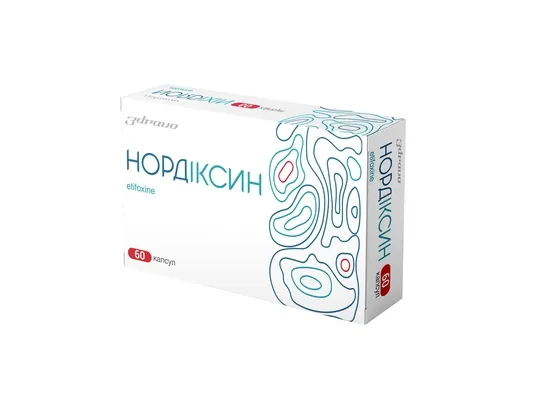
Table of Contents
INSTRUCTIONS FOR MEDICAL USE OF THE MEDICINAL PRODUCT NORDIXIN®
Composition:
Active substance: ethofexide hydrochloride;
1 capsule contains ethofexide hydrochloride 50 mg;
Excipients: lactose monohydrate; fumaric acid; stearic acid;
capsule shell: gelatin; titanium dioxide (E 171); patent blue (E 131), azorubine (E 122), purified water.
Pharmaceutical form. Capsules.
Main physicochemical properties: hard gelatin capsule with a blue cap and white body, containing almost white powder.
Pharmacotherapeutic group.
Agents acting on the nervous system. Psycholeptics. Anxiolytics. Other anxiolytics. Ethofexide. ATC code N05BX03.
Pharmacological properties.
Pharmacodynamics.
In therapeutic doses, ethifenacine hydrochloride exhibits anxiolytic properties and exerts a neurovegetative regulatory effect.
In vitro and in vivo studies in animals have shown that the anxiolytic effect of ethifenacine is due to a dual mechanism of action (direct and indirect) on GABAA receptors to enhance GABAergic transmission:
- Direct action on GABAA receptors through positive allosteric modulation by binding predominantly to β2 or β3 subunits; studies indicate that the binding site of ethifenacine on the GABAA receptor differs from that of benzodiazepines;
- Indirect action via increasing the production of neurosteroids in the brain (by activating mitochondrial protein translocation), including allopregnanolone, which are positive allosteric modulators of the GABAA receptor.
Clinical studies have not revealed any withdrawal effects or dependence potential (physical or psychological).
Animal studies have not shown a possibility of developing pharmacological dependence on ethifenacine.
Pharmacokinetics.
Ethifenacine hydrochloride is well absorbed in the gastrointestinal tract. It is rapidly metabolized, does not bind to blood cells, and its plasma levels decline slowly in three phases. The drug and its main metabolite are excreted primarily via urine. Ethifenacine hydrochloride crosses the placental barrier.
Clinical characteristics.
Indications.
Psychosomatic manifestations of anxiety.
Contraindications.
Hypersensitivity to the components of the medicinal product, shock state, myasthenia gravis, severe impairment of liver and/or kidney function.
The drug is contraindicated in patients who have experienced severe hepatitis or cytolytic syndrome during previous treatment with ethifoxine; in patients who have had severe skin reactions, including DRESS syndrome, Stevens–Johnson syndrome, and generalized exfoliative dermatitis, during prior ethifoxine therapy.
Pregnancy or breastfeeding period.
Interaction with other medicinal products and other forms of interaction.
Concomitant use of Norderexin® with medicinal products that depress the central nervous system (morphine derivatives (analgesics, antitussives, and opioid substitution therapy for drug dependence), benzodiazepines, hypnotics, neuroleptics, H1-receptor histamine blockers, antidepressants, centrally-acting antihypertensive agents, baclofen, thalidomide) may result in mutual potentiation of effects.
Alcohol enhances the sedative effect of Norderexin®.
Simultaneous use of Norderexin® with alcohol or with medicinal products that depress the central nervous system (morphine derivatives (analgesics, antitussives, and opioid substitution therapy for drug dependence), benzodiazepines, hypnotics, neuroleptics, H1-receptor histamine blockers, antidepressants, centrally-acting antihypertensive agents, baclofen, thalidomide) may impair reaction speed, which in turn may pose a danger when driving or operating machinery. Consumption of alcohol, medicinal products containing alcohol, and medicinal products that depress the central nervous system is not recommended during treatment with this drug.
Special precautions for use.
Alcohol consumption and the use of other centrally-acting agents (e.g., haloperidol, diazepam, imipramine, etc.) are not recommended during treatment with Nordixin®.
If skin or allergic reactions or severe hepatic dysfunction occur, treatment with etifoxine should be discontinued immediately.
The product contains lactose and therefore should not be administered to patients with congenital galactosemia, glucose-galactose malabsorption syndrome, or lactase deficiency.
Severe skin reactions
Very rare cases of severe skin reactions have been reported, including drug-induced eosinophilia with systemic symptoms (DRESS syndrome), Stevens–Johnson syndrome, and generalized exfoliative dermatitis associated with etifoxine use. The onset of toxic skin reactions during etifoxine treatment typically ranged from several days to one month, depending on the type of reaction. According to post-marketing surveillance data, the outcome of skin reactions after discontinuation of etifoxine was mostly favorable. There have been no reports of fatal outcomes related to severe cutaneous adverse reactions during etifoxine treatment. Patients should be informed about the risk of skin toxicity and carefully monitored for skin signs and symptoms. If a skin toxicity reaction occurs during etifoxine treatment, the drug should be discontinued immediately and must never be re-administered.
Severe hepatic reactions
During the post-marketing period, very rare cases of severe cytolytic syndrome associated with etifoxine intake have been reported. According to post-marketing surveillance data, hepatic reactions after etifoxine administration mostly occurred between 2 weeks and 1 month after the start of treatment. The drug should be used with caution in patients with risk factors for hepatic dysfunction, particularly elderly patients, patients with a history of viral hepatitis, or any other conditions identified by the physician on an individual basis. Hepatic dysfunction may be asymptomatic and detectable only through specific laboratory tests. In patients with risk factors for hepatic impairment, liver function tests should be performed before initiating etifoxine treatment and approximately one month after starting therapy. If hepatic toxicity occurs during etifoxine treatment, the drug should be discontinued immediately and must never be re-administered.
Lymphocytic colitis
During the post-marketing period, several cases of lymphocytic colitis associated with etifoxine use have been reported. In patients receiving etifoxine who develop watery diarrhea, appropriate diagnostic evaluation should be considered and the drug should be discontinued immediately.
Metrorrhagia
During the post-marketing period, cases of metrorrhagia have been reported in women taking oral contraceptives during etifoxine treatment.
Use during pregnancy or breastfeeding.
The use of this drug is contraindicated in pregnant women.
If use of the drug is necessary, breastfeeding should be discontinued.
Ability to affect reaction speed when driving or operating machinery.
Due to significant individual adverse reactions (e.g., dizziness, somnolence), a temporary impairment of the ability to drive a vehicle or operate potentially hazardous machinery during treatment with this drug cannot be ruled out.
Method of Administration and Dosage.
The physician determines the dosage and duration of treatment individually, depending on the severity of the disease.
For adults: administer 3–4 capsules in 2–3 divided doses per day. Take the capsules before meals with a small amount of water.
The treatment course lasts from several days to several weeks.
Children.
The drug should not be administered to children due to insufficient clinical data.
Overdose.
Manifested by arterial hypotension. There is a risk of developing drowsiness. Gastric lavage is recommended. If necessary, provide symptomatic treatment. There is no specific antidote.
Adverse Reactions
Dizziness may occasionally occur, particularly at the beginning of treatment, and usually resolves spontaneously during continued therapy.
Classification of adverse reactions by organ systems and frequency: very common (≥1/10), common (≥1/100 to <1/10), uncommon (≥1/1,000 to <1/100), rare (≥1/10,000 to <1/1,000), very rare (<1/10,000), frequency not known (cannot be estimated from available data).
Within each frequency group, adverse events are listed in order of decreasing severity.
Nervous system disorders:
Rare – mild drowsiness at the beginning of treatment, which resolves spontaneously during continued therapy.
Skin and subcutaneous tissue disorders:
Rare – skin rashes: maculopapular rash, polymorphic erythema, pruritus, facial swelling; very rare – allergic reactions: urticaria, Quincke's edema; severe skin reactions: DRESS syndrome, Stevens-Johnson syndrome, generalized exfoliative dermatitis; frequency not known – anaphylactic shock, leukocytoclastic vasculitis.
Immune system disorders:
Very rare – urticaria, Quincke's edema, angioedema; frequency not known – anaphylactic shock, drug reaction with eosinophilia and systemic symptoms (DRESS syndrome), Stevens-Johnson syndrome, leukocytoclastic vasculitis.
Hepatobiliary disorders:
Very rare – liver injury: hepatitis, cytolytic hepatitis.
Reproductive system and breast disorders:
Very rare – intermenstrual bleeding in women taking oral contraceptives.
Gastrointestinal disorders:
Very rare – lymphocytic colitis.
Reporting of suspected adverse reactions
Reporting of suspected adverse reactions after authorization of the medicinal product is important. It allows continuous monitoring of the benefit-risk balance of the drug. Healthcare professionals are encouraged to report any suspected adverse reactions via the national reporting system.
Shelf life.
3 years.
Storage conditions.
Store in the original packaging at a temperature not exceeding 25 °C.
Keep out of reach and sight of children.
Packaging.
15 capsules per blister pack, 4 blisters per cardboard box.
Prescription status.
Prescription only.
Manufacturer.
INFARMA SCI.
Manufacturer's address.
Zone Industrielle N 2, 1 Rue Nungesser, Proville, 59121, France.
Marketing Authorization Holder.
LLC "ZDRAVO".
Address of the Marketing Authorization Holder.
54/19 Avtozavodska St., lit. A, office, Kyiv, 04114, Ukraine.