Neocardil
Ukraine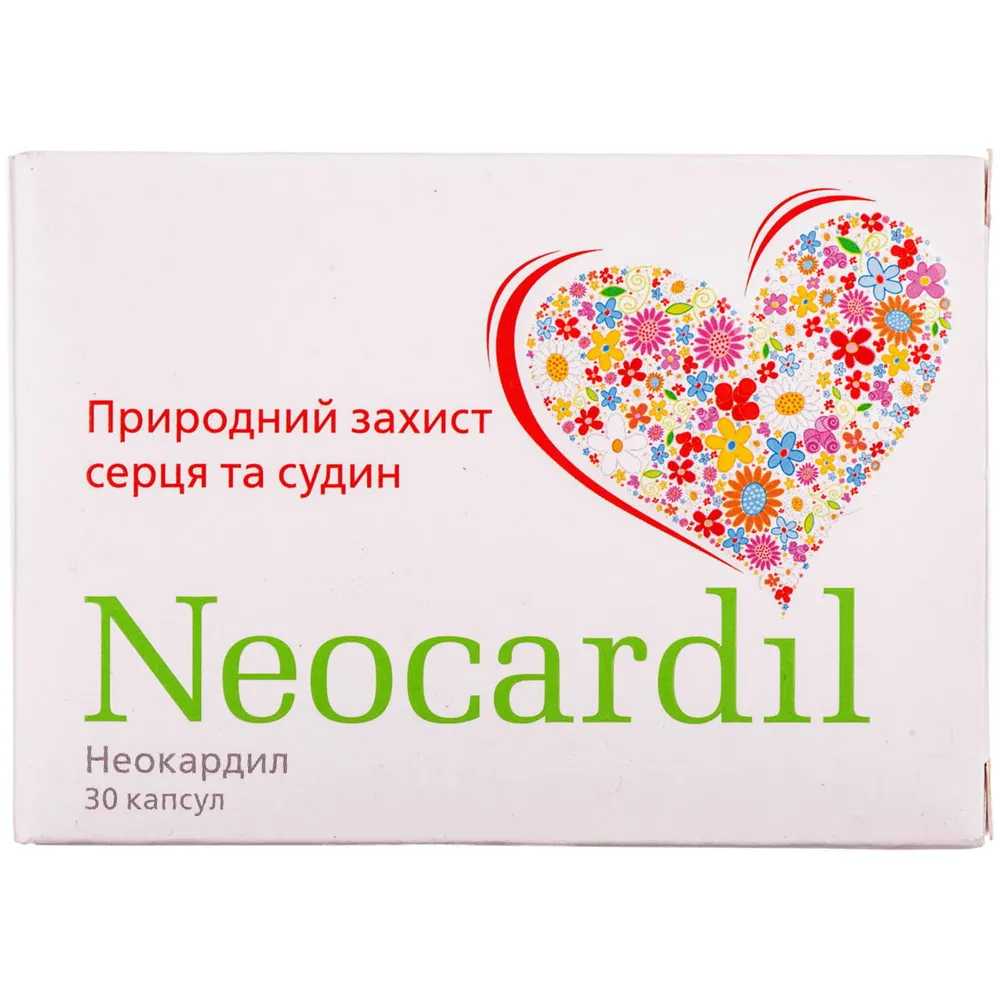
Table of Contents
INSTRUCTIONS FOR MEDICAL USE OF THE MEDICINAL PRODUCT NEOCARDIL
Composition:
Active substances: 1 capsule contains: dry extract of hawthorn leaf and flower (Crataegi folii cum flore extractum siccum) – 150 mg, dry ginkgo extract (Ginkgonis extractum siccum) – 50 mg, dry kudzu extract (Puerariae extractum siccum) – 50 mg;
Excipients: lactose monohydrate, povidone.
Composition of the hard gelatin capsule: gelatin, titanium dioxide (E 171), tartrazine (E 102), amaranth (E 123), erythrosine (E 127), patent blue V (E 131).
* Dry extract of hawthorn leaf and flower contains 6% maltodextrin and 2% colloidal silicon dioxide.
Pharmaceutical form. Capsules.
Main physicochemical properties: hard gelatin capsules No. 0 with burgundy cap and body containing powder from light brown to greenish-brown in color with white specks. Presence of compacted columns or lumps, which disintegrate upon pressure, is permissible.
Pharmacotherapeutic group. Cardiology preparations. ATC code C01EB.
Pharmacological Properties
Pharmacodynamics
Neocardil contains standardized extracts of hawthorn leaves and flowers, ginkgo leaves, and kudzu root. The main components of these extracts are flavonoids (quercetin, hyperin, hyperoside, vitexin), isoflavones, organic acids, carotenoids, pectins, triterpene and flavone glycosides, and choline. The pharmacological effect of the medicinal product is due to the combined actions of the active substances contained in its composition.
The extract of hawthorn leaves and flowers exerts a mild cardiotonic, antianginal, antioxidant, antiarrhythmic, antiaggregant, and spasmolytic effect. It improves blood supply and the functional state of the myocardium, enhances myocardial contractility and pumping function of the heart muscle, increases myocardial sensitivity to cardiac glycosides, reduces elevated arterial pressure, and normalizes heart rate.
Due to the presence of ginkgo leaf extract, the medicinal product improves cerebral circulation and enhances oxygen and glucose supply to brain tissues. It exerts anti-hypoxic and antioxidant effects, influences blood rheological properties and microcirculation, prevents platelet aggregation, and improves blood flow in the extremities. It normalizes metabolic processes and provides neuroprotective, anti-hypoxic, and antioxidant actions. The drug improves sensory and cognitive brain functions and helps prevent deterioration of mental performance.
The kudzu root extract exerts an anti-atherosclerotic effect, relieves spasm of coronary and cerebral vessels, reduces blood viscosity, prevents vascular thrombosis, and helps prevent diabetic complications.
Pharmacokinetics
Not studied.
Clinical characteristics.
Indications.
Neurocirculatory dystonia; as part of complex therapy for chronic ischemic heart disease (angina pectoris, arrhythmias), arterial hypertension.
Cerebral circulation and brain function disorders of various etiologies, manifested by impaired memory, attention and cognitive performance, dizziness, tinnitus, feelings of anxiety and restlessness, headache, and sleep disturbances.
Peripheral blood flow and microcirculation disorders in limbs, including limb arteriopathies, diabetic angiopathies, and Raynaud's syndrome.
Neurosensory disorders (dizziness, tinnitus, hypoacusis, age-related macular degeneration, diabetic retinopathy).
Vasovegetative symptoms of climacteric syndrome.
Contraindications.
Hypersensitivity to the components of the medicinal product. Severe arterial hypotension and bradycardia.
Pregnancy.
Interaction with other medicinal products and other forms of interaction.
Clinical studies on interaction with Ginkgo biloba (EGb 761) have demonstrated potentiation or inhibition of cytochrome P450 isoenzymes. Midazolam concentrations were altered following concomitant administration of Ginkgo biloba (EGb 761), suggesting a possible interaction via CYP3A4. Therefore, medicinal products primarily metabolized by CYP3A4 and having a narrow therapeutic index should be used with caution.
Concomitant use of Ginkgo-containing medicinal products with anticoagulants (phenprocoumon, warfarin) or antiplatelet agents (clopidogrel, nonsteroidal anti-inflammatory drugs) may affect the efficacy of these agents.
No interaction between warfarin and Ginkgo-containing medicinal products was observed in clinical studies; however, appropriate monitoring is recommended when warfarin is used concomitantly with Ginkgo-containing products, especially at the beginning and end of treatment or when changing the medicinal product.
Interaction studies with talinolol suggest that Ginkgo may inhibit P-glycoproteins in the small intestine, potentially increasing gastrointestinal exposure to P-glycoprotein-sensitive drugs such as dabigatran etexilate. Concomitant use of Ginkgo with dabigatran should therefore be done cautiously.
Interaction studies have shown that the Cmax of nifedipine may increase by up to 100% during Ginkgo co-administration in some patients, who may experience dizziness and increased flushing episodes.
Concomitant use of Ginkgo-containing medicinal products with efavirenz is not recommended due to the potential for reduced plasma concentrations of efavirenz caused by induction of cytochrome CYP3A4.
Hawthorn preparations enhance the effects of quinidine, procainamide, and cardiac glycosides. Concomitant use of hawthorn preparations with alkaloid salts is not recommended due to the potential for precipitate formation.
The medicinal product potentiates the action of antiarrhythmic agents and enhances the effects of sedatives, hypnotics, and antihypertensive agents. The product should not be used concomitantly with cisapride.
Special precautions for use.
Consult a physician before use.
Patients with a tendency to bleeding (hemorrhagic tendency) who are receiving concomitant therapy with anticoagulants or antiplatelet agents should consult a physician before using Neocardil.
Ginkgo-containing medicinal products increase the risk of bleeding. As a precautionary measure, treatment with Neocardil should be discontinued 3–4 days prior to surgical intervention.
In patients with epilepsy, the possibility of increased seizure frequency during treatment with ginkgo-containing medicinal products cannot be excluded.
Concomitant use of ginkgo-containing medicinal products with efavirenz is not recommended (see section "Interaction with other medicinal products and other forms of interaction").
Neocardil contains lactose; therefore, the product should not be used in patients with rare hereditary forms of galactose intolerance, lactase deficiency, or glucose-galactose malabsorption syndrome.
Use during pregnancy or breastfeeding.
Pregnancy
Ginkgo extract may reduce platelet aggregation ability. The risk of bleeding may increase. Animal studies are insufficient to draw conclusions regarding reproductive toxicity.
The medicinal product is contraindicated during pregnancy.
Breastfeeding
There are no data on whether ginkgo metabolites are excreted in breast milk. Risk to newborns and infants cannot be excluded.
Due to the lack of sufficient data, use of this medicinal product during breastfeeding is not recommended.
Fertility
No specific studies on the effect of ginkgo on human fertility have been conducted. However, certain effects have been observed in female mice.
Ability to influence reaction speed when driving or operating machinery.
No studies assessing the effect on reaction speed while driving or operating machinery have been conducted. However, drowsiness and/or dizziness may impair the ability to drive or operate machinery.
Dosage and Administration.
Adults should take Neocardil 1 capsule twice daily, in the morning and evening, or a single daily dose taken once in the morning.
The medication can be taken independently of food intake. Capsules should be swallowed with water. The duration of treatment is determined by a physician. Therapeutic effect is usually observed after 1 month. If there are no positive changes in clinical symptoms within 6 weeks of treatment, or if symptoms worsen, consult a physician. The average duration of treatment course is 3 months.
Children.
Not to be used in children.
Overdose.
May result in increased manifestations of adverse reactions, including drowsiness, hypotension, and bradycardia, requiring discontinuation of the drug.
Adverse reactions.
Blood and lymphatic system disorders: occurrence of bleeding in individual organs (eyes, nose, cerebral and gastrointestinal hemorrhages).
Gastrointestinal disorders: digestive disturbances, dyspepsia, diarrhea, abdominal pain, nausea, vomiting.
Immune system disorders: hypersensitivity reactions, including tongue, lip and cheek numbness, swelling of the neck, face, hands and feet, hot flushes, sensation of warmth throughout the body, feeling of suffocation, dyspnea, angioneurotic edema, urticaria.
Skin disorders: skin inflammation, redness, swelling, rash, pruritus, eczema.
Nervous system disorders: headache, somnolence, dizziness, weakness, tinnitus, syncope (including vasovagal).
Cardiovascular system disorders: discomfort in the area of the heart (feeling of chest tightness), cardiac arrhythmias (slowing or acceleration of heart rate), arterial hypotension.
If signs of hypersensitivity occur, treatment should be discontinued and medical advice should be sought immediately.
Shelf life.
3 years.
Storage conditions.
Store in the original packaging at a temperature not exceeding 25 °C. Keep out of reach of children.
Packaging.
10 capsules per blister, 3 blisters per pack.
Availability.
Over-the-counter (without prescription).
Manufacturer.
LLC "VALARTIN PHARMA".
Manufacturer's address and place of business.
60 Hrushevskoho St., Village Chayky, Kyiv-Sviatoshyn District, Kyiv Region, Ukraine, 08135.