Nebulomax
Ukraine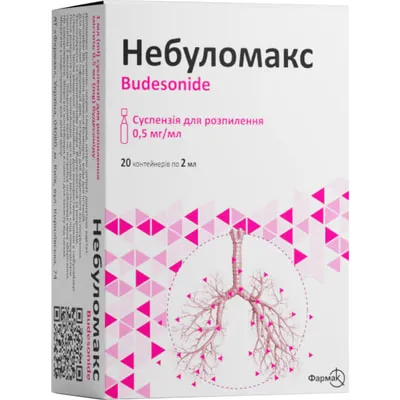
Table of Contents
INSTRUCTIONS FOR MEDICAL USE OF THE MEDICINAL PRODUCT NEBULOMAX (NEBULOMAX)
Composition:
Active substance: budesonide;
1 ml of nebulizer suspension contains 0.125 mg or 0.25 mg or 0.5 mg of budesonide;
Excipients: sodium chloride, sodium citrate, disodium edetate, polysorbate 80, citric acid anhydrous, water for injections.
Pharmaceutical form. Nebulizer suspension.
Main physicochemical characteristics: white or almost white suspension, easily resuspended, filled into polyethylene containers containing a single dose.
Pharmacotherapeutic group. Inhalation agents used in the treatment of obstructive respiratory diseases. Glucocorticoids. ATC code R03BA02.
Pharmacological properties.
Pharmacodynamics.
Budesonide is a glucocorticosteroid with potent local anti-inflammatory activity.
Local anti-inflammatory effect
The precise mechanism of action of glucocorticosteroids in the treatment of bronchial asthma has not been fully elucidated. Anti-inflammatory effects, such as inhibition of the release of inflammatory mediators and suppression of cytokine-mediated immune responses, are likely to play an important role. The potency of budesonide, measured as affinity for the glucocorticosteroid receptor, is approximately 15 times greater than that of prednisolone.
A clinical study in patients with asthma comparing inhaled and oral formulations of budesonide at doses calculated to achieve similar systemic bioavailability demonstrated a statistically significant therapeutic advantage of inhaled budesonide over oral budesonide compared to placebo. Thus, the therapeutic effect of standard doses of inhaled budesonide may largely be attributed to its direct action on the airways.
Clinical effect
Budesonide exerts anti-inflammatory effects, manifested by reduction of bronchial obstruction in both early and late phases of the allergic reaction.
Airway reactivity
It has been demonstrated that in patients with hyperreactivity, budesonide reduces airway reactivity to histamine and methacholine.
Studies have shown that the earlier treatment with budesonide is initiated after the onset of bronchial asthma symptoms, the faster improvement in lung function can be expected.
Effect on plasma cortisol concentration
In studies involving healthy volunteers, administration of budesonide in the form of an inhalation powder resulted in a dose-dependent effect on cortisol levels in plasma and urine. Budesonide in the form of an inhalation powder, when used at recommended doses, has significantly less effect on adrenal function than prednisone 10 mg, as confirmed by ACTH stimulation tests.
Clinical use – bronchial asthma
The efficacy of budesonide has been evaluated in numerous studies, which demonstrated its effectiveness in adults and children when administered once or twice daily for the prophylactic treatment of persistent asthma. Several examples of representative studies are provided below.
Children. Effect on growth
In short-term studies, a slight and usually transient reduction in growth velocity was observed, typically occurring during the first year of treatment. Limited data from long-term studies suggest that most children and adolescents receiving inhaled budesonide therapy eventually achieve their expected adult height. However, in one study, children who received high-dose inhaled budesonide (400 mcg daily) via a dry powder inhaler for 6 years without dose titration to the lowest effective dose were on average 1.2 cm shorter in adulthood compared to those who received placebo over a similar period. For information on dose titration and growth monitoring in children, see section "Dosage and administration".
Exercise-induced bronchial asthma
Inhaled budesonide has been effectively used for the prevention of asthma attacks induced by physical exertion.
Clinical use – croup
Several studies in children with croup have compared outcomes of budesonide treatment versus placebo. Examples of representative studies evaluating budesonide for the treatment of croup in children are provided below.
Efficacy in children with mild to moderate croup
To determine whether budesonide improves croup symptom scores and reduces hospitalization duration, a randomized, double-blind, placebo-controlled study was conducted in 87 children (aged 7 months to 9 years) hospitalized with a clinical diagnosis of croup. Participants received an initial dose of budesonide suspension for nebulization (2 mg) or placebo, followed by doses of budesonide suspension for nebulization (1 mg) or placebo every 12 hours. Budesonide nebulization solution significantly improved croup severity scores at 12 and 24 hours, as well as at 2 hours in patients with initial symptom scores above 3 points. Hospitalization duration was also reduced by 33%.
Efficacy in children with moderate to severe croup
To compare the efficacy of budesonide versus placebo, a randomized, double-blind, placebo-controlled study was conducted in 83 infants and children (aged 6 months to 8 years) hospitalized with a clinical diagnosis of croup. Patients received budesonide 2 mg or placebo every 12 hours for up to 36 hours or until discharge. Total croup symptom scores were assessed before dosing and at 0, 2, 6, 12, 24, 36, and 48 hours after the initial dose. At 2 hours, both budesonide and placebo groups showed similar improvement in symptom scores, with no statistically significant difference between groups. At 6 hours, croup symptom scores in the budesonide group were significantly better than in the placebo group, and this improvement compared to placebo remained evident at 12 and 24 hours.
Pharmacokinetics.
Absorption
Systemic availability of budesonide in adults after administration of nebulized suspension via a jet nebulizer is approximately 15% of the nominal dose and 40–70% of the dose delivered to the patient. A minor portion of this amount is due to systemic absorption of the drug that has been swallowed. Maximum plasma concentration is reached approximately 10–30 minutes after the start of nebulization and is about 4 nmol/L after a 2 mg dose.
Distribution
The volume of distribution of budesonide is approximately 3 L/kg. Plasma protein binding averages 85–90%.
Metabolism
Budesonide undergoes extensive first-pass metabolism in the liver (≈90%) into metabolites with low glucocorticosteroid activity. The glucocorticosteroid activity of the main metabolites, 6β-hydroxybudesonide and 16α-hydroxyprednisolone, is less than 1% of that of budesonide. Budesonide metabolism is primarily mediated by CYP3A enzymes of the cytochrome P450 superfamily.
Elimination
Budesonide metabolites are excreted primarily via the kidneys in unchanged or conjugated forms. Unchanged budesonide is not detected in urine. In healthy adults, systemic clearance of budesonide is typically high (approximately 1.2 L/min), and the terminal half-life after intravenous administration averages 2–3 hours.
Linearity
Budesonide kinetics are dose-proportional when administered at clinically relevant doses.
In a study where patients also received 100 mg ketoconazole twice daily, plasma levels of budesonide after oral administration (single 10 mg dose) were increased on average by 7.8-fold. Data on similar interactions with inhaled budesonide are lacking, but a substantial increase in plasma levels is entirely expected.
Pharmacokinetics in specific patient groups
Children
In children aged 4–6 years with bronchial asthma, systemic clearance of budesonide is approximately 0.5 L/min. Clearance in children (per kg body weight) is about 50% higher than in adults. In children with bronchial asthma, the terminal half-life of budesonide after inhalation is approximately 2.3 hours, similar to that observed in healthy adults. In children aged 4–6 years with bronchial asthma, systemic availability of budesonide after administration of nebulized suspension via a jet nebulizer (Pari LC Jet Plus with Pari Master compressor) is approximately 6% of the nominal dose and 26% of the delivered dose. Systemic availability in children is approximately half that in healthy adults.
In children aged 4–6 years with bronchial asthma, maximum plasma concentration is reached within 20 minutes after the start of nebulization and is approximately 2.4 nmol/L after a 1 mg dose. Budesonide exposure parameters (Cmax and AUC) after a single 1 mg nebulized dose in children aged 4–6 years are comparable to those in healthy adults receiving the same dose via the same nebulization system.
Patients with hepatic impairment
The effect of budesonide may be enhanced in patients with liver disease.
Plasma clearance after intravenous administration of budesonide was similar in patients with liver cirrhosis and healthy volunteers. However, after oral administration, systemic bioavailability of budesonide increased due to impaired liver function, resulting from reduced presystemic metabolism. The clinical significance of these changes for budesonide therapy has not been fully established, as data on inhaled budesonide are lacking; however, an increase in plasma drug levels, and consequently an increased risk of systemic adverse reactions, can be expected.
Patients with renal impairment
The pharmacokinetics of budesonide in patients with renal impairment is unknown.
Clinical characteristics.
Indications.
Nebulomax contains a potent non-halogenated corticosteroid – budesonide, intended for the treatment of bronchial asthma in patients in whom the use of pressurized metered-dose inhalers or dry powder inhalers has proven ineffective or inappropriate.
Nebulomax is also recommended for use in infants and children with croup (a complication of acute viral infection of the upper respiratory tract, also known as laryngotracheobronchitis or subglottic laryngitis) requiring hospitalization.
Contraindications.
Hypersensitivity to the active substance or to any of the excipients of Nebulomax.
Interaction with other medicinal products and other forms of interaction.
Budesonide is metabolized primarily via CYP3A4. Concomitant use with CYP3A inhibitors, such as itraconazole, ketoconazole, or HIV protease inhibitors, is expected to increase the risk of systemic adverse effects of budesonide several-fold (see section "Special warnings and precautions for use"). Since data on dosing are lacking, concomitant use of these medicinal products should be avoided. If concomitant use cannot be avoided, the interval between administration of these drugs should be as long as possible, and consideration should be given to reducing the dose of budesonide.
Limited data on similar interactions with high doses of inhaled budesonide show that co-administration of itraconazole 200 mg once daily increases plasma concentrations of inhaled budesonide (single dose 1000 µg) significantly (on average by 4 times).
In women receiving estrogens or hormonal contraceptives concurrently, plasma concentrations of budesonide were increased and corticosteroid effects were enhanced; however, this effect was not observed when budesonide was used together with low-dose combined oral contraceptives.
Concomitant use of Nebulomax with CYP3A inhibitors, including medicinal products containing cobicistat, is expected to increase the risk of systemic adverse reactions. This combination should be avoided unless the benefit outweighs the increased risk of systemic corticosteroid side effects. In such cases, patients should be monitored by a physician for signs of systemic corticosteroid adverse effects.
Since adrenal function may be suppressed, an ACTH stimulation test intended for the diagnosis of pituitary insufficiency may yield false-negative results (low values).
Special precautions for use.
Nebulomax is not intended for rapid relief of acute episodes of bronchial asthma requiring the use of short-acting inhaled bronchodilators.
If treatment with short-acting bronchodilators becomes ineffective or if a patient requires more inhalations than usual, medical intervention is necessary. In such a situation, intensification of regular therapy should be considered, for example, by increasing the dose of inhaled budesonide, adding a long-acting beta-agonist, or initiating a course of oral glucocorticosteroids.
Respiratory tract infections
The drug should be used with caution in patients with active or inactive pulmonary tuberculosis, and fungal or viral infections of the respiratory tract.
Patients dependent on steroids
Particular caution is required when switching therapy from oral glucocorticosteroids to inhaled medications. During this period, there is a risk of developing temporary adrenal insufficiency.
Patients who have required emergency high-dose corticosteroid therapy or prolonged treatment with inhaled corticosteroids at the highest recommended dose are also at risk of developing adrenal dysfunction. Such patients may experience signs and symptoms of adrenal insufficiency during periods of severe stress. Additional systemic corticosteroid therapy may be prescribed during stressful situations or prior to planned surgical procedures.
When switching from oral steroid therapy to Nebulomax, a reduction in systemic corticosteroid effects is usually observed, which may lead to the emergence of allergy- or arthritis-related symptoms such as rhinitis, eczema, and musculoskeletal pain. Specific treatment should be initiated for these conditions. Inadequate glucocorticosteroid therapy effect may be suspected if symptoms such as fatigue, headache, nausea, or vomiting occur, although this is rare. In such cases, temporary increase in the dose of oral glucocorticosteroids may sometimes be required.
Systemic effects may occur with the use of any inhaled glucocorticosteroids, particularly when high doses are used over prolonged periods. The likelihood of such effects is significantly lower with inhaled corticosteroids compared to oral administration. Possible systemic effects include Cushing's syndrome, Cushing-like symptoms, cushingoid features, adrenal suppression, growth retardation in children and adolescents, decreased bone mineral density, cataract, glaucoma, and less frequently, various psychiatric and behavioral disorders including psychomotor hyperactivity, sleep disturbances, anxiety, depression, or aggression (especially in children). Therefore, it is important to titrate the dose of inhaled corticosteroid to the lowest effective dose that maintains adequate control of bronchial asthma.
Bronchospasm
As with other forms of inhaled therapy, paradoxical bronchospasm may occur, characterized by increased wheezing immediately after inhalation. If this occurs, treatment with inhaled budesonide should be discontinued immediately, the patient's condition should be assessed, and alternative therapy initiated if necessary.
Hepatic impairment
Reduced liver function may affect the elimination of glucocorticosteroids from the body, as clearance decreases and systemic exposure increases. Patients should be warned about the possible development of adverse effects.
Concomitant use of other medicinal products
Concomitant use with CYP3A inhibitors, such as itraconazole, ketoconazole, HIV protease inhibitors, and products containing cobicistat, is expected to increase the risk of systemic corticosteroid side effects. Such combinations should be avoided unless the benefit outweighs the increased risk. If such combination therapy cannot be avoided, patients should be monitored for the development of systemic corticosteroid-related adverse effects. This has limited clinical significance during short-term (1–2 weeks) treatment with itraconazole or ketoconazole or other potent CYP3A inhibitors, but should be considered during long-term therapy. A reduction in the budesonide dose should also be considered (see section "Interaction with other medicinal products and other forms of interaction").
The nebulizer chamber must be cleaned after each use. The nebulizer chamber and mouthpiece or face mask should be washed with hot water and a mild detergent. The chamber should be thoroughly rinsed and dried by attaching it to the compressor or air intake.
Oropharyngeal candidiasis
Oropharyngeal candidiasis may develop during treatment with inhaled corticosteroids. This infection may necessitate appropriate antifungal treatment, and in some patients, discontinuation of inhaled corticosteroid therapy may be required (see also section "Dosage and administration").
Pneumonia in patients with COPD
An increased incidence of pneumonia, including pneumonia requiring hospitalization, has been observed in patients with COPD receiving inhaled corticosteroids.
Evidence suggests an increased risk of pneumonia with higher corticosteroid doses, although this has not been definitively demonstrated in any study.
There are no conclusive clinical data differentiating inhaled corticosteroid products regarding the magnitude of pneumonia risk.
Physicians should remain vigilant for possible pneumonia in patients with COPD, as clinical signs of such infections resemble symptoms of COPD exacerbations.
Risk factors for pneumonia in patients with COPD include smoking, advanced age, low body mass index (BMI), and severe COPD.
Visual disturbances
Visual disturbances may occur with both systemic and local use of corticosteroids. If patients experience symptoms such as blurred vision or other visual disturbances, they should consult an ophthalmologist to evaluate possible causes, including cataract, glaucoma, or rare conditions such as central serous chorioretinopathy (CSC), which has been reported following systemic or local corticosteroid use.
Children
Effect on growth
Regular monitoring of growth is recommended in children receiving long-term inhaled corticosteroid therapy. If growth velocity slows, therapy should be reviewed with the aim of reducing the inhaled corticosteroid dose to the lowest possible dose that maintains effective control of bronchial asthma. The benefits of corticosteroid therapy should be carefully weighed against the potential risk of growth retardation. Additionally, referral to a pediatric pulmonologist should be considered.
Use during pregnancy or breastfeeding
Pregnancy
Most findings from prospective epidemiological studies and international post-marketing experience with budesonide suggest that inhaled budesonide treatment during pregnancy does not adversely affect fetal or neonatal health.
It is important for both the fetus and the pregnant woman that bronchial asthma is adequately controlled during pregnancy. As with other medicinal products used during pregnancy, the benefit of budesonide use for the mother should be weighed against potential risks to the fetus. Inhaled glucocorticosteroids should be preferred over oral glucocorticosteroids due to their lower systemic effects when equivalent respiratory responses are achieved.
Animal studies have shown that glucocorticosteroids may cause developmental abnormalities. However, these data are not considered relevant to humans when recommended doses are used.
Animal studies have also shown that excessive prenatal exposure to glucocorticoids may be associated with an increased risk of intrauterine growth retardation, adult-onset cardiovascular disease, and permanent changes in glucocorticoid receptor density, neurotransmitter metabolism, and behavior, even at doses below teratogenic levels.
Inhaled budesonide should be used during pregnancy at the lowest effective dose, taking into account the risk of bronchial asthma exacerbation.
Breastfeeding
Budesonide passes into breast milk. However, no adverse effects on the breastfed infant are expected when Nebulomax is used at therapeutic doses. Nebulomax may be used during breastfeeding.
Ability to affect reaction speed when driving or operating machinery
Nebulomax does not affect the ability to drive or operate machinery.
Method of administration and dosing.
Dosing
The dosage of Nebulomax should be adjusted according to individual patient needs.
The dose delivered to the patient depends on the nebulizing equipment used. Nebulization time and delivered dose depend on the airflow rate, nebulizer chamber volume, and fill volume. The airflow rate through the nebulizing device should be 6–8 liters per minute. The appropriate fill volume for most nebulizers is 2–4 mL. The dose should be reduced to the minimum required to maintain adequate control of bronchial asthma. The highest dose (2 mg daily) should be prescribed to children under 12 years of age only in cases of severe asthma and for a limited period of time.
Bronchial asthma
Initiation of therapy
At the beginning of treatment, during exacerbations of bronchial asthma, and when reducing or discontinuing oral glucocorticosteroids, the recommended dose of Nebulomax is:
Adults (including elderly patients): usually 1–2 mg twice daily. In very severe cases, the dose may be further increased.
Children aged 12 years and older: dosage is the same as for adults.
Children aged 6 months to 12 years: 0.5–1 mg twice daily.
Maintenance therapy
The maintenance dose should be individually adjusted and should be the lowest dose at which the patient remains free of disease symptoms.
Adults (including elderly patients) and children aged 12 years and older: 0.5–1 mg twice daily.
Children aged 6 months to 12 years: 0.25–0.5 mg twice daily.
Patients receiving oral glucocorticosteroids as maintenance therapy
Nebulomax allows for discontinuation or significant reduction of oral glucocorticosteroid dosage while maintaining control of bronchial asthma. The transition from oral steroids should begin when the patient is in a relatively stable condition. For approximately 10 days, a high dose of Nebulomax should be administered in combination with the previously used dose of oral steroid. After this period, the dose of oral steroids should be gradually reduced to the lowest possible level, for example, by 2.5 mg of prednisolone or equivalent per month. Often, oral steroid therapy can be completely discontinued and replaced with Nebulomax. For further details on discontinuation of oral glucocorticosteroids, see section "Special precautions".
Patients not receiving oral glucocorticosteroids
Therapeutic effect is usually achieved within 10 days. In patients with excessive mucus secretion in the bronchi, an initial short-term (approximately 2 weeks) course of oral corticosteroids may be administered. After completion of the oral corticosteroid course, treatment with Nebulomax alone may be sufficient as monotherapy.
Dosing considerations
Nebulomax can be mixed with 0.9% physiological saline and with nebulizing solutions containing terbutaline, salbutamol, fenoterol, acetylcysteine, sodium cromoglicate, or ipratropium bromide. The mixture should be used within 30 minutes.
Dosing recommendations
Table 1
| Dose (mg) |
Volume of Nebulomax, suspension for nebulization |
||
| 0.125 mg/ml |
0.25 mg/ml |
0.5 mg/ml |
|
| 0.25 |
2 ml |
1 ml |
- |
| 0.5 |
- |
2 ml |
1 ml |
| 0.75 |
- |
3 ml |
- |
| 1.0 |
- |
4 ml |
2 ml |
| 1.5 |
- |
6 ml |
3 ml |
| 2.0 |
- |
8 ml |
4 ml |
For patients in whom enhanced therapeutic effect is desired, especially those without excessive mucus in the airways, increasing the dose of Nebulomax is recommended instead of combined therapy with oral corticosteroids, due to a lower risk of systemic adverse effects.
Croup
For children with croup, the usual dose is 2 mg of nebulized budesonide. This dose may be administered as a single dose or as two doses of 1 mg each, given 30 minutes apart. The treatment may be repeated every 12 hours, up to a maximum of 36 hours or until clinical improvement occurs.
Administration method
Nebulomax must be used only with appropriate nebulizers.
To open the container, detach it from the strip, gently shake it, and break off the tab on the nozzle to open. Carefully squeeze the entire contents into the nebulizer chamber. Discard the empty container and cover the nebulizer chamber with its cap.
Nebulomax should be administered using a jet nebulizer with a mouthpiece or an appropriate face mask. The nebulizer should be connected to an air compressor providing sufficient airflow (6–8 L/min), with a filling volume of 2–4 mL.
Note. It is important that the patient:
- carefully reads the instructions for use provided in the patient information leaflet included in the packaging of each nebulizer;
- understands that ultrasonic nebulizers are not suitable for administering Nebulomax and therefore their use is not recommended;
- is informed about the possibility of mixing Nebulomax with 0.9% saline solution or with nebulizing solutions containing terbutaline, salbutamol, fenoterol, acetylcysteine, sodium cromoglicate, or ipratropium bromide, and knows that the mixture must be used within 30 minutes;
- rinses the mouth with water after inhaling the prescribed dose to minimize the risk of oropharyngeal candidiasis;
- washes the face with water after using a face mask to prevent skin irritation;
- properly cleans and stores the nebulizer according to the manufacturer's instructions.
Children
Nebulomax may be used in children as indicated (see sections "Indications" and "Dosage and administration").
Overdose
Overdose with Nebulomax, even with excessive doses, is not expected to cause clinically significant problems. However, prolonged use of high doses may lead to systemic glucocorticosteroid effects such as hypercortisolism and adrenal suppression.
Side effects
To assess the frequency of occurrence of side effects, the following definitions were used. Frequency is defined as: very common (≥1/10); common (≥1/100 to <1/10); uncommon (≥1/1,000 to <1/100); rare (≥1/10,000 to <1/1,000); very rare (<1/10,000).
Side effects classified by system organ classes and frequency
Table 2
| System organ classes |
Frequency |
Adverse reactions |
| Infections and infestations |
Common |
Oropharyngeal candidiasis Pneumonia (in COPD patients) |
| Immune system disorders |
Uncommon |
Immediate and delayed hypersensitivity reactions*, including rash, contact dermatitis, urticaria, angioedema, and anaphylactic reaction |
| Endocrine system disorders |
Uncommon |
Signs and symptoms of systemic corticosteroid effects, including adrenal suppression and growth retardation** |
| Psychiatric disorders |
Uncommon |
Anxiety |
| Depression |
||
| Uncommon |
Psychomotor hyperactivity |
|
| Sleep disorders |
||
| Agitation |
||
| Behavioural changes (mainly in children) |
||
| Nervous system disorders |
Uncommon |
Tremor*** |
| Eye disorders |
Uncommon |
Cataract |
| Blurred vision (see section "Special precautions") |
||
| Not known |
Glaucoma |
|
| Respiratory, thoracic and mediastinal disorders |
Common |
Cough |
| Hoarseness |
||
| Throat irritation |
||
| Uncommon |
Bronchospasm |
|
| Dysphonia |
||
| Hoarseness**** |
||
| Skin and subcutaneous tissue disorders |
Uncommon |
Contusion |
| Musculoskeletal and connective tissue disorders |
Uncommon |
Muscle cramps |
* See below for description of individual adverse reactions; facial skin irritation.
** See section "Children" below.
*** Based on frequency recorded during clinical trials.
**** Rarely in children.
Sometimes, when using inhaled glucocorticosteroids, signs or symptoms of systemic glucocorticosteroid side effects may occur, likely depending on dose, duration of exposure, concomitant and prior corticosteroid exposure, as well as individual sensitivity (see section "Special precautions for use").
Description of individual adverse reactions
Oropharyngeal candidiasis occurs due to deposition of the medicinal product. Patients should be instructed to rinse the mouth with water after each inhalation of the maintenance dose to minimize this risk.
As with any inhaled therapy, paradoxical bronchospasm may very rarely occur (see section "Special precautions for use").
Occasionally, when using a nebulizer with a face mask, hypersensitivity reactions in the form of facial skin irritation have been reported. To prevent irritation, patients should wash their face after using the mask.
Cataract was also reported infrequently in the placebo group in placebo-controlled studies.
In pooled clinical trials, 13,119 patients received inhaled budesonide and 7,278 patients received placebo. The incidence of anxiety was 0.52% with inhaled budesonide and 0.63% with placebo; the incidence of depression was 0.67% with inhaled budesonide and 1.15% with placebo.
Children
Due to the risk of growth suppression in children, growth monitoring should be performed as described in the section "Special precautions for use".
Reporting of adverse reactions
It is important to report suspected adverse reactions during the post-marketing period of the medicinal product. This enables continuous monitoring of the benefit-risk balance of the medicinal product. Healthcare professionals are obliged to report any suspected adverse reactions through the national reporting system.
Shelf life. 2 years.
After opening the pouch, the containers inside should be used within 3 months.
Do not use the medicinal product after the expiry date stated on the packaging.
Storage conditions.
The medicinal product does not require special storage conditions.
Do not freeze. Store containers in the pouch to protect from light.
Keep out of reach and sight of children.
Packaging.
2 ml in a single-dose container. 5 containers in a pouch. 4 pouches in a carton.
Prescription status. Prescription only.
Manufacturer. JSC "Farmak".
Manufacturer's address and place of business.
74, Kyrylivska Street, Kyiv, 04080, Ukraine.