Nazo drops
Ukraine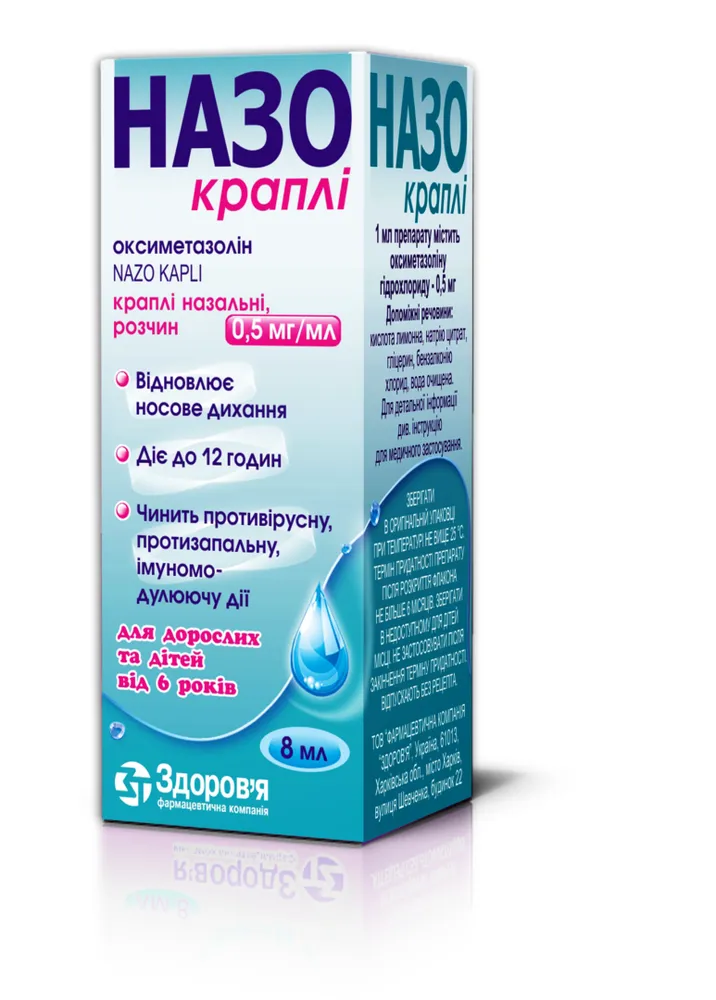
Table of Contents
INSTRUCTIONS FOR MEDICAL USE OF THE MEDICINAL PRODUCT NAZO DROPS
Composition:
active substance: oxymetazoline;
1 ml of the preparation contains oxymetazoline hydrochloride 0.25 mg, 0.5 mg;
excipients: citric acid, sodium citrate, glycerol, benzalkonium chloride, purified water.
Pharmaceutical form. Nasal drops, solution.
Main physico-chemical properties: clear or almost clear solution, colorless to slightly yellowish in tint.
Pharmacotherapeutic group. Anti-edematous and other medicinal agents for local use in nasal cavity disorders. Sympathomimetics, simple medicinal agents.
ATC code: R01A A05.
Pharmacological Properties.
Pharmacodynamics.
Oxymetazoline belongs to the group of local vasoconstrictive agents. The drug exerts sympathomimetic and vasoconstrictive effects, reducing edema of the nasal mucosa. It constricts blood vessels at the site of application, decreases swelling of the nasal and upper respiratory tract mucosa, and reduces nasal discharge. It restores nasal breathing. Relief of nasal mucosal edema promotes restoration of aeration in the paranasal sinuses and middle ear cavity, thereby preventing the development of bacterial complications.
Oxymetazoline exerts antiviral, anti-inflammatory, immunomodulatory, and antioxidant effects. Due to this combined mechanism of action, clinical studies have demonstrated faster and more effective relief of symptoms of acute rhinitis (nasal congestion, rhinorrhea, sneezing, malaise).
There is evidence from a double-blind, parallel-group comparative study showing more rapid and effective improvement of typical symptoms of acute rhinitis (nasal congestion, rhinorrhea, sneezing, malaise) (p < 0.05), attributable to the combined vasoconstrictive, antiviral, anti-inflammatory, and antioxidant effects of oxymetazoline. Thus, treatment with 0.05% oxymetazoline nasal drops, compared to physiological saline, significantly shortens the duration of the common cold, reducing it on average from 6 to 4 days (p < 0.001).
Pharmacokinetics.
When oxymetazoline is administered in the form of nasal drops at a concentration of 0.25 mg/mL, the effect manifests within several minutes after instillation.
When applied topically to the nasal mucosa at therapeutic concentrations, oxymetazoline does not irritate the nasal mucosa or cause hyperemia. The elimination half-life is approximately 35 hours after administration. About 2.1% of the drug is excreted via the kidneys, and approximately 1.1% is excreted in feces.
The effect of oxymetazoline lasts for several hours (on average 6–8 hours), with a maximum duration of up to 12 hours.
Clinical characteristics.
Indications.
Acute respiratory diseases accompanied by nasal congestion.
Allergic rhinitis.
Vasomotor rhinitis.
For restoration of drainage and nasal breathing in diseases of the paranasal sinuses, eustachitis.
For reduction of swelling prior to diagnostic procedures in the nasal passages.
Contraindications.
Hypersensitivity to any component of the medicinal product. Dry rhinitis.
Nazol drops, nasal drops, solution 0.25 mg/mL: children under 1 year of age.
Nazol drops, nasal drops, solution 0.5 mg/mL: children under 6 years of age.
Interaction with other medicinal products and other forms of interaction.
Concomitant use of oxymetazoline and:
- tricyclic antidepressants;
- monoamine oxidase inhibitors (MAO) of the tranylcypromine type;
- hypertensive agents may lead to increased arterial pressure. These agents should not be combined, if possible.
In case of oxymetazoline overdose, or if swallowed, or when used simultaneously or immediately after tricyclic antidepressants and/or MAO inhibitors, an increase in arterial pressure is possible.
Special precautions for use
The medicinal product should be used only after careful assessment of the benefit/risk ratio in the following cases:
- elevated intraocular pressure, especially in angle-closure glaucoma;
- severe cardiovascular disorders (e.g., ischemic heart disease) and arterial hypertension;
- pheochromocytoma;
- metabolic disorders (e.g., hyperthyroidism, diabetes mellitus, porphyria);
- benign prostatic hyperplasia;
- concomitant use of MAO inhibitors and other medicinal products that potentially increase blood pressure.
Prolonged use and exceeding the recommended dose should be avoided, especially when prescribing to children. Doses exceeding the recommended should be used only under medical supervision.
Benzalkonium chloride contained in the product may cause irritation and may provoke mucosal reactions.
Prolonged use and overdose of nasal decongestants may lead to reduced effectiveness of the drug and may produce clinical symptoms similar to vasomotor rhinitis. Misuse of this product may cause drug-induced rhinitis, mucosal atrophy, and reactive hyperemia of the nasal mucosa (rebound effect).
Use during pregnancy or breastfeeding
Pregnancy
The medicinal product should be used with particular caution during pregnancy or breastfeeding after evaluation of the benefit/risk ratio. Exceeding the recommended dosage is not recommended.
Breastfeeding period
It is unknown whether oxymetazoline passes into breast milk; therefore, the use of the product is possible only after a careful assessment of the benefit/risk ratio. Exceeding the recommended dosage is not recommended, as it may reduce breast milk production.
Ability to influence reaction speed when driving or operating machinery
When used at recommended doses, no effect on reaction speed is expected during driving or operating machinery. However, after prolonged use of doses exceeding the recommended, a systemic effect on the cardiovascular system cannot be excluded. In such cases, the ability to drive or operate machinery may be impaired.
Method of Administration and Dosage
The medicinal product Nazo drops, nasal drops, solution 0.25 mg/mL and 0.5 mg/mL, is intended for intranasal administration.
Adults and children aged 6 years and older.
Administer the medicinal product Nazo drops, 0.5 mg/mL, 1–2 drops into each nostril 2–3 times daily.
The single dose should not be used more than 3 times a day.
The effect of the drug develops within 25 seconds after administration and lasts for several hours (on average 6–8 hours, up to a maximum of 12 hours).
Children aged 1 to 6 years.
Administer the medicinal product Nazo drops, 0.25 mg/mL, 1–2 drops into each nostril 2–3 times daily.
The single dose should not be used more than 3 times a day.
The effect of the drug develops within a few minutes after administration and lasts for several hours (on average 6–8 hours, up to a maximum of 12 hours).
Doses higher than recommended should be used only under medical supervision.
Nazo drops, 0.25 mg/mL and 0.5 mg/mL, should not be used for longer than 5–7 days.
Children.
The medicinal product Nazo drops, 0.25 mg/mL, must not be used in children under 1 year of age, and Nazo drops, 0.5 mg/mL, must not be used in children under 6 years of age.
Overdose.
Overdose may occur following intranasal or accidental oral administration of the medicinal product. The clinical picture caused by intoxication with imidazole derivatives may be diffuse, as hyperreactive phases may alternate with phases of depression of the central nervous system, cardiovascular system, and respiratory system.
Stimulation of the central nervous system manifests as anxiety, agitation, hallucinations, and seizures.
Depression of the central nervous system manifests as decreased body temperature, lethargy, drowsiness, and coma.
Other possible symptoms include: arterial hypertension, tachycardia, bradycardia, miosis, mydriasis, seizures, increased body temperature, spasms, excessive sweating, pallor, lethargy, decreased body temperature, cyanosis, palpitations, arrhythmia, cardiac arrest, shock hypotension, nausea and vomiting, respiratory depression and apnea, and psychogenic disorders.
In children, overdose often leads to predominant central nervous system effects with seizures and coma, bradycardia, apnea, as well as arterial hypertension, which may follow an initial phase of arterial hypotension.
Therapeutic measures: indicated in cases of severe overdose. Administration of activated charcoal (adsorbent), sodium sulfate (laxative), or gastric lavage (in case of ingestion of a large amount of the medicinal product) should be performed immediately, as oxymetazoline may be rapidly absorbed. Vasopressor agents are contraindicated. Non-selective alpha-blockers may be used as an antidote. If necessary, anticonvulsant therapy, lung ventilation, and antipyretic measures should be initiated.
Adverse reactions
The frequency of adverse reactions is classified as follows: very common (≥10%), common (≥1% – <10%), uncommon (≥0.1% – <1%), rare (≥0.01% – <0.1%), very rare or isolated cases (<0.01%).
Respiratory, thoracic and mediastinal disorders
Common: burning or dryness of the nasal mucosa, sneezing.
Uncommon: increased swelling of the mucous membrane, nasal bleeding after discontinuation of use.
Very rare: apnea in newborns and young children.
Skeletal and muscular system disorders
Very rare: seizures (mainly in children).
Nervous system disorders
Very rare: restlessness, insomnia, fatigue (drowsiness, sedative effect), headache, hallucinations (especially in children).
Cardiovascular system disorders
Rare: palpitations, tachycardia, arterial hypertension.
Very rare: arrhythmia.
Immune system disorders
Uncommon: hypersensitivity reactions (rash, itching, angioneurotic edema).
Reporting of adverse reactions. Reporting adverse reactions after drug registration is of great importance. It enables continuous monitoring of the benefit-risk balance of the medicinal product. Healthcare and pharmacy professionals, as well as patients or their legal representatives, are encouraged to report all suspected adverse reactions and lack of drug efficacy via the Automated Pharmacovigilance Information System at the following link: https://aisf.dec.gov.ua.
Shelf life. 2 years.
The shelf life of the medicinal product after opening the bottle is no more than 6 months.
Storage conditions. Store in the original packaging at a temperature not exceeding 25 °C.
Keep out of reach and sight of children.
Packaging. 8 mL of 0.25 mg/mL and 0.5 mg/mL solution in a bottle sealed with a screw-cap dropper and glass pipette; 1 bottle per carton.
Availability. Over-the-counter (without prescription).
Manufacturer. Limited Liability Company "Pharmaceutical Company "Zdorovia".
Manufacturer's address and place of business. 22, Shevchenka Street, Kharkiv, Kharkiv Oblast, 61013, Ukraine.