Peppermint leaf
Ukraine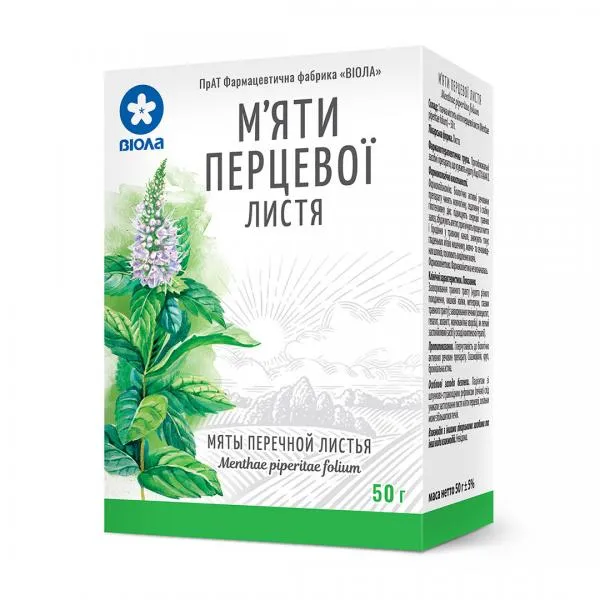
Table of Contents
INSTRUCTIONS FOR MEDICAL USE OF THE MEDICINAL PRODUCT PEPPERMINT LEAVES (MENTHAE PIPERITAE FOLIUM)
Composition:
Active substance: peppermint leaves (Menthae piperitae folium);
1 pack contains peppermint leaves (Menthae piperitae folium) – 50 g; 1 filter bag contains peppermint leaves (Menthae piperitae folium) – 1.5 g.
Pharmaceutical form. Leaves.
Main physico-chemical properties:
Ground herbal material: fragments of leaves of various shapes, with admixture of flowers and buds. Leaf margins are serrated with uneven sharp teeth; surface is glabrous, only on the lower side along the veins, under magnification, sparse appressed hairs are visible, and over the entire leaf surface – shining golden-yellow or darker glands. Leaf color ranges from light green to dark green. Odor is strong, pleasant. Taste is slightly pungent, cooling.
Coarse powder: fragments of leaves of various shapes, with admixture of flowers and buds, passing through sieve No. 1400. Leaf margins are serrated with uneven sharp teeth; surface is glabrous, only on the lower side along the veins, under magnification, sparse appressed hairs are visible, and over the entire leaf surface – shining golden-yellow or darker glands. Leaf color ranges from light green to dark green. Odor is strong, pleasant. Taste is slightly pungent, cooling.
Pharmacotherapeutic group.
Antiemetics and drugs used to relieve nausea. ATC code A04AD.
Pharmacological properties.
Pharmacodynamics.
The biologically active substances of the drug exert choleretic, sedative, and mild hypotensive effects; enhance secretion of the digestive glands, stimulate appetite, suppress putrefactive and fermentation processes in the gastrointestinal tract, reduce the tone of smooth muscles of the intestine, biliary and urinary tracts, and enhance bile excretion.
*Pharmacokin游戏副本
Clinical characteristics.
Indications.
Disorders of the gastrointestinal tract (nausea of various origins, intestinal colic, flatulence, gastrointestinal spasms); liver diseases (cholecystitis, hepatitis, cholangitis, cholelithiasis); as a mild sedative agent (as part of complex therapy).
Contraindications.
Hypersensitivity to the biologically active substances of the drug. Spasmophilia, croup, bronchial asthma.
Special precautions.
Patients with gastroesophageal reflux (heartburn) should avoid using peppermint leaves, as heartburn may increase.
Interaction with other medicinal products and other forms of interaction.
Not known.
Special precautions.
Use during pregnancy or breastfeeding. Only under a doctor's prescription, in cases where the benefit to the mother outweighs the potential risk to the fetus/child.
Ability to affect reaction speed when driving or operating machinery. No effect.
Method of Administration and Dosage.
Place 1 tablespoon of leaves into an enameled container, pour 200 ml of hot boiled water, cover with a lid, and steep in a boiling water bath for 15 minutes. Cool at room temperature for 45 minutes, then strain and squeeze the residue into the strained infusion. Adjust the volume of the infusion to 200 ml with boiled water.
Take warm, 2–3 times daily, 15 minutes before meals: adults and children aged 14 years and older – ½–⅓ cup; children aged 12–14 years – ¼ cup; children aged 7–12 years – 2 tablespoons; children aged 3–7 years – 1 tablespoon. Shake the infusion well before use.
Place 2 filter packets into a glass or enameled container, pour 200 ml of boiling water, cover, and steep for 15 minutes. Take warm, 3–4 times daily, 15 minutes before meals: adults and children aged 14 years and older – 1 cup; children aged 12–14 years – ½ cup; children aged 7–12 years – ⅓ cup; children aged 3–7 years – 2 tablespoons.
The duration of treatment is determined individually by a physician.
Children. The preparation may be administered to children aged 3 years and older.
Overdose.
Inappropriate use of peppermint preparations may cause chest pain. Treatment is symptomatic.
Side effects.
Allergic reactions (including hyperemia, rash, itching, skin swelling, urticaria, contact dermatitis). If side effects occur, discontinue use of the medication and consult a doctor.
Shelf life. 2 years.
Do not use the medication after the expiry date stated on the packaging.
Storage conditions.
Store in the original packaging at a temperature not exceeding 25 °C, in a place inaccessible to children. Prepared infusion: store at 8–15 °C for no more than 2 days.
Packaging.
50 g in packages with inner pouch; 1.5 g in tea-filter bags in packs of 10 or 20.
Availability. Over-the-counter.
Manufacturer. JSC Pharmaceutical Factory "Viola".
Manufacturer's location and address of business activity.
69050, Ukraine, Zaporizhzhia, Skladska St., 4.
Marketing Authorization Holder. JSC Pharmaceutical Factory "Viola".
Address of the Marketing Authorization Holder.
69063, Ukraine, Zaporizhzhia, Akademika Amosova St., 75.