Moxogama®
Ukraine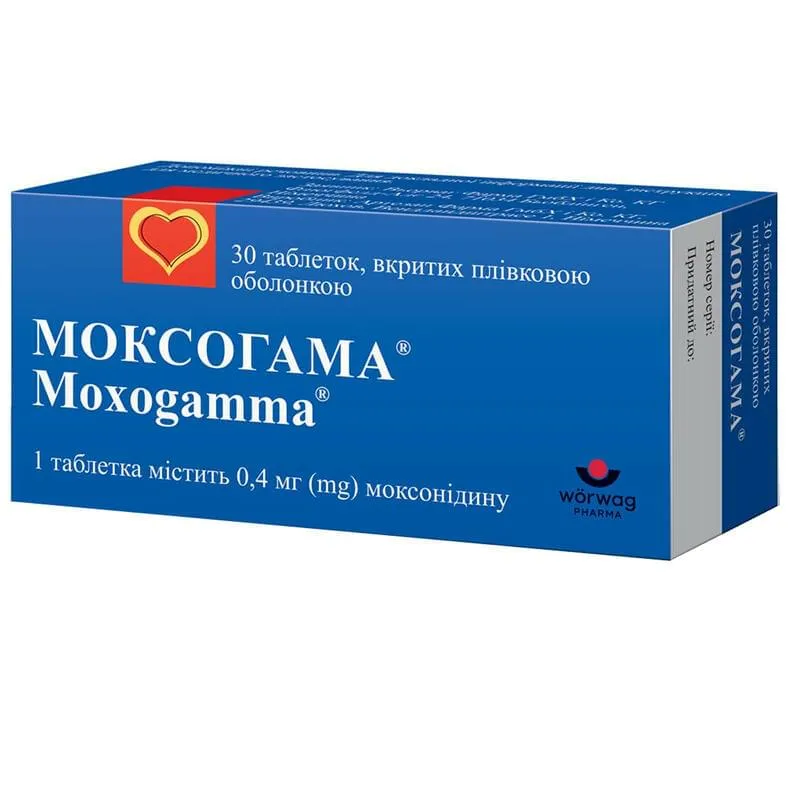
Table of Contents
INSTRUCTIONS FOR MEDICAL USE OF THE MEDICINAL PRODUCT MOXOGAMMA® (MOXOGAMMA®)
Composition:
Active substance: moxonidinum;
1 tablet contains moxonidinum 0.2 mg or 0.3 mg or 0.4 mg;
Excipients: lactose monohydrate, crospovidone, povidone K 25, magnesium stearate, Opadry® Y-1-7000 (contains hypromellose, titanium dioxide (E 171), polyethylene glycol 400), iron oxide red (E 172).
Pharmaceutical form. Film-coated tablets.
Main physico-chemical properties:
0.2 mg tablets: round film-coated tablets, light pink in colour;
0.3 mg tablets: round film-coated tablets, pink in colour;
0.4 mg tablets: round film-coated tablets, dark pink in colour.
Pharmacotherapeutic group. Antihypertensive agent. Antiadrenergic agent with central mechanism of action. Imidazoline receptor agonist.
ATC code: C02AC05.
Pharmacological properties.
Pharmacodynamics.
Moxonidine is a selective agonist of imidazoline receptors in the central nervous system.
In the brainstem, moxonidine selectively binds to imidazoline receptors. These imidazoline-sensitive receptors are located predominantly in the rostral ventrolateral portion of the medulla oblongata, a region that plays a key role in the central regulation of the sympathetic nervous system. The effect of this interaction with imidazoline receptors is a reduction in sympathetic nervous system activity and a consequent decrease in blood pressure.
Moxonidine differs from sympatholytic antihypertensive agents by its low affinity for central α-adrenergic receptors compared to its affinity for imidazoline receptors. Therefore, sedative effects and dry mouth occur rarely with moxonidine use. Moxonidine is an effective antihypertensive agent. Administration of moxonidine leads to a reduction in peripheral vascular resistance, resulting in decreased arterial blood pressure.
Pharmacokinetics.
After oral administration, moxonidine is rapidly absorbed. Approximately 90% of the administered dose is absorbed. There is no presystemic metabolism, and bioavailability is 88%.
Only about 7% of moxonidine is protein-bound in plasma.
Moxonidine is metabolized to 10–20%, primarily to 4,5-dihydromoxonidine and an aminomethanamidine derivative, via opening of the imidazoline ring. The antihypertensive effect of 4,5-dihydromoxonidine is only 1/10 that of moxonidine, and the effect of the aminomethanamidine derivative is less than 1/100 of moxonidine’s effect.
Moxonidine and its metabolites are almost entirely eliminated via the kidneys.
Over 90% of the dose is excreted within the first 24 hours through the kidneys, and approximately 1% is excreted in feces. Total excretion of unchanged moxonidine is approximately 50–75%.
The mean elimination half-life of moxonidine and its metabolites is approximately 2.5 hours and 5 hours, respectively.
In patients with moderate renal impairment (glomerular filtration rate 30–60 mL/min), clearance is reduced by up to 52%.
Pharmacokinetic studies in children have not been conducted.
Moxonidine crosses the blood-brain and placental barriers and is excreted into breast milk.
Clinical characteristics.
Indications. Mild to moderate arterial hypertension.
Contraindications.
- Hypersensitivity to any component of the drug;
- sinus node weakness syndrome or sinoatrial heart block;
- bradycardia (less than 50 beats per minute at rest);
- second- or third-degree atrioventricular block;
- heart failure.
Interaction with other medicinal products and other forms of interaction. Concomitant use of the drug with other antihypertensive agents produces an additive effect.
Since tricyclic antidepressants may reduce the effectiveness of centrally acting antihypertensive agents, concomitant use of these drugs with moxonidine is not recommended.
Moxonidine may potentiate the effects of tricyclic antidepressants (concomitant use should be avoided), tranquilizers, alcohol, sedatives, and hypnotics.
Moxonidine moderately enhances cognitive impairment in patients receiving lorazepam. It may also enhance the sedative effect of benzodiazepines when used concomitantly.
Moxonidine is eliminated via tubular secretion. Interactions with agents that are also eliminated by tubular secretion cannot be excluded.
Special precautions for use.
Moxonidine should be used with particular caution in patients with first-degree atrioventricular block to avoid bradycardia.
Moxonidine should be used cautiously in patients with severe coronary artery disease or unstable angina, as experience with the use of this drug in such patients is limited.
Caution is recommended when using moxonidine in patients with impaired renal function, as the drug is primarily excreted by the kidneys. Careful dose titration is recommended in such patients, especially at the beginning of therapy. Treatment should be initiated at a dose of 0.2 mg once daily; the dose may be increased up to a maximum of 0.4 mg once daily if clinically indicated and the drug is well tolerated.
If moxonidine is used in combination with β-adrenoblockers and both drugs need to be discontinued, the β-adrenoblocker should be withdrawn first, followed by moxonidine several days later.
To date, no rebound effects on blood pressure have been observed after discontinuation of moxonidine. However, abrupt interruption of moxonidine therapy is not recommended; instead, the dose should be gradually reduced over a period of 2 weeks.
This medicinal product must not be used in patients with rare hereditary conditions such as galactose intolerance, lactase deficiency, or glucose-galactose malabsorption.
Use during pregnancy or breastfeeding.
There are no adequate data on the use of moxonidine in pregnant women. Animal studies have shown fetal toxicity. The potential risk to humans is unknown. Moxonidine should not be used during pregnancy unless clearly necessary.
Moxonidine is excreted in breast milk and therefore should not be used during breastfeeding. If moxonidine therapy is considered necessary, breastfeeding must be discontinued.
Ability to influence reaction rate while driving or operating machinery.
Studies on the effect of the drug on the ability to drive or operate machinery have not been conducted. However, somnolence and dizziness have been reported. This should be taken into account when performing such activities.
Dosage and Administration
Adults. Treatment should be initiated with the lowest dose of moxonidine – 0.2 mg once daily. If the therapeutic effect is insufficient, the dose may be increased after 3 weeks to 0.4 mg. This dose can be taken as a single dose (in the morning) or divided into two doses (in the morning and evening). If results remain unsatisfactory after the following 3 weeks, the dose may be increased up to a maximum of 0.6 mg daily, administered in two divided doses in the morning and evening. The single dose of 0.4 mg moxonidine and the maximum daily dose of 0.6 mg must not be exceeded. The dosage should be individually adjusted according to the patient's response.
The medication can be taken independently of food intake. The tablet should be taken with sufficient fluid.
Elderly patients. If there is no renal impairment, the dosage is the same as for adults.
Renal impairment. For patients with moderate renal dysfunction (glomerular filtration rate >30 mL/min but <60 mL/min) and for patients undergoing hemodialysis, the initial dose should not exceed 0.2 mg; the dose may be increased if necessary. Moxonidine is contraindicated in patients with severe renal impairment (glomerular filtration rate <30 mL/min).
Hepatic impairment. Clinical data in patients with hepatic dysfunction are lacking. However, moxonidine is not subject to hepatic metabolism, and therefore a significant impact on its pharmacokinetics is not expected. Thus, the recommended dosage for patients with mild to moderate hepatic dysfunction is the same as for adults. The medication should not be discontinued abruptly, as rebound arterial hypertension as a "withdrawal effect" cannot be completely excluded. The treatment should be discontinued gradually over a period of 2 weeks by tapering the dose.
Children. The efficacy and safety of the drug in children have not been established; therefore, the drug should not be prescribed to this age group.
Overdose.
In isolated cases, even doses of up to 19.6 mg daily have not resulted in fatal outcomes. Symptoms of overdose may include headache, sedative effect, drowsiness, arterial hypotension, dizziness, general weakness, bradycardia, dry mouth, vomiting, upper abdominal pain, and malaise. In cases of severe overdose, careful monitoring of consciousness disturbances and particularly respiratory depression is recommended. Based on animal studies with high doses of the drug, transient arterial hypertension, tachycardia, and hyperglycemia may additionally be expected.
No specific antidotes are known. In case of arterial hypotension, dopamine and plasma expanders are recommended to support hemodynamics. Atropine may be effective in the event of bradycardia.
Alpha-adrenergic antagonists may reduce or eliminate the paradoxical hypertensive effects of moxonidine overdose.
Adverse Reactions.
The most common side effects of moxonidine include dry mouth, dizziness, somnolence, and general weakness/asthenia. These symptoms often diminish after several weeks of treatment.
Nervous system disorders: headache, dizziness/vertigo, somnolence, syncope.
Gastrointestinal disorders: dry mouth, diarrhea, nausea/vomiting, dyspepsia.
Eye and labyrinth disorders: tinnitus.
Skin and subcutaneous tissue disorders: hypersensitivity reactions, including rash, pruritus; angioneurotic edema.
Cardiovascular disorders: bradycardia, arterial hypotension (including orthostatic hypotension).
Musculoskeletal and connective tissue disorders: back pain, neck pain.
Psychiatric disorders: insomnia; restlessness.
General disorders: asthenia; edema.
Shelf life.
2 years for the 0.2 mg dosage. 3 years for the 0.3 mg and 0.4 mg dosages.
Storage conditions. Store in the original packaging at a temperature not exceeding 30 °C, in a place inaccessible to children.
Packaging. 10 film-coated tablets in a blister, 3 blisters in a cardboard box; 25 film-coated tablets in a blister, 2 blisters in a cardboard box.
Prescription category. Prescription only.
Manufacturer. Artesan Pharma GmbH & Co. KG, Germany.
Manufacturer's address and place of business. 29439, Luechow, Wendlandstrasse 1 / 29439, Luechow, Wendlandstrasse 1.