Lacidofil
Ukraine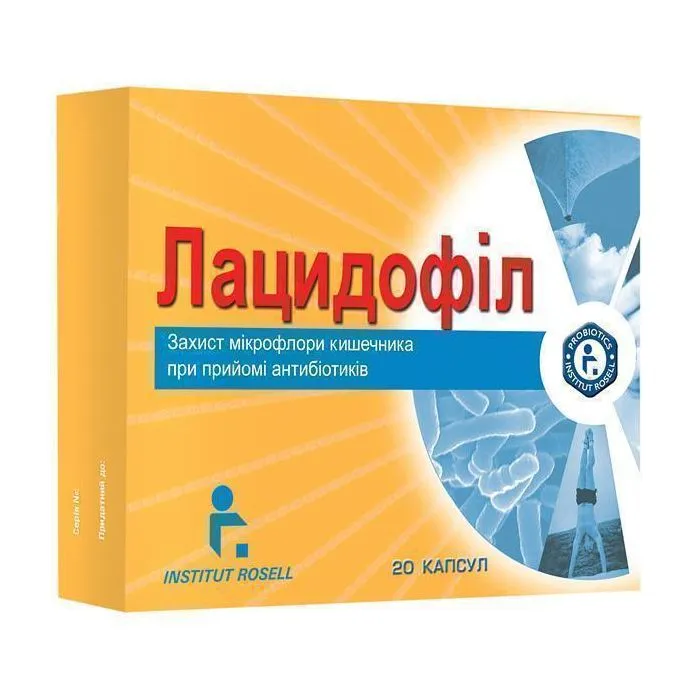
Table of Contents
INSTRUCTION FOR MEDICAL USE OF THE MEDICINAL PRODUCT Lacidofil® (Lacidofil®)
Composition:
Active substances: Lactobacillus rhamnosus R0011, Lactobacillus helveticus R0052;
1 capsule contains no less than 2 × 10⁹ CFU of lyophilized bacteria Lactobacillus rhamnosus R0011 (95%) and Lactobacillus helveticus R0052 (5%);
Excipients: maltodextrin, magnesium stearate, ascorbic acid, gelatin.
Pharmaceutical form. Capsules.
Main physicochemical properties: fine ivory-colored powder with small beige specks.
Pharmacotherapeutic group.
Antidiarrheal medicinal products. Antidiarrheal microorganisms. Lactic acid bacteria.
ATC code A07FA01.
Pharmacological properties.
Pharmacodynamics.
Lactic acid bacteria (Lactobacillus), present in the human gastrointestinal tract, are part of the natural ecological barrier. They maintain the balance of intestinal microflora, prevent the overgrowth of pathogenic putrefactive microorganisms in the intestine, and inhibit the formation and effects of certain endotoxins.
In addition, lactic acid bacteria produce hydrogen peroxide (H₂O₂), activate macrophages, and promote the production of the immunoglobulin G subclass (IgG2), thereby stimulating immune system activity. They support the synthesis of certain B-group vitamins (B₁, B₂, B₆, B₁₂, niacin, folic acid, pantothenic acid).
They positively influence intestinal peristalsis, improve protein digestion, promote lactose breakdown into glucose and galactose, and contribute to lactic acid production. They inhibit the activity of nitroreductase, azoreductase, and beta-glucuronidase, thereby reducing the production of carcinogenic amines.
Pharmacokinetics.
Lactobacillus rhamnosus R0011 and Lactobacillus helveticus R0052 are completely eliminated from the intestine within 7–15 days after administration.
Clinical characteristics.
Indications.
- Prevention of gastrointestinal microbiota disorders during and after antibiotic therapy.
- Prevention of traveler's diarrhea.
- Supportive treatment during and after antibiotic therapy.
- Recurrent pseudomembranous colitis.
Contraindications.
- Hypersensitivity to the active substances and/or excipients of the medicinal product.
- Milk or soy allergy, since traces of milk, soy, and sucrose may remain in the active substances during manufacturing.
- Lapp lactase deficiency or sucrose-isomaltase deficiency.
- Hereditary galactose intolerance, fructose intolerance, glucose-galactose malabsorption syndrome.
Interaction with other medicinal products and other forms of interaction.
Not studied.
During the post-marketing period, no interactions with other medicinal products or other types of interactions have been reported.
Special precautions for use.
Certain patient groups are more sensitive to microbial agents, particularly probiotics. These patients should consult a physician before using the medicinal product. Such groups include:
- patients with fever, vomiting, or severe abdominal pain;
- patients with acute pancreatitis and other life-threatening conditions;
- patients with central venous catheters, following surgery, especially those with myocarditis or endocarditis, or after gastrointestinal, cardiac, or oral cavity surgery (including tooth extraction), since open wounds may serve as portals of infection;
- patients with blood in stool, particularly children and elderly individuals, as compromised intestinal barriers represent potential sites through which microbes may enter the bloodstream;
- patients with severely weakened or suppressed immune systems, including allograft recipients, patients undergoing radiotherapy or chemotherapy, and those with underdeveloped immune systems, such as premature infants, patients with AIDS, lymphoma, or those receiving prolonged corticosteroid therapy;
- children with short bowel syndrome. D-lactate acidosis is a risk in children with short bowel syndrome. When administering the medicinal product to such patients, lactate levels should be monitored, and treatment should be discontinued immediately if levels increase.
The risk of complications primarily concerns weakened patients. It is important to note that lactobacillemia does not pose a health threat to humans.
Use during pregnancy or breastfeeding.
There are no data available on the use of this medicinal product during pregnancy or breastfeeding. Studies on the effect on fertility have not been conducted.
Ability to affect reaction speed when driving or operating machinery.
The medicinal product does not affect the ability to drive or operate machinery.
Dosage and Administration.
Administration method.
The medicinal product is intended for oral administration.
Take capsules with a small amount of water during a meal or within 30 minutes after a meal.
For children under 3 years of age, the capsule may be opened and its contents mixed with cool water or cool food.
Dosage.
Prevention of gastrointestinal microflora disturbances during and after antibiotic therapy, prevention of traveler's diarrhea.
Children under 4 years: administer 1 capsule daily.
Children aged 4–12 years: administer 1–2 capsules daily.
Adults and children aged 12 years and older: administer 1 capsule three times daily.
The medicinal product should be used for 10 days, starting from the first day of antibiotic therapy, or during travel.
Supportive treatment during and after antibiotic therapy, recurrent pseudomembranous colitis.
Infants under 1 year: administer 1 capsule daily.
Children aged 1–4 years: administer 1 capsule twice daily.
Children aged 4–12 years: administer 1 capsule three times daily.
Adults and children aged 12 years and older: administer 1–2 capsules three times daily.
The medicinal product should be used for at least 14 days.
Children.
The medicinal product may be administered to children from 1 month of age, following consultation with a physician.
Overdose.
No cases of overdose have been reported.
Side effects.
Very rarely, hypersensitivity reactions may occur, manifesting as allergic reactions, including rash and diarrhea. In such cases, it is recommended to discontinue use of the medicinal product until symptoms resolve.
Reporting of suspected adverse reactions.
Reporting of suspected adverse reactions following marketing authorization of the medicinal product is important. This allows continuous monitoring of the benefit-risk balance of the medicinal product. Healthcare professionals should report any suspected adverse reactions through the national pharmacovigilance system.
Shelf life.
3 years.
Storage conditions.
Store in a refrigerator at a temperature of 2 to 8 °C.
Packaging.
10 capsules in an aluminum blister pack; 2 blisters per cardboard box.
Availability.
Over-the-counter (without prescription).
Manufacturer.
Takeda Pharma Sp. z o.o.
Takeda Pharma Sp. z o.o.
Manufacturer's address and place of business.
12 Ksiestwa Lowickiego Str., 99-420 Lyszkowice, Poland
Marketing Authorization Holder.
WORLD MEDICINE, LLC, Ukraine
WORLD MEDICINE, LLC, Ukraine.