Lansoprol®
Ukraine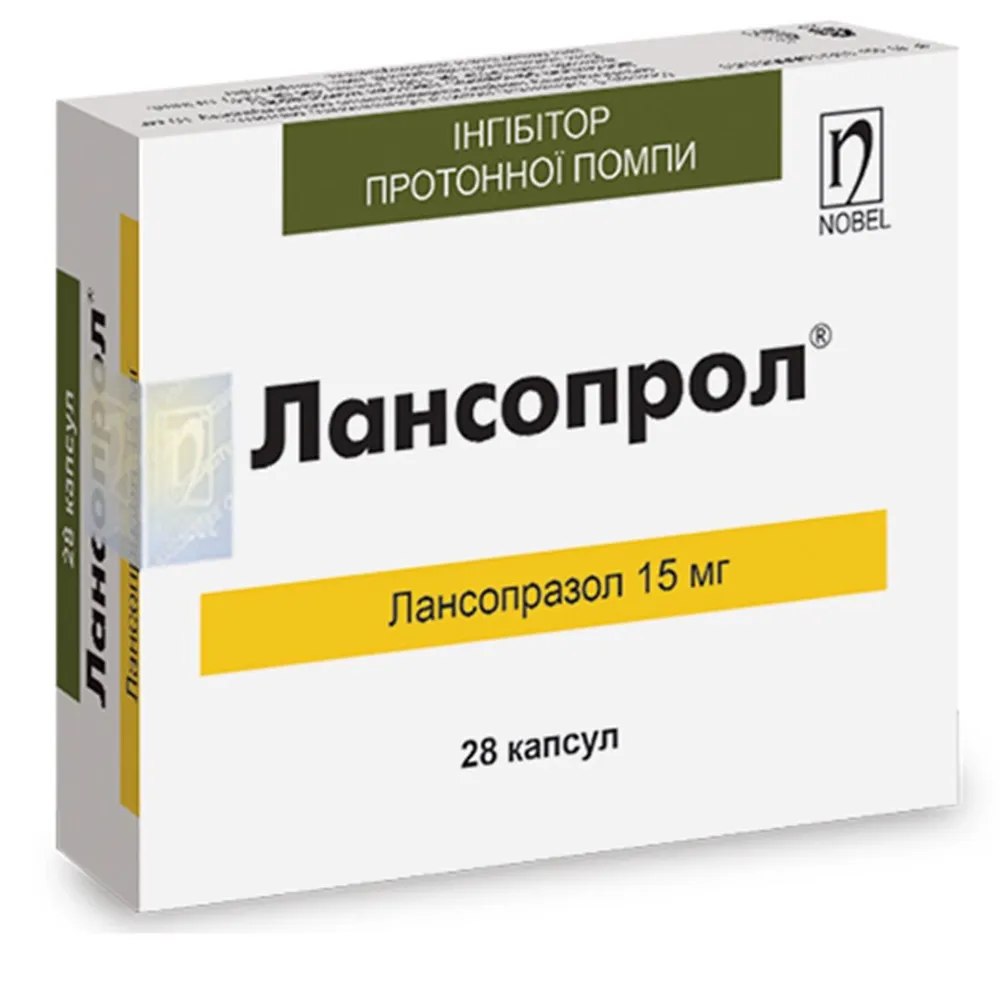
Table of Contents
INSTRUCTIONS FOR MEDICAL USE OF THE MEDICINAL PRODUCT LANSOPROL® (LANSOPROL®)
Composition:
Active substance: lansoprazole;
1 capsule contains lansoprazole 15 or 30 mg;
Excipients: spherical sugar, mannite (E 421), sodium starch glycolate (type A), light magnesium carbonate, povidone, sucrose, poloxamer, hypromellose, methacrylic acid copolymer dispersion, talc, triethyl citrate, simethicone.
Gelatin capsule No. 1 contains: titanium dioxide (E 171), iron oxide red (E 172), iron oxide yellow (E 172), patent blue V (E 131), gelatin.
Gelatin capsule No. 2 contains: titanium dioxide (E 171), iron oxide red (E 172), iron oxide yellow (E 172), gelatin.
Dosage form. Capsules.
Main physicochemical properties:
hard gelatin capsules No. 2 with orange cap and body containing spherical pellets of white or almost white color (15 mg);
hard gelatin capsules No. 1 with green cap and orange body containing spherical pellets of white or almost white color (30 mg).
Pharmacotherapeutic group.
Agents for treatment of peptic ulcer and gastroesophageal reflux disease. Proton pump inhibitors. ATC code A02BC03.
Pharmacological properties.
Pharmacodynamics.
Lansoprazole inhibits the activity of H+/K+-ATPase (proton pump) in the parietal cells of the gastric mucosa. Thus, Lansoprol**®** suppresses the final stage of gastric acid production, reduces the volume and acidity of gastric juice, thereby decreasing the harmful effect of gastric juice on the mucosa.
The degree of inhibition depends on the dose and duration of treatment. Even a single 30 mg dose of lansoprazole inhibits gastric acid secretion by 70–90%. Onset of action occurs within 1–2 hours and lasts for several days.
Pharmacokinetics.
Lansoprazole is absorbed in the intestine. In healthy volunteers, after administration of 30 mg lansoprazole, maximum plasma concentration reaches 0.75–1.15 mg/L and is achieved within 1.5–2 hours. Maximum plasma concentration and bioavailability depend on individual patient characteristics and do not change with the frequency of drug administration.
Protein binding of the drug to plasma proteins is 98%.
Lansoprazole is excreted from the body via bile and urine (only in the form of metabolites – lansoprazole sulfone and hydroxylansoprazole), with 21% of the administered dose being excreted in the urine within 24 hours. The elimination half-life is 1.5 hours.
The elimination half-life is prolonged in patients with severe hepatic impairment and in patients aged 69 years and older. In patients with renal impairment, lansoprazole absorption is virtually unchanged.
Clinical characteristics.
Indications.
Benign peptic ulcer of the stomach and duodenum, including those associated with the use of nonsteroidal anti-inflammatory drugs; gastroesophageal reflux disease; Zollinger-Ellison syndrome; for eradication of Helicobacter pylori (in combination with antibiotics).
Contraindications.
Hypersensitivity to lansoprazole or to any other component of the medicinal product; concomitant use with atazanavir; malignant neoplasms of the gastrointestinal tract.
Interaction with other medicinal products and other forms of interaction.
Lansoprazole may affect the absorption of other medicinal products whose absorption depends on gastric pH.
Concomitant use of lansoprazole and HIV protease inhibitors whose absorption depends on gastric acidity (e.g., atazanavir and nelfinavir) is not recommended due to a significant reduction in their bioavailability (see section "Special warnings and precautions for use").
In studies, concomitant administration of lansoprazole (60 mg daily) and atazanavir (400 mg) significantly reduced atazanavir exposure (approximately 90% reduction in AUC and Cmax) in healthy volunteers.
Lansoprazole, like other proton pump inhibitors, reduces the concentration of atazanavir (an HIV protease inhibitor) whose absorption depends on gastric acidity, and therefore may affect the therapeutic effect of atazanavir and lead to the development of resistance to HIV infection. Concomitant use of atazanavir and lansoprazole is contraindicated.
Lansoprazole may increase plasma concentrations of drugs metabolized by CYP3A4 (warfarin, antipyrine, indometacin, ibuprofen, phenytoin, propranolol, prednisolone, diazepam, clarithromycin, or terfenadine). Combination of lansoprazole with medicinal products that depend on CYP3A4 metabolism and have a narrow therapeutic index should be prescribed with caution.
Medicinal products that inhibit CYP2C19 (fluvoxamine) cause a significant increase (4-fold) in lansoprazole plasma concentration. Dose adjustment of lansoprazole is required when used concomitantly.
Inducers of CYP2C19 and CYP3A4 (rifampicin, St. John's wort) may significantly reduce lansoprazole plasma concentrations. Dose adjustment of lansoprazole is required when used concomitantly.
Concomitant use of lansoprazole with high doses of methotrexate has led to increased and prolonged methotrexate serum concentrations, which may result in methotrexate toxicity.
Lansoprazole causes prolonged inhibition of gastric acid secretion; therefore, a theoretical impact of lansoprazole on the bioavailability of drugs whose absorption is pH-dependent (ketoconazole, itraconazole, ampicillin esters, iron salts, digoxin) is possible.
Absorption of ketoconazole and itraconazole increases due to gastric acid. Concomitant use with lansoprazole may affect their bioavailability. Therefore, such combination should be avoided.
Concomitant use of lansoprazole and digoxin may increase digoxin plasma levels. Therefore, careful monitoring of digoxin plasma levels and dose adjustment of digoxin, if necessary, is required at the beginning and after discontinuation of lansoprazole treatment.
No clinical manifestations of interactions between lansoprazole and amoxicillin have been observed.
Sucralfate and antacids may reduce lansoprazole bioavailability; therefore, lansoprazole should be taken at least 1 hour after administration of these agents.
No clinically significant interaction between lansoprazole and nonsteroidal anti-inflammatory drugs has been identified.
When lansoprazole is used concomitantly with theophylline (CYP1A2, CYP3A), a moderate increase (up to 10%) in theophylline clearance has been observed, but the clinical significance of this interaction is unlikely. However, to maintain clinically effective theophylline concentrations, dose adjustment of theophylline may be required in some patients at the beginning or after discontinuation of lansoprazole treatment.
Elevations in INR (international normalized ratio) and prothrombin time have been reported with concomitant use of proton pump inhibitors and warfarin. Increased INR and prothrombin time may lead to bleeding and even fatal outcomes. When lansoprazole is used concomitantly with warfarin, close monitoring of INR and prothrombin time is required.
When lansoprazole is used concomitantly with tacrolimus [a substrate of CYP3A and P-glycoprotein (Pgp)], plasma concentrations of tacrolimus may increase by up to 81%, especially in transplant patients. Therefore, tacrolimus plasma levels should be monitored at the start and after discontinuation of combination therapy with lansoprazole. In vitro studies indicate that lansoprazole inhibits transport proteins, including Pgp. The clinical significance of this phenomenon is unknown.
Special precautions for use.
Before prescribing the medicinal product Lanzoprol®, it is necessary to exclude the possibility of malignant tumors in the stomach and esophagus, as the drug may mask symptoms and thereby delay correct diagnosis. Therefore, endoscopic monitoring with biopsy should be performed before starting and after completing the course of treatment with lansoprazole.
Lansoprazole, like other proton pump inhibitors, may increase the number of microorganisms present in the gastrointestinal tract. This increases the risk of gastrointestinal infections caused by opportunistic pathogens such as Salmonella, Campylobacter, and Clostridium difficile, particularly in hospitalized patients.
Concomitant use of lansoprazole and HIV-protease inhibitors is not recommended. Since the concentration of atazanavir and nelfinavir depends on gastric acidity, their bioavailability may be significantly reduced (see section "Interaction with other medicinal products and other types of interactions"). If concomitant use of lansoprazole with HIV-protease inhibitors is necessary, careful monitoring of the patient's condition is recommended.
Severe hypomagnesemia has been observed in patients treated with proton pump inhibitors such as lansoprazole for at least three months (in most cases, after one year). Severe manifestations of hypomagnesemia may include fatigue, muscle spasms, delirium, convulsions, dizziness, and ventricular arrhythmia, and may develop suddenly. In most patients, symptoms of hypomagnesemia resolved after magnesium replacement therapy and discontinuation of the proton pump inhibitor.
If a patient is receiving long-term therapy or is taking proton pump inhibitors concomitantly with digoxin or other medicinal products that may cause hypomagnesemia (e.g., diuretics), consideration should be given to measuring magnesium levels before initiating proton pump inhibitor therapy and periodically during treatment.
Increased serum chromogranin A (CgA) levels may affect the results of neuroendocrine tumor testing. To avoid this effect, lansoprazole therapy should be discontinued at least 5 days before CgA level assessment. Temporary discontinuation of proton pump inhibitor therapy for at least 14 days before CgA measurement is required when repeating the test if initial CgA and gastrin levels are elevated.
Long-term daily use of any medicinal product that suppresses gastric acid secretion (e.g., for several years) may lead to malabsorption of cyanocobalamin (vitamin B12), and hypo- or achlorhydria. This should be considered when treating patients with Zollinger-Ellison syndrome or other hypersecretory conditions requiring long-term therapy, underweight patients, or those with risk factors for reduced vitamin B12 absorption (e.g., elderly patients), during prolonged therapy or if clinical symptoms associated with cyanocobalamin deficiency occur.
Lansoprazole reduces gastric juice acidity, thereby increasing the risk of gastrointestinal infections caused by opportunistic pathogens such as Salmonella and Campylobacter.
When treating patients with gastric or duodenal ulcers, H. pylori infection should be considered as a possible etiological factor. If lansoprazole is used in combination with antibiotics for H. pylori eradication therapy, the instructions for medical use of these antibiotics should be followed.
Due to limited safety data on the use of lansoprazole as maintenance therapy for longer than 1 year, the benefit-risk ratio should be regularly evaluated in this patient group.
In isolated cases, colitis may occur during lansoprazole use. Therefore, treatment should be discontinued immediately if patients develop acute or persistent diarrhea.
Except in cases of Helicobacter pylori eradication, lansoprazole therapy should be immediately discontinued in cases of severe persistent diarrhea, as there is a risk of developing microscopic colitis with collagenous thickening or inflammatory cell infiltration of the submucosa of the large intestine.
Treatment and prevention of peptic ulcer should be limited to patients requiring long-term nonsteroidal anti-inflammatory drug (NSAID) therapy or those at risk, such as patients with a history of gastrointestinal bleeding, perforation, or ulcers; elderly patients; patients receiving concomitant medications that increase the risk of upper gastrointestinal disorders (corticosteroids or anticoagulants); patients with severe comorbid conditions; or those on prolonged treatment with maximum recommended NSAID doses.
Proton pump inhibitors, particularly when used at high doses and for prolonged periods (more than 1 year), are associated with a slightly increased risk of fractures of the hip, wrist, or spine, especially in elderly patients or those with other defined risk factors. Experimental study results indicate that proton pump inhibitors may increase the overall fracture risk by 10–40%. Some of these cases may be attributable to other risk factors. Patients at risk of osteoporosis should be monitored according to current clinical guidelines and should consume adequate amounts of calcium and vitamin D.
Subacute cutaneous lupus erythematosus. The use of proton pump inhibitors has been associated with very rare cases of subacute cutaneous lupus erythematosus. If skin lesions develop, particularly in sun-exposed areas, and are accompanied by arthralgia, the patient should seek immediate medical attention, and discontinuation of lansoprazole should be considered. Development of subacute cutaneous lupus erythematosus during prior proton pump inhibitor therapy increases the risk of recurrence with other proton pump inhibitors.
When using combination therapy with clarithromycin and amoxicillin, the warnings provided in the medical instructions for clarithromycin and amoxicillin should be considered. Prior to initiating amoxicillin and clarithromycin, the presence of a history of hypersensitivity reactions to penicillins, cephalosporins, or other allergens should be assessed.
In patients with renal impairment, protein binding in blood is reduced by 1–1.5%.
Lansoprazole should be administered with caution in patients with moderate to severe hepatic impairment.
In patients with chronic hepatic impairment, plasma half-life increases from 1.5 hours to 3.2–7.2 hours, depending on the degree of liver dysfunction. Dose reduction is recommended in patients with severe hepatic impairment. Treatment should begin with half the recommended dose, gradually increasing to the standard doses, but not exceeding 30 mg per day.
Renal function impairment
Acute tubulointerstitial nephritis has been observed in patients taking lansoprazole and may occur at any time during lansoprazole therapy (see section "Adverse reactions"). Acute tubulointerstitial nephritis may progress to renal failure.
Lansoprazole should be discontinued if acute tubulointerstitial nephritis is suspected, and appropriate treatment should be initiated immediately.
Elderly patients.
Ulcer treatment in elderly patients does not differ significantly from treatment in younger patients. Adverse reactions and laboratory changes in elderly patients are similar to those in younger patients.
The medicinal product contains sucrose. Patients with rare hereditary fructose intolerance, glucose-galactose malabsorption syndrome, or sucrase-isomaltase deficiency should not use this product.
Use during pregnancy or breastfeeding.
The drug should not be used during pregnancy or breastfeeding.
If use of the drug is necessary, breastfeeding should be discontinued.
Ability to affect reaction speed when driving or operating machinery.
When driving or operating machinery, the possibility of adverse reactions affecting the nervous system and visual organs, such as dizziness, vertigo, visual disturbances, and somnolence, should be considered. In such conditions, reaction ability may be impaired.
Method of Administration and Dosage
Administered orally to adults. The usual dose is 30 mg once daily, taken 30–40 minutes before a meal. Capsules should be swallowed whole with 150–200 ml of water, without chewing. If this is not possible, the capsule may be opened, its contents mixed with a small amount of apple juice (approximately one full spoonful), and immediately swallowed without chewing. The same procedure should be followed if the drug is administered through a nasogastric tube.
Dosage and duration of treatment are determined by a physician depending on the clinical condition and course of the disease.
The maximum daily dose of the drug is 60 mg; for patients with impaired liver function – 30 mg. For patients with Zollinger–Ellison syndrome, doses may be increased.
If two daily doses are required, the patient should take one dose before breakfast and the second before dinner.
If the patient misses a dose at the scheduled time, they should take it as soon as possible. However, if little time remains before the next scheduled dose, the patient should not take the missed dose.
Peptic Ulcer of the Duodenum
The dose for treatment of active ulcer is 30 mg once daily for 2–4 weeks. The dose for treatment of ulcers caused by nonsteroidal anti-inflammatory drugs (NSAIDs) is 30 mg once daily. Treatment lasts 4–8 weeks.
The dose for prevention of ulcers caused by long-term NSAID therapy in high-risk patients (age over 65 years or history of gastritis or duodenal ulcer) is 15 mg per day. If treatment is ineffective, a dose of 30 mg per day is prescribed.
Benign Gastric Ulcer
The dose for treatment of active ulcer is 30 mg once daily for 8 weeks. The dose for treatment of ulcers caused by NSAIDs is 30 mg once daily for 4–8 weeks.
The dose for prevention of ulcers caused by long-term NSAID therapy in high-risk patients (age over 65 years or history of gastritis or duodenal ulcer) is 15 mg per day. If treatment is ineffective, a dose of 30 mg per day is prescribed.
Gastroesophageal Reflux Disease, Reflux Esophagitis
The recommended dose for treatment of gastroesophageal reflux disease is 15–30 mg daily. Symptom relief occurs rapidly. Individual dose adjustment should be considered. If symptoms do not improve within 4 weeks with a dose of 30 mg daily, additional diagnostic tests are recommended.
For moderate to severe esophagitis, the recommended dose is 30 mg once daily for 4 weeks. If erosive esophagitis is not healed within 4 weeks, the treatment duration may be doubled.
The dose for long-term prevention of recurrence of erosive esophagitis is 15–30 mg once daily. The safety and efficacy of maintenance therapy with lansoprazole have been confirmed for up to 12 months of treatment.
Helicobacter pylori Eradication
The dose is 30 mg of the drug twice daily (before breakfast and before dinner). The patient should take the drug in combination with antibiotics according to approved regimens for 1–2 weeks.
Zollinger–Ellison Syndrome
The physician adjusts the dose individually to ensure that basal acid secretion does not exceed 10 mmol/h. The recommended initial dose is 60 mg once daily before breakfast. If the patient requires doses exceeding 120 mg, they should take the first half of the daily dose before breakfast and the second half before dinner. Treatment continues until clinical indications resolve.
Renal and Hepatic Impairment
Patients with mild to moderate impairment of liver or kidney function do not require dose adjustment.
Patients with severe liver function impairment should receive the lowest effective doses of the drug, not exceeding 30 mg per day.
Elderly Patients
No dose adjustment is required when using the drug in elderly patients.
Children.
Not recommended for use in children.
Overdose.
Symptoms of lansoprazole overdose in humans are unknown (although acute toxicity is expected to be low). However, during studies, administration of daily doses up to 180 mg orally or up to 90 mg intravenously did not result in adverse reactions. In case of overdose, the manifestations of adverse reactions may be intensified (see section "Adverse Reactions").
In case of overdose, patient monitoring is required. Hemodialysis is ineffective. To reduce drug absorption, activated charcoal should be administered. In case of excessive intake, symptomatic and supportive treatment should be provided.
Side effects.
Side effects are listed by organ system and categorized by frequency of occurrence:
common (≥1/100, <1/10); uncommon (≥1/1000, <1/100); rare (≥1/10000, <1/1000); very rare (<1/10000); not known (cannot be estimated from available data).
| Common |
Uncommon |
Rare |
Very rare |
Unknown |
|
| Blood and lymphatic system disorders |
Thrombocytopenia, eosinophilia, leukopenia |
Anemia |
Agranulocytosis, pancytopenia |
||
| Metabolism and nutrition disorders |
Hypomagnesemia (see section "Special precautions") |
||||
| Psychiatric disorders |
Depression |
Insomnia, hallucinations, confusion |
Visual hallucinations |
||
| Nervous system disorders |
Headache, dizziness |
Increased irritability, vertigo, paraesthesia, somnolence, tremor |
|||
| Eye disorders |
Visual disturbances |
||||
| Gastrointestinal disorders |
Vomiting, diarrhoea, abdominal pain, constipation, vomiting, flatulence, dry mouth/thirst, fundic gland polyps (benign) |
Glossitis, candidiasis of gastrointestinal mucosa, pancreatitis, taste alterations |
Colitis, stomatitis |
||
| Hepatobiliary disorders |
Elevated liver enzymes |
Hepatitis, jaundice |
|||
| Skin and subcutaneous tissue disorders |
Urticaria, pruritus, rash |
Petechiae, purpura, alopecia, erythema multiforme, photosensitivity |
Stevens-Johnson syndrome, toxic epidermal necrolysis |
Subacute cutaneous lupus erythematosus (see section "Special precautions") |
|
| Musculoskeletal and connective tissue disorders |
Arthralgia, myalgia, fractures of femur, wrist or spine (see section "Special precautions") |
||||
| Renal and urinary disorders |
Tubulointerstitial nephritis (with possible progression to renal failure) |
||||
| Reproductive system and breast disorders |
Gynaecomastia |
||||
| General disorders |
Increased fatigue |
Angioedema |
Fever, hyperhidrosis, angioedema, anorexia, impotence |
Anaphylactic shock |
|
| Investigations |
Elevated cholesterol and triglyceride levels, hyponatremia |
Reporting of suspected adverse reactions.
Reporting of suspected adverse reactions after marketing authorization of the medicinal product is of great importance. It enables continuous monitoring of the benefit-risk balance of the medicinal product. Healthcare professionals should report any suspected adverse reactions through the national reporting system.
Shelf life. 3 years.
Storage conditions.
Store at temperatures not exceeding 25 °C in the original packaging.
Keep out of reach of children.
Packaging.
7 capsules in a blister, 2 or 4 blisters per cardboard package.
14 capsules in a blister, 1 or 2 blisters per cardboard package.
4 capsules in a blister, 1 blister per cardboard package.
Prescription status. Prescription only.
Manufacturer. NOBEL ILAC SANAYI VE TICARET A.S.
Manufacturer's address and site of manufacturing activity.
Sankaklar Quarter, Eski Akcakoca Avenue, No. 299, 81100, Duzce, Turkey.