Cloveit
Ukraine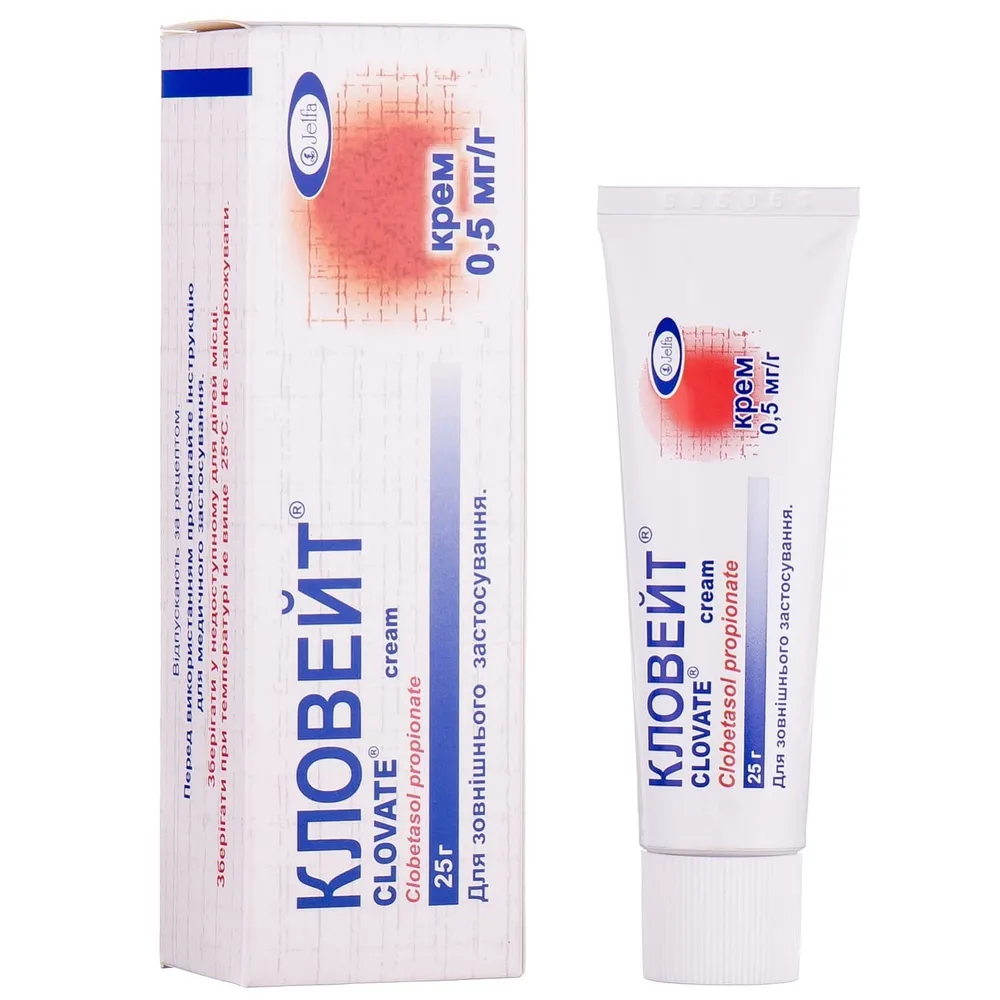
Table of Contents
INSTRUCTIONS FOR MEDICAL USE OF THE MEDICINAL PRODUCT CLOVATE® (CLOVATE®)
Composition:
Active substance: clobetasol;
1 g of cream contains clobetasol propionate 0.5 mg;
Excipients: propylene glycol; disodium edetate; chlorocresol; mineral oil; white soft paraffin; glycerol monostearate; cetylstearyl alcohol; polysorbate 40; medium-chain triglycerides; sodium citrate; citric acid monohydrate; colloidal anhydrous silicon dioxide; purified water.
Pharmaceutical form. Cream.
Main physicochemical properties: homogeneous white mass with a weak characteristic odor.
Pharmacotherapeutic group. Corticosteroids for topical use.
ATC code: D07AD01.
Pharmacological Properties
Pharmacodynamics
The primary effect of clobetasol propionate on the skin is a nonspecific anti-inflammatory action due to vasoconstriction and reduced collagen synthesis.
Pharmacokinetics
Skin penetration of clobetasol propionate varies among individuals and may increase with the use of occlusive dressings or in the presence of inflamed or damaged skin. In individuals with healthy skin, mean peak plasma concentrations of clobetasol propionate of 0.63 ng/mL may be observed 8 hours after the second application (13 hours after the first application) of 30 g of 0.05% clobetasol propionate ointment. After application of a second dose of 30 g of 0.05% clobetasol propionate cream, mean peak plasma concentrations may be slightly higher than with the ointment and may occur at 10 hours. Other peak concentrations (approximately 2.3 ng/mL and 4.6 ng/mL) may be observed at 3 hours after a single application of 25 g of 0.05% clobetasol propionate ointment in patients with psoriasis and eczema, respectively. Following absorption through the skin, the drug is likely to undergo the same metabolic pathway as corticosteroids administered systemically. However, the systemic metabolism of clobetasol has not been fully elucidated.
Clinical Characteristics.
Indications.
Psoriasis (except widespread plaque psoriasis), recalcitrant eczema, lichen planus, discoid lupus erythematosus, and other skin disorders unresponsive to treatment with less potent corticosteroids.
Contraindications.
Untreated skin infections.
Rosacea.
Common acne.
Pruritus without inflammation.
Perianal and genital pruritus.
Perioral dermatitis.
Hypersensitivity to components of the medicinal product.
Clobetasol is not intended for the treatment of primarily infected skin lesions caused by fungi (e.g., candidiasis, tinea) or bacterial microorganisms (e.g., impetigo), dermatitis, or diaper rash.
Interaction with other medicinal products and other forms of interaction.
Concomitant use with agents that may inhibit CYP3A4 (e.g., ritonavir, itraconazole) has been shown to inhibit corticosteroid metabolism, potentially leading to systemic effects. The clinical significance of such an interaction depends on the dose of the drug, the route of administration of the corticosteroid, and the potency of the CYP3A4 inhibitor.
Special precautions for use
The drug should be used with caution in patients with a history of local hypersensitivity reactions to corticosteroids or any of the excipients. Local hypersensitivity reactions (see section "Side effects") may resemble symptoms of the disease being treated. Manifestations of hypercorticism (Cushing's syndrome) and reversible suppression of the hypothalamic-pituitary-adrenal (HPA) axis with adrenal insufficiency in some individuals may result from increased systemic absorption of topical corticosteroids. If any of the above symptoms occur, treatment should be gradually discontinued by reducing the frequency of application or switching to a less potent corticosteroid. Abrupt discontinuation of treatment may lead to glucocorticosteroid insufficiency (see section "Side effects").
Cloveyt® cream contains:
- Propylene glycol, which may cause skin irritation;
- Cetostearyl alcohol, which may cause local skin reactions (e.g., contact dermatitis);
- Chlorocresol, which may cause allergic reactions.
Risk factors for systemic effects include:
- Potency and formulation of the topical corticosteroid;
- Duration of treatment;
- Application over a large skin surface area;
- Use on skin surfaces in close contact (e.g., intertriginous areas) or under occlusive dressings (in infants, diapers may act as occlusive dressings);
- Increased hydration of the stratum corneum;
- Application to areas with thin skin, such as the face;
- Application to damaged skin or under other conditions involving impaired skin barrier function.
Compared to adults, children may absorb a proportionally greater amount of topical corticosteroid and are therefore more susceptible to systemic side effects. This is due to children's underdeveloped skin barrier and larger skin surface area relative to body weight compared to adults.
Children
Prolonged use of topical corticosteroids in children aged 1 to 12 years should be avoided whenever possible, as they have a higher risk of developing adrenal suppression.
Children are more susceptible to developing atrophic changes when using topical corticosteroids. If Cloveyt® is required for treatment of children, therapy should be limited to several days and reviewed weekly.
Infection risk with occlusive dressings
The risk of bacterial infections increases in warm and moist environments, such as those under occlusive dressings. Therefore, the skin should be thoroughly cleaned before applying a new dressing.
Treatment of psoriasis
Topical corticosteroids should be used with caution in the treatment of psoriasis, as in some cases, relapses, development of tolerance, risk of generalized pustular psoriasis, and symptoms of local or systemic toxicity due to impaired skin barrier function have been reported. When used for psoriasis treatment, the patient should remain under close medical supervision.
Concomitant infections
When treating infected inflammatory lesions, appropriate antibacterial therapy should be prescribed. If infection spreads, topical corticosteroids should be discontinued and appropriate antibacterial treatment initiated.
Chronic leg ulcers
Topical corticosteroids may occasionally be used to treat dermatitis occurring around chronic leg ulcers. However, such use is associated with an increased incidence of local hypersensitivity reactions and a higher risk of local infections.
Application of cream to the face
Application of cream to facial skin is not recommended, as atrophic changes occur more frequently in this area. If necessary, use should be limited to a few days.
Application to eyelids
When applying cream to the eyelids, care should be taken to avoid contact with the eyes, as repeated exposure may lead to cataracts and glaucoma.
Visual disturbances
Visual disturbances may occur with systemic and topical corticosteroid use. If a patient experiences symptoms such as blurred vision or other visual disturbances, an ophthalmologist should be consulted to identify possible causes, including cataract, glaucoma, or rare conditions such as central serous chorioretinopathy (CSCR), which have been reported following systemic and topical corticosteroid use.
Cases of severe osteonecrotic infections (including necrotizing fasciitis) and systemic immunosuppression (sometimes leading to reversible Kaposi's sarcoma lesions) have been reported with prolonged use of clobetasol propionate exceeding recommended doses (see section "Method of administration and dosage"). In some cases, patients were concurrently using other potent oral/topical corticosteroids or immunosuppressants (e.g., methotrexate, mycophenolate mofetil). If treatment with topical corticosteroids is clinically justified for longer than 4 weeks, consideration should be given to switching to a less potent corticosteroid.
Use during pregnancy or breastfeeding
Pregnancy
Data on the use of Cloveyt® in pregnant women are limited.
Topical administration of corticosteroids to pregnant animals has resulted in fetal developmental abnormalities. The relevance of these findings to humans is unknown. Cloveyt® should be used during pregnancy only if the expected benefit to the mother outweighs the potential risk to the fetus. The minimum effective amount should be used for the shortest possible duration.
Breastfeeding
The safety of clobetasol propionate during breastfeeding has not been established. It is unknown whether topical corticosteroids can be systemically absorbed to an extent that leads to measurable levels in breast milk. Cloveyt® should be used during breastfeeding only if the expected benefit to the mother outweighs the potential risk to the infant. If used during breastfeeding, the cream should not be applied to the breasts to avoid accidental oral exposure of the infant.
Ability to affect reaction speed when driving or operating machinery
No studies have been conducted to assess this effect. Given the side effect profile, no influence on reaction speed when driving or operating machinery is expected.
Method of Administration and Dosage.
Clobetasol propionate belongs to the class of the most potent topical corticosteroids (Group IV), and prolonged use may lead to serious adverse effects (see section "Special Warnings and Precautions for Use"). If treatment with a topical corticosteroid is clinically justified beyond 4 weeks, consideration should be given to switching to a less potent corticosteroid. Repeated, but short courses of clobetasol propionate may be used to control exacerbations (see details below).
The cream is particularly suitable for treating moist or weeping skin lesions.
The cream should be applied in a thin layer to affected areas of the skin once or twice daily until improvement occurs. As with other highly potent corticosteroids, treatment should be discontinued once disease control is achieved. The time to response varies individually: in patients who respond well, improvement may be seen within a few days. Treatment is recommended not to exceed 4 weeks; if no improvement is observed, the diagnosis should be reconsidered.
To prevent disease relapse, repeated short courses of treatment with Clovate® may be used. If long-term continuous steroid therapy is required, alternative, less potent corticosteroid agents should be considered.
For particularly resistant lesions, especially in areas of hyperkeratosis, the anti-inflammatory effect of Clovate® may be enhanced, if necessary, by covering the affected area with polyethylene film. For optimal results, apply an occlusive dressing overnight. Once improvement is achieved, maintain the response by simple application of the cream without occlusion.
Children.
The medicinal product is contraindicated for the treatment of dermatoses, including dermatitis, in children under 1 year of age.
Overdose.
Symptoms.
With regular use, Clovate® may be absorbed in amounts sufficient to produce systemic effects. The likelihood of acute overdose is very low; however, with chronic overdose or improper use, signs of hypercortisolism may occur.
Treatment.
In case of overdose, Clovate® should be gradually withdrawn by reducing the frequency of cream application or by replacing it with a less potent corticosteroid to avoid the risk of glucocorticoid insufficiency.
Further management should be based on the patient's clinical condition or according to national guidelines for the treatment of poisoning, if applicable.
Adverse reactions.
Infections and infestations: opportunistic infections.
Immune system disorders: local hypersensitivity.
Endocrine system disorders: suppression of the hypothalamic-pituitary-adrenal (HPA) axis: Cushingoid features (e.g., moon face, central obesity), growth retardation/weight gain in children, osteoporosis, glaucoma, hyperglycemia/glucosuria, cataract, hypertension, weight gain/obesity, decreased levels of endogenous cortisol, alopecia, brittle hair.
Skin and subcutaneous tissue disorders: pruritus, local burning sensation/pain in the skin, local skin atrophy*, atrophic striae*, telangiectasia*, skin thinning*, skin wrinkling*, skin dryness*, pigmentary changes*, hypertrichosis, exacerbation of underlying symptoms, allergic contact dermatitis/dermatitis, pustular psoriasis, erythema, rash, urticaria.
Vision disorders: blurred vision (see section "Special precautions"). If topical application involves use on eyelid skin, glaucoma or cataract may occur.
General disorders and administration site conditions: irritation/pain at the application site.
*Skin disorders secondary to local and/or systemic hypothalamic-pituitary-adrenal suppression.
Shelf life. 3 years.
Storage conditions. Store at temperatures not exceeding 25 °C. Do not freeze.
Packaging. 25 g of cream in a tube.
Prescription status. Prescription only.
Manufacturer.
Elfa Pharmaceutical Works A.T., Poland.
Manufacturer's address and place of business.
58-500 Jelenia Góra, ul. Władysława Pola 21, Poland.