Ketosteril
Ukraine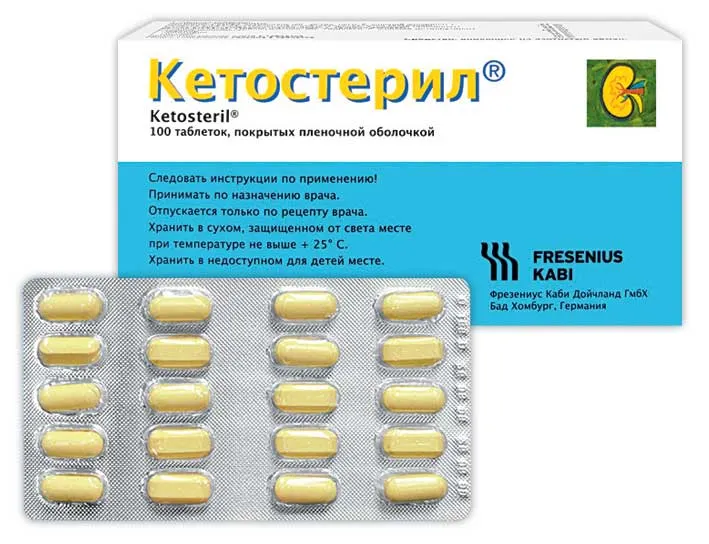
Table of Contents
INSTRUCTIONS for medical use of the medicinal product KETOSTERIL (KETOSTERIL®)
Composition:
active substances: 1 tablet contains
| α-Ketoisoleucine, calcium salt α-Ketoleucine, calcium salt α-Ketophenylalanine, calcium salt α-Ketovaline, calcium salt α-Hydroxymethionine, calcium salt Lysine acetate, corresponding to 75 mg Lysine Threonine Tryptophan Histidine Tyrosine |
67 mg 101 mg 68 mg 86 mg 59 mg 105 mg 53 mg 23 mg 38 mg 30 mg; |
| Total nitrogen content per tablet Calcium content per tablet |
36 mg 1.25 mmol = 50 mg |
| Excipients: maize starch, crospovidone, talc, colloidal anhydrous silicon dioxide, magnesium stearate, polyethylene glycols (macrogols), quinoline yellow (E 104), acrylic copolymer, triacetin, titanium dioxide (E 171), povidone. |
|
Dosage form. Film-coated tablets.
Basic physicochemical properties: yellow tablets with a glossy surface.
Pharmacotherapeutic group. Amino acids, including combinations with polypeptides.
ATC code V06D D.
Pharmacological Properties.
Pharmacodynamics.
Ketosteril is a combination medication for the treatment of renal insufficiency, containing keto analogues of amino acids. It improves nitrogen metabolism, promotes protein anabolism, reduces the severity of uremic symptoms, and improves the condition of patients with chronic kidney disease.
After absorption, keto analogues are transaminated into the corresponding essential amino acids by utilizing nitrogen from nonessential amino acids, thereby reducing urea formation through reuse of amino groups. The drug promotes the utilization of nitrogen-containing metabolic waste products.
When used in combination with a low-protein diet, Ketosteril allows for reduced nitrogen intake while simultaneously preventing the harmful consequences of inadequate dietary protein intake and malnutrition, providing the body with necessary amino acids at minimal nitrogen load. The keto analogues of essential amino acids contained in the formulation provide complete substrate support for protein synthesis.
Keto/amino acids do not induce hyperfiltration of residual nephrons. Ketosteril improves nitrogen metabolism and reduces blood concentrations of potassium, magnesium, and phosphate ions, exerting a beneficial effect in renal hyperphosphatemia and secondary hyperparathyroidism.
With regular use of Ketosteril, improvement in the condition of patients with chronic renal insufficiency has been observed. In some cases, Ketosteril delays the need for initiating dialysis.
Pharmacokinetics.
The plasma kinetics of amino acids and their integration into metabolic pathways are well understood. In uremic patients, altered plasma amino acid levels, which are frequently observed, are not due to impaired absorption of administered amino acids—absorption itself is not impaired. Altered plasma levels related to post-absorptive kinetic disturbances may be detected at a very early stage of the disease.
In healthy individuals, plasma levels of keto acids increase within 10 minutes after oral administration, reaching a peak increase of up to 5-fold above baseline levels. Peak concentrations are observed within 20–60 minutes, and by 90 minutes, levels stabilize back to baseline range. Thus, gastrointestinal absorption is very rapid. Concurrent increases in keto acid and corresponding amino acid levels indicate that keto acids are rapidly transaminated. Due to the physiological pathways of keto acid utilization in the body, exogenous keto acids are likely integrated very quickly into metabolic cycles. Keto acids undergo the same catabolic pathways as classical amino acids. Specific excretion studies of keto acids have not yet been conducted.
Clinical characteristics.
Indications.
Prevention and treatment of disorders caused by altered or insufficient protein metabolism in chronic renal insufficiency, in combination with restricted dietary protein intake up to 40 g per day (for adults) and less. To be used in patients with glomerular filtration rate (GFR) less than 25 ml/min.
Contraindications.
Hypersensitivity to the components of the drug. Hypercalcemia, disturbances of amino acid metabolism.
Interaction with other medicinal products and other forms of interaction.
Concomitant administration of medicinal products containing calcium may lead to increased serum calcium levels.
Medicinal products forming poorly soluble compounds with calcium, such as tetracyclines, quinolones (e.g., ciprofloxacin and norfloxacin), and medicinal products containing iron, fluoride, or estramustine, should not be taken simultaneously with Ketosteril in order to avoid impaired absorption of active substances; therefore, at least two hours should elapse between the administration of Ketosteril and these drugs.
Sensitivity to cardioactive glycosides and, consequently, the risk of arrhythmia, may increase if Ketosteril causes elevated serum calcium levels. During treatment with Ketosteril, symptoms of uremia decrease. Therefore, the possible administration of aluminum hydroxide should also be reduced. Serum phosphate levels should be monitored and their reduction controlled.
Special precautions for use.
Regular monitoring of serum calcium levels is necessary.
Ketosteril should be taken during meals to ensure better absorption and conversion into the corresponding amino acids. Adequate caloric intake should be ensured, approximately 30–40 kcal/kg/day.
In patients with phenylketonuria, it should be noted that the drug contains phenylalanine.
Depending on the degree of reduction of uremic symptoms under the influence of Ketosteril, the dose of concomitantly prescribed aluminum hydroxide should be reduced.
Monitoring of serum phosphate levels is required.
Use during pregnancy or breastfeeding.
There is insufficient experience with the use of Ketosteril during pregnancy and breastfeeding. Reproductive toxicity studies do not indicate any direct or indirect harmful effects on pregnancy, fetal development, delivery, or the postnatal period. Nevertheless, Ketosteril should be used with caution during pregnancy.
Ability to affect reaction rate when driving or operating machinery.
No effect.
Dosage and Administration.
The drug is administered orally. Unless otherwise prescribed, Ketosteril should be taken at a dose of 1 tablet per 5 kg of body weight/day (0.1 g/kg body weight/day), or 4–8 tablets (dose calculated for a patient weighing 70 kg) three times daily during meals.
Tablets should be swallowed whole without chewing. Ketosteril should be administered concurrently with a low-protein diet (protein restriction in the diet to 40 g or less per day).
Children. There is no experience with use in children; therefore, the drug is not recommended for this patient group.
Overdose.
There have been no reports of overdose.
Side effects
Side effects are classified by frequency as follows: very common (≥ 1/10), common (> 1/100, < 1/10), uncommon (> 1/1000, < 1/100), rare (> 1/10,000, < 1/1000), very rare (< 1/10,000).
Metabolic disorders: very rare – hypercalcemia.
In case of hypercalcemia, the dose of vitamin D should be reduced. If hypercalcemia persists, the dose of Ketosteril should be reduced, as well as other sources of calcium.
In individuals with increased sensitivity, allergic reactions are possible.
Shelf life. 3 years.
Storage conditions. Store in the original packaging to protect from moisture at a temperature not exceeding 25 °C.
Keep out of reach of children.
Packaging.
20 tablets in a blister; 5 blisters in a sealed aluminum foil pouch; 1 pouch in a cardboard box.
Prescription category. Prescription only.
Manufacturer.
Labesfal Laboratorios Almiro, S.A.
Manufacturer's address.
Zona Industrial do Lagido, Santiago de Besteiros,
3465-157, Portugal.
Marketing authorization holder.
Fresenius Kabi Deutschland GmbH.
Address of the marketing authorization holder and/or its representative.
Else Kröner-Strasse 1, 61352 Bad Homburg, Germany.