Irbigen
Ukraine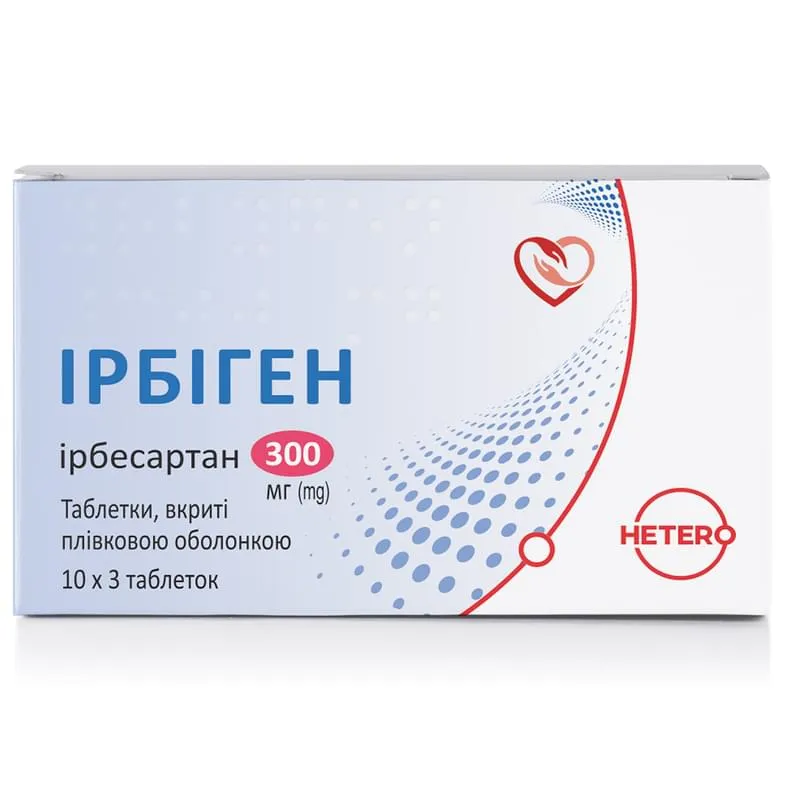
Table of Contents
INSTRUCTIONS FOR MEDICAL USE OF THE MEDICINAL PRODUCT IRBIGEN (IRBIGEN)
Composition:
Active substance: irbesartan;
One film-coated tablet contains irbesartan 75 mg or 150 mg or 300 mg;
Excipients: microcrystalline cellulose, calcium carmellose, povidone, colloidal anhydrous silicon dioxide, calcium stearate; film coating: Opadry white OY-S-38956 (hypromellose, talc, titanium dioxide).
Pharmaceutical form. Film-coated tablets.
Main physicochemical properties:
75 mg tablets: white or almost white, capsule-shaped, biconvex film-coated tablets, with the imprint «158» on one side and «Н» on the other;
150 mg tablets: white or almost white, capsule-shaped, biconvex film-coated tablets, with the imprint «159» on one side and «Н» on the other;
300 mg tablets: white or almost white, capsule-shaped, biconvex film-coated tablets, with the imprint «160» on one side and «Н» on the other.
Pharmacotherapeutic group.
Angiotensin II receptor antagonists (not combined). ATC code C09C A04.
Pharmacological Properties
Pharmacodynamics
Mechanism of Action
Irbesartan is a potent, orally active, selective antagonist of angiotensin II receptors (type AT1). It blocks all effects of angiotensin II mediated by the AT1 receptor, regardless of the source or pathway of angiotensin II synthesis. Selective antagonism of angiotensin II receptors (AT1) leads to increased plasma renin and angiotensin II levels, as well as decreased plasma aldosterone concentration. Irbesartan has no significant effect on serum potassium levels when administered as monotherapy at recommended doses. Irbesartan does not inhibit ACE (kininase II), the enzyme responsible for converting angiotensin I to angiotensin II and for degrading bradykinin into inactive metabolites. Irbesartan is pharmacologically active without requiring metabolic activation.
Clinical Efficacy
Arterial Hypertension
The drug reduces arterial blood pressure with minimal effect on heart rate. The antihypertensive effect is dose-dependent, with a tendency toward a plateau at doses exceeding 300 mg. When irbesartan is administered at doses of 150–300 mg once daily, mean seated or supine blood pressure at trough (i.e., 24 hours after dose administration) is on average 8–13/5–8 mm Hg (systolic/diastolic) lower than with placebo.
Maximum reduction in blood pressure occurs within 3–6 hours after administration, and the antihypertensive effect persists for at least 24 hours. With recommended doses, the blood pressure reduction at 24 hours after dosing represents 60–70% of the peak diastolic and systolic response. Administration of irbesartan 150 mg once daily provides a minimal effect and mean 24-hour response comparable to that observed with twice-daily dosing at the same total daily dose.
The antihypertensive effect develops within 1–2 weeks, with maximal effect achieved within 4–6 weeks of initiating therapy. This antihypertensive effect is maintained during long-term treatment. After discontinuation of the drug, blood pressure gradually returns to baseline levels. Rebound hypertension has not been observed.
The antihypertensive effects of irbesartan and thiazide diuretics are additive. In patients whose blood pressure is not adequately controlled with irbesartan monotherapy, adding a low dose of hydrochlorothiazide (12.5 mg) once daily results in an additional placebo-corrected reduction in blood pressure of 7–10/3–6 mm Hg (systolic/diastolic) at trough.
The antihypertensive effect of irbesartan is independent of patient age or sex. As with other drugs affecting the renin-angiotensin system, patients of non-Caucasian race with arterial hypertension show a markedly reduced response to irbesartan monotherapy. When irbesartan is combined with a low dose of hydrochlorothiazide (e.g., 12.5 mg daily), the antihypertensive response in these patients approaches that observed in Caucasian patients.
Clinically significant effects of irbesartan on plasma uric acid levels or urinary uric acid excretion have not been observed.
Chronic Kidney Disease in Patients with Arterial Hypertension and Type 2 Diabetes
In a double-blind, placebo-controlled trial, long-term effects (mean follow-up 2.6 years) of irbesartan on progression of kidney disease and all-cause mortality were evaluated. Dose titration of irbesartan was performed from 75 mg to 300 mg (maintenance dose), amlodipine from 2.5 mg to 10 mg, or placebo, depending on tolerability. Patients in all treatment groups generally received 2–4 antihypertensive drugs. The study results showed no effect of irbesartan treatment on all-cause mortality; however, a positive trend toward reduced risk of end-stage renal disease and a statistically significant reduction in the risk of doubling of serum creatinine were observed. This indicates a slowing of progression of chronic kidney disease in patients with chronic renal insufficiency and overt proteinuria.
The treatment effect was evaluated in subgroups by sex, race, age, duration of diabetes, baseline blood pressure, serum creatinine, and albumin excretion rate. In subgroups of women and non-Caucasian patients, representing 32% and 26% of the total study population, respectively, no renal benefit from treatment with the investigational drug was demonstrated.
In a placebo-controlled, double-blind, long-term trial (2-year follow-up) evaluating the effects of irbesartan on microalbuminuria in patients with arterial hypertension and type 2 diabetes, it was shown that administration of irbesartan 300 mg in patients with microalbuminuria slows the progression of kidney dysfunction to overt proteinuria (urinary albumin excretion rate (UAER) > 300 mg/day and an increase in UAER of at least 30% from baseline).
The slowing of progression to clinical proteinuria was evident as early as 3 months after initiation of treatment and was sustained throughout the 2-year study period. Cases of regression to normoalbuminuria (< 30 mg/day) were more frequent in the irbesartan group (34%) than in the placebo group (21%).
Dual Blockade of the Renin-Angiotensin-Aldosterone System (RAAS)
Results from two randomized controlled trials evaluating the combination of an ACE inhibitor with an angiotensin II receptor antagonist show no statistically significant benefits of combined therapy with these agents on renal and/or cardiovascular clinical outcomes or mortality. However, an increased risk of hyperkalemia, acute kidney injury, and/or hypotension was observed compared to monotherapy. Given the similar pharmacodynamic profiles of these agents, these findings are also applicable to other ACE inhibitors and angiotensin II receptor antagonists. Therefore, ACE inhibitors and angiotensin II receptor antagonists should not be used concomitantly in patients with diabetic nephropathy.
In a study evaluating the addition of aliskiren to standard therapy with an ACE inhibitor or angiotensin II receptor antagonist in patients with type 2 diabetes, chronic kidney disease, cardiovascular disease, or both, an increased risk of hyperkalemia, hypotension, and renal dysfunction was observed, along with a higher incidence of cardiovascular mortality and stroke.
Pharmacokinetics
Absorption
After oral administration, irbesartan is well absorbed, with a bioavailability of approximately 60–80%. Co-administration with food has no clinically significant effect on the bioavailability of irbesartan.
Distribution
Plasma protein binding of irbesartan is approximately 96%, while binding to blood cellular components is negligible. The volume of distribution of irbesartan ranges from 53 to 93 liters.
Metabolism
Following oral or intravenous administration of 14C-irbesartan, 80–85% of the radioactivity in plasma corresponds to unchanged irbesartan. Irbesartan is metabolized in the liver via glucuronidation and oxidation. The main circulating metabolite of irbesartan is the glucuronide conjugate (approximately 6%). In vitro studies indicate that irbesartan is primarily oxidized by the CYP2C9 isoenzyme of the cytochrome P450 system, with minor involvement of CYP3A4.
Linearity/Non-linearity
Irbesartan exhibits linear, dose-proportional pharmacokinetics over the dose range of 10 mg to 600 mg. Less than dose-proportional increases in absorption were observed after oral administration at doses exceeding 600 mg (twice the maximum recommended dose); the mechanism of this phenomenon is not fully understood. Peak plasma concentration (Cmax) is reached within 1.5–2 hours after oral administration. Total and renal clearance are approximately 157–176 mL/min and 3–3.5 mL/min, respectively. The terminal elimination half-life of irbesartan is 11–15 hours. Steady-state plasma concentrations are achieved within 3 days of once-daily dosing. With repeated once-daily administration, limited accumulation of irbesartan in plasma occurs (< 20%).
In one study, female patients with arterial hypertension showed slightly higher plasma concentrations of irbesartan compared to males. However, no differences in elimination half-life or accumulation between males and females were observed. Dose adjustment of irbesartan is not required in female patients. In elderly patients (≥ 65 years), AUC and Cmax values of irbesartan are higher than in younger patients (18–40 years). However, the terminal elimination half-life does not differ significantly. Dose adjustment is not required in elderly patients.
Excretion
Irbesartan and its metabolites are excreted both via bile and urine. After both oral and intravenous administration of 14C-irbesartan, approximately 20% of radioactivity is excreted in urine, and the remainder in feces. Less than 2% of the dose is excreted unchanged in urine.
Pediatric Population. Pharmacokinetics of irbesartan were evaluated in 23 children with arterial hypertension after single and multiple (once daily) doses of irbesartan (2 mg/kg) up to a maximum daily dose of 150 mg for 4 weeks. Of these 23 children, 21 were evaluable for pharmacokinetic comparison with adults (12 children aged 12 years, 9 children aged 6–12 years). Results showed that Cmax, AUC, and clearance were comparable to those in adults receiving 150 mg irbesartan daily. With repeated once-daily dosing, limited accumulation of irbesartan (18%) in plasma was observed.
Patients with Renal Impairment
Pharmacokinetic parameters of irbesartan are not significantly altered in patients with renal impairment or in patients undergoing hemodialysis. Irbesartan is not removed by hemodialysis.
Patients with Hepatic Impairment
Pharmacokinetic parameters of irbesartan are not significantly altered in patients with mild to moderate hepatic cirrhosis. Studies in patients with severe hepatic dysfunction have not been conducted.
Clinical characteristics.
Indications.
Treatment of essential arterial hypertension in adult patients.
Treatment of chronic kidney disease in adult patients with arterial hypertension and type 2 diabetes mellitus as part of an antihypertensive therapy regimen.
Contraindications.
Hypersensitivity to the active substance or to any of the excipients.
Second and third trimesters of pregnancy.
Concomitant use of Irbigen with medicinal products containing aliskiren is contraindicated in patients with diabetes mellitus or renal dysfunction (glomerular filtration rate (GFR) < 60 ml/min/1.73 m²).
Interaction with other medicinal products and other forms of interaction.
Diuretics and other antihypertensive agents
When used concomitantly with other antihypertensive drugs, there may be an increased risk of developing arterial hypotension, although irbesartan has been safely used with certain antihypertensive agents such as beta-blockers, long-acting calcium channel blockers, and thiazide diuretics. Prior treatment with high doses of diuretics may also lead to hypovolemia and increase the risk of arterial hypotension after initiation of irbesartan (see section "Special precautions for use").
Aliskiren-containing agents or ACE inhibitors
Clinical studies have demonstrated that dual blockade of the renin-angiotensin-aldosterone system (RAAS) by combining ACE inhibitors, angiotensin II receptor antagonists, or aliskiren is associated with an increased incidence of adverse reactions such as arterial hypotension, hyperkalemia, and renal impairment (including acute renal failure), compared to using a single RAAS-acting agent (see sections "Pharmacodynamics", "Contraindications", and "Special precautions for use").
Potassium supplements and potassium-sparing diuretics
Based on experience with other medicinal products affecting the renin-angiotensin system, concomitant use of potassium-sparing diuretics, potassium supplements, potassium-containing salt substitutes, or other medicinal products that may increase plasma potassium levels (e.g., heparin) may lead to increased plasma potassium levels and is therefore not recommended (see section "Special precautions for use").
Lithium
Concomitant use of angiotensin II receptor antagonists, including irbesartan, with lithium preparations may increase lithium plasma concentrations and enhance its toxic effects. Such combination is not recommended (see section "Special precautions for use"). If concomitant use is necessary, careful monitoring of plasma lithium levels is advised.
Nonsteroidal anti-inflammatory drugs (NSAIDs)
Concomitant use of angiotensin II antagonists, including irbesartan, with NSAIDs (including selective COX-2 inhibitors, acetylsalicylic acid (> 3 g/day), and nonselective NSAIDs) may result in reduced antihypertensive efficacy.
As with ACE inhibitors, concomitant use of angiotensin II antagonists and NSAIDs may also lead to deterioration of renal function, including development of acute renal failure, and increased plasma potassium levels, particularly in patients with pre-existing renal impairment. This combination should be used with caution, especially in elderly patients. Adequate hydration should be ensured and renal function should be monitored at the start of such combined therapy and periodically thereafter.
Repaglinide
Irbesartan may inhibit the OATP1B1 transporter. In a clinical study, administration of irbesartan one hour prior to repaglinide increased the Cmax and AUC of repaglinide (a substrate of the OATP1B1 transporter) by 1.8 and 1.3 times, respectively. In another study, no significant pharmacokinetic interaction was observed between irbesartan and repaglinide. Dose adjustment of repaglinide may be required when these medicinal products are used concomitantly (see section "Special precautions for use").
Additional information on irbesartan interactions
Hydrochlorothiazide has been reported not to interfere with the pharmacokinetics of irbesartan.
Irbesartan is metabolized primarily by the CYP2C9 enzyme, and to a lesser extent via glucuronidation. No significant pharmacokinetic or pharmacodynamic interactions were observed when irbesartan was coadministered with warfarin (a drug metabolized by CYP2C9). The effect of CYP2C9 inducers such as rifampicin on the pharmacokinetics of irbesartan has not been evaluated. The pharmacokinetics of digoxin were not altered when coadministered with irbesartan.
Special precautions for use.
Risk of intravascular hypovolemia
Hypovolemia and/or hyponatremia due to intensive diuretic therapy, restricted salt intake, diarrhea, or vomiting may result in symptomatic arterial hypotension, especially after the first dose of irbesartan. Such conditions should be corrected prior to initiating treatment with the medicinal product.
Risk of renovascular hypertension
When using medicinal products affecting the renin-angiotensin-aldosterone system (RAAS), there is an increased risk of severe arterial hypotension and renal impairment in patients with bilateral renal artery stenosis or stenosis of the artery of a single functioning kidney. Similar effects may also occur with angiotensin II receptor antagonists.
Patients with renal impairment and kidney transplant
Periodic monitoring of plasma potassium and creatinine levels is recommended in patients with impaired renal function during treatment with the medicinal product. There is no experience with the use of irbesartan in patients who have recently undergone kidney transplantation.
Patients with arterial hypertension, type 2 diabetes, and chronic kidney disease
Clinical trial results showed that the effects of irbesartan on both renal and cardiovascular outcomes were not uniform. Specifically, its benefits were less pronounced in women and in men of non-Caucasian race.
Risk of dual blockade of the RAAS
Concomitant use of ACE inhibitors, angiotensin II receptor antagonists, or aliskiren has been shown to increase the risk of arterial hypotension, hyperkalemia, and renal dysfunction (including acute renal failure). Therefore, dual blockade of the RAAS by combining ACE inhibitors, angiotensin II receptor antagonists, or aliskiren is not recommended (see sections "Pharmacodynamics" and "Interaction with other medicinal products and other forms of interaction"). If such dual blockade therapy is considered absolutely necessary, it should be administered only under specialist supervision and with frequent monitoring of renal function, electrolyte levels, and blood pressure. ACE inhibitors and angiotensin II receptor antagonists should not be used concomitantly in patients with diabetic nephropathy.
Risk of hyperkalemia
As with other medicinal products affecting the RAAS, hyperkalemia may occur during treatment with irbesartan, particularly in the presence of renal dysfunction, overt proteinuria due to diabetic nephropathy, and/or heart failure. Careful monitoring of plasma potassium levels is required in patients at risk of this complication (see section "Interaction with other medicinal products and other forms of interaction").
Risk of hypoglycemia
Irbesartan may cause hypoglycemia, especially in patients with diabetes mellitus. When the medicinal product is used in patients receiving insulin or antidiabetic agents, appropriate monitoring of plasma glucose levels should be considered. Dose adjustment of insulin or antidiabetic agents may be required as clinically indicated (see section "Interaction with other medicinal products and other forms of interaction").
Concomitant use with lithium preparations
The medicinal product is not recommended for concomitant use with lithium preparations (see section "Interaction with other medicinal products and other forms of interaction").
Use in patients with aortic and mitral valve stenosis, obstructive hypertrophic cardiomyopathy
Like other vasodilators, the medicinal product should be used with particular caution in patients with aortic or mitral valve stenosis or obstructive hypertrophic cardiomyopathy.
Use in patients with primary hyperaldosteronism
Patients with primary hyperaldosteronism generally do not respond to antihypertensive agents acting via inhibition of the renin-angiotensin system. Therefore, use of the medicinal product for treatment of such patients is not recommended.
General considerations
In patients whose vascular tone and renal function depend primarily on the activity of the RAAS (e.g., patients with severe congestive heart failure or underlying renal disease, including renal artery stenosis), treatment with ACE inhibitors or angiotensin II receptor antagonists affecting this system has been associated with acute arterial hypotension, azotemia, oliguria, and occasionally acute renal failure (see section "Special precautions for use"). As with any antihypertensive agent, excessive reduction in blood pressure in patients with ischemic heart disease or ischemic cerebrovascular disease may lead to myocardial infarction or stroke. Similar to ACE inhibitors, irbesartan and other angiotensin antagonists appear to be less effective in lowering blood pressure in black patients than in patients of other races, possibly because hypertension in black patients is more frequently associated with low renin levels (see section "Pharmacodynamics").
Use during pregnancy
Initiation of angiotensin II receptor antagonists during pregnancy is not recommended. If continued use of an angiotensin II receptor antagonist is considered necessary, pregnant women or women planning pregnancy should be switched to alternative antihypertensive therapy with a well-established safety profile during pregnancy. If pregnancy is confirmed, angiotensin II receptor antagonists should be discontinued immediately, and alternative therapy initiated if needed (see sections "Contraindications" and "Use during pregnancy or breastfeeding").
Use in children
Irbesartan has been studied in children aged 6 to 16 years, but available data are insufficient to extend its indications for use in children until additional data are obtained.
Use during pregnancy or breastfeeding.
Pregnancy
Use of angiotensin II receptor antagonists (ARBs) is not recommended during the first trimester of pregnancy (see section "Special precautions for use"). ARBs are contraindicated during the second and third trimesters of pregnancy (see sections 4.3 and 4.4).
Epidemiological data on teratogenic risk associated with ACE inhibitors during the first trimester of pregnancy are inconclusive, but a small increased risk cannot be excluded. As there are no controlled epidemiological data on the risk of angiotensin II receptor antagonists, similar risks may exist for this class of drugs. Unless continued therapy is considered essential, women planning pregnancy should be switched to alternative antihypertensive therapy with an established safety profile during pregnancy. If pregnancy is confirmed, angiotensin II receptor antagonists should be discontinued immediately, and alternative therapy initiated if needed.
It is known that use of angiotensin II receptor antagonists during the second and third trimesters of pregnancy causes fetotoxicity (impaired renal function, oligohydramnios, delayed skull ossification) and neonatal toxicity (renal failure, arterial hypotension, hyperkalemia) in humans.
If angiotensin II receptor antagonists are used from the second trimester of pregnancy, ultrasound monitoring of fetal renal function and skull ossification is recommended.
Newborns whose mothers have used angiotensin II receptor antagonists should be closely monitored for the development of arterial hypotension (see sections "Contraindications" and "Special precautions for use").
Breastfeeding
As information on the use of irbesartan during breastfeeding is currently lacking, use of the medicinal product in such patients is not recommended. Alternative medicinal products with a better-established safety profile during breastfeeding should be preferred, especially when nursing newborns or preterm infants.
It is unknown whether irbesartan or its metabolites are excreted in human breast milk. Available pharmacodynamic/toxicological data from studies in rats have demonstrated excretion of irbesartan or its metabolites into breast milk.
Fertility
Irbesartan had no effect on fertility in rats or on their offspring up to doses causing the first signs of maternal toxicity.
Ability to influence reaction speed when driving or operating machinery.
Due to its pharmacodynamic properties, the influence on this ability is unlikely. However, when driving or operating machinery, it should be considered that dizziness or increased fatigue may occur during treatment.
Dosage and Administration
The medicine is intended for oral administration.
Treatment of essential arterial hypertension in adult patients
The usual recommended initial and maintenance dose is 150 mg once daily, taken independently of food intake. Irbesartan 150 mg once daily generally provides better 24-hour blood pressure control than 75 mg. However, initiating treatment with a dose of 75 mg should be considered, particularly in patients undergoing hemodialysis and elderly patients (aged 75 years and older).
For patients in whom a dose of 150 mg once daily does not provide adequate control, the dose may be increased to 300 mg or other antihypertensive agents may be added. In particular, the addition of a diuretic such as hydrochlorothiazide has been shown to have an additive effect to irbesartan.
Treatment of chronic kidney disease in adult patients with arterial hypertension and type 2 diabetes
The usual recommended initial dose is 150 mg once daily, taken independently of food intake. The dose should be titrated up to the maintenance dose of 300 mg once daily.
The benefits of irbesartan on renal function in patients with arterial hypertension and type 2 diabetes have been demonstrated in clinical studies where irbesartan was used in addition to other antihypertensive agents, if necessary, to achieve target blood pressure.
Special patient populations
Patients with renal impairment
Dosage adjustment is not required in these patients.
For patients undergoing hemodialysis, consideration should be given to using a lower initial dose (75 mg).
Patients with hepatic impairment
Dosage adjustment is not required in patients with mild to moderate hepatic impairment. There is no clinical experience with the use of irbesartan in patients with severe hepatic impairment.
Elderly patients
Generally, no dosage adjustment is required in these patients. However, in patients aged 75 years and older, initiating treatment with a dose of 75 mg should be considered.
Children
The safety and efficacy of irbesartan in children (under 18 years of age) have not been established.
Available data are insufficient to extend the indications for use of the medicine to children (see sections "Pharmacodynamics", "Pharmacokinetics" and "Adverse Reactions") until additional data on use become available.
Overdose
Symptoms
No toxic reactions were observed in adult patients treated with irbesartan at doses up to 900 mg/day for 8 weeks. The most likely manifestations of overdose are hypotension and tachycardia; bradycardia may also occur.
Treatment
Continuous monitoring of the patient's condition is recommended, and symptomatic and supportive therapy should be administered as necessary. Induction of vomiting, gastric lavage, and administration of adsorbents are also recommended. Irbesartan is not removed by hemodialysis.
Side effects
The frequency of the side effects listed below was determined according to the following criteria: very common (≥1/10); common (≥1/100, <1/10); uncommon (≥1/1,000, <1/100); rare (≥1/10,000, <1/1,000); very rare (<1/10,000); frequency not known (cannot be estimated from the available data).
Blood and lymphatic system disorders:
Frequency not known – anaemia, thrombocytopenia.
Immune system disorders:
Frequency not known – hypersensitivity reactions, including anaphylactic reactions, anaphylactic shock, angioedema, rash, urticaria.
Metabolism and nutrition disorders:
Frequency not known – hyperkalaemia, hypoglycaemia.
Nervous system disorders:
Common – dizziness, orthostatic dizziness; frequency not known – vertigo, headache.
Ear and labyrinth disorders:
Frequency not known – tinnitus.
Cardiac disorders:
Uncommon – tachycardia.
Vascular disorders:
Common – orthostatic hypotension; uncommon – flushing.
Respiratory, thoracic and mediastinal disorders:
Uncommon – cough.
Gastrointestinal disorders:
Common – nausea, vomiting; uncommon – diarrhoea, dyspepsia, heartburn; frequency not known – dysgeusia.
Hepatobiliary disorders:
Uncommon – jaundice; frequency not known – hepatitis, hepatic function abnormalities.
Skin and subcutaneous tissue disorders:
Frequency not known – leukocytoclastic vasculitis.
Musculoskeletal and connective tissue disorders:
Common – muscle and bone pain; frequency not known – arthralgia, myalgia (in some cases associated with elevated plasma creatine kinase levels), muscle spasms.
Renal and urinary disorders:
Frequency not known – renal dysfunction, including cases of renal failure in patients at increased risk of this complication.
Reproductive system and breast disorders:
Uncommon – sexual dysfunction.
General disorders:
Common – increased fatigue; uncommon – chest pain.
Investigations:
Very common – hyperkalaemia; common – increased plasma creatine kinase levels (no case of such increase was associated with clinical manifestations in the musculoskeletal system that could be identified).
In patients with arterial hypertension and advanced-stage diabetic nephropathy treated with irbesartan, a decrease in haemoglobin levels was observed, which was not clinically significant.
Pediatric population. In children and adolescents aged 6 to 16 years with arterial hypertension, the following adverse reactions were observed: headache (7.9%), arterial hypotension (2.2%), dizziness (1.9%), cough (0.9%). The most common laboratory test abnormalities were increased creatinine levels (6.5%) and increased creatine kinase levels in 2% of children receiving the drug.
Reporting suspected side effects after authorization of the medicinal product is important. It allows continuous monitoring of the benefit-risk balance of the medicinal product. Healthcare and pharmacy professionals, as well as patients or their legal representatives, should report all suspected side effects and lack of efficacy via the Automated Pharmacovigilance Information System at the following link: https://aisf.dec.gov.ua/.
Shelf life. 2 years.
Storage conditions.
Store at temperatures not exceeding 25 °C in a place inaccessible to children.
Packaging. 10 tablets per blister, 1 or 3 blisters per cardboard box.
Prescription category. Prescription only.
Manufacturer.
Hetero Labs Limited.
Manufacturer's address and location of its operations.
Unit-V, Block V and V-A, TSIIC - Formulation SEZ, S. Nos 439, 440, 441 & 458, Polepally Village, Jadcherla Mandal, Telangana State, 509301, India.