Ipidacord
Ukraine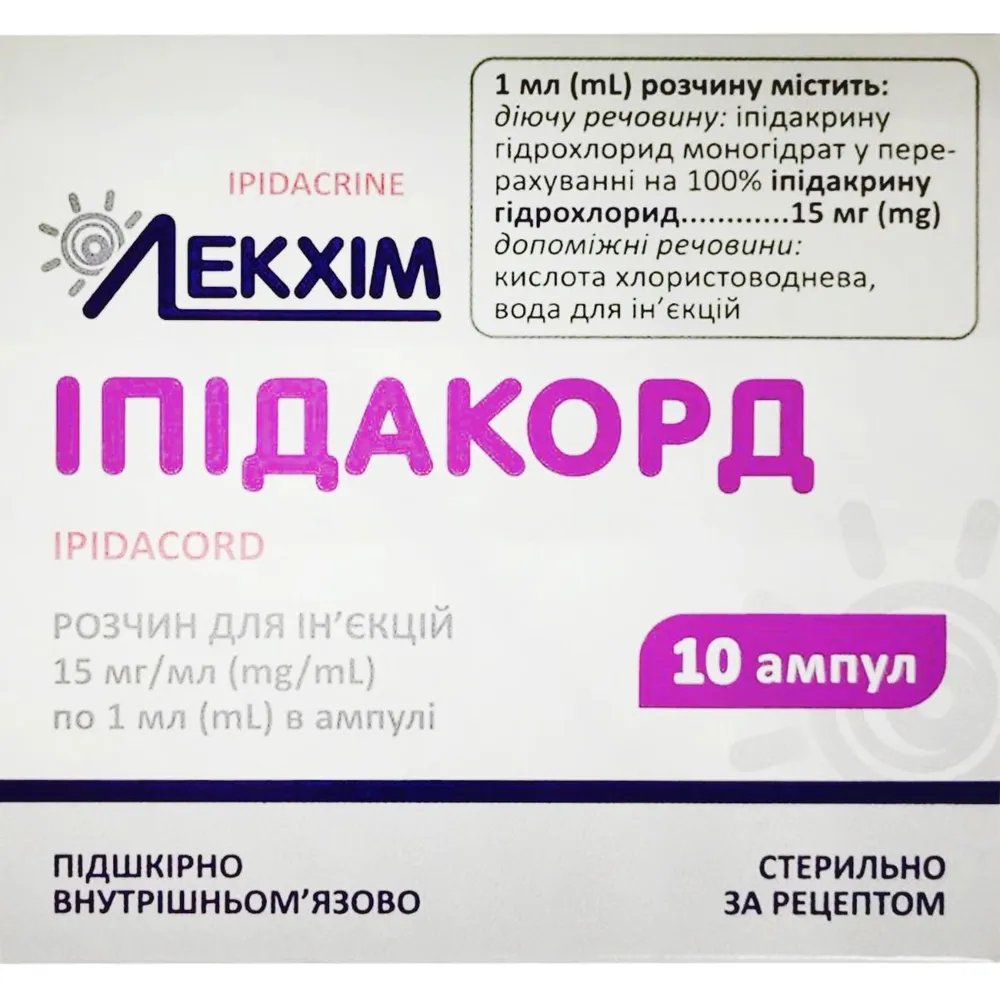
Table of Contents
INSTRUCTION for medical use of the medicinal product IPIDACORD (IPIDACORD)
Composition:
Active substance: ipidacrine hydrochloride;
Ipidacord, injection solution 5 mg/ml: 1 ml of injection solution (one ampoule) contains ipidacrine hydrochloride monohydrate, recalculated to 100% ipidacrine hydrochloride – 5 mg;
Excipients: hydrochloric acid, water for injections;
Ipidacord, injection solution 15 mg/ml: 1 ml of injection solution (one ampoule) contains ipidacrine hydrochloride monohydrate, recalculated to 100% ipidacrine hydrochloride – 15 mg;
Excipients: hydrochloric acid, water for injections.
Pharmaceutical form. Injection solution.
Main physicochemical properties: clear, colorless solution.
Pharmacotherapeutic group.
Other agents acting on the nervous system. Parasympathomimetics. Anticholinesterase agents. ATC code N07AA.
Pharmacological properties.
Pharmacodynamics.
Ipidacord, solution for injection, is a reversible cholinesterase inhibitor.
Ipidacord, solution for injection, exerts a direct stimulatory effect on impulse conduction along nerve fibers, interneuronal, and neuromuscular synapses of the peripheral and central nervous systems.
The pharmacological action of Ipidacord, solution for injection, is based on a combination of two mechanisms of action:
- blockade of potassium channels in the membranes of neurons and muscle cells;
- reversible inhibition of cholinesterase at synapses.
Ipidacord, solution for injection, enhances the effect on smooth muscles not only of acetylcholine but also of adrenaline, serotonin, histamine, and oxytocin.
Ipidacord, solution for injection, demonstrates the following significant pharmacological effects:
- restores and stimulates impulse conduction in the nervous system and neuromuscular transmission;
- enhances contractility of smooth-muscle organs under the influence of all antagonists of acetylcholine, adrenaline, serotonin, histamine, and oxytocin receptors, except potassium chloride;
- improves memory and inhibits the progressive development of dementia;
- restores impulse conduction in the peripheral nervous system impaired due to various factors such as trauma, inflammation, local anesthetics, certain antibiotics, potassium chloride, toxins, etc.;
- moderately stimulates the central nervous system, combined with some sedative effects;
- exhibits analgesic effect;
- exhibits antiarrhythmic effect.
The medicinal product has no teratogenic, embryotoxic, mutagenic, or carcinogenic effects, nor does it have allergenic or immunotoxic effects. It also does not affect the endocrine system.
Pharmacokinetics.
Ipidacord, solution for injection, is rapidly absorbed after subcutaneous or intramuscular administration. Maximum plasma concentration is reached within 25–30 minutes. Approximately 40–50% of the active substance binds to plasma proteins. Ipidacord, solution for injection, rapidly distributes into tissues; the elimination half-life in the phase is 40 minutes. The drug is metabolized in the liver. It is excreted by the kidneys and also extrarenally (through the gastrointestinal tract). The elimination half-life after parenteral administration is 2–3 hours. Excretion occurs mainly via tubular secretion, with only 1/3 of the dose eliminated by glomerular filtration. After parenteral administration, 34.8% of the administered dose is excreted unchanged in urine.
Clinical characteristics.
Indications.
Diseases of the peripheral nervous system: mono- and polyneuropathies, polyradiculopathies, myasthenia and myasthenic syndrome of various etiologies.
Diseases of the central nervous system (CNS): bulbar paralysis and paresis; recovery period of organic CNS lesions accompanied by motor disturbances.
Contraindications.
Hypersensitivity to ipidacrine.
Epilepsy.
Extrapyramidal disorders with hyperkinesia.
Angina pectoris.
Marked bradycardia.
Bronchial asthma.
Vestibular disorders.
Mechanical obstruction of the intestine and urinary tract.
Peptic ulcer of the stomach or duodenum in the stage of exacerbation.
Pregnancy.
Breastfeeding period.
Interaction with other medicinal products and other forms of interactions.
Ipidacord, solution for injection enhances the sedative effect when used in combination with agents that suppress the central nervous system. The action and adverse effects are potentiated when used concomitantly with other cholinesterase inhibitors and m-cholinomimetic agents. In patients with myasthenia, the risk of developing a "cholinergic" crisis increases if Ipidacord, solution for injection is used simultaneously with cholinergic agents. The risk of developing bradycardia increases if β-adrenoblockers were used prior to initiation of treatment with Ipidacord, solution for injection.
Ipidacord, solution for injection can be used in combination with nootropic agents.
Alcohol enhances the adverse effects of the drug.
Special precautions for use.
Use with caution in patients with a history of gastric or duodenal peptic ulcer, respiratory tract diseases including acute respiratory infections, cardiovascular disorders not related to coronary pain, and in thyrotoxicosis.
Use during pregnancy or breastfeeding.
Ipidacord, injection solution increases uterine tone and may cause premature labor; therefore, the use of the medicinal product during pregnancy is contraindicated.
The use of the drug is contraindicated during breastfeeding.
Ability to affect reaction speed when driving or operating machinery.
During treatment, patients should refrain from driving vehicles and from engaging in potentially hazardous activities requiring increased attention and rapid psychomotor reactions.
Administration and Dosage
The injection solution should be administered intramuscularly or subcutaneously. The dosage and duration of treatment should be determined individually depending on the severity of the disease.
Peripheral Nervous System Disorders
Mono- and polyneuropathies of various origins: 5–15 mg administered subcutaneously or intramuscularly 1–2 times daily; treatment course lasts 10–15 days (up to 30 days in severe cases). Afterwards, treatment should be continued with the tablet form of the drug.
Myasthenia and myasthenic syndrome: 5–30 mg administered subcutaneously or intramuscularly 1–3 times daily, followed by transition to the tablet form. The total treatment course is 1–2 months. If necessary, treatment may be repeated several times with 1–2 months intervals between courses.
Central Nervous System Disorders
Bulbar palsies and pareses: 5–15 mg administered subcutaneously or intramuscularly 1–2 times daily; treatment course lasts 10–15 days, with transition to the tablet form whenever possible.
Recovery Period after Organic CNS Lesions
Intramuscularly 10–15 mg 1–2 times daily for up to 15 days, followed by 1–2 times daily if possible.
Children
There are no systematic data on the use of the parenteral form of Ipidacord, injection solution, in children (under 18 years of age). Therefore, the drug should not be used in children.
Overdose.
Symptoms.
In severe overdose, a cholinergic crisis may develop, characterized by:
bronchospasm, lacrimation, increased sweating, miosis, nystagmus, increased gastrointestinal peristalsis, spontaneous defecation and urination, vomiting, jaundice, bradycardia, disturbances in intracardiac conduction, arrhythmias, decreased arterial blood pressure, restlessness, anxiety, excitement, fear, ataxia, seizures, coma, speech disturbances, drowsiness, and general weakness.
Treatment: symptomatic therapy should be administered; use M-cholinoblockers: atropine, cyclopol, metacyne.
Side effects
Ipidacor, solution for injection, like other medicinal products, may cause adverse reactions, although they do not occur in all patients.
Frequency of adverse reactions according to the MedDRA classification (Medical Dictionary for Regulatory Activities):
Very common (≥1/10); common (≥1/100 to <1/10); uncommon (≥1/1000 to <1/100); rare (≥1/10000 to <1/1000); very rare (<1/10000); frequency not known (cannot be estimated from available data).
Cardiac disorders: common – palpitations, bradycardia.
Nervous system disorders: uncommon – dizziness, headache, drowsiness (when high doses are administered).
Respiratory, thoracic and mediastinal disorders: uncommon – increased bronchial secretion, bronchospasm.
Gastrointestinal disorders: common – increased salivation, nausea; uncommon – vomiting (when high doses are administered); rare – diarrhea, epigastric pain.
Hepatic disorders: frequency not known – jaundice.
Skin and subcutaneous tissue disorders: common – increased sweating; uncommon – allergic reactions, including rash, pruritus, urticaria, angioneurotic edema.
Reproductive system disorders: increased uterine tone.
Musculoskeletal and connective tissue disorders: uncommon – muscle cramps (when high doses are administered).
Immune system disorders: frequency not known – hypersensitivity reactions (including allergic dermatitis, anaphylactic shock, asthma, toxic epidermal necrolysis, erythema, urticaria, wheezing, laryngeal edema, injection site rash).
General disorders and administration site conditions: uncommon – weakness (when high doses are administered).
Anticholinergic agents such as atropine may reduce salivation and bradycardia.
If adverse reactions occur, the dose should be reduced or the administration of the medicinal product should be temporarily interrupted (for 1–2 days).
Shelf life.
2 years.
Storage conditions.
Store in the original packaging at a temperature not exceeding 25 °C.
Keep out of reach of children.
Incompatibilities.
The medicinal product should not be mixed with other solutions except those specified in the section «Directions for use and dosage».
Packaging.
1 ml in an ampoule, 5 ampoules in a blister pack, 2 blister packs in a carton, or 100 ampoules in a carton.
Prescription status.
Prescription only.
Manufacturer.
Private Joint-Stock Company "Lekhym-Kharkiv".
Address of manufacturer and location of its business activity.
36 Severin Pototskoho Street, Kharkiv, Kharkiv Oblast, 61115, Ukraine.