Insty for children
Ukraine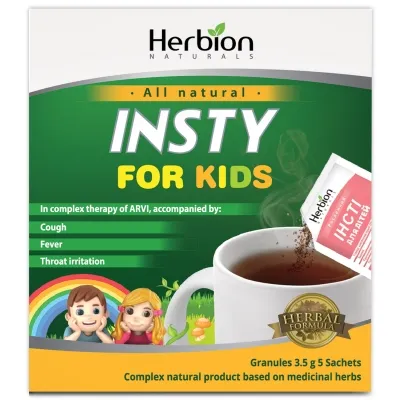
Table of Contents
INSTRUCTION FOR MEDICAL USE OF THE MEDICINAL PRODUCT INSTI FOR CHILDREN
Composition:
1 sachet contains:
Active substances:
- Extract of white willow bark dry (1:5) (Salix alba) (extracting agent – water) – 84 mg;
- Extract of Malabar nut leaf dry (1:5) (Adhatoda vasica) (extracting agent – water) – 32 mg;
- Extract of sweet violet leaf dry (1:5) (Viola odorata) (extracting agent – water) – 9 mg;
- Extract of licorice root and rhizome dry (1:5) (Glycyrrhiza glabra) (extracting agent – water) – 72 mg;
- Extract of Chinese tea leaf dry (1:5) (Thea sinensis) (extracting agent – water) – 19 mg;
- Extract of common fennel fruit dry (1:5) (Foeniculum vulgare) (extracting agent – water) – 9 mg;
- Extract of globulus eucalyptus leaf dry (1:5) (Eucalyptus globulus) (extracting agent – water) – 16 mg;
- Extract of valerian root and rhizome dry (1:5) (Valeriana officinalis) (extracting agent – water) – 9 mg;
Excipients: corn starch, “Tutti-Frutti” flavoring, sucrose.
Medicinal form: Granules.
Main physicochemical properties: Brown-colored granules.
Pharmacotherapeutic group: Combined preparations used in cough and colds.
ATC code: R05X.
Pharmacological properties
Pharmacodynamics:
"Insti for Children" is a complex natural medicinal product based on medicinal herbs that collectively possess a broad spectrum of antimicrobial activity (antiseptic and anti-inflammatory properties).
- White willow (Salix alba): Willow bark contains salicin and is used for pain and elevated body temperature. Salicin enhances the analgesic, antipyretic, disinfectant, and antiseptic properties of other components of the medicinal product.
- Malabar nut (Adhatoda vasica): Contains the bitter non-volatile alkaloid vasicine, which provides antiseptic properties and exerts expectorant action.
- Sweet violet (Viola odorata): Has antihistaminic, expectorant, and antipyretic properties.
- Licorice (Glycyrrhiza glabra): Reduces irritation and exerts expectorant action due to stimulation of tracheal mucus secretion; also has spasmolytic effects.
- Chinese tea (Thea sinensis): Exerts bronchodilatory action and exhibits astringent and stimulant properties.
- Common fennel (Foeniculum vulgare): Helps in various respiratory diseases such as bronchial asthma and bronchitis due to secretolytic and spasmolytic properties.
- Globulus eucalyptus (Eucalyptus globulus): Exerts antiseptic and expectorant action.
- Valerian (Valeriana officinalis): Exerts sedative effects, helps with headache, cough, and fever.
Clinical characteristics
Indications:
As part of complex therapy for acute respiratory viral infections accompanied by cough, fever, and throat irritation.
Contraindications:
- Hypersensitivity to the components of the medicinal product.
- Hypersensitivity to salicylates, plants of the Apiaceae (Umbelliferae) family, or anethole.
- Severe impairment of liver or kidney function.
Interaction with other medicinal products and other types of interactions:
Concomitant use with cardiac glycosides, antiarrhythmic agents (quinidine), thiazide and loop diuretics, adrenocorticosteroids, and laxatives may enhance hypokalemia.
Excessive doses of medicinal products containing fennel may, due to estrogenic activity, affect the outcomes of hormonal therapy and oral contraceptive use.
Enhances the effects of alcohol, sedatives, hypnotics, antihypertensives, anxiolytics, and spasmolytics.
Simultaneous use of this medicinal product with other antitussive agents or drugs that reduce sputum production is not recommended.
Special precautions for use:
Use with caution in glomerulonephritis, hepatitis, organic heart lesions, arterial hypertension, impaired liver or kidney function, hypokalemia, marked obesity, bronchial asthma, bronchospasms, croup, false croup; in depression.
Prolonged and high-dose use of the medicinal product may impair digestion, cause headache, stimulate the nervous system, and impair cardiac function.
Important information about excipients:
The granules contain sucrose, which should be considered by patients with diabetes mellitus and those on a low-calorie diet.
Use during pregnancy or breastfeeding:
The use of the medicinal product during pregnancy is contraindicated.
If use during lactation is necessary, breastfeeding should be discontinued.
Ability to influence reaction rate while driving or operating machinery:
During treatment with this medicinal product, patients should refrain from driving vehicles or operating complex machinery.
Method of administration and dosage:
Children aged 12 years and older – 1 sachet 2–3 times daily. The contents of the sachet should be dissolved in a cup of hot water or tea and taken in small portions.
The treatment course is determined individually by a physician and should not exceed 7 days.
Maximum daily dose for children aged 12 years and older – 3 sachets per day.
Children: The medicinal product is not prescribed for children under 12 years of age.
Overdose:
Symptoms: nausea, vomiting, diarrhea, allergic skin rash, electrolyte imbalance, which may lead to hypokalemic myopathy and myoglobinuria, feelings of depression, increased fatigue, drowsiness, dizziness, headache, bradycardia, increased blood coagulation.
Treatment: gastric lavage, symptomatic therapy.
Adverse reactions:
- Gastrointestinal tract: nausea, vomiting, abdominal spasms, intestinal dysfunction, diarrhea, dyspepsia.
- Immune system: allergic reactions, including skin rashes, itching, skin redness, urticaria, angioedema.
- Cardiovascular system: increased blood pressure, bradycardia, arrhythmia.
- Respiratory system, thoracic organs, and mediastinum: respiratory disturbances.
- Nervous system: sleep disturbances, nervous excitement, headache, weakness, drowsiness, depression, reduced work capacity.
- Metabolism and nutrition: electrolyte imbalance (appearance of edema), hypokalemia.
In case of any unusual reactions, administration of the medicinal product should be discontinued and medical advice sought.
Reporting of suspected adverse reactions:
Reporting of adverse reactions after medicinal product registration is of great importance. It allows continuous monitoring of the benefit-risk ratio of the medicinal product. Healthcare professionals, pharmacists, patients, or their legal representatives should report all cases of suspected adverse reactions and lack of efficacy via the Automated Pharmacovigilance Information System at: https://aisf.dec.gov.ua
Shelf life: 3 years.
Storage conditions: Store in the original packaging at a temperature not exceeding 25 °C. Keep out of reach of children.
Packaging: 3.5 g in sachets, pack of 5 in a cardboard box.
Category of release: Over-the-counter (without prescription).
Manufacturer: Herbion Pakistan Private Limited.
Manufacturer’s address: Plot № 30, Sector 28, Korangi Industrial Area, Karachi, Pakistan.