Heviran
Ukraine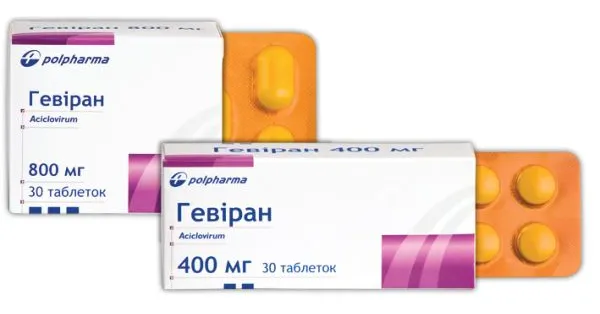
Table of Contents
INSTRUCTIONS FOR MEDICAL USE OF THE MEDICINAL PRODUCT HEVIRAN (HEVIRAN)
Composition:
Active substance: acyclovir;
One film-coated tablet contains 200 mg, 400 mg, or 800 mg of acyclovir;
Excipients: microcrystalline cellulose, povidone, sodium starch glycolate (type A), magnesium stearate;
Coating: hypromellose, macrogol 6000, titanium dioxide (E 171), triethyl citrate, talc.
Pharmaceutical form. Film-coated tablets.
Main physicochemical properties: 200 mg and 400 mg tablets: white-colored, round, biconvex.
800 mg tablets: white-colored, oblong, biconvex, with a break line.
Pharmacotherapeutic group. Antiviral agents for systemic use.
ATC code J05AB01.
Pharmacological properties.
Pharmacodynamics.
Acyclovir is a synthetic purine nucleoside analogue that inhibits in vitro and in vivo replication of human pathogenic Herpes viruses: herpes simplex virus (HSV) types I and II, and varicella-zoster virus (VZV).
The action of acyclovir in suppressing replication of these viruses is highly selective. In uninfected cells, acyclovir is not a substrate for endogenous thymidine kinase (TK), so its toxic effects on mammalian cells are minimal. However, viral thymidine kinase, encoded by HSV and VZV, phosphorylates acyclovir to its monophosphate derivative (a nucleoside analogue), which is then further phosphorylated by cellular enzymes to acyclovir diphosphate and triphosphate. Acyclovir triphosphate acts as a substrate for viral DNA polymerase, which incorporates it into viral DNA, thereby terminating the elongation of the viral DNA chain and inhibiting its replication.
Prolonged or repeated courses of acyclovir treatment in patients with severe immunodeficiency may lead to the emergence of acyclovir-resistant viral strains. Most of the isolated strains with reduced sensitivity show a certain deficiency in thymidine kinase; however, strains with altered viral thymidine kinase or DNA polymerase have also been described. In vitro studies have also demonstrated the potential for development of HSV strains with reduced sensitivity. The relationship between in vitro determined herpes virus sensitivity to acyclovir and clinical response to treatment is unknown.
Pharmacokinetics.
Acyclovir is partially absorbed from the gastrointestinal tract. At steady state, the mean maximum concentration (Cssmax) after administration of 200 mg every 4 hours is 3.1 µmol/L (0.7 µg/mL), and the corresponding minimum concentration (Cssmin) is 1.8 µmol/L (0.4 µg/mL). After doses of 400 mg and 800 mg every 4 hours, Cssmax is 5.3 µmol/L (1.2 µg/mL) and 8 µmol/L (1.8 µg/mL), respectively, and Cssmin is 2.7 µmol/L (0.6 µg/mL) and 4 µmol/L (0.9 µg/mL), respectively.
Following intravenous administration in adults, the plasma elimination half-life of acyclovir is approximately 2.9 hours. Most of the drug is excreted unchanged in urine. Renal clearance of acyclovir is significantly higher than creatinine clearance, indicating that tubular secretion, in addition to glomerular filtration, contributes to the drug's urinary excretion. The main metabolite of acyclovir is 9-carboxymethoxymethylguanine, which is excreted in urine in amounts of about 10–15% of the administered dose.
Administration of 1 g probenecid 60 minutes before acyclovir infusion prolongs the elimination half-life of acyclovir by 18% and increases the area under the plasma concentration-time curve by 40%.
In adults, the mean maximum concentration (Cssmax) after one-hour intravenous infusion of acyclovir at doses of 2.5 mg/kg body weight, 5 mg/kg body weight, and 10 mg/kg body weight was 22.7 µmol/L (5.1 µg/mL), 43.6 µmol/L (9.8 µg/mL), and 92 µmol/L (20.7 µg/mL), respectively. The Cssmin concentrations at 7 hours were 2.2 µmol/L (0.5 µg/mL), 3.1 µmol/L (0.7 µg/mL), and 10.2 µmol/L (2.3 µg/mL), respectively. In children aged 1 year and older, administration of doses of 250 mg/m² body surface area instead of 5 mg/kg body weight, and 500 mg/m² instead of 10 mg/kg body weight, resulted in Cssmax and Cssmin concentrations similar to those observed in adults. In neonates and infants under 3 months of age receiving acyclovir at 10 mg/kg body weight every 8 hours via one-hour intravenous infusion, Cssmax was 61.2 µmol/L (13.8 µg/mL) and Cssmin was 10.1 µmol/L (2.3 µg/mL).
The elimination half-life of the drug in plasma is 3.8 hours.
In elderly patients, total acyclovir clearance decreases in parallel with creatinine clearance, although changes in the plasma elimination half-life of the drug are minimal.
In patients with chronic renal insufficiency, the mean elimination half-life of acyclovir is 19.5 hours. The mean elimination half-life during hemodialysis is 5.7 hours. Drug concentration in plasma decreases by 60% during dialysis.
The concentration of acyclovir in cerebrospinal fluid is approximately 50% of the plasma level. Plasma protein binding of acyclovir is low (9–33%), so competitive displacement from binding sites by other drugs does not occur.
Clinical characteristics.
Indications.
- Treatment of viral infections of the skin and mucous membranes caused by herpes simplex virus, including primary and recurrent genital herpes.
- Suppression (prevention of recurrences) of infections caused by herpes simplex virus in patients with normal immunity.
- Prevention of infections caused by herpes simplex virus in immunocompromised patients.
- Treatment of infections caused by Varicella zoster virus (chickenpox and herpes zoster).
Contraindications.
Heviran is contraindicated in patients with hypersensitivity to acyclovir, valacyclovir, or any other components of the drug.
Interaction with other medicinal products and other forms of interactions.
Clinically significant interactions of acyclovir with other medicinal products have not been identified.
Acyclovir is primarily excreted unchanged by the kidneys via tubular secretion; therefore, any drugs with a similar elimination mechanism may increase acyclovir plasma concentrations. Probenecid and cimetidine prolong the half-life and increase the area under the plasma concentration-time curve of acyclovir. When administered concomitantly with immunosuppressive agents in organ transplant patients, plasma levels of both acyclovir and the inactive metabolite of the immunosuppressive agent may increase; however, due to the wide therapeutic index of acyclovir, dose adjustment is not required.
Special precautions for use
Acyclovir is excreted in the urine; therefore, the dose should be reduced in patients with renal impairment (see “Dosage and administration”). Renal function may be impaired in elderly individuals, and a dose reduction may be required for these patients. Elderly patients and those with renal impairment are at increased risk of developing neurological side effects, so careful monitoring of these patients is necessary. Neurological symptoms usually resolve after discontinuation of the drug (see section “Adverse reactions”).
Particular attention should be paid to maintaining adequate hydration in patients receiving high doses of acyclovir.
The risk of renal damage is increased when other nephrotoxic medicinal products are used concomitantly. Clinical trial data are insufficient to conclude that acyclovir treatment reduces the frequency of complications of varicella in immunocompetent patients.
Prolonged or repeated courses of acyclovir in patients with severe immunodeficiency may lead to the emergence of viral strains resistant to acyclovir therapy.
Use during pregnancy or breastfeeding
Pregnancy
Post-marketing surveillance data from a pregnancy registry document the outcomes of various pharmaceutical forms of acyclovir used during pregnancy. No increased incidence of congenital malformations has been observed in children whose mothers received acyclovir during pregnancy compared to the general population. However, Geveran tablets should be used only when the potential benefit to the mother outweighs the possible risk to the fetus.
Breastfeeding
After oral administration of 200 mg acyclovir five times daily, acyclovir is excreted into breast milk at concentrations ranging from 0.6% to 4.1% of the corresponding plasma acyclovir levels. A nursing infant may potentially absorb acyclovir at a dose of up to 0.3 mg/kg body weight per day. Therefore, acyclovir should be administered to breastfeeding women with caution, taking into account the risk-benefit ratio.
Fertility
There are no data on the effect of acyclovir on female fertility.
In a study of 20 male patients with normal sperm counts, oral acyclovir at a dose of 1 g per day for up to 6 months did not result in any significant clinical effect on sperm count, morphology, or motility.
Ability to affect reaction speed when driving or operating machinery
When considering the ability to drive a vehicle or operate machinery, the patient’s clinical status and the drug’s adverse effect profile should be taken into account.
No studies have been conducted on the effect of the medicinal product Geveran on the ability to drive vehicles or operate machinery. Due to the potential occurrence of adverse effects, caution should be exercised when driving vehicles or operating machinery.
In addition, delayed undesirable effects of the active substance should be considered.
Administration and Dosage
The tablet should be taken whole with water. When high doses of acyclovir are used, adequate hydration should be maintained.
Adults
Treatment of infections caused by herpes simplex virus
For the treatment of infections caused by herpes simplex virus, tablets of Geviran should be taken at a dose of 200 mg five times daily at approximately 4-hour intervals, excluding the nighttime period.
Treatment should last for 5 days, but may be prolonged in cases of severe primary infection.
For patients with severe immunodeficiency (e.g., after bone marrow transplantation) or for patients with reduced intestinal absorption, the dose may be doubled to 400 mg or an appropriate dose of the intravenous formulation may be used.
Treatment should be initiated as early as possible after the onset of infection. In cases of recurrent herpes, treatment should ideally begin during the prodromal period or immediately after the appearance of the first skin lesions.
Prevention of recurrences (suppressive therapy) of infections caused by herpes simplex virus
For immunocompetent patients to prevent recurrences of herpes simplex virus infections, Geviran tablets at a dose of 200 mg should be administered four times daily at 6-hour intervals.
For convenience, patients may take 400 mg of Geviran twice daily at 12-hour intervals.
Therapy may remain effective even after reducing the dose of oral Geviran to 200 mg taken three times daily at 8-hour intervals, or even twice daily at 12-hour intervals.
In some patients, significant improvement is observed with a daily dose of Geviran 800 mg.
To monitor possible changes in the natural course of the disease, Geviran therapy should be periodically interrupted at intervals of 6–12 months.
Prevention of infections caused by herpes simplex virus
For the prevention of herpes simplex virus infections in immunocompromised patients, Geviran tablets at a dose of 200 mg should be taken four times daily at 6-hour intervals. For patients with severe immunodeficiency (e.g., after bone marrow transplantation) or for patients with reduced intestinal absorption, the dose may be doubled to 400 mg or an appropriate dose of the intravenous formulation may be used.
The duration of prophylaxis depends on the duration of the risk period.
Treatment of varicella and herpes zoster
For the treatment of infections caused by varicella and herpes zoster viruses, Geviran tablets should be taken at a dose of 800 mg five times daily at 4-hour intervals, excluding the nighttime period. Treatment should last for 7 days.
For patients with severe immunodeficiency (e.g., after bone marrow transplantation) or with reduced intestinal absorption, the intravenous formulation is preferred.
Treatment should be initiated as early as possible after the onset of disease. The outcome is better if treatment is started immediately after the appearance of the rash.
Treatment of varicella in immunocompetent patients should be initiated no later than 24 hours after the onset of rash.
Elderly Patients
Renal function impairment should be considered in elderly patients, and the dose should be adjusted accordingly (see "Patients with renal impairment"). Adequate hydration should be maintained.
Patients with Renal Impairment
Geviran should be administered with caution in patients with renal impairment. Adequate hydration should be maintained.
For the prevention and treatment of herpes simplex virus infections in patients with renal impairment, the recommended oral doses do not lead to accumulation of acyclovir above the safe levels established for intravenous administration. However, for patients with severe renal impairment (creatinine clearance less than 10 mL/min), a dose of 200 mg twice daily at approximately 12-hour intervals is recommended.
For the treatment of Varicella zoster virus infections (varicella and herpes zoster) in immunocompromised patients, in cases of severe renal impairment (creatinine clearance less than 10 mL/min), a dose of 800 mg twice daily at approximately 12-hour intervals is recommended; for patients with moderate renal impairment (creatinine clearance 10–25 mL/min), a dose of 800 mg three times daily at approximately 8-hour intervals is recommended.
Children
For the treatment and prevention of herpes simplex virus infections, children aged 2 years and older with immunodeficiency may receive adult doses.
For the treatment of varicella in children aged 6 years and older, 800 mg of Geviran should be administered four times daily; for children aged 2 to 6 years, 400 mg of Geviran should be given four times daily. The duration of treatment is 5 days.
The dose may be more precisely calculated as 20 mg/kg body weight (not exceeding 800 mg) of Geviran four times daily.
There are no specific data on the use of Geviran for the prevention (suppression of recurrences) of herpes simplex virus infections or for the treatment of herpes zoster virus infections in immunocompetent children.
Children
This pharmaceutical form of the drug is not recommended for children under 2 years of age.
Overdose.
Symptoms.
Acyclovir is only partially absorbed from the gastrointestinal tract. Cases of accidental oral intake of up to 20 g of acyclovir by patients have been reported without toxic effects. However, accidental repeated overdosage of oral acyclovir over several days may result in gastrointestinal symptoms (such as nausea and vomiting) and neurological symptoms (headache and confusion).
Overdose with intravenous acyclovir leads to increased serum creatinine and blood urea nitrogen levels, resulting in renal failure. Neurological manifestations of overdose may include confusion, hallucinations, agitation, seizures, and coma.
Treatment.
The patient should be thoroughly examined to identify symptoms of intoxication. Since acyclovir is effectively eliminated from the blood by hemodialysis, hemodialysis should be used in cases of overdose.
Adverse Reactions
Blood and lymphatic system disorders
Very rare: anaemia, leucopenia, thrombocytopenia.
Immune system disorders
Rare: hypersensitivity.
Psychiatric and nervous system disorders
Common: headache, dizziness.
Very rare: excitation, confusion, tremor, ataxia, dysarthria, hallucinations, psychotic symptoms, convulsions, somnolence, encephalopathy, coma.
The above-mentioned neurological reactions are generally reversible and usually occur in patients with renal impairment or other risk factors (see section "Special precautions").
Respiratory, thoracic and mediastinal disorders
Rare: dyspnoea.
Gastrointestinal disorders
Common: nausea, vomiting, diarrhoea, abdominal pain.
Hepatobiliary disorders
Rare: transient increase in bilirubin levels and elevated liver transaminase activity in blood.
Very rare: hepatitis, jaundice.
Skin and subcutaneous tissue disorders
Common: pruritus, rash (including photosensitivity).
Uncommon: urticaria, accelerated generalized hair loss.
Since accelerated generalized hair loss may be caused by various diseases and medications, its occurrence during acyclovir treatment is not clearly established.
Rare: angioneurotic oedema.
Frequency not known: alopecia, erythema multiforme, toxic epidermal necrolysis, Stevens-Johnson syndrome.
Renal and urinary disorders
Rare: increased serum creatinine and urea levels.
Very rare: acute renal failure, renal pain.
Renal pain may be associated with renal impairment and crystalluria.
Patient hydration status should be monitored. Renal dysfunction usually resolves rapidly after rehydration and/or dose reduction or discontinuation of the drug. In exceptional cases, acute renal failure may occur.
General disorders
Common: increased fatigue, fever.
Shelf life. 3 years.
Storage conditions. Store at temperatures not exceeding 25 °C in a dry, light-protected place.
Keep out of reach of children.
Packaging. 10 tablets in a blister, 3 blisters in a cardboard box.
Prescription category. Prescription only.
Manufacturer. Pharmaceutical Works "Polpharma" S.A., Poland.
Manufacturer's address and place of business.
Pelplinska Street 19, 83-200 Starogard Gdanski, Poland /
19, Pelplinska Str., 83-200 Starogard Gdanski, Poland.