Hepatox
Ukraine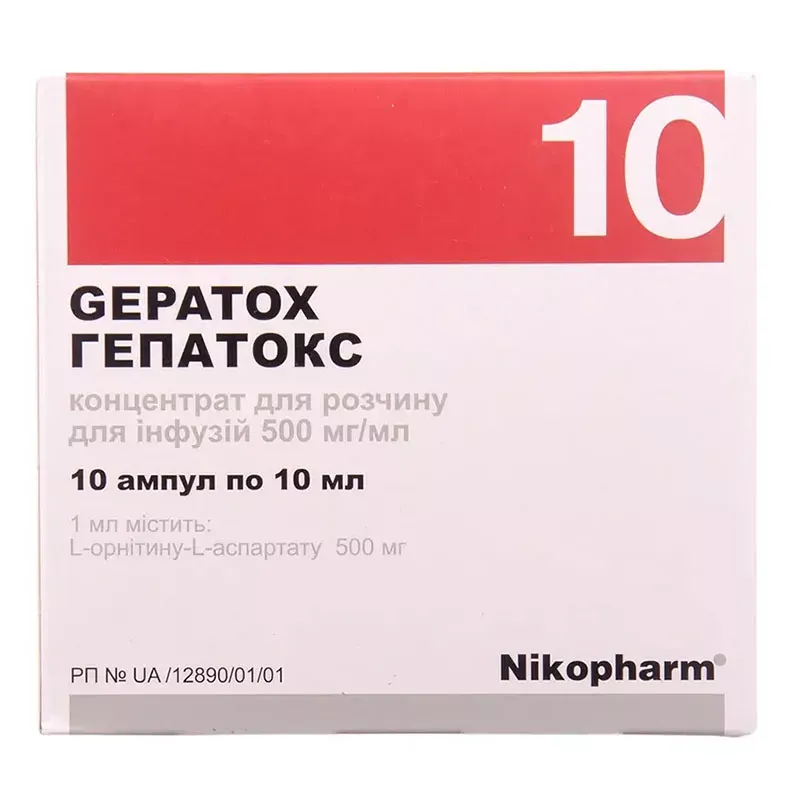
Table of Contents
INSTRUCTIONS for medical use of the medicinal product GEPATOX (GEPATOX)
Composition:
Active substance: L-ornithine-L-aspartate;
1 ml of concentrate contains L-ornithine-L-aspartate 500 mg;
Excipient: water for injections.
Pharmaceutical form. Concentrate for solution for infusion.
Main physicochemical properties: clear colorless or slightly yellowish liquid.
Pharmacotherapeutic group.
Agents used in liver diseases, lipotropic substances. Hepatotropic agents. ATC code A05BA.
Pharmacological properties.
Pharmacodynamics.
In vivo, the action of L-ornithine-L-aspartate is mediated by the amino acids ornithine and aspartate through two key mechanisms of ammonia detoxification: urea synthesis and glutamine synthesis.
Urea synthesis occurs in periportal hepatocytes, where ornithine acts as an activator of two enzymes: ornithine carbamoyltransferase and carbamoyl phosphate synthetase, as well as a substrate for urea synthesis.
Glutamine synthesis occurs in perivenous hepatocytes. In particular, under pathological conditions, aspartate and dicarboxylates, including metabolites of ornithine, are taken up by cells and utilized there for ammonia binding in the form of glutamine.
Glutamate is the amino acid that binds ammonia under both physiological and pathophysiological conditions. The resulting amino acid, glutamine, is not only a non-toxic form for ammonia elimination but also activates the important urea cycle (intracellular glutamine metabolism).
Under physiological conditions, ornithine and aspartate do not limit urea synthesis.
Animal experimental studies have shown that the ability of L-ornithine-L-aspartate to reduce ammonia levels is due to accelerated glutamine synthesis. In individual clinical studies, this improvement has been demonstrated relative to the branched-chain amino acids/aromatic amino acids ratio.
Pharmacokinetics.
The elimination half-life of both ornithine and aspartate is short – 0.3–0.4 hours. A small portion of aspartate is excreted unchanged in urine.
Clinical characteristics.
Indications.
Treatment of concomitant diseases and complications caused by impaired hepatic detoxification function (e.g., in liver cirrhosis) associated with symptoms of latent or manifest hepatic encephalopathy, particularly disturbances of consciousness (pre-coma, coma).
Contraindications.
Hypersensitivity to L-ornithine-L-aspartate.
Severe renal insufficiency (serum creatinine level above 3 mg/100 ml is considered a guideline value).
Special safety precautions.
Hepatokos, concentrate for infusion solution, must not be administered intra-arterially.
Interaction with other medicinal products and other forms of interaction.
Interaction studies have not been conducted. No interactions are currently known.
Special precautions for use
When administering high doses of Hepatox, it is necessary to monitor plasma and urine urea levels.
In patients with impaired liver function, the infusion rate should be adjusted according to the individual patient's condition to prevent nausea and vomiting.
Use during pregnancy or breastfeeding
There are no data on the use of Hepatox during pregnancy. Animal studies with L-ornithine-L-aspartate to evaluate its toxic effects on reproductive function have not been conducted. Therefore, the use of Hepatox during pregnancy should be avoided.
However, if treatment with Hepatox during pregnancy is considered necessary based on life-threatening indications, the physician should carefully weigh the potential risks to the fetus/child against the expected benefits for the mother.
It is unknown whether L-ornithine-L-aspartate passes into breast milk; therefore, the use of Hepatox should be avoided during breastfeeding.
Ability to affect reaction speed when driving or operating machinery
Due to the underlying disease, the ability to drive or operate machinery may be impaired during treatment with L-ornithine-L-aspartate. Therefore, such activities should be avoided during therapy.
Administration and Dosage
Administer intravenously.
If not otherwise prescribed, up to 4 ampoules (40 ml) per day may be administered.
In severe hepatic encephalopathy and in cases of pre-coma or coma, up to 8 ampoules (80 ml) may be administered within 24 hours, depending on the severity of the condition.
Before administration, the contents of the ampoules should be added to 500 ml of infusion solution (0.9% sodium chloride solution, 5% glucose solution, Ringer's solution); however, no more than 6 ampoules should be dissolved in 500 ml of infusion solution.
The maximum infusion rate of Hepatoksu is 5 g/h (corresponding to the contents of 1 ampoule).
The duration of treatment is determined by the physician according to the patient's clinical condition.
Children.
Experience with use in children is limited; therefore, the drug should not be used in pediatric practice.
Overdose.
To date, there have been no reported signs of intoxication due to overdose of L-ornithine-L-aspartate. Overdose may enhance adverse effects. In case of overdose, symptomatic treatment is recommended.
Adverse reactions.
Gastrointestinal tract
Very rare (<1/10,000): nausea.
Rare (>1/10,000, <1/1,000): vomiting.
Generally, these symptoms are transient and do not require mandatory discontinuation of treatment with the medicinal product. They resolve with dose reduction or slower administration rate.
Allergic reactions are possible.
Reporting suspected adverse reactions
Reporting of suspected adverse reactions after medicinal product registration is of great importance. It allows continuous monitoring of the benefit-risk balance of the medicinal product. Healthcare and pharmaceutical professionals, as well as patients or their legal representatives, should report all suspected adverse reactions and lack of efficacy via the Automated Pharmacovigilance Information System at the following link: https://aisf.dec.gov.ua.
Shelf life. 2 years.
Storage conditions.
Store in a refrigerator (at a temperature of +2 °C to +8 °C). Do not freeze. To protect from light exposure, keep the ampoule in the outer packaging. Keep out of reach and sight of children.
Incompatibility.
Since compatibility studies have not been conducted, this medicinal product should not be mixed with other medicinal products.
Hepatoks can be mixed with standard infusion solutions (see section "Administration and dosage"). However, no more than 6 ampoules should be dissolved in 500 ml of infusion solution.
Packaging.
10 ml in ampoules, pack of 10.
Prescription status. Prescription only.
Manufacturers.
LLC "FARMASEL"
Manufacturer's address and location of business activity.
3 Pryrizna Street, Kvitneve village, Brovary district, Kyiv region, 07408, Ukraine